- Date:
- 1 Sep 2026
Department of Education 2026–2030 Strategic Plan
The 2026–2030 Strategic Plan (PDF, 3MB) articulates our commitment to implementing new and continuing transformational reforms. This year we have made several important changes to our guiding principles, focus areas and foundations to ensure they reflect our operating environment and current priorities.
Acknowledgement of Country
The department proudly acknowledges Victoria’s First Nations communities as the Traditional Owners of the unceded lands, waters and skies, and pays respect to all Elders past and present.
We recognise First Nations people as Victoria’s first educators, artists and scientists, and we value the ongoing contribution of First Nations people and communities to Victorian life and how this enriches us all.
We also commit to work together to deliver the Victorian Government’s commitment to self-determination, Truth and Treaty.
Language statement
Throughout this publication the terms ‘Koorie’ or ‘First Nations’ are used to refer to both Aboriginal and Torres Strait Islander people. Use of the terms ‘Aboriginal’ or ‘Aboriginal and Torres Strait Islander’ are retained in the names of programs and data references.
Message from the Acting Secretary
The Acting Secretary’s introduction to the Strategic Plan.
I am pleased to present our Strategic Plan for 2026–2030, which outlines how we will work towards our vision of 'A great education for every child and young person – so they can thrive now, and in the future, for a fairer, smarter and more prosperous state.'
It is a privilege to work for a department that makes a difference every day to Victorian families, children and young people.
In this time of rapid social, economic and technological change, the role of education is more important than ever. How we prepare for the future will help us to continue delivering strong outcomes for Victorian families.
The Strategic Plan is our roadmap. It builds on what we have already achieved and reflects current government priorities. Key among these is our delivery of the Statewide Treaty commitments. This plan ensures that self-determination and cultural safety for First Nations people are at the centre of everything we do.
This plan also guides our goal to deliver excellence in every classroom and expand high-quality early learning. It furthers our mission to give children and young people access to world-class learning in safe and inclusive environments. It sets out our priorities to focus our efforts as a department, so that every young Victorian can achieve their potential.
Over the past year, we have funded more hours of free, quality early learning for children and strengthened child safety across the early childhood education and care sector. We have upgraded existing government schools and opened new schools and early learning centres. We have also laid the foundations for major digital infrastructure renewal. We have supported the rollout of the Victorian Teaching and Learning Model 2.0 and developed lesson plans to support best practice across the state.
We have continued to help ease the cost of living for families so every student can reach their full potential.
The Strategic Plan builds on these achievements and reaffirms our commitment to expand early learning, prioritise Treaty and self-determination, support excellence in learning, address disadvantage and vulnerability, strengthen safety, wellbeing and engagement and support our teachers and education workforce.
Our people are central to our success. I want to acknowledge the efforts of all department staff and thank you for your contribution to education at all levels, from early learning to senior secondary.
The 2026–2030 Strategic Plan sets a clear direction and reflects our shared responsibility to support every child and young person to learn, thrive and succeed. I look forward to working together with you and all our partners to see this plan realised.
David Howes
Acting Secretary
Department of Education
Department overview
What we do and who we work with.
What we do
We are responsible for early childhood and school education in Victoria. This is through a wide range of learning and development services and support.
We provide policy leadership and plan for the future of education in Victoria. We also collaborate across the sectors.
We play an important system steward role. We provide support, guidance, oversight and assurance across early childhood and school education systems. We also provide school education and early learning.
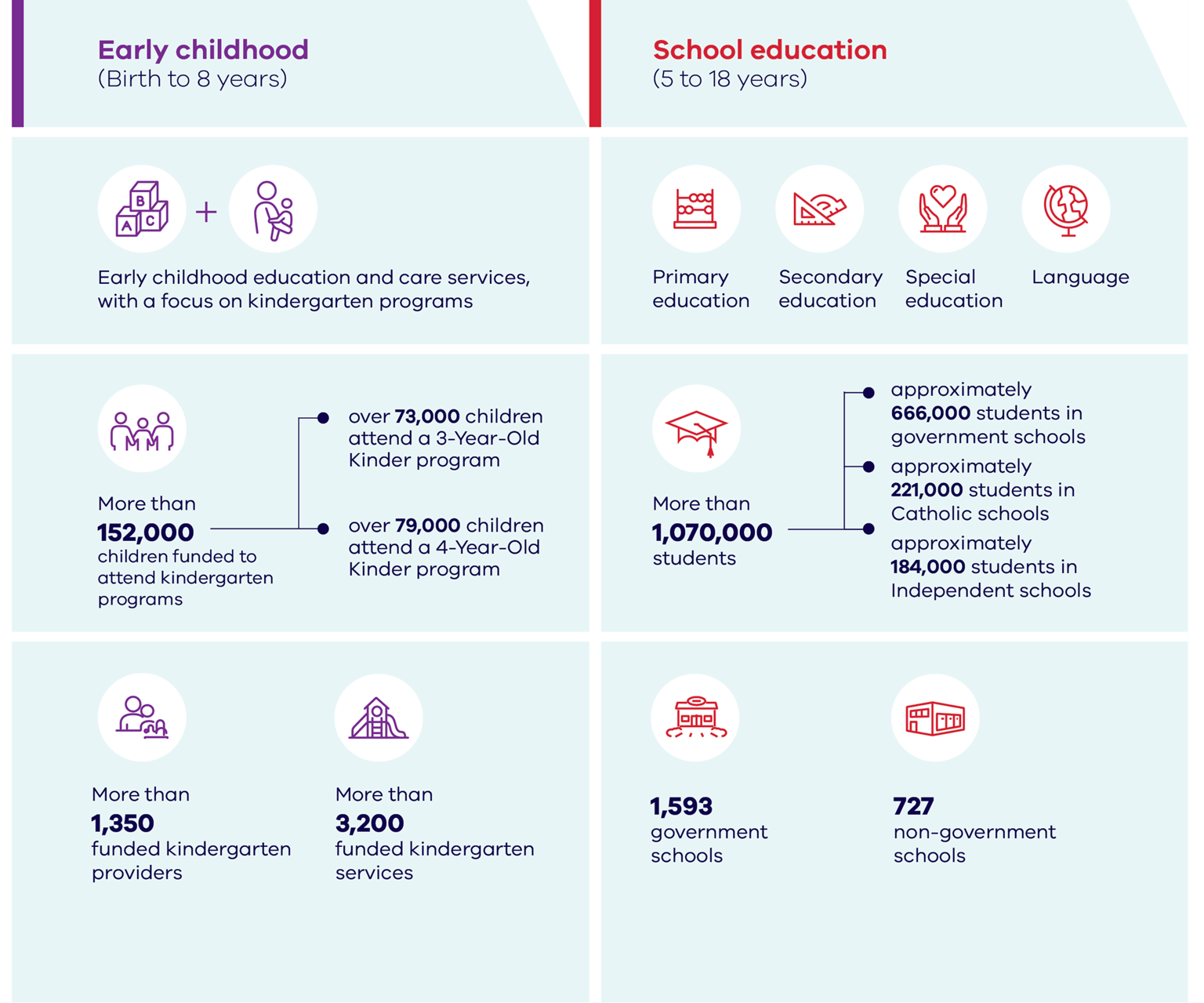
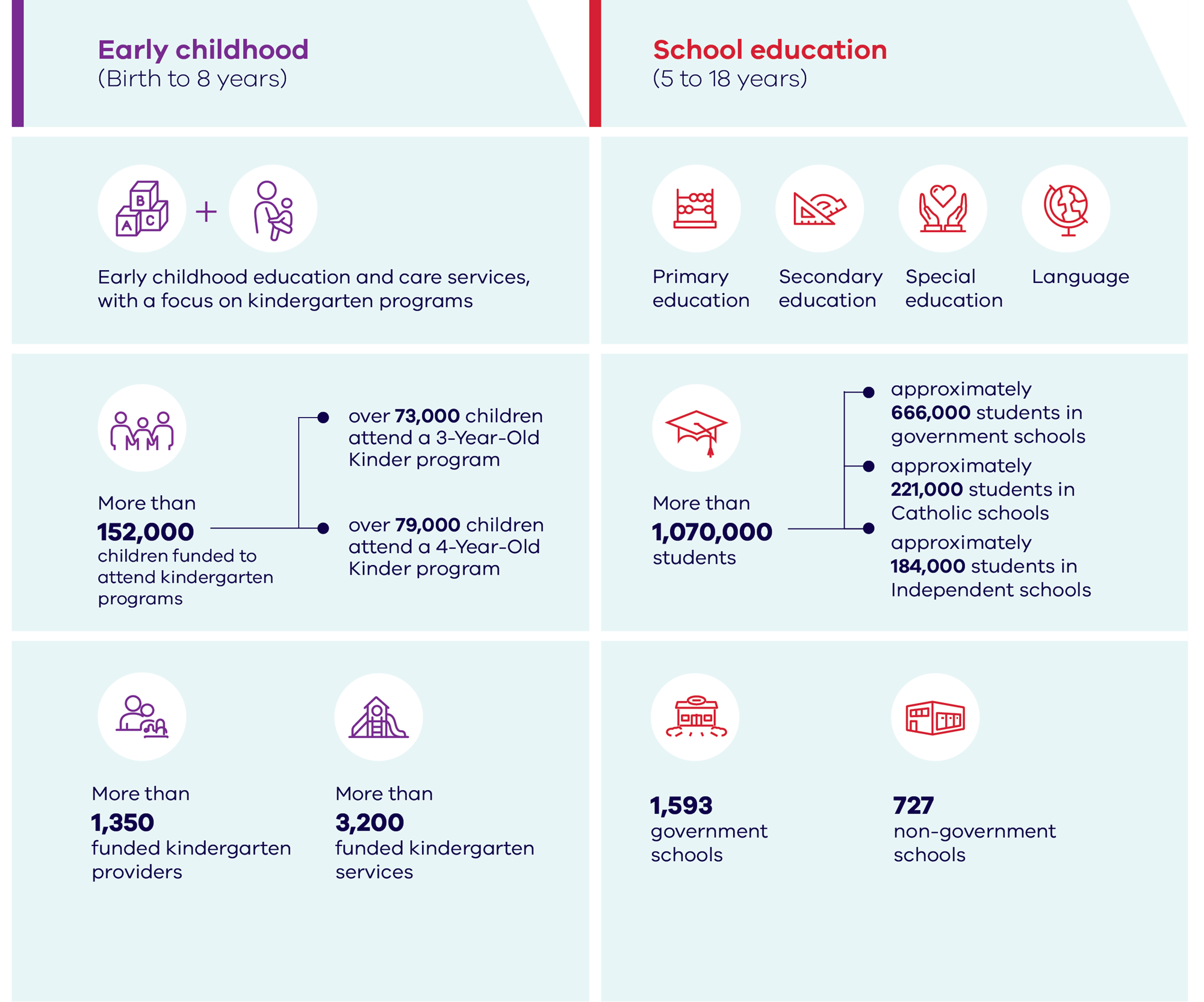
What we do infographic
Who we work with
The department and its entities work with a range of stakeholders. This includes public, private and not-for-profit providers serving Victorian children and young people.
Education portfolio partners and authorities include:
- Disciplinary Appeals Boards
- Independent Office for School Dispute Resolution
- Merit Protection Boards
- Victorian Academy of Teaching and Leadership
- Victorian Curriculum and Assessment Authority
- Victorian Early Childhood Regulatory Authority
- Victorian Institute of Teaching
- Victorian Registration and Qualifications Authority.
Key stakeholder groups include:
- Gellung Warl, Victorian Aboriginal Education Association Incorporated, Aboriginal Community Controlled Organisations and First Nations communities
- advocacy and special interest groups
- early childhood and school education experts
- early childhood and school education peak bodies
- government departments and agencies
- industry associations and unions
- skills and training providers
- parents, carers and students.
Strategic direction
Our vision, outcomes and objectives.
Our vision
A great education for every child and young person – so they can thrive now, and in the future, for a fairer, smarter and more prosperous state.
Our outcomes
Our outcomes clarify the impact we want to see from the collective efforts of the department.
| Outcome | Why it matters |
|---|---|
| Learning and development: Excellent learning and development outcomes. Strong engagement and wellbeing for all Victorian children and young people. | Learning and development are central to our ambition for education services and support. The evidence shows a strong sense of wellbeing enables children to engage positively and confidently with their environment and take full advantage of learning opportunities. Quality of teaching matters for year-on-year student progression and achievement, and for child development more broadly. |
| Equity and inclusion: Equitable and inclusive education and care for all Victorian children and young people. | Every child and young person has the fundamental human right to education, so that they can fully participate in society and achieve their potential. Many learners face significant barriers to their learning and development that are outside their control and too often affect their life outcomes. Targeted and effective support is needed to ensure education is equitable and inclusive, so that every child and young person can thrive. |
| Pathways and opportunities: Children and young people have pathways through education to future careers. Victorian parents and carers are supported to participate in the workforce. | The individual journey through education settings looks different for every child and young person. It is important that pathways are in place for every learner to reach a variety of careers they may aspire to. Helping parents and carers to work and study supports their economic participation, their goals for themselves and their families, and has a positive influence on their children’s aspirations and the pathways they choose to take. |
| Child safety: Children and young people are safe from harm throughout their education. Staff are well equipped to keep children safe and identify early signs of child safety risk or harm. | Children and young people should be able to live a life free of sexual and physical abuse, serious emotional harm, psychological harm and neglect. The care of children is of paramount importance and requires constant vigilance. This requires oversight, proactive strategies, enhanced child safety capabilities and strong support to schools to meet Child Safe Standards. |
Our objectives
The department’s objectives are published in 2026–27 Department Performance Statement as part of the Department of Treasury and Finance 2026–27 Victorian Budget papers.
Objective 1: Raise development outcomes of 3- and 4-year-old children prior to attending school.
Objective 2: Raise learning, development, engagement and wellbeing outcomes for all Victorian students.
Objective 3: Provide equitable and inclusive schooling to all Victorian students.
Guiding principles and values
This section describes the department’s guiding principles and the Victorian Public Sector values.
Guiding principles
Our guiding principles describe how we will approach our work and the culture we will foster.
| Guiding principle | Why it matters |
|---|---|
Hearts in, minds on We bring our passion, knowledge and skills to improve outcomes. | Our people are passionate and knowledgeable, and we want to encourage every person to bring their whole self to work. When we put our ‘hearts in’ and ‘minds on’ it means we are authentic and make connections that are positive and impactful. |
Our best work matters We do high-quality work that matters to people’s lives. | Our efforts to do high-quality work means we follow the steps to get it right, we involve the right people, and we hold ourselves to the highest standards. This approach to delivering high-quality work directly leads to greater impact. |
Be curious and work together We listen, collaborate and value challenge and diversity. | Our inclusive and collaborative approach to working with our colleagues, partners and stakeholders brings in different perspectives and builds confidence. This is important for arriving at well-considered conclusions that are also well-supported. |
Seize the day We are proactive, seek to solve problems and adapt to deliver. | Our commitment to be proactive, to solve problems and adapt is what helps us to deliver positive change. From marginal improvements all the way up to transformational reform, we seize the day and take the initiative to push our work forwards. |
See the whole picture We are fiscally prudent, guided by evidence and seek to understand the broader context. | Our perspectives and discussions are shaped by fiscal prudence, the evidence of what works and are informed by our broader understanding of the context and system at play. This ability to see the whole picture improves our work, ensuring every dollar spent makes a difference to the community. |
Victorian Public Sector values
Our Victorian public sector values describe the behaviour that the Victorian Government and community expect of us and are codified in the Public Administration Act 2004. These values ensure we are fair, objective and courteous in all our dealings.
The VPS values are:
- Responsiveness
- Integrity
- Impartiality
- Accountability
- Respect
- Leadership
- Human Rights

Operating environment, key challenges, and opportunities
This section describes our operating environment, challenges, and opportunities.
In our operating environment, challenges and opportunities shape the department’s planning, implementation and delivery of our services and system reform.
The economy
In 2026, global economic conditions are volatile due to wars in Europe and the Middle East. High energy prices, inflation, and trade uncertainties are having local and global impacts. Communities and organisations face rising costs for goods, services and construction.
In Victoria, the economy is expected to grow gradually. The government remains committed to investing in early childhood and school education.
To address rising costs, the department will continue to seek efficiencies in how it delivers its infrastructure programs and high-quality services. We will also continue to give cost-of-living relief to families through various education and early learning programs.
Digital security, transformation and disruption
Technology use in schools, early learning centres and homes continues to change and evolve, including through the national ban on access to social media for children under 16. Understanding how educators can use Artificial Intelligence (AI) to assist teaching and learning and reduce administrative workloads remains a work-in-progress. We have an initial AI strategy to support the existing Generative Artificial Intelligence policy for schools. This sets out the requirements and advice for using AI tools in a safe and responsible way and complements the Australian Framework for Generative Artificial Intelligence in Schools.
Information security and privacy
Information security and privacy risks continue to increase. Major data breaches across many sectors have highlighted the importance of continuing to protect the personal information of children, families, and educators. Protecting sensitive information and ensuring children’s online safety remain critical responsibilities for the department, schools and early childhood services.
Quantum computing is an emerging technology that will dramatically increase computer processing speeds, allowing complex problems to be solved quickly. Advances in quantum computing and AI could increase the sophistication of cyber threats and reduce the effectiveness of cyber security controls.
We are strengthening our ability to prevent, detect and respond to cyber security and privacy risks. We are doing this through robust controls, improved monitoring and incident response processes, and secure technology platforms that support schools and early learning centres. We also ensure that third-party providers meet the same high standards for security, privacy and child safety.
Self-determination
The Victorian Government is committed to Truth, Treaty, and self-determination. Treaty is about acknowledging the past and making practical changes to achieve better outcomes for First Nations people in Victoria and close the gap.
On average, First Nations students achieve lower National Assessment Program – Literacy and Numeracy (NAPLAN) results, report lower connectedness with school and attend school less regularly than their non-First Nations peers. Cultural safety and access to targeted supports are critical to ensure First Nations learners achieve their potential, succeed in life and feel strong in their cultural identity.
We are prioritising self-determination in education to improve learning and wellbeing for First Nations learners. We will continue to work with First Nations people and communities. We will build on our successes to realise the ambition of Marrung: Aboriginal Education Plan 2016–2026 and the objectives of Dhelk Wukang 2022–2026: Aboriginal Inclusion Plan. We are developing a new First Nations education plan, informed by the evaluation of Marrung.
Workforce availability and capability
Significant growth is projected in early childhood and school enrolments. This means we will need more teachers, educators and staff. By 2030, Victoria will need around 120,000 teachers across early childhood education, primary school and secondary school settings.
We have implemented initiatives to attract teachers to Victorian government schools. These are having a positive impact on workforce supply. We have also invested in school staff retention by reducing administrative workload and improving career development and progression.
The department will continue to implement targeted initiatives to support Victorian government schools facing workforce challenges. This includes those in rural and regional areas and Melbourne’s urban growth corridors, as well as in specialist schools.
The Best Start, Best Life reforms are significantly increasing the number of early childhood professionals across the state. The reforms are also reducing barriers to work for women and, as such, supporting a higher proportion of Victorians to be in the workforce. We are implementing a comprehensive strategy to attract and retain this workforce, in partnership with the early childhood sector. We will ensure that all people involved in the provision of early childhood education and care services have the appropriate training and support to maximise child safety.
Population and demographic change
Our state is expected to continue to grow, with Victoria’s population projected to reach 10.3 million by 2051. Most of the growth will be in the inner and outer growth areas of metropolitan Melbourne. In regional Victoria, the strongest growth is expected in Greater Geelong and Ballarat.
Victoria’s Housing Statement and Plan for Victoria seek to fast-track and concentrate housing development in priority precincts to accommodate the growing population. This creates a potential demand for more schools and expansion of existing schools, new and expanded kindergartens and early learning centres, and more staff.
Societal change and community expectations
Global and local events can challenge social cohesion in communities. This affects early learning and education settings across Victoria.
Reform to the National Disability Insurance Scheme, including the introduction of Thriving Kids, will change how some children and families access supports. This will affect engagement with mainstream and specialist systems, including education.
Changes in family habits and norms since the COVID-19 pandemic have contributed to more student absences, as parents and carers continue to follow health advice to keep children with symptoms of illness at home. We know that regular absences are often the result of an underlying problem. Issues such as poor mental health and cost of living can affect the ability of families to send their children to school. We are delivering a range of initiatives to help overcome these barriers to learning, including student mental health and positive behaviour supports, as well as school breakfast clubs.
Keeping children engaged with learning and connected to trusted adults and positive peer networks increases their sense of belonging. This reduces the risk of poorer educational outcomes and vulnerability to involvement in crime and antisocial behaviour. Alongside local and targeted efforts to improve attendance and engagement, community expectations are evolving. Schools and early learning centres are seen as ideal places for families to access inclusion and wellbeing supports for their children.
The department continues to provide universal and targeted supports for multicultural and multifaith communities.
In 2025, the department introduced a Preventing and Addressing Racism in Schools policy that is being implemented in all Victorian government schools.
Climate change
Victoria’s climate is changing. This means we will continue to experience rising temperatures and more frequent and intense extreme weather events. These present risks to our infrastructure, service delivery and people.
Our experience with extreme weather events has improved our ability to minimise disruption to learning, support staff, children and students, and recover from these events. We will continue to ensure our infrastructure can withstand climate impacts and protect our people from the effects of climate extremes.
The department and all schools and early childhood education settings play a role in achieving Victoria’s target of net zero emissions by 2045. This includes improving energy efficiency and transitioning to renewable energy sources.
We continue to support Victoria’s commitment to building a clean economy workforce. We are strengthening clean energy career pathways. This includes providing vocational explorer and Vocational Education and Training (VET) taster experiences in the clean economy and investing in clean energy equipment and programs in Tech Schools.
Strategic reforms
This section outlines our key strategic reforms in education.
First Nations education
Prioritising self-determination, strengthening cultural safety and delivering on Statewide Treaty commitments are central to our strategy. Self-determination is a fundamental enabler to lift education and wellbeing outcomes for Victoria’s First Nations children and young people.
We want to amplify the voices of First Nations children, young people, families and communities. We want their voices to be heard at every level of decision making. This will help drive systemic change in early childhood and school education. It will also help create more connected, supportive and positive experiences and outcomes for First Nations people in Victoria.
This work continues through Marrung: Aboriginal Education Plan 2016–2026. Marrung is delivered in partnership with the Victorian Aboriginal Education Association Incorporated (VAEAI). VAEAI is the Victorian Government’s principal partner in First Nations education. This work will also be strengthened through the delivery of commitments under Statewide Treaty.
The principles of Marrung and the Dhelk Wukang: Aboriginal Inclusion Plan 2022–2026 provide a strong foundation for ongoing partnerships with First Nations communities. The evaluation of Marrung has also informed the co-design of a new First Nations education strategy with community.
We are committed to implementing the Victorian Government’s response to the recommendations of the Yoorrook Justice Commission. This work will be done in partnership with First Nations communities, organisations and relevant stakeholders.
We are supporting Victoria’s Closing the Gap Implementation Plan. It builds on successful approaches across health, education, employment and community wellbeing. It also has a strong emphasis on shared decision making and community-controlled solutions.
Reform directions are outlined in Strengthening Aboriginal Self-Determination in Education. These directions help position the education system to better support self-determination. They also elevate the voices of First Nations learners and their communities.
We continue to consult First Nations and education (including early childhood education) stakeholders. This consultation helped develop legislative amendments to strengthen First Nations recognition and embed self-determination principles in the Education and Training Reform Act 2006. They also aim to improve learning and wellbeing outcomes for First Nations people.
We are supporting the implementation of Victoria’s Statewide Treaty. A key priority is the ‘Inclusion of Truth-telling in the Victorian Curriculum’. It will ensure Victorian students can learn more about Victoria’s history, including from the perspectives of First Nations people.
Our ongoing reforms aim to improve learning and wellbeing outcomes for First Nations children and young people. They also support community-led initiatives and choice. As part of the Education State – Excellence in Every Classroom strategy, we are continuing to strengthen First Nations histories, cultures and perspectives in the Victorian Curriculum. We are engaging with First Nations people on the design of our schools and kindergartens to help make education settings culturally safe. We are also working with the First Nations community, including Traditional Owners, to make culture and Country visible in these settings.
In the early childhood education sector, we are prioritising more hours of 4-Year-Old Kinder for First Nations children. We are also continuing our partnership with VAEAI. This will help support culturally safe and responsive kindergartens that value and respect First Nations cultures, children and families.
Early childhood education reform
We are continuing to deliver the Best Start, Best Life reforms that are transforming early childhood education in Victoria.
Between 2025 and 2036, more hours of 4-Year-Old Kinder will be rolled out across the state in stages. Once fully implemented, this will give children across Victoria access to up to 30 hours a week of kindergarten in the year before school. Led by qualified teachers, more hours of 4-Year-Old Kinder provide greater opportunities to socialise and learn through play. The rollout prioritises children who will benefit the most from additional hours of kindergarten.
Four-Year-Old Kinder has been successfully launched in 18 regional local government areas (LGAs) and in 2026, became available statewide to First Nations children, children from a refugee or asylum seeker background and children who have had contact with Child Protection.
Free Kinder continues to be available for children enrolled in a kindergarten program, enabling greater participation for children from disadvantaged backgrounds.
More than 145,000 children benefited from this program in 2025, with a similar number expected to benefit in 2026. The rollout of the 3-Year-Old Kinder reform is also progressing successfully: 92% of services across the state now offer 15 hours per week, and more than 92% of all eligible children were enrolled in a program in 2025.
Victoria is also establishing Thriving Kids. This will support children aged 8 years and under with development delay or autism and their families. The department will lead the design and implementation of this new model of early intervention.
Fifty Victorian government-owned and operated Early Learning Victoria centres will be open by 2032 in areas of greatest need, co-located with schools or other services such as TAFEs, hospitals and major employers. Centres will include space for maternal and child health services, and where possible other services such as playgroups. Of the 50 centres, 18 have opened to date.
We will continue to deliver on the government’s commitment to provide 180 new government-owned kindergartens, on or near school sites. Forty-four of these new or expanded kindergartens will have opened by the end of 2026, with a further 32 to be delivered in 2027 and 2028. We will also continue to deliver kinders at non-government schools and support sector-delivered new and expanded early learning centres.
We have implemented recommendations from the 2025 Rapid Child Safety Review to strengthen safety standards in early childhood education and care services and keep Victorian children safe. The Victorian Early Childhood Regulatory Authority was established in 2026, creating a strengthened independent authority to regulate the system. The Victorian Early Childhood Regulatory Authority will also double the frequency of compliance checks, visiting providers at least once every 12 months to ensure they are delivering quality early childhood education and care services that the community can trust.
School reform
Our next phase of school reforms will focus on continuing to realise the Education State vision: to deliver excellence in every classroom in every corner of the state.
Over the past 10 years, the department has delivered major reforms that have enhanced the experiences and outcomes of schooling. Future effort will build on this progress to further improve student outcomes.
In 2026, Victoria achieved the best overall NAPLAN results in the country. Victoria has seen significant improvements in Year 5, 7 and 9 Numeracy scores since 2023. More Year 7 and 9 students reached the highest level in Numeracy as did Year 9 students in Writing. Despite these excellent overall results, there is still work to be done to improve outcomes for students facing disadvantage.
We will continue to focus on excellence in teaching and learning. This includes implementing the VTLM 2.0 in all government schools by 2028. Based on evidence about how students learn, VTLM 2.0 places explicit teaching at its core.
High-quality Victorian Lesson Plans, including Phonics Plus, and professional learning programs aligned to the VTLM 2.0, are helping teachers. They provide ready-to-use resources that reduce lesson preparation time. They also support implementation of the Victorian Curriculum 2.0. We will continue to support government schools to implement Victoria’s reading and mathematics positions. Building on the success of the Phonics Check, the Year 1 Numeracy Check pilot will inform statewide use in 2027. It will give teachers the data they need to identify students at risk of falling behind and intervene early.
Education State reforms also focus on helping every student to succeed. Generational reforms in student mental health and wellbeing, and disability inclusion have been rolled out in schools and will continue to be embedded over the coming years.
Supporting families with education costs and equal access to education is also a current focus.
We are continuing the significant senior secondary school pathway reforms. These reforms are building the aspirations and skills of young people in Victoria. They are also helping prepare students for post-school pathways into rewarding careers that will meet the needs of the modern economy. They have contributed to an increase in Victorian Certificate of Education (VCE) completion rates, including the VCE Vocational Major (VM). Completion rates increased from 91.7% in 2021 to 97.4% in 2025.
Supporting these senior secondary reforms, we will complete the construction of 6 new Tech Schools. This will give 62,000 more secondary students access to high-tech programs. These programs will inspire them to pursue careers and further education in science and technology-related industries.
Expanding, supporting and recognising our school workforce remains a priority. Investment in the school workforce has contributed to 14,000 more registered school teachers in Victoria in 2025 compared to 2020. Victoria’s government teaching service also grew by more than 1,300 full-time equivalent staff from June 2024 to June 2025. Since 2019, the Teacher Financial Incentives program has supported more than 890 teachers to relocate to hard-to-staff roles.
We are also building the capability of teachers. The Career Start induction program supports graduate teachers as they enter the profession. It provides professional learning, mentoring, time release and networking opportunities with peers.
We will continue to prioritise the wellbeing and safety of our workforce. We have already implemented several recommendations from the Independent Review into administrative and compliance activities in Victorian government schools to reduce teacher and school leader workload. We will continue to work closely with stakeholders to further reduce this workload, in line with the findings from the Review.
We are providing a high-quality, contemporary learning environment through the delivery of modern infrastructure. This includes building 126 new schools between 2017 and 2029, planning 3 more, and delivering more than 2,400 upgrade projects. We will also deliver high-quality digital foundations. These foundations will be cybersafe and enable schools and teachers to deliver a modern educational offering.
The Better and Fairer Schools Agreement (BFSA) Head Agreement was signed by the Victorian and Australian governments in 2025. It supports delivery of the Education State. The agreement secures 100% of the Schooling Resource Standard for Victorian government schools by 2034. It also sets out a suite of national reforms aimed at improving schooling outcomes for all Australian students.
The establishment of Thriving Kids will also support school students aged 8 years and under with development delay or autism and their families.
Focus areas and foundations
This section describes our initiatives and key activities, aligned to our focus areas and foundations.
Focus areas
To lift outcomes for all children and young people, we will focus on:
- Expanding quality early learning: Providing more hours of free, quality early learning for all children.
- Excellence in learning: Supporting schools and services to achieve better learning outcomes for children and young people.
- Strengthening safety, wellbeing and engagement: Having the right supports and services in place to enable each child and young person to thrive and be safe from harm.
- Prioritising self-determination, strengthening cultural safety and delivering on Treaty: Improving learning and wellbeing outcomes for First Nations children and young people, supporting community control and choice and supporting Treaty implementation.
- Addressing disadvantage and vulnerability: Enabling children and young people experiencing disadvantage and vulnerability to get the full benefit of education.
- Supporting our teaching and education workforce: Growing and supporting our education and care workforces, addressing their workload and safety, and supporting best practice in teaching.
Foundations
To be successful, our priorities will be:
- Our people: Supporting a strong culture of integrity, inclusion, safety and high performance.
- Strong systems: Ensuring we have the right systems and business processes in place.
- Stewardship: Ensuring our education and early childhood sectors deliver strong outcomes and meet regulatory standards through direct operation of state-owned services and by providing sector-wide support, guidance and oversight.
- Partnerships and engagement: Building strong and effective partnerships across and with our sectors, families and carers.
- Physical and digital infrastructure: Building and partnering to create and maintain contemporary, safe, and sustainable systems and spaces.
- Resilience, mitigation and adaptation to climate change: Doing our bit to address climate change and ensuring continuity of learning in the event of natural disasters and emergency events.
Focus areas (initiatives)
Expanding quality early learning
Providing more hours of free, quality early learning for all children.
Strategic Plan Initiatives
1.1 3-Year-Old Kinder: Continue to roll out kindergarten programs for 3-year-olds across the state, growing to 15 hours by 2029.
1.2 4-Year-Old Kinder: Continue to roll out more hours of 4-Year-Old Kinder, increasing to a universal 30-hours a week program of play-based learning for every 4-year-old child in Victoria.
1.3 New early learning centres: Establish 50 Victorian government-owned and operated early learning centres, in areas of greatest need.
Excellence in learning
Supporting schools and services to achieve better learning outcomes for children and young people.
Strategic Plan Initiatives
2.1 Early years assessment and learning tool: Support teachers and co-educators to embed best practice assessment of children’s strengths, interests and abilities using an online observation-based tool.
2.2 Intensive school support: Deliver intensive and tailored support to schools facing challenging and complex circumstances to ensure there is consistently strong practice across the government school system.
2.3 Lifting student attainment – Excellence in mathematics education: Support the implementation of Victoria’s mathematics position, strengthening mathematics teaching in government schools and improving numeracy outcomes. Implement the Year 1 Numeracy Check Pilot, with participation open to all Victorian government primary schools in 2026, and statewide implementation from 2027.
2.4 Lifting student attainment – Excellence in reading: Support the implementation of Victoria’s reading position, through the Year 1 Phonics Check and Foundation Assessment Literacy suite, strengthening evidence-based reading instruction in government schools and improving literacy outcomes.
2.5 Lifting student attainment – Lesson plans: Develop and implement high-quality, sequenced lesson plans in priority curriculum areas to reduce administrative burden and ease workload pressure for teachers.
2.6 Lifting student attainment – VTLM 2.0: Implement the Victorian Teaching and Learning Model 2.0.
2.7 Lifting student attainment – Small group learning support: Provide small group learning support to students who are behind their age-expected literacy and numeracy standard.
2.8 Lifting student attainment – Student Excellence Program: Support high-ability students.
2.9 New Tech Schools: Complete the construction of 6 new Tech Schools which will provide free, hands-on and immersive science, technology, engineering and maths learning experiences to more than 62,000 secondary school students.
2.10 Senior Secondary Pathways Reform: Continue implementation of the VCE VM and the Victorian Pathways Certificate in Victorian schools, make high-quality VET accessible to all Victorian students, develop pathways for students to engage with emerging industries and a consistent model for the effective delivery of meaningful careers and pathways education in all secondary schools.
2.11 Strengthen student engagement and achievement in early secondary school: Identify opportunities to invigorate Years 7 to 9 to foster early secondary student engagement, wellbeing, and achievement, including by improving access to a range of learning opportunities.
Strengthening safety, wellbeing and engagement
Having the right supports and services in place to enable each child and young person to thrive and be safe from harm.
Strategic Plan Initiatives
3.1 Child safety: Strengthen child safety policy, guidance, training and support for schools and early childhood education and care services, so that children and young people are safe, and staff are equipped to identify and respond to risk or harm.
3.2 Rapid Child Safety Review: Implement relevant recommendations from the Rapid Child Safety Review, to strengthen safety in early childhood education and care settings.
3.3 Kinder participation: Improve kinder participation through strengthened local and statewide strategies, leveraging existing initiatives such as Compact, Early Childhood LOOKOUT, and School Readiness Funding. This will be supported through the establishment of kindergarten attendance data reporting using the new Arrival IT system.
3.4 Student mental health reforms: Following the statewide implementation of the Schools Mental Health Fund and Menu, the Mental Health in Primary Schools program, and the Mental Health Practitioners initiative, work continues to embed these reforms and equip schools to use evidence-based initiatives to better identify and support the mental health and wellbeing needs of their students.
3.5 Disability Inclusion: Following the statewide implementation of the Disability Inclusion reform in schools, work continues to embed the reform to help schools better identify and respond to the needs of students with disability.
3.6 Thriving Kids: Design and implement Thriving Kids for children aged 8 years and under who have developmental delay or autism and low to moderate support needs, and their families. Services will be provided in places where children live, learn and play.
3.7 Engaging students: Strengthen strategic focus on improving school attendance and student engagement with an emphasis on early intervention for at-risk students and connection with programs and support.
3.8 Victorian Early Leaver Connection initiative: Establish the Victorian Early Leaver Connection initiative to identify and support early school leavers to remain engaged in education and training and successfully complete a Year 12 or equivalent qualification. This initiative will provide career advice, additional support and strengthened Year 12 pathways at TAFE, including targeted support for early school leavers who are First Nations students or who have a disability.
3.9 Supporting families with the cost of education: Continue to deliver School Breakfast Clubs, Affordable School Uniforms, Glasses for Kids and free period products, including an expansion of the Glasses for Kids program to more government schools.
3.10 Student behaviour: Strengthen responses and supports for student behaviour so that classrooms and school environments are respectful, safe and engaged for students, school staff and school communities.
Prioritising self-determination, strengthening cultural safety and delivering on Treaty
Improving learning and wellbeing outcomes for First Nations children and young people, supporting community control and choice and supporting Treaty implementation.
Strategic Plan Initiatives
4.1 Cultural safety and inclusion in kinder: Work with VAEAI on new approaches to establishing a culturally safe environment across all services, which value and respect First Nations culture, children and families.
4.2 Roll out more hours of 4-Year-Old Kinder to First Nations children as a priority: From 2026, First Nations children will be eligible for between 16 and 25 hours of 4-Year-Old Kinder per week.
4.3 Marrung: Aboriginal Education Plan 2016–2026: Strengthen cultural safety and responsiveness and ensure equitable access to early childhood and education supports so that First Nations learners achieve their potential, succeed in life and feel strong in their cultural identity.
4.4 New First Nations Education Strategy: Develop and deliver the new First Nations Education Strategy in partnership with VAEAI and community, following the cessation of Marrung: Aboriginal Education Plan 2016–2026 in 2026.
4.5 Dhelk Wukang – Aboriginal Inclusion Plan: Strengthen Aboriginal inclusion, self-determination and cultural safety at all levels within the department and government teaching service.
4.6 Self-determination in education reforms: Strengthen self-determination for First Nations learners and their families through building school capability and practice in partnership with First Nations communities and organisations.
4.7 Aboriginal Employment Plan 2025-2029: Attract and retain new First Nations people to the schools, corporate and early childhood workforces. Continue to work with VAEAI on supporting First Nations people to become early childhood teachers and educators.
4.8 Statewide Treaty implementation: Support implementation of Statewide Treaty commitments, such as the ‘Inclusion of Truth-telling in the Victorian Curriculum’, which will be co-designed between Gellung Warl, VAEAI, the Victorian Curriculum and Assessment Authority and the department.
4.9 Implementation of government response to Yoorrook Justice Commission: Deliver the Victorian Government response to the education (including early childhood education) recommendations of the Yoorrook Justice Commission, in partnership with First Nations communities, organisations, and relevant stakeholders.
4.10 Self-determination in early childhood education: Support and strengthen existing Aboriginal Community Controlled Organisations (ACCOs) delivering kindergarten and other childhood services, and help establish more ACCO-delivered services so more First Nations families have this option for their children.
Addressing disadvantage and vulnerability
Enabling children and young people experiencing disadvantage and vulnerability to get the full benefits of education.
Strategic Plan initiatives
5.1 Fighting for students with disability and their families: Provide more support for students with disability and their families, ensuring more students have better access to the services they need.
5.2 Roll out 4-Year-Old Kinder to priority cohorts: Priority cohorts of children will be eligible to receive between 16 and 25 hours of 4-Year-Old Kinder statewide:
- from 2026, children from a refugee or asylum seeker background and children who have had contact with Child Protection
- from 2028, children (or guardians) who have a concession card, and children who are a multiple-birth child.
5.3 Multicultural, multifaith and culturally and linguistically diverse support: Support multicultural and multifaith communities by continuing refugee education support programs, implementing the new anti-racism policy for schools, and continue support for students through the Victorian African Communities Action Plan and place-based partnerships education initiatives.
Supporting our teaching and education workforce
Growing and supporting our education and care workforces, addressing their workload and safety, and supporting best practice in teaching.
Strategic Plan Initiatives
6.1 School workforce supply initiatives: Continue delivering initiatives to attract and retain people in our school education workforce.
6.2 Improving school staff mental health and wellbeing support: Continue to prioritise the wellbeing of our school workforce by implementing initiatives to improve government school staff mental health.
6.3 Reducing administrative and compliance workload: Continue to embed meaningful and sustained administrative and compliance workload reduction for Victorian government schools, in line with the recommendations and findings from the Independent Review into administrative and compliance activities in Victorian government schools.
6.4 Best Start, Best Life workforce strategy: Implement Best Start, Best Life workforce strategy to build workforce supply and support retention of early childhood workforce to deliver high-quality early childhood education.
Foundations (initiatives and key activities)
Our people
Supporting a strong culture of integrity, inclusion, safety and high performance.
Strategic Plan Initiatives
1.1 Victorian Secretaries Board (VSB) Integrity Statement Action Plan: Support a strong culture of integrity by implementing the 2023 VSB Integrity Statement Action Plan through the delivery of work planned as part of the department’s integrity program and our Integrity Statement Action Plan.
1.2 Develop a new workforce diversity and inclusion strategy: Consolidate the range of existing strategies and plans into one, to focus effort and streamline actions for greater impact.
1.3 VSB 2025 Capability Development Statement: Support a learning culture aimed at building capability in priority areas aligned to our Strategic Plan and the Public Sector Values. We will:
- promote and support alignment of craft capabilities (working in government, leadership and management, integrity, and the public sector values)
- implement the mandatory minimum training requirements for executives across the craft capabilities.
Key Activities
1.4 Support departmental Occupational Health and Safety through policies, procedures, encouraging staff consultation, employee wellbeing and support services and reporting systems.
Strong systems
Ensuring we have the right systems and business processes in place.
Strategic Plan Initiatives
2.1 Cyber security and Information and Communications Technology (Securing Connected Learners): Create a safe and secure system-wide digital learning environment for students and schools to achieve a globally engaged and competitive education system.
2.2 Child Link and Kindergarten information systems: Continue operation and workforce support for Child Link, which integrates key information to support individual children’s wellbeing and safety (birth to 18 years). Establish a new kindergarten information system (Arrival) for monitoring kindergarten funding and data collection of enrolment and attendance information.
2.3 Improve information access and records management practices: Implement a strategic Records Management Program consistent with the Records Management Strategy 2024–2028 to improve access to departmental information, support staff to systematically keep high-quality, digital-first records and ensure historic records are safeguarded and preserved.
2.4 Review of the Victorian Curriculum and Assessment Authority (VCAA): Implement the recommendations of the independent review of the VCAA led by Dr Yehudi Blacher PSM and the observations of the Independent Monitor to ensure that the VCAA can deliver its statutory functions and has the confidence of Victorian students, families and schools.
2.5 Strengthen early childhood law and regulatory policy: Strengthen early childhood education and care National Law and regulatory policy to support quality and child safety across the sector. As host jurisdiction for the National Law, legislate further child safety and regulatory amendments in 2027.
Stewardship
Ensuring our education and early childhood sectors deliver strong outcomes and meet regulatory standards through direct operation of state-owned services and by providing sector-wide support, guidance and oversight.
Strategic Plan initiatives
3.1 Better and Fairer Schools Agreement (BFSA): Finalise negotiations with the Australian Government for a Victorian Bilateral Agreement to the BFSA and collaborate with other Australian governments to deliver agreed national commitments in schooling.
3.2 Preschool Reform Agreement: Finalise negotiations with the Australian Government for a new Preschool Reform Agreement.
Key activities
3.3 Support Best Start, Best Life provision, planning and change management at the sector and local level.
3.4 Strengthen child information sharing and improve service connections in the early years, working with other departments, local governments and partners.
3.5 Deliver agreed National Enabling Initiatives and National Reform Directions under the BFSA to support improvement in Australian schooling outcomes.
Partnerships and engagement
Building strong and effective partnerships across and with our sectors, families and carers.
Key activities
4.1 Continue working closely with local and federal governments on maximising our collaborative impact.
4.2 Continue working closely with the Department of Jobs, Skills, Industry and Regions to improve access to VET Delivered to School Students, for students to participate in quality work-based learning activities with industry. Continue to improve senior secondary certificate implementation including through non-school providers, as part of the Senior Secondary Pathways Reform.
Physical and digital infrastructure
Building and partnering to create and maintain contemporary, safe and sustainable systems and spaces.
Strategic Plan Initiatives
5.1 Department of Education Asset Strategy: Develop and maintain a high-performing asset base by targeting investment and improving processes so assets meet demand, are safe and in good condition, fit-for-purpose and inclusive, environmentally sustainable, and asset managers are accountable and capable across the early childhood and school systems.
5.2 School infrastructure program: Deliver infrastructure to meet demand, including new school construction and associated establishment processes, land acquisition, additional permanent, refurbished and upgraded infrastructure at existing schools and modular classrooms, including building 126 new schools between 2017 and 2029, planning 3 more, and delivering over 2,400 upgrade projects.
5.3 Early childhood infrastructure: Grants and direct delivery to support expansion of places through kindergarten and early learning building projects that support the rollout of 3-Year-Old Kinder and 4-Year-Old Kinder. Building Blocks is also making early learning and kinder buildings, playgrounds and equipment more inclusive for children of all abilities.
5.4 Digital enrolment expansion: Deliver modernised enrolment and student administration services, a portable unique student identity and a single integrated platform for student support.
5.5 Whole-of-Victorian Government (WoVG) data centre exit and transition to cloud-first infrastructure: Migrate the department’s Information and Communications Technology (ICT) infrastructure from the WoVG data centre in East Burwood to secure cloud platforms.
Key activities
5.6 Continue to update Kindergarten Infrastructure and Service Plans with all local governments.
5.7 Partner with local government, non-government schools and not-for-profit providers to deliver new early childhood infrastructure and identify non-government school sites for delivery of kindergartens.
5.8 Undertake analysis to determine where and when new schools should be built, and additional capacity required at established schools.
Resilience, mitigation and adaptation to climate change
Doing our bit to address climate change and ensuring continuity of learning in the event of natural disasters and emergency events.
Strategic Plan Initiatives
6.1 Education and training climate change adaptation action plans: Deliver actions to build resilience to the impacts of extreme weather and climate change on people, services and infrastructure in the education system, and to support skills and careers in Victoria’s clean economy.
6.2 Greener Government Schools Buildings: Install solar power systems in schools to lower the cost of electricity and reduce schools’ carbon footprint.
How we measure our success
This section provides information on our objective indicators and performance measures.
We use a set of objective indicators and performance measures to evaluate outcomes and assess how well we are meeting our objectives and delivering our outputs.
Through monitoring and measuring our performance, we are better able to understand and demonstrate the impact we are having on educational outcomes in the Victorian community. The full set of our objective indicators and performance measures is published in the 2026–27 Victorian Budget – 2026–27 Department Performance Statement.
The department reports progress against the objective indicators and performance measures in the Annual Report. The Annual Report also provides a summary of the progress in implementing the initiatives outlined in this Strategic Plan.
Appendix – Financial and asset outlook
This section provides information about the department's financial and asset outlook.
Output costs
The 2026–27 Department Performance Statement sets out the department’s outputs and funding. For the 2026–27 financial year, the department’s output budget totals $18.6 billion.
| The department’s objectives and outputs | 2026–27 $ million |
|---|---|
| Raise development outcomes of 3- and 4‑year old children prior to attending school |
|
| Kindergarten delivery | 1,319.4 |
| Early childhood sector supports and regulation | 994.1 |
| Raise learning, development, engagement and wellbeing outcomes for all Victorian students |
|
| School education – primary | 5,492.7 |
| School education – secondary | 4,759.0 |
| Wellbeing supports for students | 432.7 |
| Supports for schools and staff | 2,021.3 |
| Provide equitable and inclusive schooling to all Victorian students |
|
| Promoting equal access to education | 1,120.4 |
| Additional supports for students with disabilities | 2,507.0 |
| Total (may not add due to rounding) | 18,646.6 |
Operating performance
The department is expected to report an operating surplus of $460 million in 2026–27, compared with an expected operating surplus of $287 million in 2025–26 for the revised budget.
Balance sheet
The department’s net assets position is estimated to increase by $1.9 billion in 2026–27, compared with the 2025–26 revised budget, mainly reflecting an increase in total assets of $2.0 billion.
Investing and finance
The department is anticipating an increase of $6 million in its net cash position in 2026–27, compared with the 2025–26 revised budget increase of $100 million.
Asset outlook and investment
The department manages a significant and growing asset portfolio to deliver effective education services for Victorians. The asset portfolio includes schools’ and government-owned early learning and childcare centres’ property, plant and equipment. The department’s total assets are estimated to increase to $52 billion by 30 June 2027. More than $2.4 billion has been committed in 2026–27 for new and existing capital projects and $2.1 billion remaining expenditure has been committed for future capital works. Further financial detail on the department’s asset program is available in the 2026–27 Victorian Budget Paper 4: State Capital Program.
Approved use of State Administration Unit surplus
The Resource Management Framework (section 3.5.2) sets out the order of funding for approved asset investments.
The department follows this order and if required, funds will be drawn down from accumulated State Administration Unit funding, after seeking approval from the Treasurer, as required under Section 33 of the Financial Management Act 1994.
Details of any access to surplus under Section 33 can be found in the department’s Annual Report.