2024 saw expanded skills and training delivery supported by a 15% increase in TAFE commencements.
There were more than 280,000 government-funded enrolments in 2024 – a 3% increase on 2023 – with more people reskilling and TAFE delivery growing.
TAFE commencements increased by 15% – including a large increase in the Free TAFE Literacy and Numeracy Support (LN Support) program.
The top 5 2024 courses remain the same as 2023 with a large increase in Certificate III Individual Support due to requirements changing for the Certificate IV in Disability Support and significant growth in the Certificate III in Early Childhood Education & Care.
The top 3 TAFE courses were electrician, plumbing and carpentry apprenticeships – supporting the pipeline of workers for the housing and clean energy industries.
Table 1a: Commencements, continuing enrolments and enrolments by provider type
TAFEs
| Type | 2022 | 2023 | 2024 |
|---|---|---|---|
| TAFE Continuing Enrolments | 69,234 | 58,693 | 60,303 |
| TAFE Commencements excluding LN Support | 69,949 | 73,454 | 75,830 |
| TAFE LN Support Commencements | 2,032 | 2,564 | 11,405 |
Other RTOs
| Type | 2022 | 2023 | 2024 |
|---|---|---|---|
| Other RTO Continuing Enrolments | 66,962 | 62,090 | 68,928 |
| Other RTO Commencements | 64,466 | 76,118 | 63,633 |
Table 1b: Top 5 courses by TAFE and other registered training organisations enrolments
| Course Name | 2023 TAFE | 2023 Other RTO | 2024 TAFE | 2024 Other RTO |
|---|---|---|---|---|
| Certificate III in Individual Support | 16% | 84% | 15% | 85% |
| Certificate III in Early Childhood Education and Care | 17% | 83% | 19% | 81% |
| Certificate III in Electrotechnology Electrician | 83% | 17% | 82% | 18% |
| Certificate III in Carpentry | 48% | 52% | 46% | 54% |
| Certificate III in Plumbing | 93% | 7% | 92% | 8% |
TAFE Growth
TAFE growth has continued in the first quarter of 2025, lifting its share of training activity to 76%.
Quarter 1 data indicates that TAFE commencements have continued to be strong in 2025, particularly for stand-alone TAFEs – and are the highest since 2022.
TAFE share of commencements has increased to its highest level in many years and is now at 76%.
This means more skills funding is going to TAFEs, consistent with the Government’s commitment to provide TAFEs with more than 70% of skills funding.
Table 2a: TAFE Network Commencements and Enrolments March 2022-25
| Category | 2022 | 2023 | 2024 | 2025 |
|---|---|---|---|---|
Category Total Enrolments | 2022 93,915 | 2023 84,471 | 2024 88,778 | 2025 94,065 |
Category Continuing Enrolments | 2022 65,274 | 2023 53,862 | 2024 56,561 | 2025 61,708 |
Category Commencements if LNSUPPORT is included* | 2022 29,306 | 2023 31,081 | 2024 35,733 | 2025 37,345 |
Category Commencements | 2022 28,641 | 2023 30,609 | 2024 32,217 | 2025 32,357 |
*LN Support is excluded unless stated otherwise.
Table 2b: TAFE Network Commencement Share (excl. LN Support)
| Type | Mar 2020 | Mar 2021 | Mar 2022 | Mar 2023 | Mar 2024 | Mar 2025 |
|---|---|---|---|---|---|---|
Type TAFE | Mar 2020 70% | Mar 2021 68% | Mar 2022 68% | Mar 2023 64% | Mar 2024 67% | Mar 2025 76% |
Type Other RTOs | Mar 2020 30% | Mar 2021 32% | Mar 2022 32% | Mar 2023 36% | Mar 2024 33% | Mar 2025 24% |
Free TAFE Growth
Free TAFE has continued to grow in 2025 and is supporting more people to access training.
Free TAFE has saved students more than $625 million in tuition fees since the Victorian Government introduced the initiative in 2019, reducing the cost of living and barriers to training for more than 206,200 students (as at March 2025).
More than 35,580 students commenced a Free TAFE course in 2024 - a 15% increase on 2023 – and the highest level since 2019. Quarter 1 data suggests that demand for Free TAFE continues to be strong in 2025.
Free TAFE offers more than 80 programs without tuition fees to more Victorians, including those retraining for new in-demand careers. The most popular courses are in areas of high labour market need (see table below).
Table 3a: Free TAFE Commencements by year
| 2019 | 2020 | 2021 | 2022 | 2023 | 2024 |
|---|---|---|---|---|---|
2019 39,734 | 2020 30,442 | 2021 30,371 | 2022 25,271 | 2023 31,035 | 2024 35,580 |
Please note: Chart excludes short courses like LN Support.
Table 3b: Top 10 Free TAFE courses by 2024 commencements
| Course Name | 2023 | 2024 | Change |
|---|---|---|---|
Course Name Certificate IV in Training and Assessment | 2023 2,691 | 2024 3,072 | Change 14% |
Course Name Certificate IV in Accounting and Bookkeeping | 2023 2,321 | 2024 2,932 | Change 26% |
Course Name Certificate IV in Cyber Security | 2023 2,735 | 2024 2,831 | Change 4% |
Course Name Diploma of Nursing | 2023 2,516 | 2024 2,452 | Change -3% |
Course Name Certificate III in Individual Support | 2023 967 | 2024 1,788 | Change 85% |
Course Name Certificate III in Early Childhood Education and Care | 2023 1,621 | 2024 1,682 | Change 4% |
Course Name Diploma of Community Services | 2023 1,354 | 2024 1,498 | Change 11% |
Course Name Certificate IV in Work Health and Safety | 2023 792 | 2024 1,045 | Change 32% |
Course Name Certificate II in Electrotechnology (Pre-vocational) | 2023 781 | 2024 1,023 | Change 31% |
Course Name Certificate III in Information Technology | 2023 815 | 2024 968 | Change 19% |
Care courses
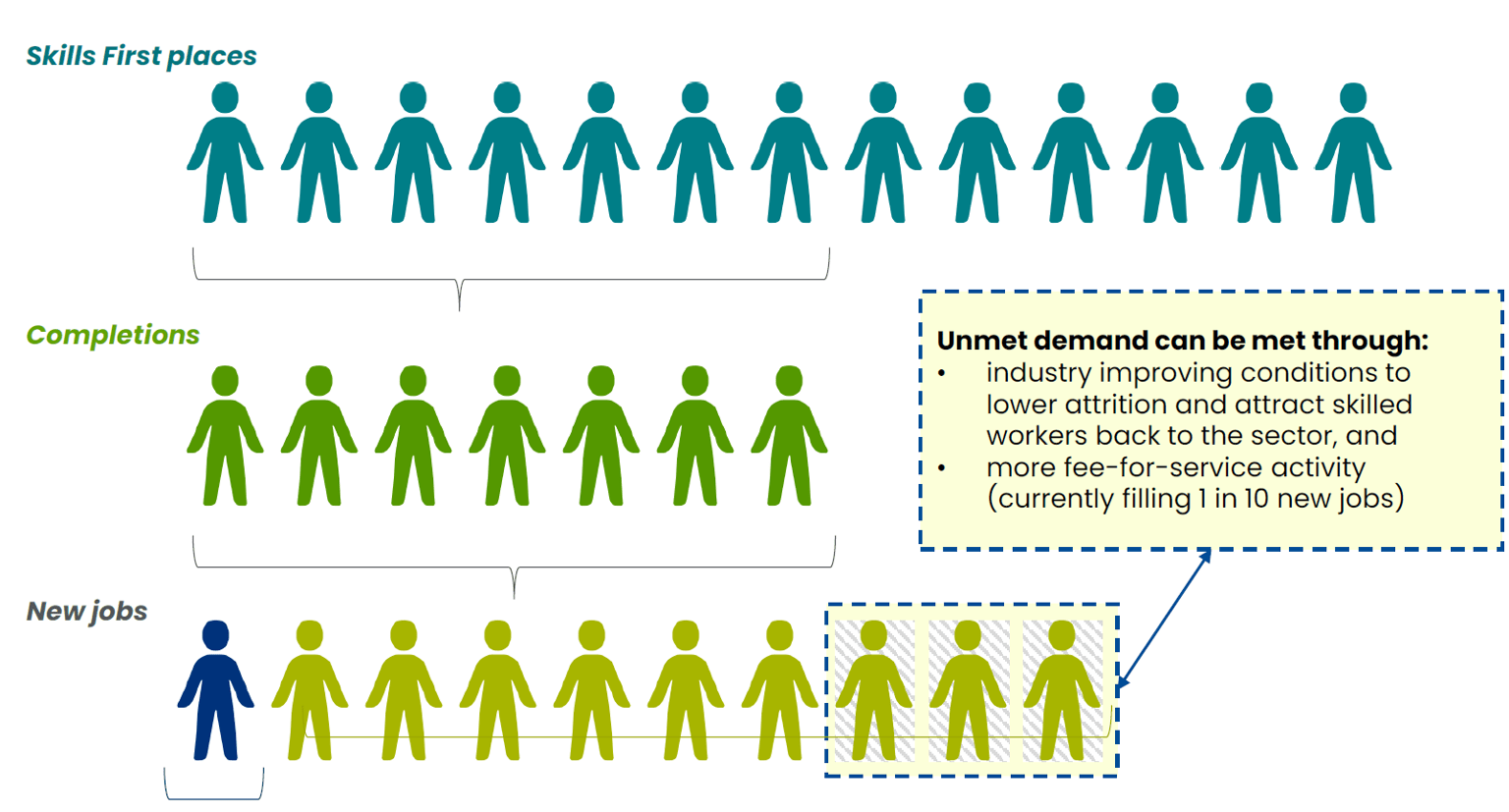
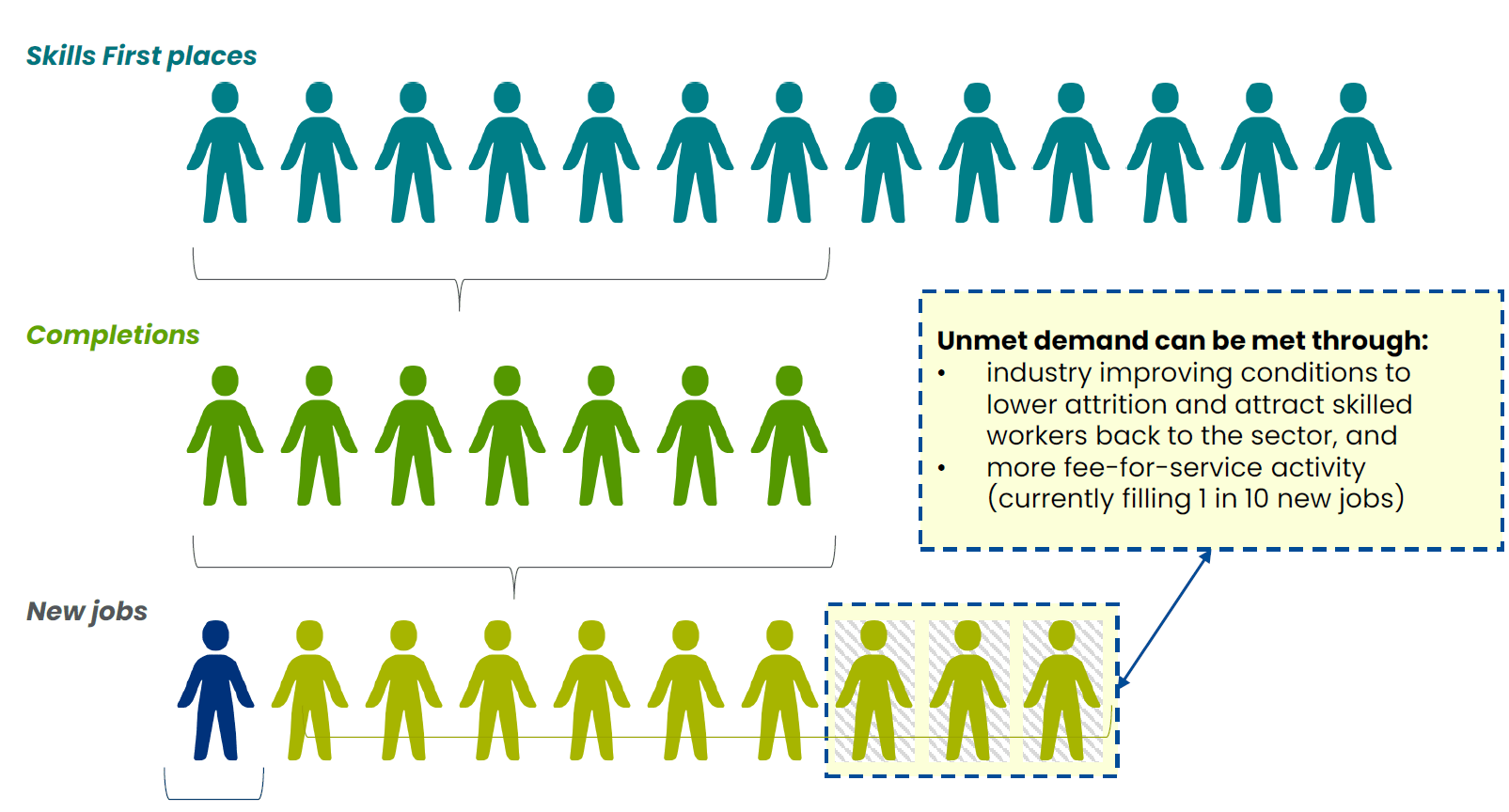
Current government funded training for Child Carers meets industry’s employment growth and most demand linked to attrition.
In 2024, government paid for more than $73 million in subsidies to deliver care courses, including the Certificate III in Early Childhood Education and Care which had the second most commencements in the system.
Care courses statistics
Regional training delivery
Regional training delivery grew in 2024 and Quarter 1 data indicates it has continued to increase in 2025, led by TAFEs.
Quarter 1 data indicates that regional delivery has increased by 14% in 2025, with strong growth in Gippsland, Barwon South West, Loddon Mallee, and Grampians. This builds on a strong 2024 when regional delivery increased by 2%.
TAFE delivery is driving regional growth. TAFE regional delivery was 12% higher in 2024, and Quarter 1 data suggests that regional TAFE delivery
has grown by a further 20% in 2025.
The courses with the highest enrolments in regional Victoria are in care and housing courses, and the Certificate IV in Training and Assessment.
Table 4a: March 2025 Commencements by Regions (Data includes LN Support)
| Region | Commencement Change | Growth Percentage |
|---|---|---|
Region Grampians | Commencement Change 1,783 | Growth Percentage 9% |
Region Loddon Mallee | Commencement Change 2,191 | Growth Percentage 15% |
Region Hume | Commencement Change 2,564 | Growth Percentage 1% |
Region Gippsland | Commencement Change 2,216 | Growth Percentage 23% |
Region Barwon SW | Commencement Change 4,212 | Growth Percentage 21% |
Training delivery for First Nations students
More First Nations students commenced training in 2024, supported by the introduction of the Skills First Aboriginal Access fee waiver.
The Aboriginal Access Fee Waiver was introduced in 2024 to enable First Nations Victorians to do any VET qualification under Skills First without tuition fees.
4,591 people accessed the Skills First Aboriginal Access fee waiver in 2024 which helped boost First Nations commencements by 6% compared to 2023.
Commencements grew most in the Certificate I in General Education for Adults, Certificate II in Building and Construction Pre-Apprenticeship, and Certificate II in Supply Chain Operations.
There were 4,519 Skill First Aboriginal Access Fee Waiver enrolments in 2024.
54% of 2024 Aboriginal enrolments were in metro areas, while 46% were in regional areas.
There were 364 ACCOs enrolments in 2024, an increase from 301 ACCOs enrolments in 2023.
Table 5a: Aboriginal Accredited Training Overview
| Category | 2019 | 2020 | 2021 | 2022 | 2023 | 2024 |
|---|---|---|---|---|---|---|
Category Total Enrolments | 2019 5,193 | 2020 4,899 | 2021 5,364 | 2022 5,362 | 2023 5,927 | 2024 6,583 |
Category Total Students | 2019 4,774 | 2020 4,569 | 2021 5,009 | 2022 4,974 | 2023 5,513 | 2024 5,949 |
Category Commencements | 2019 3,438 | 2020 2,820 | 2021 2,986 | 2022 2,955 | 2023 3,654 | 2024 3,883 |
Category Continuing Enrolments | 2019 1,755 | 2020 2,079 | 2021 2,378 | 2022 2,407 | 2023 2,273 | 2024 2,700 |
Student outcomes
Student outcomes and completion rates are on a positive trajectory.
76.1% of employers are satisfied with the training provided by their RTO.
Around 9 in 10 students who finish their VET qualification achieve their main reason for training and are satisfied with their training.
Table 6a: Student and Employer Satisfaction Survey Outcomes
| Category | Percentage |
|---|---|
Category Completers who achieved their main reason for training | Percentage 89.1% |
Category Completers who are satisfied with their training | Percentage 87.2% |
Category Completers with an improved employment status after training | Percentage 64.5% |
Category Employers of apprentices and trainees who are satisfied with training | Percentage 76.1% |
Completion rates for non-apprentices have improved by 6 percentage points since 2017.
Apprentice completion rates have increased by 3 percentage points since 2017.
Table 6b: Completion Rates by Completed Year
| Type | 2017 | 2018 | 2019 | 2020 | 2021 | 2022 | 2023 | 2024 |
|---|---|---|---|---|---|---|---|---|
Type 6-Yr Apprenticeship | 2017 58% | 2018 61% | 2019 60% | 2020 61% | 2021 60% | 2022 58% | 2023 60% | 2024 61% |
Type 4-Yr Standard Course | 2017 44% | 2018 45% | 2019 45% | 2020 48% | 2021 50% | 2022 51% | 2023 51% | 2024 50% |