- Published by:
- Fire Services Implementation Monitor
- Date:
- 19 June 2026
The Country Fire Authority (CFA) and Fire Rescue Victoria (FRV) have provided their quarterly fire service performance updates for the quarter 3, 2025–26 reporting period (1 January 2026 to 31 March 2026) to the Fire Services Implementation Monitor (FSIM).
In this quarter, CFA reported on 26 indicators and FRV reported on 50 measures.
The FSIM has reported on select results based on the following criteria:
Demonstrates a notable achievement:
- CFA: An increase in the number of After Action Reviews (AAR) (indicator 4.4.1).
- CFA: Increase in percentage of structure fires contained to room of origin (indicator 2.2.1).
- CFA: Increase in percentage of vegetation fires contained to 5 hectares (indicator 2.2.2).
- CFA: Road accident rescue response times meeting benchmark (indicator 2.4.1).
- FRV: Percentage of response times to Emergency Medical Response (EMR) within 9.2 minutes (90%) (measure 11.1.ii).
- FRV: Percentage of firefighters undertaking a level 2 or 3 practical skills maintenance drill annually (measure 11.4).
Continuing off-track trend over repeated quarters:
- CFA: Timely delivery of major programs and projects (indicator 4.1.1).
- FRV: Percentage of response times within the FRV district within FRV benchmark (YTD) to structure fire incidents within 7.7 minutes (measure 11.1.i).
Significant change from the baseline or previous comparable quarter (undesirable outcome):
- FRV: Percentage of FRV capital projects: On time (measure 7.5.i).
The FSIM acknowledges CFA and FRV for their ongoing cooperation and active contribution to the FSIM’s monitoring and reporting activities.
1. Summary
The Fire Services Outcomes Framework Progress Report is prepared and published in accordance with the Fire Services Implementation Monitor’s (FSIM) functions under section 141 of the Fire Rescue Victoria Act 1958 (Vic). It includes results and commentary from the FSIM on select results from the Country Fire Authority’s (CFA) and Fire Rescue Victoria’s (FRV) respective outcomes frameworks for quarter 3 (Q3) of the 2025–26 financial year.
The FSIM publishes these quarterly reports on its website at Fire Services Implementation Monitor publications.
In Q3 2025–26:
- CFA’s Outcomes Framework Report reported on 26 out of 28 quarterly indicators (see Appendix A).
- FRV’s Outcomes Framework Progress Report reported on 50 quarterly measures (see Appendix B).
CFA indicators and FRV measures short-listed for reporting
The FSIM has reported on select results based on the following criteria:
Demonstrates a notable achievement
- CFA: An increase in the number of After Action Reviews (AAR) (indicator 4.4.1).
- CFA: Increase in percentage of structure fires contained to room of origin (indicator 2.2.1).
- CFA: Increase in percentage of vegetation fires contained to 5 hectares (indicator 2.2.2).
- CFA: Road accident rescue response times meeting benchmark (indicator 2.4.1).
- FRV: Percentage of response times to Emergency Medical Response (EMR) within 9.2 minutes (90%) (measure 11.1.ii).
- FRV: Percentage of firefighters undertaking a level 2 or 3 practical skills maintenance drill annually (measure 11.4).
Continuing off-track trend over repeated quarters
- CFA: Timely delivery of major programs and projects (indicator 4.1.1).
- FRV: Percentage of response times within the FRV district within FRV benchmark (YTD) to structure fire incidents within 7.7 minutes (target 90%) (measure 11.1.i).
Significant change from baseline or previous comparable quarter (undesirable outcome):
- FRV: Percentage of FRV capital projects: On time (measure 7.5.i).
2. Outcomes framework Q3 results
The Fire Services Implementation Monitor’s analysis of select results from Q3 2025–26 fire services outcome measures.
2.1 Demonstrates a notable achievement
Summary of notable achievements recorded by CFA and FRV this quarter.
2.2 Continuing off-track trend over repeated quarters
Summary of outcome measures that represent an off-track trend over repeated quarters.
2.3 Significant change from baseline or previous comparable quarter (undesirable outcome)
Summary of outcome measures that recorded a significant change from the baseline or previous comparable quarter.
2.1 Demonstrates a notable achievement
CFA: An increase in the number of After Action Reviews
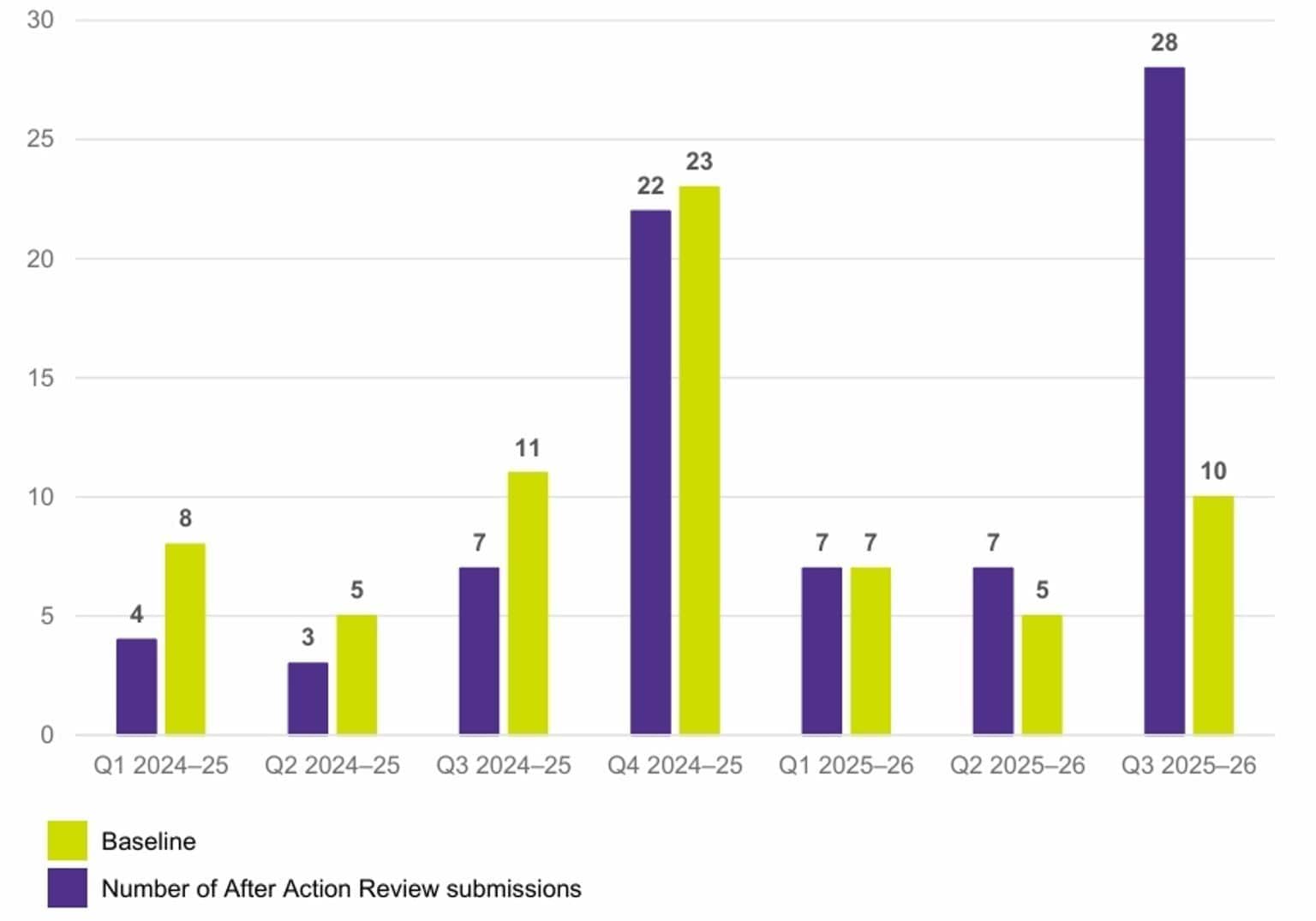
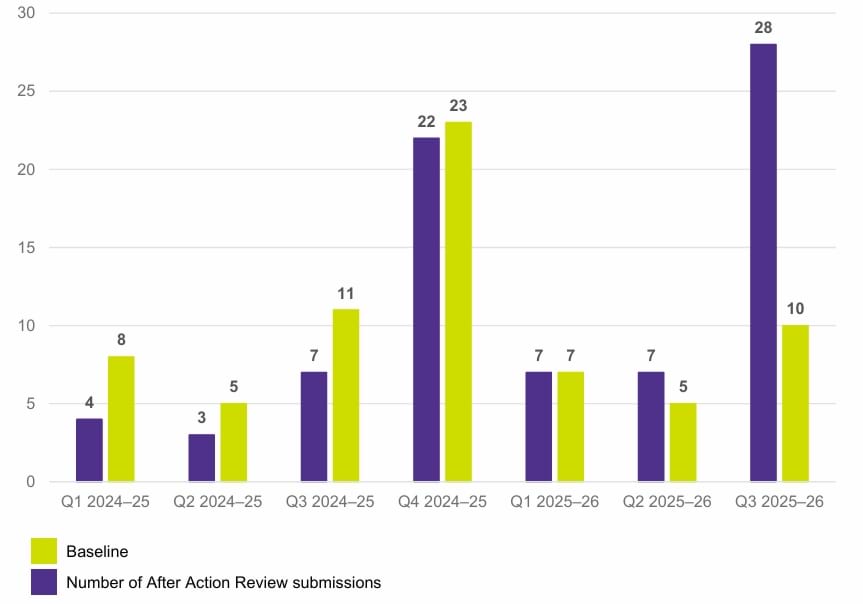
CFA reported that 28 AAR were submitted in Q3 2025–26, against a baseline of 10. This result is a 180% increase above the baseline for Q3. This is also a substantial escalation compared to the previous 2 quarters.
A Post Season Debrief Program is coordinated each year (during Q3) where brigades, districts and regions are encouraged to undertake and submit AARs. CFA advised that this year a different approach was taken to ensure learnings were captured given the scale of the season. CFA contracted external facilitators to coordinate several AARs, and have noted this contributed to the significant increase in submissions for Q3 2025–26.
Whilst the FSIM appreciates the result for this period is affected by unique circumstances, it is still the highest number for any quarter since reporting on this measure began. Therefore, the FSIM believes CFA has demonstrated a notable achievement for the measure during this reporting period.
Figure 1: An increase in the number of After Action Reviews
CFA: Increase in percentage of structure fires contained to room of origin
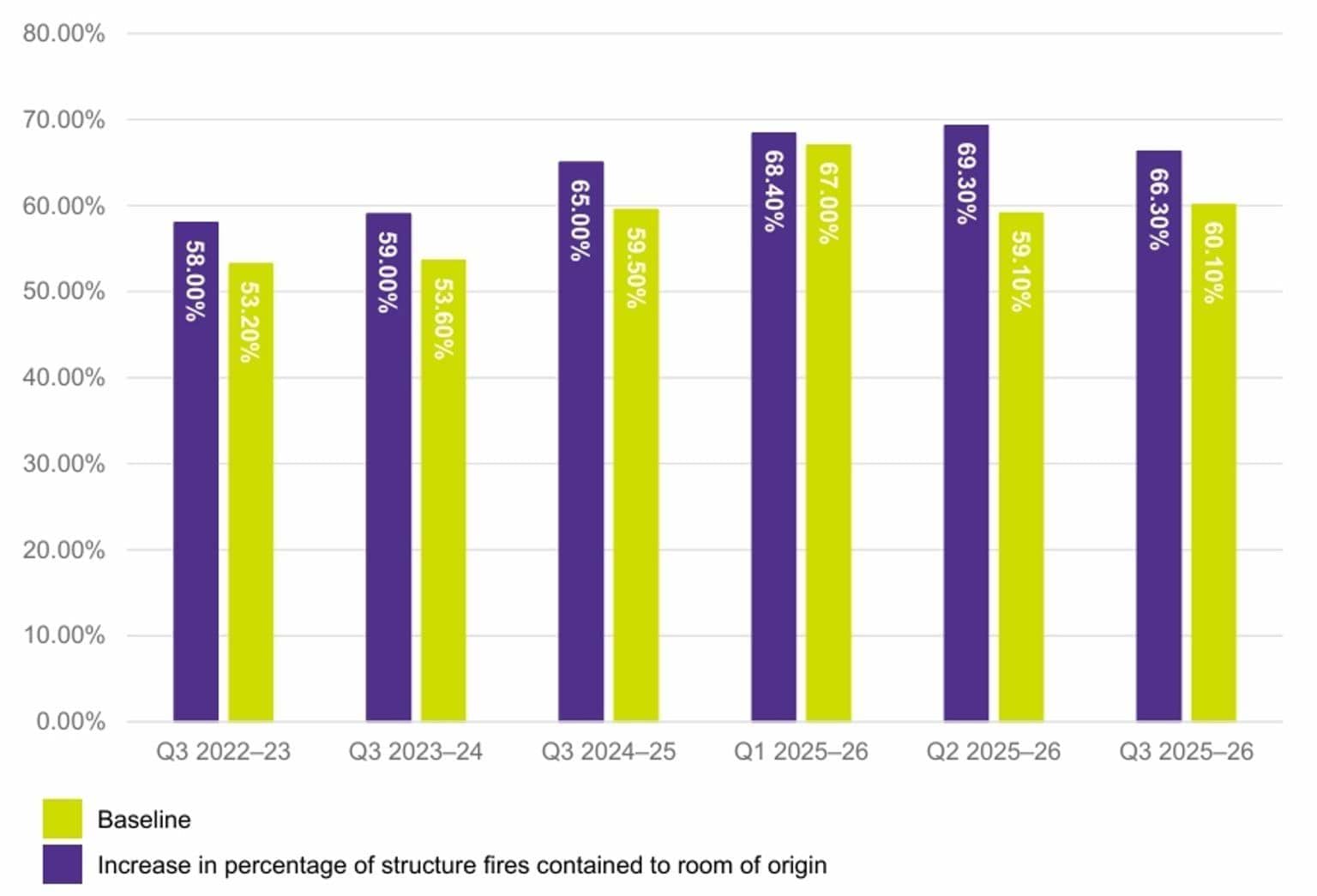
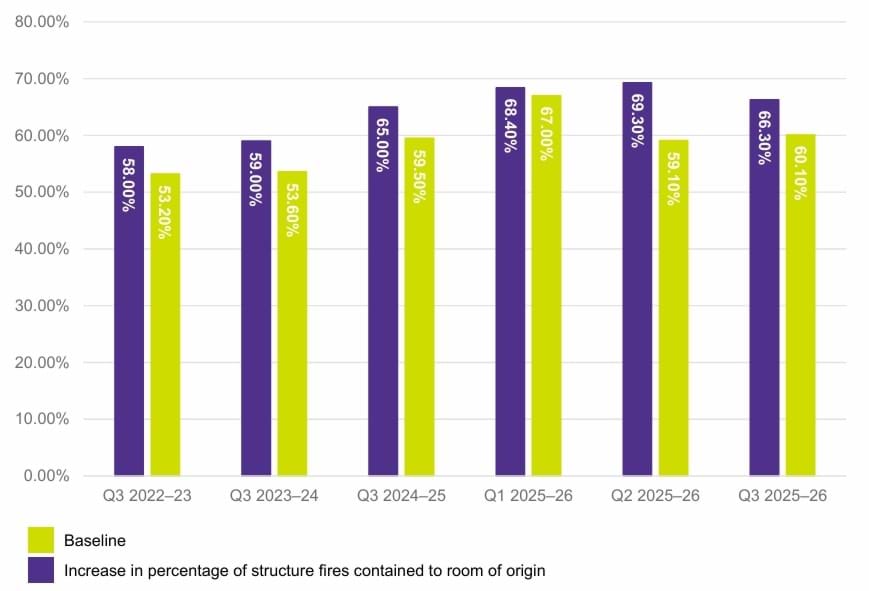
CFA reported that 66.3% of structure fires were contained to room of origin in Q3 2025–26. This result was against a baseline of 60.1%. The FSIM notes that this is the sixth consecutive reporting period in which the results are above the baseline.
Figure 2: Increase in percentage of structure fires contained to room of origin
CFA: Increase in percentage of vegetation fires contained to 5 hectares
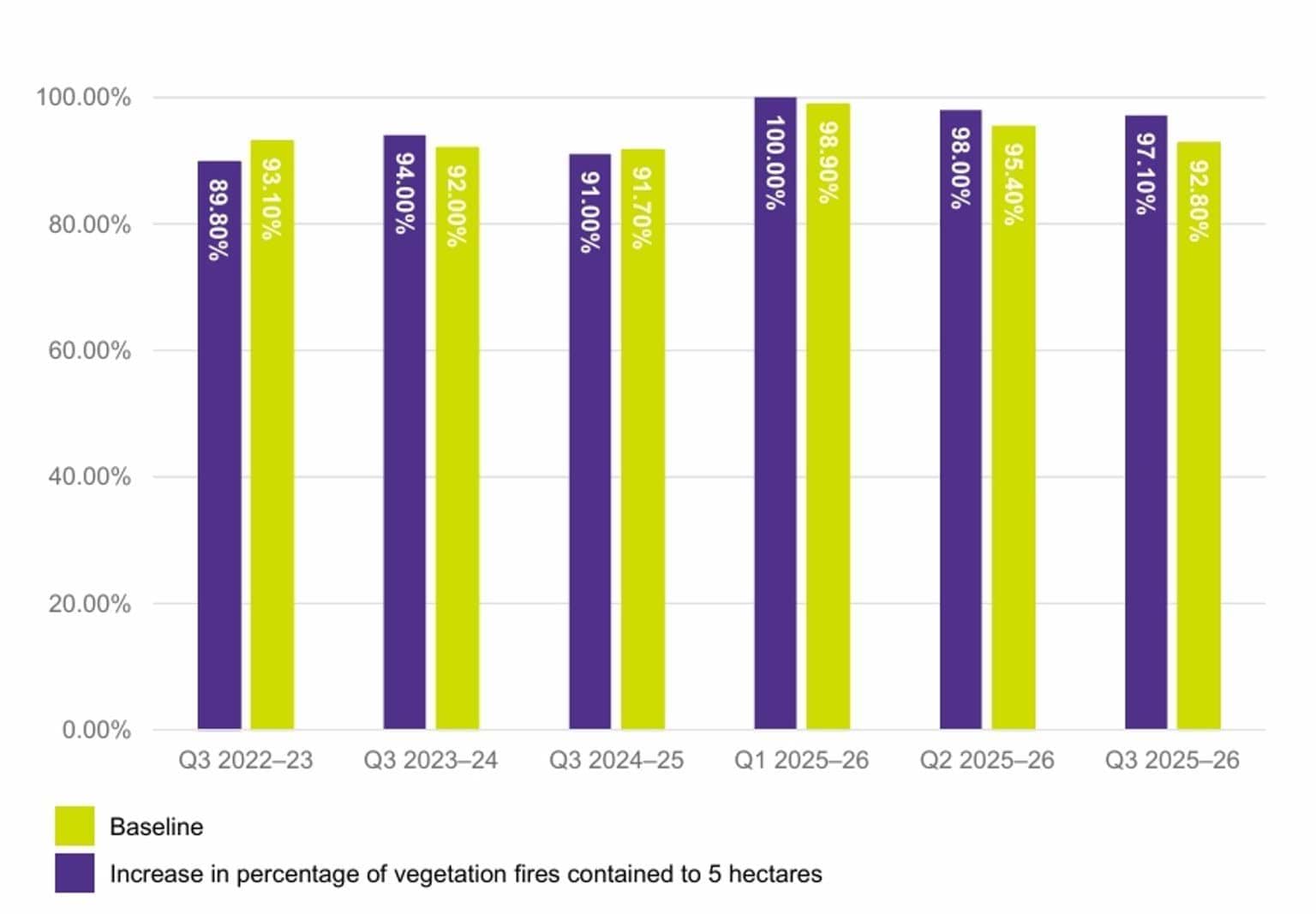
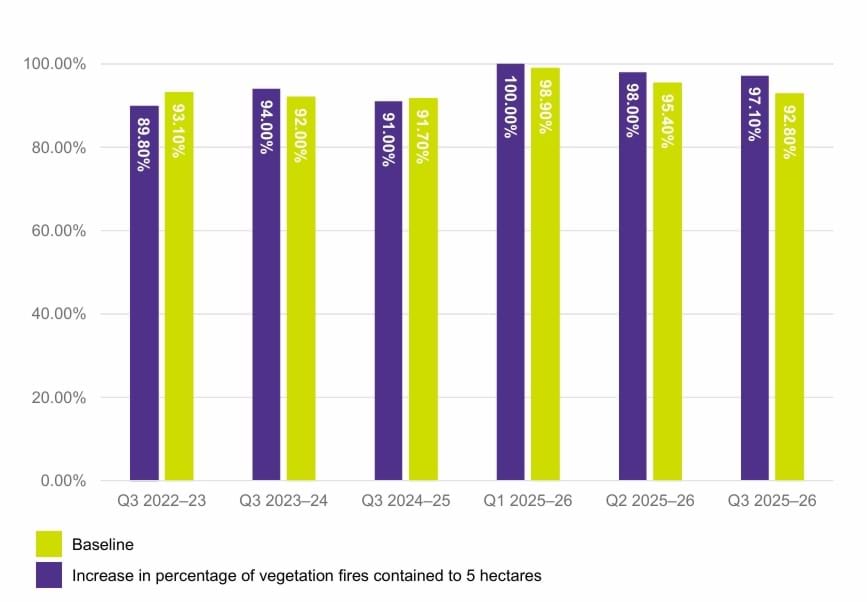
CFA reported that 97.1% of vegetation fires were contained to 5 hectares in Q3 2025–26. This result was against a baseline of 92.8%. The FSIM notes that this is the third consecutive reporting period in which the results are above the baseline. Further, the result for Q3 2025–26 is a notable achievement given the catastrophic fire weather conditions Victoria experienced this quarter.
Figure 3: Increase in percentage of vegetation fires contained to 5 hectares
CFA: Road accident rescue response times meeting benchmark (target 90%)
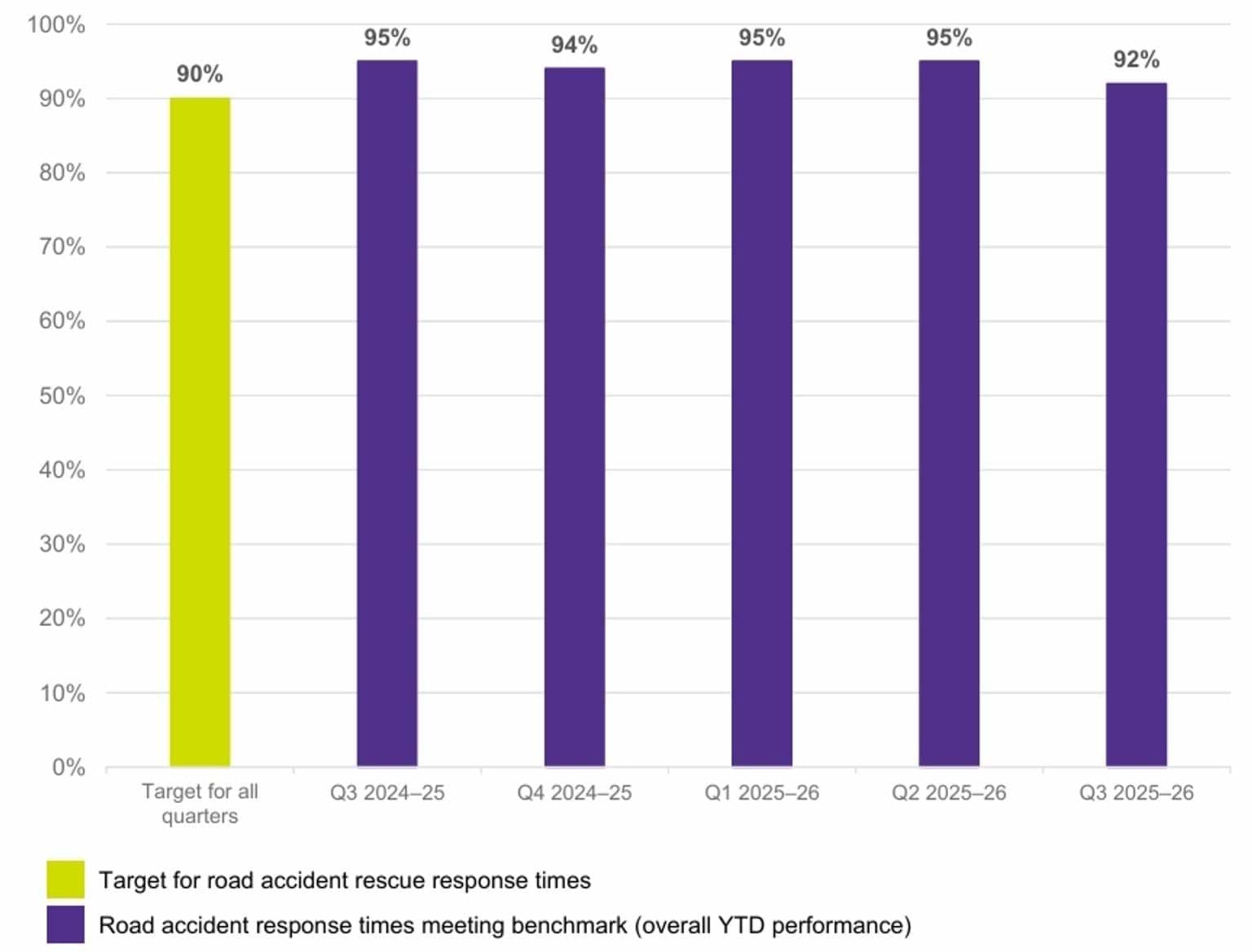
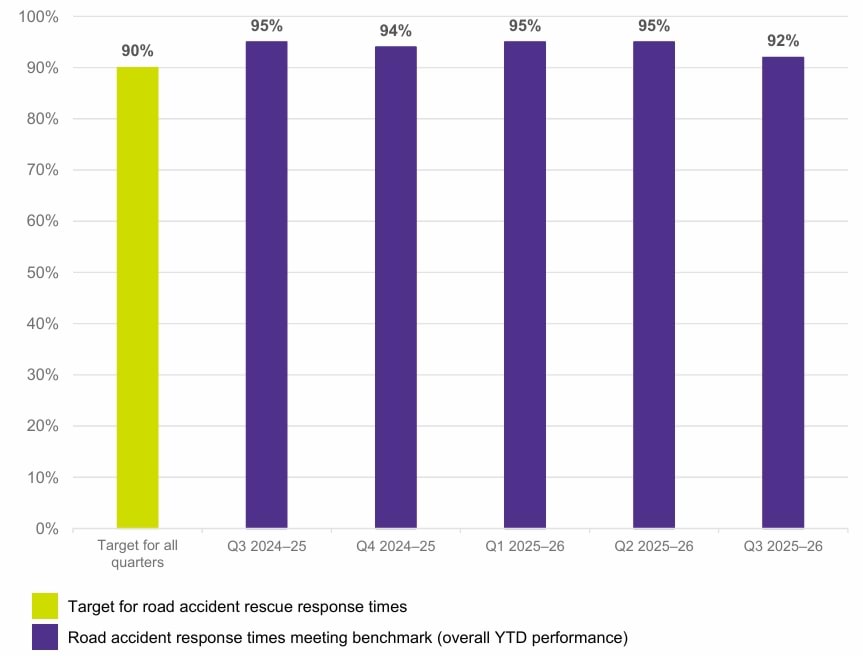
CFA reported that 49 incidents were attended by accredited road accident rescue brigades in Q3 2025–26. 92% of road accident rescue responses in 2025–26 (YTD) have been within CFA time benchmarks. CFA has consistently exceeded the target benchmark of 90% since this measure was included and reported via its Outcomes Framework in Q2 2024–25.
Figure 4: Road accidents response times meeting benchmark
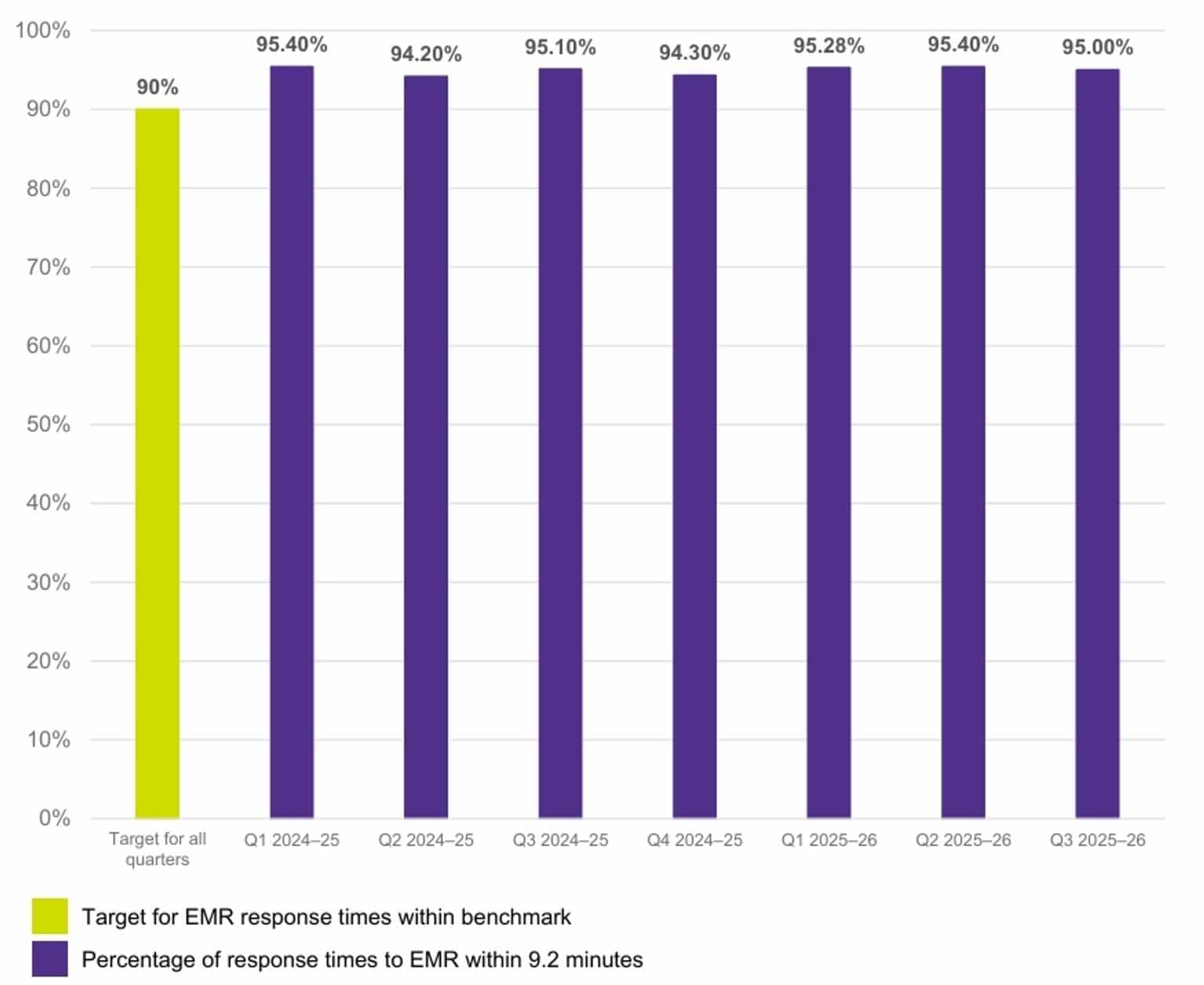
FRV: Percentage of response times to EMR within 9.2 minutes (90%)
FRV reported a 95% response time to EMR within the target benchmark of 9.2 minutes for Q3 2025–26. FRV has consistently exceeded the target benchmark of 90% since this measure was first reported on in 2020–21.
Figure 5: Percentage of response times to EMR within the target benchmark of 9.2 minutes
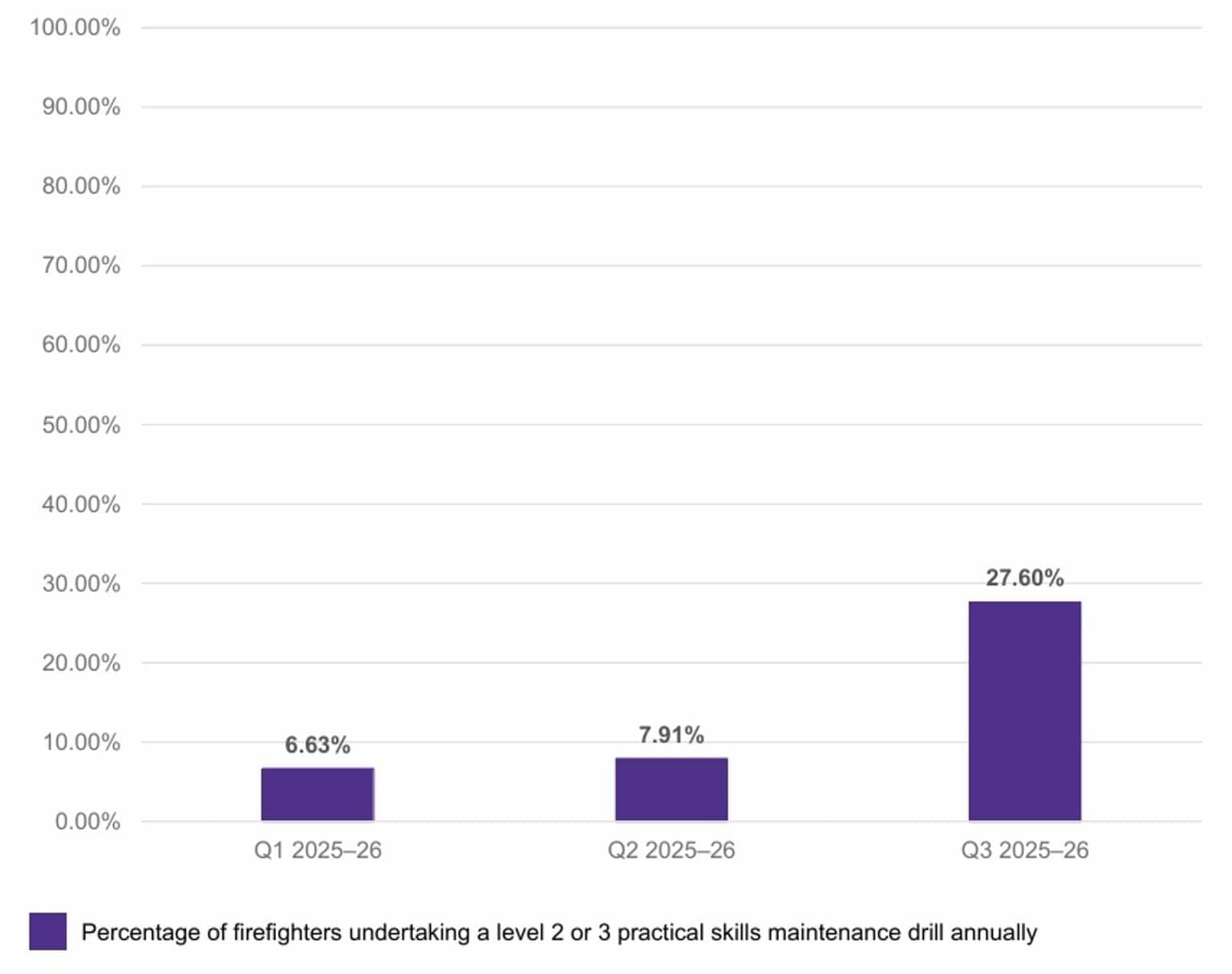
FRV: Percentage of firefighters undertaking a level 2 or 3 practical skills maintenance drill annually
FRV reported that 27.6% of firefighters undertook a level 2 or 3 practical skills maintenance drill in Q3 2025–26. The Q3 result of 27.6% during this reporting period is a significant increase of 19.69% on the previous comparable quarter of 7.91%. FRV have explained the substantial increase in Q3 2025–26 was due to increased availability of instructors, with a significant number of instructors deployed regionally to deliver practical skills maintenance training.
Figure 6: Percentage of firefighters undertaking a level 2 or 3 practical skills maintenance drill annually
2.2 Continuing off-track trend over repeated quarters
CFA: Timely delivery of major programs and projects
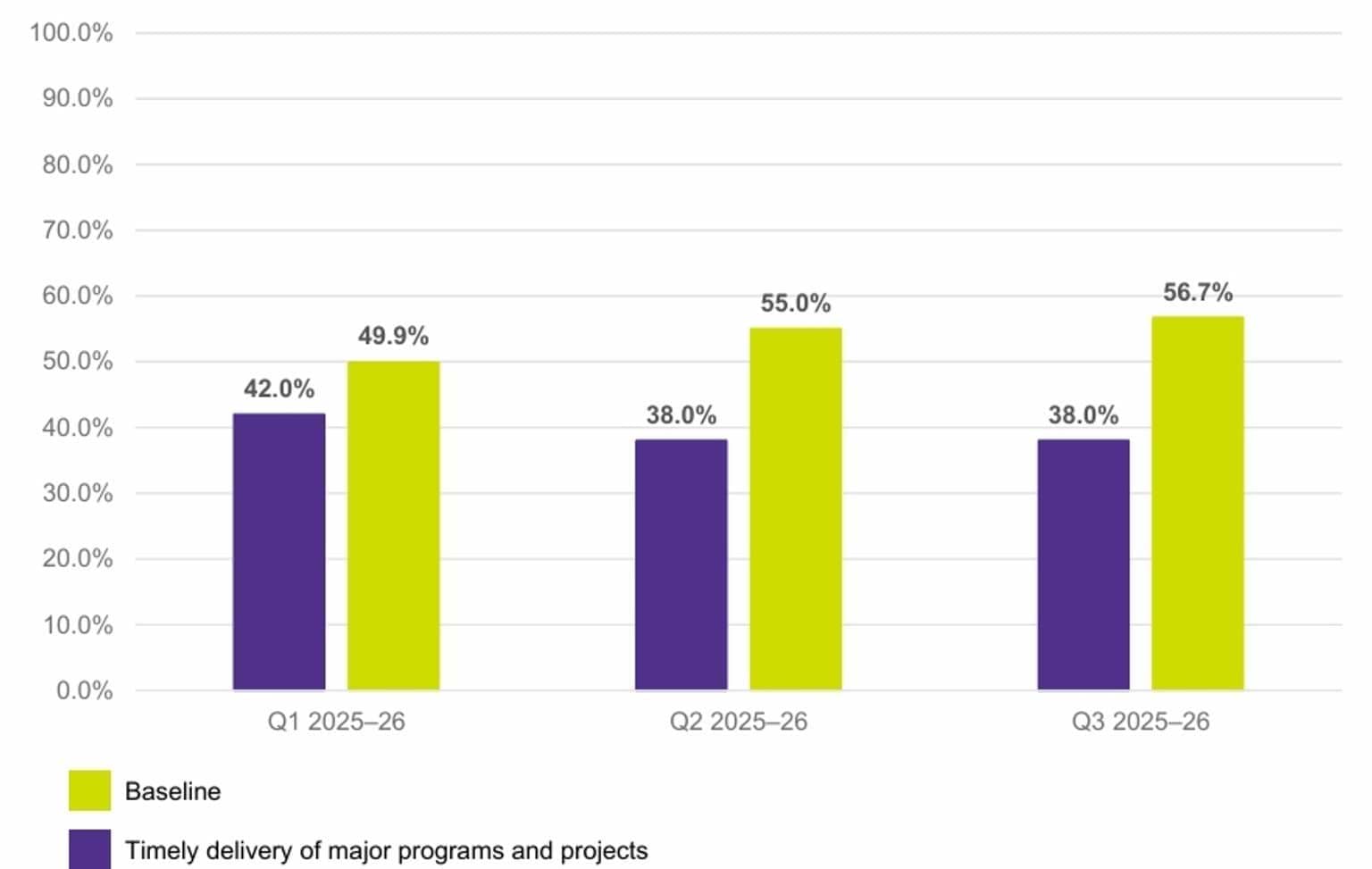
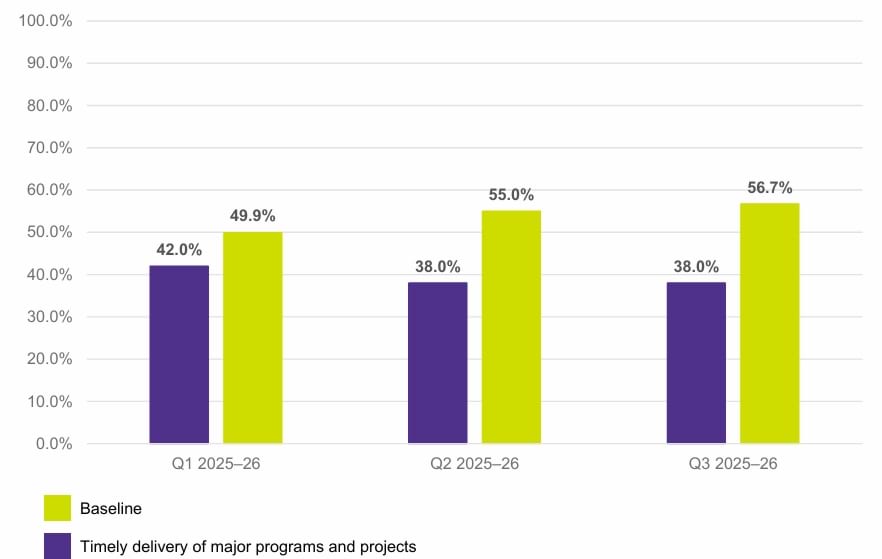
CFA reported 38% of major programs and projects as having an overall status of ‘on track’ at the end of Q3 2025–26, against a quarterly baseline of 56.7%. This is the third reporting period in which the results were below the baseline. CFA clarified that in Q3, project schedules and delivery timelines were impacted by significant fire activity, requiring the reprioritisation of resources and subsequently, the need to adjust timeframes across several projects. CFA have advised the FSIM that a planned review of CFA Project Management Framework is progressing and on track for completion this year. This will inform a roadmap to improve project maturity, delivery consistency, and governance across CFA projects.
Figure 7: Timely delivery of major programs and projects
FRV: Percentage of response to structure fire incidents within 7.7 minutes (target 90%)
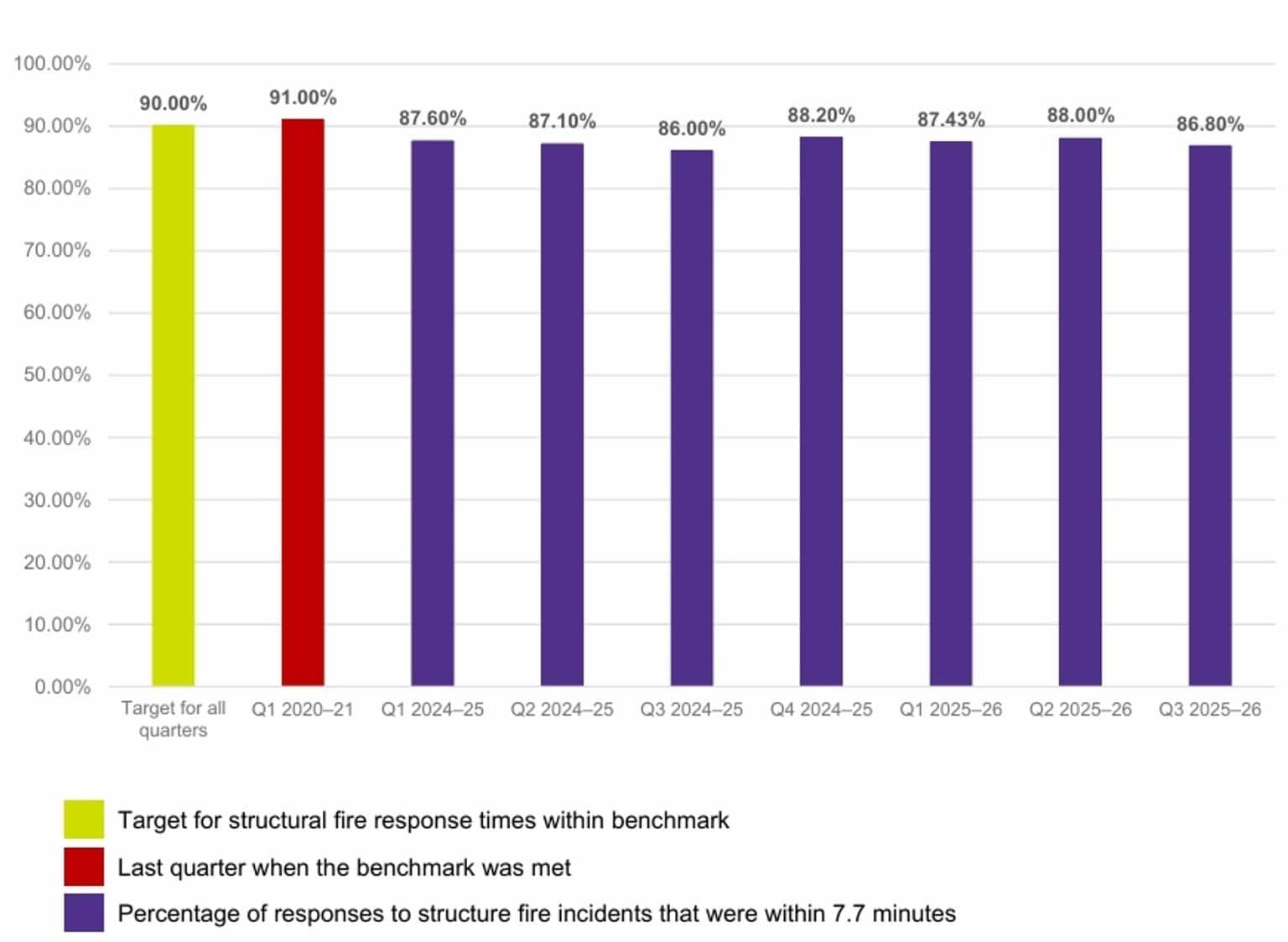
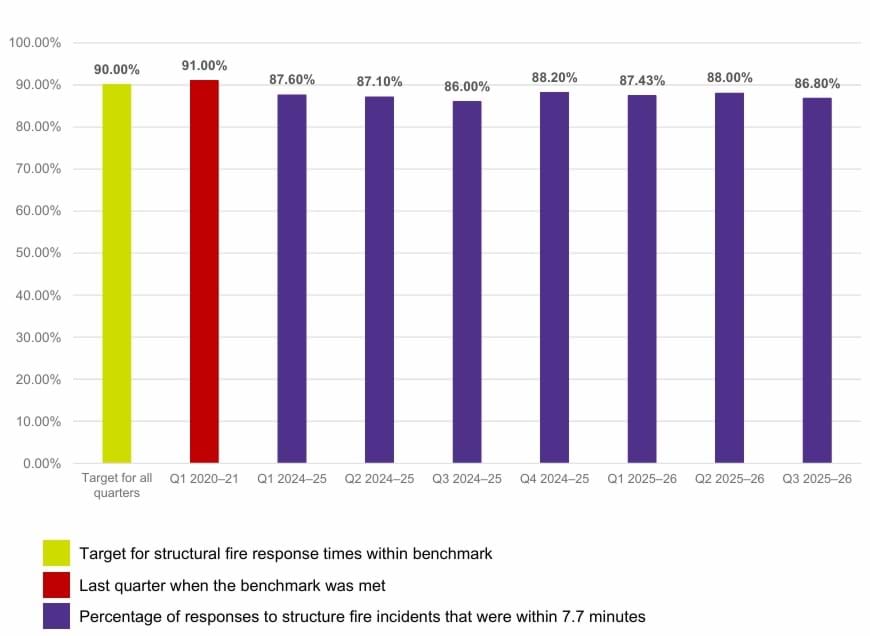
FRV’s result for this measure in Q3 2025–26 represents the 22nd consecutive quarter where the benchmark target of 90% has not been met. Q1 2020–21 was the last quarter this benchmark was achieved (indicated in red in Figure 8). The Q3 2025–26 result of 86.8% was a 1.2% decrease on the Q2 2025–26 result of 88%.
The FSIM has repeatedly identified FRV’s continuing underperformance against this measure. This issue has persisted for too long, and as a risk to community safety, necessitates action by FRV to address the issues. As such, the FSIM has asked FRV to identify what is being done to rectify or address this ongoing inability to meet or exceed the benchmarked target.
FRV explained there are a number of factors contributing to this result, including sustained growth in the number of incidents that FRV attend (7% per annum on average for the last 3 years), and this growth has reduced availability and places additional strain on the current system, making it harder for FRV to meet the 90% target.
Population growth within Victoria has also increased traffic congestion on the road network and has resulted in a greater number of people residing in areas beyond a 6.2-minute drive time from the existing network.
FRV has advised it is investigating possible initiatives to enhance response times, including reviewing turnout times, noting response time performance is dependent on a range of factors. While increasing the number of stations (expanding coverage) and/or increasing the number of primary appliances (improving availability within existing coverage areas) could contribute to reducing the response times, these options would require significant capital investment, and it would be important to target investment to the areas of greatest need.
Figure 8: Percentage of response to structure fire incidents within 7.7 minutes
2.3 Significant change from baseline or previous comparable quarter (undesirable outcome)
FRV: Percentage of FRV capital projects: On time
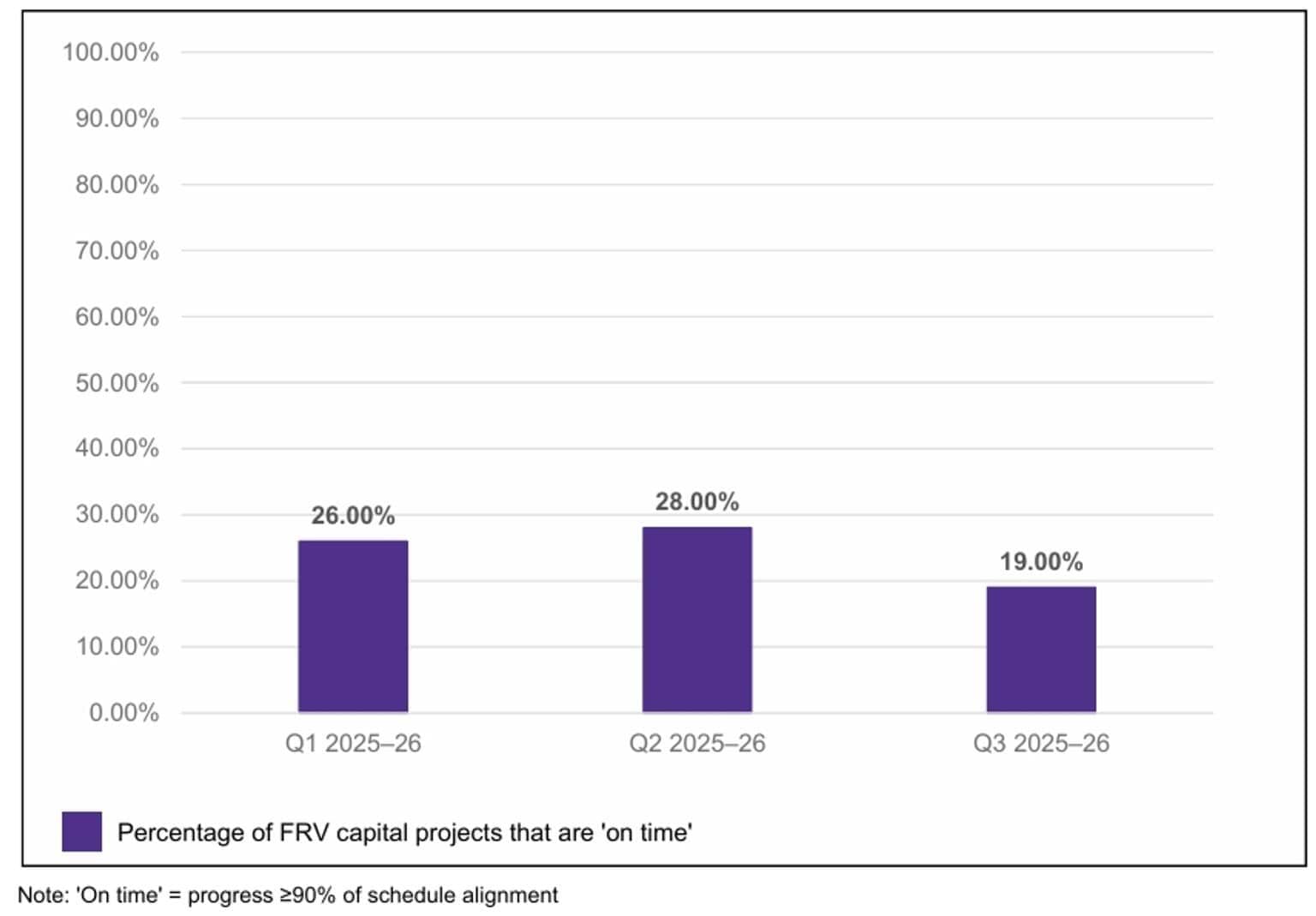
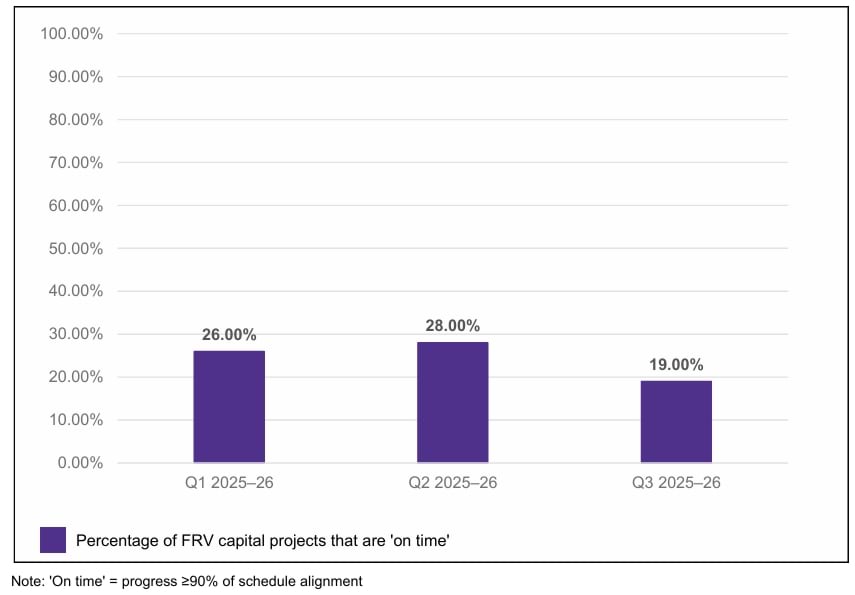
FRV reported 19% of FRV capital projects were on time at the end of Q3 2025–26. This is a significant negative change to the 2 previous comparable quarters.
FRV clarified that for measure 7.5.i, 'on time' equates to progress of greater than or equal to 90% or more of the planned project milestones (as reflected on the reporting system) have been met. FRV advised that whilst the Q3 results indicate a low number of projects meeting this threshold across the capital program, the results are partially explained by data accuracy issues. Several projects are currently not being updated in the system due to protected industrial action. As a result, while work and progress may still be occurring and budget expended, this would not be fully reflected on the system from a schedule perspective. Despite data accuracy challenges, FRV acknowledges there are clear opportunities for improvement in its capital program performance.
FRV advised they have recently undertaken a Capital Program Evaluation to identify systemic issues that contribute to scheduling and budget under performance. Key findings identified to date include a lack of consistency and effectiveness in project planning and budget forecasting across its portfolio. A suite of initiatives is planned to be implemented to address the key findings of the evaluation.
FRV have explained that they have the objective that all capital projects are on-time and utilise their allocated budget as planned. Whilst historically this has not been achieved at FRV, the implementation of targeted actions stemming from the evaluation is intended to deliver a significant uplift in the performance of FRV’s capital program in coming financial years.
Figure 9: FRV capital projects: On time
3. Reader guide
Definitions
| Acronym | Title |
|---|---|
| AAR | After Action Review |
| CFA | Country Fire Authority |
| EMR | Emergency Medical Response |
| FRV | Fire Rescue Victoria |
| FSIM | Fire Services Implementation Monitor |
| YTD | Year-to-date |
4. Appendix A: CFA’s Q3 2025–26 outcomes progress report
This is CFA’s outcomes progress report for Q3 2025–26. This progress report includes results against CFA’s quarterly outcome indicators.
5. Appendix B: FRV’s Q3 2025–26 outcomes progress report
This is FRV’s outcomes progress report for Q3 2025–26. This progress report includes results against FRV’s quarterly outcome measures.