- Date:
- 31 Oct 2026
Gabrielle Williams MP
Deputy Premier
Minister for Education
Minister for Skills and Training
Minister for First Peoples
Minister for Women and Gender Equality
1 Treasury Place
East Melbourne VIC 3002
Dear Minister,
In accordance with the Financial Management Act 1994 (Vic), I am pleased to present the Adult, Community and Further Education Board’s annual report for the year ending 30 June 2026.
Mr John Maddock AM OLY
Chairperson
Adult, Community and Further Education Board
9 October 2026
Year in review
Our vision
The vision of the Adult, Community and Further Education Board (the board) is that adult, community and further education (ACFE) develops the core skills Victorian adults need for study, work and life.
Our mission
The mission of the board is to lead literacy, numeracy, English language, employability and digital skills education and training for adult learners in Victoria.
Our values
In accordance with the Public Administration Act 2004 (Vic), the board upholds the 7 core Victorian public sector values of:
- responsiveness
- integrity
- impartiality
- accountability
- respect
- leadership
- human rights.
Chairperson’s report
As Chairperson, it is my pleasure to present the board’s annual report for 2025–26.
This was a year of both continuity and transition for the board. The reporting period spanned the final 6 months of the Adult, Community and Further Education Board Strategy 2020–25 and the first 6 months of the board’s 2026 strategic priorities and projects. Throughout this period, the board remained focused on ensuring Victorian adult learners could access a responsive, high-quality place-based education and training system that supports participation in study, work and life. The board has continued to strengthen the systems, partnerships and supports that underpin pre-accredited training in Victoria, while also reviewing key settings to ensure that the place-based education and training system remains responsive, sustainable and focused on learner outcomes.
Supporting a strong and responsive place-based education and training system and strengthening the impact of pre-accredited training
During 2025–26, the board remained committed to supporting a strong, responsive and inclusive place-based education and training system across Victoria. Key areas of focus included strengthening contracting and grant processes, reviewing quality settings, investing in curriculum and professional development, improving Learn Local provider engagement and promoting the value of Learn Local training across the state.
The board continued to provide targeted support for provider capability and sustainability through a range of grant programs. This included the Technology and Digital Support Grant and the Learner and Program Sustainability Grant, which assisted Learn Local providers to strengthen digital capability, attract and retain learners, support progression, and enhance curriculum, outreach and partnerships.
The board maintained ongoing funding for important learner support programs, such as Family Learning Partnerships (FLP), which aim to improve participation, confidence, and lifelong learning outcomes for families who may face barriers to participation in education and training. Extension of the Learn Local Learning for Work initiative and pilot grant continued to strengthen pathways to employment for learners by encouraging innovative pre-accredited learning, authentic workplace experiences and stronger industry partnerships. Together, these investments contribute to improved access to quality training and education across Victoria.
A further priority was improving the sustainability of delivery in thin markets, where low enrolments, dispersed populations and limited access to services can make provision more challenging. During the year, the department worked with Learn Local providers to pilot new approaches and develop case studies to support more sustainable training delivery in these communities.
In 2025–26, the board invested in professional development to strengthen the capability of the Learn Local workforce and support delivery of high-quality pre-accredited training. Through partnerships with lead providers, the board funded targeted learning opportunities in language, literacy, numeracy, employability and digital skills. These activities included peer mentoring, self-paced learning and subsidised participation to encourage broad engagement across Learn Local providers. The Learn Local Secure Portal remained central to this work, providing a key platform for professional learning, resources and connectivity.
A key focus in 2025–26 was the review and redevelopment of the pre-accredited quality framework. Based on feedback from Learn Local providers, the board committed to reviewing the framework and supporting development of an updated framework shaped by co-design, independent quality assurance expertise, national policy settings and stakeholder feedback. In April 2026, the board endorsed a roadmap to guide this work. The board remains highly committed to this project. We envision a refreshed framework that places the learner at the centre and defines consistent high-quality training across providers, while allowing flexibility to accommodate diverse environments and learner needs. Doing so will ensure learners can access high-quality relevant training that meets their needs and allows them to confidently achieve their life, work or study goals. It will also produce Victorians who have the skills to meet Victoria’s economic, social and environmental priorities.
The board is focused on meeting the foundation skills requirements for learners in an ever-changing economic landscape. Its investment in curriculum development and maintenance is demonstrated in 64 sets of curricula and resources available to Learn Local providers through the Learn Local Secure Portal. Most importantly, these courses are underpinned by Commonwealth frameworks and approaches to teaching core skills that support effective participation in society. The board also sponsors nationally recognised accredited curricula that enable adult learners to improve their foundation literacy, numeracy and general education skills.
To meet employer and learner needs in growing and emerging industries, the board funds initiatives that lead directly to employment outcomes and bring economic benefits to Victoria. Just-in-Time Learn Local Industry Partnerships and the related Industry Practice Networks strengthen partnerships between Learn Local providers, employers and local industry to co design pre-accredited training that responds to immediate foundation skills needs and builds provider capability in employer engagement.
The additional Victorian Government funding of $5.9 million via the National Skills Agreement offered a significant boost to board-funded training in 2025–26. This funding is specifically for pre-accredited digital skills training and extends to the end of 2029. It means Learn Local providers will be able to provide essential training to learners to meet emerging digital skills needs.
It has also been great to see the Department of Jobs, Skills, Industry and Regions and the Victorian Government partner with the Commonwealth Government to launch the $4.5 million Victorian Adult Community Education (ACE) Scholarships Program. The program is part of the National Skills Agreement Ensuring Access to Foundation Skills initiative, which includes action to build the capacity and capability of the Learn Local workforce to deliver foundation skills training. It offers scholarships to people pursuing a rewarding career as an adult literacy and numeracy educator and provides new and existing ACE trainers and practitioners with qualifications, specialist training and upskilling in language, literacy and numeracy. This initiative will increase the quality, capacity and capability of core foundation skills training through community-based adult education. It will also attract and increase the retention of foundation skills teachers and trainers. Importantly, the program will give adults seeking community-based education greater access to accessible and relevant training in foundation skills.
The board also continued work to strengthen culturally safe and inclusive practices across community-based education. The board commissioned the Victorian Aboriginal Education Association Inc. (VAEAI), which developed the board-funded Koorie Education in Learn Locals: Best Practice and Protocols, to develop a toolkit that will help providers better identify and enrol First Peoples Victorians who may benefit from pre-accredited training.
Engagement and promotion
Engagement with Learn Local providers and the promotion of pre-accredited training remained important priorities. The annual Pre-accredited Learner Survey again highlighted the strength of Learn Local courses, with positive results in learner satisfaction, skills development, community participation and employment outcomes. Results of the 2025 survey reinforced the value of Learn Local delivery in providing welcoming, accessible and effective learning opportunities for Victorian communities.
In 2025, through the Your Goals, Your Way campaign, the board broadened engagement with diverse communities across Victoria, including culturally and linguistically diverse communities, regional learners and First Peoples. It was pleasing to see this work exceed the board’s brand awareness target among potential learners, while new brand guidelines and promotional resources established a strong foundation for future promotion.
During the year, the board also saw a significant change to the regional council governance model. Following consultation, 4 new regional councils were established, abolishing the historical 8 regions of ACFE. These changes will reinvigorate the regional councils’ role in providing local intelligence to the board and promoting pre-accredited training to stakeholders and the community. I wish to take this opportunity to thank outgoing, ongoing and newly appointed regional council members for their willingness to serve in these important roles, and for their valuable contributions of advice and advocacy in their local regions.
Leadership and acknowledgements
The year also marked an important period of transition in leadership for the board.
On behalf of the board, I would like to acknowledge the Hon Gayle Tierney (former Minister for Skills and TAFE) for her longstanding contribution to ACE in Victoria. Her ministerial statement for ACE was visionary in its goals, and the benefits to learners as well as Learn Local providers, industry and local communities will be felt for many years.
In April 2026, we welcomed the Hon Colin Brooks as the new Minister for Skills and TAFE. In August 2026, we welcomed Gabrielle Williams as the new Minister for Skills and Training. As Chairperson, I look forward to continuing to work collaboratively with Minister Williams, government, the board and Learn Local providers to support positive outcomes for learners and communities across Victoria.
During 2025–26, the board bid farewell to 2 members: Michael Grogan and former Chairperson Teresa De Fazio. On behalf of the board, I extend a special thanks to Dr De Fazio for her steadfast commitment to the board, Learn Local providers and above all, adult learners. Her leadership ensured that board initiatives and programs advanced ACFE’s unique contribution to supporting Victorians to build foundation skills, prepare for further training and improve their employment opportunities. I would also like to acknowledge Mr Grogan’s considerable contributions to the board and its committees, particularly the Finance Committee and the Audit and Risk Committee, of which he was deputy chairperson, and his involvement with regional councils and special advisory groups. I wish them well in their future endeavours.
I would also like to acknowledge the reappointments of Margaret Lewis and Natasha Ngweso to the board for a further 12 months.
I thank Learn Local providers, regional councils, board members, peak organisations and departmental staff for their commitment, expertise and professionalism throughout the year. I also extend my thanks to the many Learn Local providers, management and staff working directly with learners in communities across the state. Their efforts continue to ensure that pre-accredited training remains accessible, relevant and responsive to the needs of Victorian learners.
Place-based ACE benefits Victoria
Now more than ever, it is apparent that the place-based education and training system is an essential part of Victoria’s tertiary education system and that it contributes socio-economic benefits for Victoria. As we move forward, the board remains committed to funding flexible, inclusive and sustainable place-based training, where Learn Local providers support adult learners to build the foundation skills, confidence and capabilities they need for study, work and life. This is particularly important for people who face barriers to participation and benefit from community-based pathways into further education, training, employment and broader social participation.
We look forward to continuing to work closely with stakeholders on ACFE programs and initiatives throughout 2026–27, for the benefit of all Victorians.
John Maddock AM OLY
Chairperson, ACFE Board
Our purpose and functions
The board was established as an authority under Victorian legislation in 1991. It performs important statutory functions under the Education and Training Reform Act 2006 (Vic) (ETR Act) to support the development of ACFE in Victoria.
The board has 5 broad functions:
- advisory – to advise the Minister for Skills and Training on ACFE matters
- development – to foster and support the research and development of matters relating to ACFE, and evaluate and report on policies, programs, resources and services developed for the coordination, provision, funding and support of ACFE
- strategic – to establish ACFE’s strategic objectives, priorities and targets in relation to its leadership and the training provided in the tertiary education system, and plan policies, programs, resources and services for the coordination, provision, funding and support of ACFE, having regard to its quality and equity of access and its economic and social benefits to the Victorian community
- profiling – to advocate for and promote awareness of ACFE in the place-based education and training system and the Victorian community
- registration – to register providers of ACFE to deliver education and training to the Victorian community and to develop matters related to ACFE.
In performing these functions, the board pays close attention to providing equitable access to adult community learning opportunities for Victorians who have faced barriers to educational attainment. The board monitors the quality of education so that it remains relevant to specific community needs.
Adult community education in Victoria
The Victorian Government, through the board, registers and funds ACE providers to deliver pre-accredited training through Learn Local courses. These reach a broad range of adult Victorians, developing their core skills for study, work or life.
Short courses are offered for free or at low cost to eligible Victorians, with offerings spanning literacy and numeracy skills training to job readiness and digital skills training. Courses are delivered by experienced and dedicated trainers.
Learn Local courses contribute to learners’ wellbeing by building their self-confidence and increasing their social engagement through positive learning experiences that can lead to further study or employment.
They also:
- offer learners more opportunities for economic participation
- support stronger Victorian communities and economies, through greater workforce participation
- increase socioeconomic resilience across communities.
By strengthening adult Victorian’s ability to participate fully in their communities, courses deliver social and societal benefits.
Learn Local providers delivering board-funded courses are part of the place-based education and training system, an essential part of Victoria’s tertiary education system. Community-based adult education plays a vital role in providing pathways for adult learners to employment and further training. It also supports meaningful social participation.
Community-based adult education supports adult learners with diverse needs. These learners include adults who are still developing core skills, those who may not have completed secondary school and those who may not have engaged in education for a considerable time. Some learners face other challenges in their lives, such as poor physical or mental health, disability, homelessness, housing instability, violence or discrimination. They may also have experienced long-term unemployment or unemployment across generations of their family.
Community-based adult education also supports people in the workforce who are vulnerable to job loss, particularly if their industry is changing or has been ‘disrupted’, such as when new technologies are introduced.
Learn Local providers take an informal, welcoming, flexible approach to learning. They are often the most appropriate and accessible education and training option in the local community.
Learn Local providers are community-based, not-for-profit organisations. They range from large, sophisticated organisations with expertise in many areas to smaller organisations with expertise primarily in ACE. Some Learn Local providers focus solely on delivering board-funded courses. However, the majority have much broader educational and service delivery responsibilities.
In 2026, 189 Learn Local providers are listed on the board’s register, following board approval.
The ACFE Board’s strategic focus
Ministerial statement 2020–25
The Ministerial Statement on The Future of Adult Community Education in Victoria 2020–25 (the Ministerial Statement) was launched by the former Minister for Skills and TAFE, the Hon Gayle Tierney, on 14 November 2019. The Ministerial Statement concluded on 31 December 2025.
The Ministerial Statement established a reform agenda for the board and ACE. It set ambitious aspirations, goals and a range of qualitative and quantitative measures to demonstrate progress.
The Ministerial Statement prioritised pre-accredited training in adult literacy, numeracy, employability and digital skills, to augment Victoria’s tertiary education system. It identified a stronger role for Learn Local providers in supporting students to enter and successfully complete TAFE and university courses, and in upskilling and re-skilling low-skilled workers who may be vulnerable to unemployment as the nature of work changes.
The Ministerial Statement set an agenda that included:
- building the capability of the place-based education and training system to provide literacy, numeracy, employability and digital skills training
- enhancing professional development for Learn Local providers and teaching resources
- building board capacity to deliver on ministerial priorities
- developing partnerships with employers across the tertiary education system and the Victorian Government to support learners to work, study and fully participate in society
- enhancing learners’ access, inclusion and engagement across all local government areas
- directing all board funding to learners based on need
- promoting the role and value of the place-based education and training system.
The Ministerial Statement sought to guide collaboration to improve the lives of Victorian learners through education.
The board is preparing a report to acquit the Ministerial Statement, including key achievements, the enduring positive impacts on learners and outcomes for Learn Local providers.
Strategy 2020–25
The Adult, Community and Further Education Board Strategy 2020–25 (the Strategy) was a blueprint for the board and the place-based education and training system. It detailed the primary means of delivering on the Ministerial Statement, positioning and strengthening the role of ACE in Victoria.
The Strategy focused on adult Victorians who are seeking to develop the core skills they need for study, work or life. It places the learner at the centre of all endeavours, acknowledging the strengths of engaging with pre-accredited training.
The Strategy focuses on 4 strategic directions:
- engaging learners and developing their confidence and skills
- building greater collaboration between Learn Local providers and partners, especially employers and TAFEs
- investing in people across Learn Local providers, and in high-quality products and tools to support them
- maintaining high standards of board stewardship and governance, and championing and communicating the value and impact of community-based pre-accredited training.
The Strategy concluded on 31 December 2025.
ACFE Board priorities and projects 2026
The board’s priorities and projects 2026 sets the board’s strategic directions and priorities for one year.
The board has prioritised:
- implementing board policy and service delivery decisions by commissioning, contracting and operating an end-to-end pre-accredited training system, including reviews of milestone payments and registrations
- developing and delivering key policy and programs to build the capacity and capability of Learn Local providers, including a new quality framework, a professional development program, new curricula, and First Peoples learners’ tools and materials
- further supporting established and successful grant programs, Learn Local awards, conferences and sponsorships, including engagement, marketing and intelligence programs and initiatives.
The board’s one-year focus is aligned to the Ministerial Statement of Expectations.
Ministerial Statement of Expectations
Across 2025–26, the minister provided the board with Statements of Expectations that informed priorities of focus within the context of the Ministerial Statement, the Strategy and the board’s priorities and projects for 2025 and 2026.
The board reports once a year to the minister on achievements against the annual Statement of Expectations.
Non-financial performance reporting
Table 1: Performance against output performance measures
| Performance measure | Unit of measure | 2025–26 actual | 2025–26 target | Performance variation (%) | Result |
|---|---|---|---|---|---|
| Number of government-subsidised pre-accredited training hours funded through the ACFE Board | Number | 2,372,110(i) | 2,106,900 | 12.6 | ✓(ii) |
Notes:
(i) The 2025–26 outcome is higher than the target due to sustained demand for pre-accredited training and additional funding provided for digital skills training.
(ii) Performance target achieved or exceeded.
Participation in board-funded training
In 2025, the board funded the training of 27,773 Victorians through 204 contracted Learn Local providers. Almost 2.4 million hours of government-subsidised pre-accredited training was delivered.
This funding reached a diverse learner group and provided access to learning opportunities for:
- 19,456 female learners (70.1% of all learners)
- 14,257 learners from culturally and linguistically diverse backgrounds (51.3% of all learners)
- 6,535 regional learners (23.5% of all learners)
- 4,606 learners with disability (16.6% of all learners)
- 552 First Nations learners (2.0% of all learners).
Onsite training was available in 71 of Victoria’s 79 local government areas, with learners in the remaining areas able to access training in an adjacent local government area or online. Of all learners, 23.5% were based in regional Victoria (6,535 learners).
The training also supported many learners who may face barriers to education and employment, including:
- 10,242 learners with concession cards (36.9% of all learners)
- 9,712 learners not seeking work before training (35.0% of all learners)
- 8,170 learners unemployed before training (29.4% of all learners)
- 5,687 learners who are early school-leavers (20.5% of all learners)
- 536 learners who are vulnerable workers at risk of retrenchment (1.9% of all learners).
Note: Learners can be counted in more than one learner group.
Learner satisfaction with board-funded training
The annual learner survey showed strong satisfaction with Learn Local training. The 2026 Pre-accredited Learner Survey collected feedback from learners who took part in Learn Local courses in 2025. The survey, conducted as part of the vocational education and training (VET) Student Satisfaction Survey program, had a 41.6% response rate (9,409 learners).
Survey results showed that learners were highly satisfied with their teaching and learning experience.
Among respondents:
- 95% reported a safe and welcoming place to learn
- 93% felt the community-based location was convenient across both metropolitan and regional-based learners
- 91% felt their trainers taught clearly and were knowledgeable about the topic
- 90% were satisfied that their provider had identified their learning needs
- 90% were satisfied with the course materials and facilities, as well as with the support they received from their trainers
- 87% had improved their general education, skills for community or voluntary work or confidence
- 86% reported positive perceptions of the teaching.
A high percentage of learners were satisfied that their Learn Local experience supported them on their learner pathway. Among surveyed learners:
- 87% were satisfied that their Learn Local course addressed their learning needs
- 87% were satisfied the training could be a pathway to employment and further training
- 83% indicated that, overall, they achieved their main reason for training.
Survey findings also showed positive outcomes after training, including progress towards work and community participation. The results showed that 22% of learners who were not actively seeking work before training achieved employment or were actively seeking employment after training.
Of learners who were unemployed before training:
- 23% achieved employment after training
- 16% of those who studied to gain volunteering skills achieved volunteer work after their training.
Key initiatives and projects
The annual report 2025–26 covers the last 6 months of the board’s 2020–25 Strategy and the first 6 months of the board’s strategic priorities and projects for 2026. Key board initiatives and projects are categorised according to the 3 main strategic priorities for 2025–26. Reporting of key projects and initiatives that commenced or continued under the 2020–25 Strategy is subsumed under the strategic priorities and projects for 2026:
- contracting and operations
- sector policy and capability
- sector engagement and intelligence.
Strategic priority: Contracting and operations
- Run an end-to-end pre-accredited training system
- Implement grant programs
- Review milestone payments and registrations
Throughout 2025–26, the board implemented and supported key initiatives and projects to ensure learners and their needs are the focus of its work. These initiatives and projects include:
- contracting Learn Local providers to provide pre-accredited training
- extending the Digital Literacy Skills for Adults program
- the Learn Local Learning for Work initiative and pilot grant
- the Family Learning Partnerships (FLP) program
- the Technology and Digital Support Grant
- the Learner and Program Sustainability Grant
- sustainable models of provision
- a review of milestone payments and Learn Local provider registrations
- funding for the Senior Victorians Education program
- Just-in-Time Learn Local Industry Partnerships
- Learn Local Industry Practice Networks.
Strategic priority: Sector policy and capability
- Develop a new quality framework
- Implement a professional development program
- Develop new curriculum
- Develop tools and materials for First Peoples learners
Throughout 2025–26, the board continued to support existing programs that ensure the Learn Local workforce has the capacity and capability to deliver accessible, flexible and tailored education and training programs to adult learners.
This work included:
- developing a new pre-accredited quality framework
- implementing a program of professional development for Learn Local trainers and practitioners
- developing and maintaining curriculum
- developing new Koorie tools and materials.
Strategic priority: Sector engagement and intelligence
- Support providers and system integration
- Administer the Pre-accredited Learner Survey
- Undertake audits of digital channels
- Maintain marketing and branding assets and products
- Sponsor key sector conferences and awards
- Deliver the annual Learn Local Awards
Throughout 2025–26, the board continued key stakeholder engagement and intelligence gathering programs and initiatives.
This work included:
- the annual Pre-accredited Learner Survey
- on-the-ground support and engagement with Learn Local providers
- a new governance structure for regional councils and a reinvigorated approach to collaboration with the board
- maintaining and reviewing Learn Local digital channels and marketing and branding assets and products
- planning for the Learn Local Conference 2026
- sponsorships of ACE conferences
- Learn Local Awards
- sponsoring the Victorian Community Training Provider of the Year Award at the Victorian Training Awards.
Financial performance reporting
Summary of financial results
Table 2 summarises information from the board’s financial reports for the 2025–26 financial year. For comparison, it includes results from the previous 4 financial years.
Table 2: Five-year financial summary
| Result | 30 June 2026 $’000 | 30 June 2025 $’000 | 30 June 2024 $’000 | 30 June 2023 $’000 | 30 June 2022 $’000 |
|---|---|---|---|---|---|
| Total income from transactions | 32,583 | 34,588 | 40,179 | 38,751 | 37,975 |
| Total expenses from transactions | 36,932 | 39,637 | 36,793 | 35,199 | 37,674 |
| Net result from transactions | (4,349) | (5,049) | 3,386 | 3,552 | 301 |
| Other economic flows included in net result | (5) | (58) | (9) | (4) | 10 |
| Net result for the period | (4,354) | (5,107) | 3,377 | 3,548 | 311 |
| Net cash flow from operating activities | – | – | – | – | – |
| Total assets | 21,274 | 28,685 | 31,807 | 30,355 | 28,833 |
| Total liabilities | 243 | 3,300 | 1,315 | 3,240 | 5,266 |
Revenue
Total income decreased by $2 million in 2025–26, comprising a $1.1 million reduction in services received free of charge from the department and $0.9 million in operating savings allocated as part of the 2025–26 State Budget. There was no year-on-year decrease in income for training delivery grants and subsidy payments.
Expenses
Expenses were $2.7 million lower in 2025–26, comprising a $1.1 million reduction in services received free of charge from the department, $0.7 million in reduced operating costs in line with the operating savings, and $0.9 million lower grant and subsidy payments due to the completion of some projects and the timing of payments across financial years.
Subsequent events
The department implemented workforce changes under Clause 11 of the Victorian Public Service Enterprise Agreement 2024 in 2025–26. The new structure took effect on 10 November 2025 and contributed to the material reduction to the valuation of services provided free of charge.
In October 2026, the Victorian Government approved a reduction of $15 million in appropriation to the department in 2026–27 relating to the board. For 2026–27, the board will maintain the delivery of programs and services following the government’s decision to decrease appropriation funding by drawing down accumulated revenue reserves which are sufficient to fund existing expenditure. This decision relates to appropriation and the utilisation of accumulated surpluses in 2026–27 only and does not impact future year appropriation. On this basis, it is expected that the board will continue to be able to deliver its core functions and operations.
Organisational structure and corporate governance
Board membership matters
The board is to consist of no fewer than 8 and no more than 12 members, including a chairperson and a deputy chairperson. Members are appointed by the Governor in Council on the recommendation of the Minister for Skills and Training.
Members of the board reflect the breadth and diversity of adult education in the community, and provide links to government, industry and community sector activity.
On 31 October 2025, the term of Mr Grogan ended.
On 30 September 2025, the terms of Ms Lewis and Ms Ngweso ended. Each was reappointed from 1 October 2025 in an advisory role and reappointed as a board member from 8 October to 31 December 2025. On 1 January 2026, Ms Lewis and Ms Ngweso were reappointed to the board for a term ending 30 June 2026.
On 30 June 2026, Ms Lewis and Ms Ngweso were each reappointed to the board for a 12-month term from 1 July 2026 to 30 June 2027.
On 1 April 2026, the term of Dr De Fazio ended.
On 14 April 2026, Mr Maddock was appointed Acting Chairperson.
Adult, Community and Further Education Board members 2025–26
Audit and Risk Committee membership and roles
In accordance with legislative requirements, the board has an Audit and Risk Committee to oversee:
- risk management
- financial management, performance and sustainability reporting
- compliance with legislation, regulations and standards
- external audit
- internal audit.
In 2025–26, the independent members on this committee were:
- Ms Lisa Tripodi, Chairperson
- Ms Kathryn Munro, Deputy Chairperson
- Dr Teresa De Fazio (term ended 1 April 2026)
- Ms Margaret Lewis
- Mr John Maddock
- Ms Natasha Ngweso
- Mr David Wild.
Representation on panels, advisory groups and working groups
Board members represent the board on advisory and working groups and panels, such as:
- Victorian Learn Local Awards judging panels
- Victorian Training Awards judging panels
- Learn Local Conference working group.
Members of the board also facilitate communication between regional councils of ACFE and the board as part of their role as a regional champion of one of 4 regional councils of ACFE.
Representation on other bodies
The Chairperson of the board is a member of other bodies, such as the Senior Secondary Certificate Reform Reference Group, the Marrung Central Governance Committee and the Koorie Skills Working Group.
Regional councils of ACFE
Until 13 April 2026, 8 regional councils of ACFE established under the ETR Act were in place.
Councils were established for the following regional and rural areas:
- Barwon South-Western
- Gippsland
- Grampians
- Hume
- Loddon Mallee.
Three councils were established for the following metropolitan areas:
- Eastern Metropolitan
- North-Western Metropolitan
- Southern Metropolitan.
On 13 April 2026, the number of regional councils was reduced from 8 to 4:
- Western Regional Victoria, covering the Mallee, Wimmera Southern Mallee, Great South Coast, Central Highlands, Barwon and western portion of Loddon Campaspe
- Eastern Regional Victoria, covering all of Gippsland
- Central and Northern Regional Victoria, covering the eastern portion of Loddon Campaspe, Goulburn and Ovens Murray
- Metropolitan Melbourne, covering all of metropolitan Melbourne.
As of 30 June 2026, member appointments to new regional councils are in progress.
The work of regional councils is supported by departmental staff.
Role of regional councils
The board and regional councils work together to fulfil the board’s mission.
Regional councils draw on expertise and local knowledge about adult education to advise the board on the needs of adult education across their regions. Regional councils play a key role in:
- providing advice and local intelligence to the board
- promoting and advocating for Learn Local and ACFE
- fostering collaboration and partnerships between Learn Local providers and key regional stakeholders.
Regional councils assist the board to meet its objectives by:
- developing processes that enable learners and providers to advise them and the board of ACFE needs in their region
- providing advice and preparing reports for the board
- providing information and contributing to planning for ACFE in the region
- advising the board on the effectiveness of activities in their region, including activities funded by the board
- supporting and promoting ACFE in the region, networks of providers, and diversity and flexibility in ACFE provision
- participating in recommending statewide priorities and policies to the board.
Regional councils may consult with learners, providers and other education and training organisations in their regions, including local TAFEs.
Composition of regional councils
Each regional council consists of no fewer than 5 and no more than 9 members, including an elected chairperson and elected deputy chairperson. Members are appointed by the Minister for Skills and Training. Regional councils may co-opt 2 additional people for up to 12 months.
Members are appointed to ensure that regional council members:
- have knowledge, skills and experience in the place-based education and training system
- reflect community diversity
- have knowledge and experience of governance responsibilities
- have knowledge and experience of issues affecting the local industry and the broader local community.
2025–26 membership of regional councils until 13 April 2026
Department services
Under the ETR Act, the General Manager of the board is responsible for implementing the board’s policies and decisions. The General Manager of the board is an executive of the department within the meaning of the Public Administration Act 2004 (Vic). During 2025–26, the role of General Manager was filled by Ms Laura Lo Bianco-Smith, Executive Director of the Adult, Community and Further Education, Pathways and Workforce branch in the department.
The General Manager is supported by a range of services provided by the department.
The department supports Learn Local providers across Victoria to meet the Victorian Government’s goals and targets for community-based adult learning. It provides advice about the place-based education and training system, supports the board to build organisational capacity and administers the board’s grant programs.
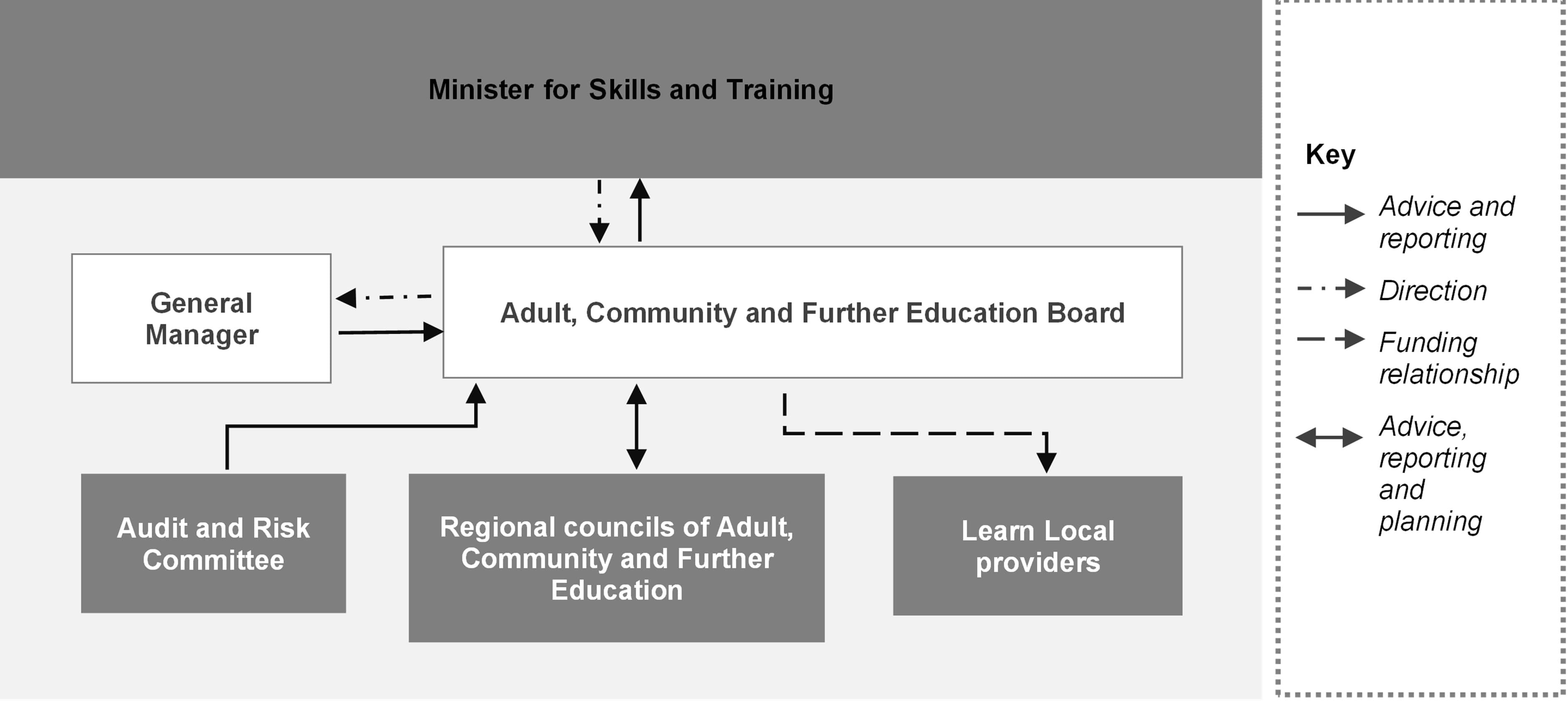
Organisational structure
Figure 1 charts the legislative relationships, governance and accountabilities of the board as at 30 June 2026.
Figure 1: ACFE Board organisational chart, 30 June 2026
Occupational health and safety, incident management and employment and conduct principles
The board does not employ staff.
Information about people and workforce is provided in the department’s annual report for 2025–26 at a whole-of-department level.
Workforce data
Public sector values and employment principles, comparative workforce data, workforce inclusion policies and executive officer data
The board does not employ staff.
Information about people and workforce is provided in the department’s annual report for 2025–26 at a whole-of-department level.
Other disclosures
Financial statements
Declaration in the financial statements
The attached financial statements for the Adult, Community, and Further Education Board have been prepared in accordance with Direction 5.2 of the Standing Directions under the Financial Management Act 1994, applicable Financial Reporting Directions, Australian Accounting Standards including interpretations, and other mandatory professional reporting requirements.
We further state that, in our opinion, the information set out in the comprehensive operating statement, balance sheet, statement of changes in equity, cash flow statement and accompanying notes, presents fairly the financial transactions during the year ended 30 June 2026, and financial position of the board at 30 June 2026.
At the time of signing, we are not aware of any circumstance which would render any particulars included in the financial statements to be misleading or inaccurate.
We authorise the attached financial statements for issue on 9 October 2026.
Ms Laura Lo Bianco-Smith
Accountable Officer
Adult Community and Further Education Board
9 October 2026
Mr Daniel Rodger
Chief Finance Officer
Adult Community and Further Education Board
9 October 2026
Mr John Maddock
Chairperson
Adult Community and Further Education Board
9 October 2026
Victorian Auditor-General’s Office independent auditor’s report
Independent auditor's report
To the Board of the Adult, Community and Further Education Board
Opinion
I have audited the financial report of the Adult, Community and Further Education Board (the entity) which comprises the:
- balance sheet as at 30 June 2026
- comprehensive operating statement for the year then ended
- statement of changes in equity for the year then ended
- cash flow statement for the year then ended
- notes to the financial statements, including material accounting policy information
- declaration in the financial statements.
In my opinion, the financial report presents fairly, in all material respects, the financial position of the entity as at 30 June 2026 and its financial performance and cash flows for the year then ended in accordance with the financial reporting requirements of Part 7 of the Financial Management Act 1994 and Australian Accounting Standards – Simplified Disclosures.
Basis for Opinion
I have conducted my audit in accordance with the Audit Act 1994 which incorporates the Australian Auditing Standards. I further describe my responsibilities under that Act and those standards in the Auditor’s Responsibilities for the Audit of the Financial Report section of my report.
My independence is established by the Constitution Act 1975. My staff and I are independent of the entity in accordance with the ethical requirements of the Accounting Professional and Ethical Standards Board’s APES 110 Code of Ethics for Professional Accountants (including Independence Standards) (the Code) that are relevant to my audit of the financial report in Victoria. My staff and I have also fulfilled our other ethical responsibilities in accordance with the Code.
I believe that the audit evidence I have obtained is sufficient and appropriate to provide a basis for my opinion.
Board’s responsibilities for the financial report
The Board of the entity is responsible for the preparation and fair presentation of the financial report in accordance with Australian Accounting Standards - Simplified Disclosures and the Financial Management Act 1994, and for such internal control as the Board determines is necessary to enable the preparation and fair presentation of the financial report that is free from material misstatement, whether due to fraud or error.
In preparing the financial report, the Board is responsible for assessing the entity’s ability to continue as a going concern, disclosing, as applicable, matters related to going concern and using the going concern basis of accounting unless it is inappropriate to do so.
Auditor’s responsibilities for the audit of the financial report
As required by the Audit Act 1994, my responsibility is to express an opinion on the financial report based on the audit. My objectives for the audit are to obtain reasonable assurance about whether the financial report as a whole is free from material misstatement, whether due to fraud or error, and to issue an auditor’s report that includes my opinion. Reasonable assurance is a high level of assurance, but is not a guarantee that an audit conducted in accordance with the Australian Auditing Standards will always detect a material misstatement when it exists. Misstatements can arise from fraud or error and are considered material if, individually or in the aggregate, they could reasonably be expected to influence the economic decisions of users taken on the basis of this financial report.
As part of an audit in accordance with the Australian Auditing Standards, I exercise professional judgement and maintain professional scepticism throughout the audit. I also:
- identify and assess the risks of material misstatement of the financial report, whether due to fraud or error, design and perform audit procedures responsive to those risks, and obtain audit evidence that is sufficient and appropriate to provide a basis for my opinion. The risk of not detecting a material misstatement resulting from fraud is higher than for one resulting from error, as fraud may involve collusion, forgery, intentional omissions, misrepresentations, or the override of internal control.
- obtain an understanding of internal control relevant to the audit in order to design audit procedures that are appropriate in the circumstances, but not for the purpose of expressing an opinion on the effectiveness of the entity’s internal control.
- evaluate the appropriateness of accounting policies used and the reasonableness of accounting estimates and related disclosures made by the Board.
- conclude on the appropriateness of the Board’s use of the going concern basis of accounting and, based on the audit evidence obtained, whether a material uncertainty exists related to events or conditions that may cast significant doubt on the entity’s ability to continue as a going concern. If I conclude that a material uncertainty exists, I am required to draw attention in my auditor’s report to the related disclosures in the financial report or, if such disclosures are inadequate, to modify my opinion. My conclusions are based on the audit evidence obtained up to the date of my auditor’s report. However, future events or conditions may cause the entity to cease to continue as a going concern.
- evaluate the overall presentation, structure and content of the financial report, including the disclosures, and whether the financial report represents the underlying transactions and events in a manner that achieves fair presentation.
I communicate with the Board regarding, among other matters, the planned scope and timing of the audit and significant audit findings, including any significant deficiencies in internal control that I identify during my audit.
Kevin Chan
as delegate for the Auditor General of Victoria
Melbourne
14 October 2026
Comprehensive operating statement
For the financial year ended 30 June 2026
Notes | 30 June 2026 | 30 June 2025 | |
|---|---|---|---|
| Income from transactions |
|
|
|
| Grants | 2.1 | 26,194 | 27,092 |
| Services received free of charge | 2.1 | 6,389 | 7,496 |
| Total income from transactions |
| 32,583 | 34,588 |
| Expenses from transactions | |||
| Grants and transfer payments | 3.1 & 3.2 | (28,366) | (29,275) |
| Operating expenses | 3.1 | (2,177) | (2,866) |
| Services provided free of charge | 3.1 | (6,389) | (7,496) |
| Total expenses from transactions |
| (36,932) | (39,637) |
| Net result from transactions (net operating balance) |
| (4,349) | (5,049) |
| Other economic flows included in net result |
|
|
|
| Net loss on financial instruments | 6.1 | (5) | (58) |
| Total other economic flows included in net result |
| (5) | (58) |
| Net result |
| (4,354) | (5,107) |
| Other economic flows – other comprehensive income |
|
|
|
| Items that will not be reclassified to net result |
|
|
|
| Total other economic flows – other comprehensive income |
| – | – |
| Comprehensive result |
| (4,354) | (5,107) |
The above comprehensive operating statement should be read in conjunction with the accompanying notes.
Balance sheet
As at 30 June 2026
Notes | 30 June 2026 | 30 June 2025 | |
|---|---|---|---|
| Assets |
|
|
|
| Financial assets |
|
|
|
| Receivables | 4.1 | 21,270 | 28,685 |
| Total financial assets |
| 21,270 | 28,685 |
| Non-financial assets |
|
|
|
| Prepayment |
| 4 | – |
| Total non-financial assets |
| 4 | – |
| Total assets |
| 21,274 | 28,685 |
| Liabilities |
|
|
|
| Payables | 4.2 | 243 | 3,300 |
| Total liabilities |
| 243 | 3,300 |
| Net assets |
| 21,031 | 25,385 |
| Equity |
|
|
|
| Accumulated surplus |
| 21,031 | 25,385 |
| Net worth |
| 21,031 | 25,385 |
The above balance sheet should be read in conjunction with the accompanying notes.
Note:
- The board does not hold a bank account with any financial institution given funding is held centrally with the portfolio department.
- Receivables and payables are stated inclusive of the amount of GST receivable or payable.
Cash flow statement
For the financial year ended 30 June 2026
| 30 June 2026 | 30 June 2025 |
|---|---|---|
| Cash flows from operating activities |
|
|
| Receipts |
|
|
| Receipts from government | 33,570 | 30,074 |
| GST recovered from ATO | 3,068 | 2,910 |
| Total receipts | 36,638 | 32,984 |
| Payments |
|
|
| Payments of grants and other expenses | (36,638) | (32,984) |
| Total payments | (36,638) | (32,984) |
| Net cash flows from/(used in) operating activities | – | – |
| Net increase/(decrease) in cash and cash equivalents | ||
| Cash and cash equivalents at the beginning of the financial year | – | – |
| Cash and cash equivalents at the end of the financial year | – | – |
Note: Cash flows are presented under operating activities on a gross basis, noting GST paid or recovered from the Australian Taxation Office (ATO) is included within the portfolio department’s business activity statement.
Statement of changes in equity
For the financial year ended 30 June 2026
| Accumulated surplus | Contributions | Total |
|---|---|---|---|
| Balance at 30 June 2024 | 30,492 | – | 30,492 |
| Net result for the year | (5,107) | – | (5,107) |
| Balance at 30 June 2025 | 25,385 | – | 25,385 |
| Net result for the year | (4,354) | – | (4,354) |
| Balance at 30 June 2026 | 21,031 | – | 21,031 |
Notes to the financial statements
Appendices
List of abbreviations
| AAG | Advertising Approval Group |
| AAS | Australian Accounting Standards |
| AASB | Australian Accounting Standards Board |
| ACE | adult and community education |
| ACFE | adult, community and further education |
| AM | Member of the Order of Australia |
| ARC | Audit and Risk Committee |
| ATO | Australian Taxation Office |
| CAE | Centre for Adult Education |
| CEO | chief executive officer |
| CFO | chief financial officer |
| ETR Act | Education and Training Reform Act 2006 (Vic) |
| FC | Finance Committee |
| FLP | Family Learning Partnerships |
| FOI | freedom of information |
| FOI Act | Freedom of Information Act 1982 (Vic) |
| FRD | Financial Reporting Direction |
| GAICD | Graduate of the Australian Institute of Company Directors |
| GST | goods and services tax |
| IBAC | Independent Broad-based Anti-corruption Commission |
| ICT | information and communications technology |
| LLNED | language, literacy, numeracy, employability and digital |
| MBA | Master of Business Administration |
| OAM | Medal of the Order of Australia |
| OLY | Olympian |
| OVIC | Office of the Victorian Information Commissioner |
| PID Act | Public Interest Disclosures Act 2012 (Vic) |
| PPPC | Planning, Prioritisation and Performance Committee |
| PQF | pre-accredited quality framework |
| PSM | Public Service Medal |
| RTO | registered training organisation |
| SD | Standing Directions |
| SPF | Social Procurement Framework |
| TAFE | technical and further education |
| the board | Adult, Community and Further Education Board |
| the department | Department of Jobs, Skills, Industry and Regions |
| U3A | University of the Third Age |
| VAEAI | Victorian Aboriginal Education Association Inc. |
| VAGO | Victorian Auditor-General's Office |
| VALBEC | Victorian Adult Literacy Basic Education Council |
| VDC | VET Development Centre |
| VET | vocational education and training |
| VRQA | Victorian Registration and Qualifications Authority |
Contacts
For queries relating to the ACFE Board, please contact:
ACFE Board
GPO Box 4509
Melbourne VIC 3001
Telephone: 03 9651 9999
Email: apw.executive.office@djsir.vic.gov.au
For queries relating to Learn Local training, please contact:
Sector Engagement and Intelligence
ACFE Board
GPO Box 4509
Melbourne VIC 3001
Telephone: 03 9651 9999
Email: sector.engagement@djsir.vic.gov.au