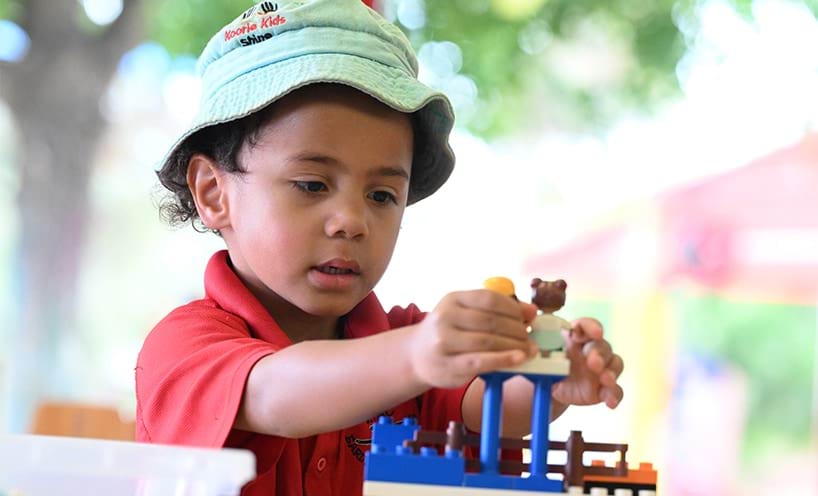
National Aboriginal and Torres Strait Islander Children’s Day is celebrated every 4 August. It’s a chance to celebrate Aboriginal and Torres Strait Islander children and learn about the impact that culture, family and community have on their lives.
This year’s theme is Living Our Truth. It celebrates the voices, stories and knowledge of Aboriginal and Torres Strait Islander children, families and communities. It recognises the importance of truth-telling in building identity, belonging and cultural strength. It also honours the role of Elders and community in passing knowledge to the next generation.
Each year, to celebrate, we work with our principal partner in First Nations education, the Victorian Aboriginal Education Association Incorporated (VAEAI), to develop and distribute a resource kit to more than 3,000 Victorian government-funded kindergartens.
Kindergartens will receive the resource by mail in time for Children’s Day.
About Children’s Day
Children’s Day is an initiative of the Secretariat of National Aboriginal and Islander Child Care(opens in a new window). The day celebrates the strengths and culture of Aboriginal and Torres Strait Islander children across Australia.
It began in 1988 amid protests during Australia’s bicentennial year. The date was chosen because it was historically used as a communal birthday for Stolen Generations children who were taken from their families at a young age and did not know their actual birth dates. (Source: SNAICC)
As Victorians, the journey of truth-telling through the Yoorrook Justice Commission is an opportunity to reflect on the stories and experiences of First Nations people. It highlights the important role that education plays in healing and moving forward.
Supporting cultural safety
Resources are available to help enact the vision of Marrung (PDF, 1.10 MB) at your services.
You can learn more about building cultural safety and self-determination in education by registering to attend one of the online facilitated modules offered by the department. For more information, refer to: Building change together: First Nations learning suite(opens in a new window).
You can also refer to the VAEAI’s Koorie Early Years Best Practice and Protocols – a practitioner’s guide (PDF, 12.7 MB). This provides guidance on how to incorporate Aboriginal perspectives into early childhood services and protocols to help provide a welcoming environment for Koorie families.
Find out more
For more information, refer to:
Updated