- Date:
- 13 Oct 2026
Responsible body’s declaration
The Hon. Ben Carroll MP
Premier
Gabrielle Williams MP
Deputy Premier
Minister for First Peoples
Ingrid Stitt MP
Special Minister of State
The Hon. Paul Edbrooke MP
Minister for Multicultural Affairs
Dear Premier and Ministers,
In accordance with the Financial Management Act 1994, I am pleased to present the Department of Premier and Cabinet’s (DPC) annual report for the year ending 30 June 2026.

Chris Barrett
Secretary
21 October 2026
Secretary's foreword
The Department of Premier and Cabinet has continued to operate in a financially responsible way in 2025–26, while supporting the government of the day and delivering key services to the Victorian community.

We have responded to the economic challenges facing the Victorian Public Service (VPS) by working closely with our colleagues in the Department of Treasury and Finance on a range of savings initiatives for VPS departments and public sector entities. This has included implementing the recommendations of the independent VPS review published in December 2025, which was led by former DPC Secretary Helen Silver AO.
As a First Minister’s department, we have played an integral role in supporting the government on a range of independent inquiries, including the Rapid Child Safety Review and Victoria’s contribution to the federal Royal Commission on Antisemitism and Social Cohesion. We have also continued to provide impartial policy and legal advice to the Premier and the ministers supported by DPC, as well as administrative support to the Cabinet.
DPC led the development of Victoria’s China Strategy: For a New Golden Era, which was launched during then Premier Jacinta Allan’s visit to China in September 2025. The strategy guides our economic and cultural engagement with China over the next five years.
The 2025–26 reporting period was a momentous one for Statewide Treaty, which formally commenced in December 2025 when the Statewide Treaty Act 2025 became law. This led to the establishment of Gellung Warl in May 2026, the independent entity leading the strengthened relationship between Victoria’s First Peoples and the State.
The State Apology to First Peoples was also delivered in December 2025 before a joint sitting of Parliament. DPC played a key role in supporting this historic occasion, as the former Premier acknowledged the impacts upon First Peoples since colonisation.
Victoria’s Multicultural Review was published in September 2025, with DPC playing a leading role in supporting the government’s response. This included preparing legislation to establish a new entity, Multicultural and Multifaith Victoria, which will consolidate the functions of the Multicultural Affairs branch in DPC and the Victorian Multicultural Commission.
We delivered a number of events of state significance in 2025–26, including multicultural events, state memorial services and state funerals. This included the State Funeral Service for Neale Daniher, the 2025 Australian of the Year, which was held at the MCG in June 2026.
DPC also commenced preparations for the 2026 caretaker period and state election by drafting and publishing the Guidelines on the Caretaker Conventions. The guidelines were published in June 2026 and apply to all Victorian public sector employees.
I welcome the release of our 2025–26 Annual Report and acknowledge the important contributions of every DPC staff member during the reporting period. I particularly acknowledge my predecessor as Secretary, Jeremi Moule, who led DPC and the Victorian Public Service from 2020 to 2026 with great distinction through a period of significant change for both the department and the VPS more broadly.
Chris Barrett
Secretary
Section 1: Strategic framework and governance
Vision and strategic objectives
DPC’s vision, mission, values and objectives.
Departmental objectives
The objectives that DPC seeks to achieve over the medium term
Governance and organisational structure
DPC's governance and organisational structure
Organisational chart
DPC organisational chart from the 2025-26 DPC Annual Report
Group functions
The 5 groups DPC delivers its core programs and services through
Portfolio entities
DPC's portfolio entities
Senior executives
DPC's senior executive group comprising the head of each of DPC’s groups
Governance committees
DPC's governance committees
Inclusive and safe workplace policies
DPC's inclusive and safe workplace policies
Vision and strategic objectives
Our vision
DPC’s vision is to be recognised and respected leaders in whole-of-government policy and performance.
Our mission
DPC’s mission is to support the people of Victoria by:
- helping government achieve its strategic objectives
- providing leadership to the public sector to improve its effectiveness
- promoting collaboration across government to drive performance and improve outcomes.
Our values
DPC upholds the public sector values as enshrined in the Public Administration Act 2004 by demonstrating:
Accountability
Our employees demonstrate accountability by:
- working to clear objectives in a transparent manner
- accepting responsibility for our decisions and actions
- seeking to achieve best use of resources
- submitting ourselves to appropriate scrutiny.
Human rights
Our employees respect and promote the human rights set out in the Charter of Human Rights and Responsibilities by:
- making decisions and providing advice consistent with human rights
- actively implementing, promoting and supporting human rights.
Impartiality
Our employees demonstrate impartiality by:
- making decisions and providing advice on merit without bias, caprice, favouritism or self-interest
- acting fairly by objectively considering all relevant facts and applying fair criteria
- implementing government policies and programs equitably.
Integrity
Our employees demonstrate integrity by:
- being honest, open and transparent in our dealings
- using powers responsibly
- reporting improper conduct
- avoiding any real or apparent conflicts of interest
- striving to earn and sustain public trust of a high level.
Leadership
Our employees demonstrate leadership by actively implementing, promoting and supporting these values.
Respect
Our employees demonstrate respect to their colleagues, other public officials and members of the Victorian community by:
- treating them fairly and objectively
- ensuring freedom from discrimination, harassment and bullying
- using their views to improve outcomes
on an ongoing basis.
Responsiveness
Our employees demonstrate responsiveness by:
- providing frank, impartial and timely advice to the Victorian Government
- providing high-quality services to the Victorian community
- identifying and promoting best practice.
Additionally, our employees adhere to the behaviours in the Code of Conduct for Victorian Public Sector Employees demonstrating our commitment to these values. |
Departmental objectives
Departmental objectives
The objectives that DPC seeks to achieve over the medium term are:
Stronger policy outcomes for Victoria
- Lead whole-of-government economic and social policy delivery and reform.
- Lead the public sector response to significant state and Commonwealth issues, policy challenges and projects.
- Deliver policies and programs that promote fairness, inclusion and the participation of Victoria’s culturally diverse communities.
First Peoples in Victoria are strong and self-determining
- Improve outcomes and services for First Peoples through prioritising actions to enable self-determination, including advancing Treaty, protecting and promoting cultural rights, recognising land and native title rights, and responding to the Yoorrook Justice Commission’s final reports.
- Address trauma, supporting healing and address systemic injustice.
- Provide culturally safe systems and services and transfer power and resources to communities.
Improved public administration and support for the Victorian public service
- Foster and promote a high-performing public service.
- Ensure effective whole-of-government performance and outcomes and support the effective administration of government.
- Protect and promote the values of good governance, integrity and accountability across the public service to foster and maintain public trust in government.
- Maintain compliance with government advertising and communication guidelines to support effective financial management, probity, and accountability of government advertising.
Governance and organisational structure
Portfolio ministers during 2025–26
Premier

Hon Jacinta Allan MP
Ms Allan was appointed Premier of Victoria on 27 September 2023 and served as Victoria’s Head of Government until 28 July 2026, when the Hon. Ben Carroll MP was appointed Premier.
DPC advises and supports the Premier in leading whole-of-government policy, delivery and reform, and improve public administration.
The Premier is the main channel of communication between the Governor, as Head of State, and Cabinet, and between the Victorian Government and other state and territory governments and the Commonwealth Government.
As at 30 June 2026, DPC’s administrative offices – the Office of the Governor, the Office of the Chief Parliamentary Counsel and the Violence Reduction Unit – were part of the Premier’s portfolio.
Deputy Premier

The Hon. Ben Carroll MP
Mr Carroll was appointed Deputy Premier of Victoria on 2 October 2023 and held the role until 28 July 2026, when Gabrielle Williams MP was appointed Deputy Premier.
In addition to his DPC portfolio responsibilities, Mr Carroll served as Minister for Education and Minister for WorkSafe and the TAC. The TAC is the Transport Accident Commission.
Minister for First Peoples
DPC supports the Minister for First Peoples to advance self-determination, progress Treaty and truth, and ensure the protection and recognition of cultural heritage and land rights for First Peoples across Victoria.

The Hon Natalie Hutchins MP
Ms Hutchins was appointed Minister for Treaty and First Peoples on 2 October 2023 and held the portfolio until 17 December 2025.
In addition to her DPC responsibilities, Ms Hutchins served as Minister for Government Services, Minister for Prevention of Family Violence and Minister for Women.

The Hon Ros Spence MP
Ms Spence was appointed Minister for Treaty and First Peoples on 17 December 2025. The portfolio was renamed First Peoples on 15 April 2026. Ms Spence held the portfolio until 28 July 2026, when Gabrielle Williams MP was appointed Minister for First Peoples.
In addition to her DPC responsibilities, Ms Spence was Minister for Roads and Road Safety and Minister for Community Sport.
Special Minister of State
Minister for Multicultural Affairs

Ingrid Stitt MP
Ms Stitt was appointed Minister for Multicultural Affairs on 2 October 2023 and held the portfolio until 15 April 2026 when the portfolio was retitled to Multicultural and Multifaith Victoria. Minister Stitt held the portfolio until 28 July 2026, when the Hon. Paul Edbrooke MP was appointed Minister for Multicultural Affairs.
Ms Stitt was appointed Special Minister of State on 15 April 2026.
DPC advises and supports:
- the Multicultural Affairs portfolio to promote fairness, inclusion and participation among Victoria’s multicultural and multifaith communities, and ensure all Victorians can enjoy the benefits of a multicultural society
- the Special Minister of State portfolio to oversee integrity, accountability and transparency frameworks across the Victorian Government.
In addition to her DPC responsibilities, Ms Stitt served as Minister for Mental Health and Minister for Ageing.
Minister for Men and Boys

The Hon. Paul Edbrooke MP
Mr Edbrooke was appointed Minister for Men and Boys on 15 April 2026 and held this role until 28 July 2026.
Other members of parliament
Steve McGhie MP, Cabinet Secretary
Mr McGhie served as the Cabinet Secretary between July 2022 and April 2026. DPC’s Cabinet and Governance Branch provides support to the Cabinet Secretary for the operations of the Cabinet process and coordinating the work of the Cabinet.
Tim Richardson MP, Parliamentary Secretary to the Premier; Cabinet Secretary
Mr Richardson supported the Premier’s portfolio responsibilities and was the Parliamentary Secretary between December 2024 and 15 April 2026. Mr Richardson served as the Cabinet Secretary from 15 April to 30 June 2026.
Chris Couzens MP, Parliamentary Secretary for First Peoples
Ms Couzens has been the Parliamentary Secretary for First Peoples since June 2022.
Iwan Walters MP, Parliamentary Secretary for Multicultural Affairs and Multifaith Victoria
Mr Walters was the Parliamentary Secretary for Multicultural Affairs from December 2024 to April 2026, and Parliamentary Secretary for Multicultural and Multifaith Victoria from April to August 2026. Since August 2026, Mr Walters has been the Parliamentary Secretary for Multicultural Affairs.
Changes to the department during 2025-26
There were no machinery of government changes during 2025–26 that impacted DPC.
Internal organisational changes were implemented during the year to better align functions with DPC’s strategic priorities and to support the effective delivery of programs and services.
DPC’s group structure, as at 30 June 2026, is outlined on the following pages.
Organisational chart
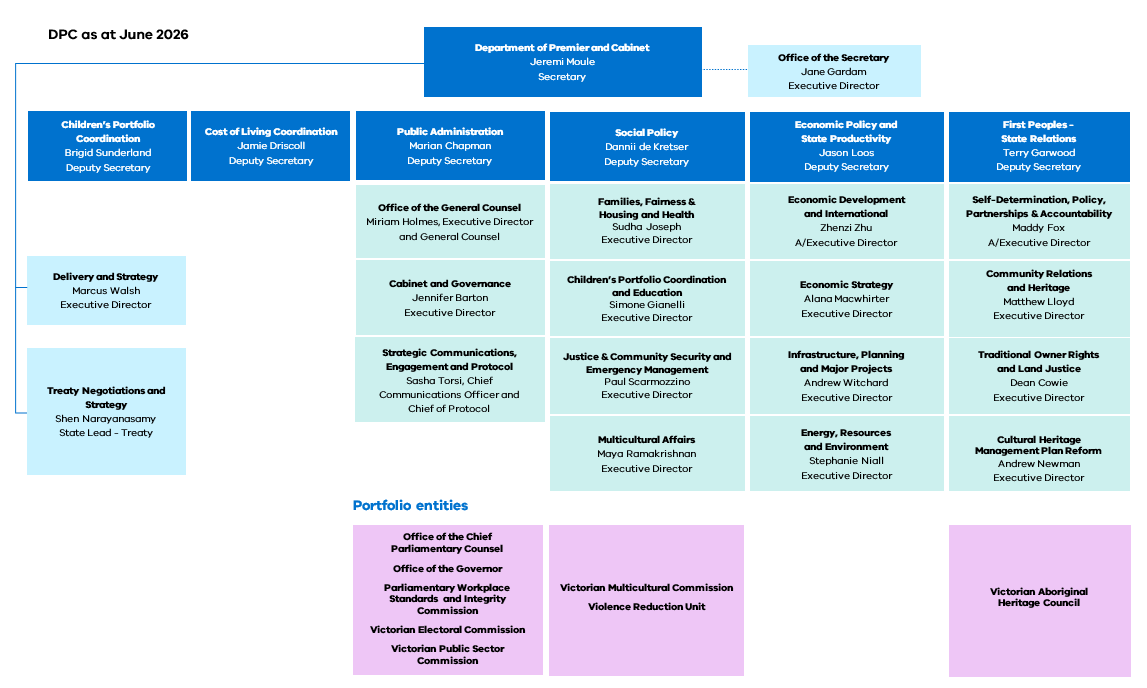
Group functions
In 2025–26, DPC delivered its core programs and services through the following groups:
- Economic Policy and State Productivity
- First Peoples – State Relations
- Public Administration
- Social Policy.
Other key functions of the department are:
- Delivery and Strategy
- Treaty Negotiation and Strategy.
Economic Policy and State Productivity
The Economic Policy and State Productivity group leads the provision of economic policy advice to the Premier. The group collaborates with relevant departments and agencies to ensure a coordinated, whole-of-government approach to policy and projects in the areas of economic development, including fiscal policy; regional development; local government; regulatory reform; consumer affairs; gambling and racing; WorkSafe and TAC; insurance; government services; community sport; creative industries; economic growth and jobs, including trade and investment; industry and advanced manufacturing; skilled migration; outdoor recreation; skills and TAFE; small business; employment; tourism, sport and major events; industrial relations; international engagement; medical research; defence; data centres and artificial intelligence; transport infrastructure; public transport; roads; ports and freight; planning; precincts; building; agriculture; resources; energy; climate action; water and the environment.
First Peoples – State Relations
The First Peoples – State Relations group is responsible for an extensive program of nation-leading work in the areas of cultural rights, land justice, self-determination, treaty and truth with First Peoples. The group recognises Victoria’s First Peoples as the self-determining drivers of Aboriginal affairs in Victoria and is committed to building ongoing, just and respectful relationships between self-determining First Peoples and the State.
Public Administration
The Public Administration group supports the Victorian Government and the Secretary by providing expertise in public sector governance, strategic communications, protocol, intergovernmental relations, and legal and legislative advice. The group also provides whole-of-government leadership and coordination across these areas. Its work places a particular focus on the institutions and systems of Westminster government, including the operation of Cabinet and the Victorian Executive Council. The group maintains key relationships with the Office of the Governor, the Parliament of Victoria, the Office of the Chief Parliamentary Counsel, the Victorian Electoral Commission (VEC) and the Victorian Public Sector Commission (VPSC). The group also leads DPC’s strategic relationship with the Department of Government Services (DGS) as the department’s shared corporate services provider.
Social Policy
The Social Policy group provides social policy advice on key services for Victorians, including: health, mental health, education, justice and policing services, emergency management, children’s services, disability services, family violence and women’s safety matters, social housing and homelessness programs, and policies and programs that build belonging and support social cohesion. The group does this in partnership with the departments responsible for these services. The group also leads and supports the Multicultural Affairs portfolio. In addition, the group maintains key relationships with the Victorian Multicultural Commission and the Violence Reduction Unit. In 2026, the group also supported the Men and Boys portfolio.
Other key functions
Delivery and Strategy
The Delivery and Strategy branch tracks and supports delivery of priority government initiatives and works with policy branches to support strategic policy development of cross-portfolio issues. The branch comprises Delivery Tracking, which monitors implementation of government priority initiatives and commitments and supports identification and resolution of risks and blockages; and Strategy, a project-based team that works closely with DPC’s policy branches and delivery agencies, employing innovative approaches to resolve priority policy and delivery issues.
Treaty Negotiations and Strategy
The Treaty Negotiations and Strategy branch is responsible for progressing the Victorian Treaty process in line with Treaty legislation and the Treaty Negotiation Framework, including embedding a whole-of-government approach to Statewide Treaty implementation and Traditional Owner Treaty negotiations. The branch also administers a Treaty Education program to build understanding of Treaty across the Victorian Public Service (VPS) and oversees Treaty public communications.
Portfolio entities
DPC has obligations to its portfolio entities, which are listed in this section, under the Financial Management Act 1994, associated Standing Directions 2018 and the Public Administration Act 2004.
DPC is classified as a public service body under the Public Administration Act, along with administrative offices and the VPSC, a DPC portfolio entity.
Administrative offices
Administrative offices are established in relation to a department. DPC is responsible for the general conduct and the effective, efficient and economical management of the functions and activities of these administrative offices.
Office of the Chief Parliamentary Counsel
The Office of the Chief Parliamentary Counsel transforms policy into legislation, advises the government on its legislative program, and drafts legislation for the government and the Parliament of Victoria. The office is responsible for ensuring up-to-date public access to authorised Victorian legislation and is also the Government Printer for Victoria, responsible for publishing Victorian legislation.
Office of the Governor
The Office of the Governor provides support to the Governor of Victoria in carrying out all aspects of their official duties for the benefit of the Victorian community and maintains Government House and its grounds as a unique heritage community asset. The Governor’s role as the constitutional Head of State of Victoria includes constitutional and ceremonial duties, community and international engagement, as well as official municipal and regional visits.
Violence Reduction Unit
Established in December 2025, the Violence Reduction Unit (VRU) focuses on stopping violence before it starts. The VRU coordinates crime prevention programs and works directly with the community and young people to connect them to and find new evidence-based solutions to address the underlying causes of violence through early intervention.
Public entities and special bodies
DPC also supports its ministers in their responsibilities for the following public entities and special bodies.
Public entities — includes statutory authorities, state-owned enterprises, state-owned corporations and formally constituted advisory boards that perform functions outside of the VPS. DPC supports the Premier, the Special Minister of State, the Minister for First Peoples, and the Minister for Multicultural Affairs in their responsibilities for the following public entities:
- Victorian Aboriginal Heritage Council
- Victorian Multicultural Commission
- Victorian Public Sector Commission
- VITS Language Loop.
Special bodies — operate with a high degree of independence from government departments and are created under separate legislation. DPC supports the Premier in their responsibilities for the Parliamentary Workplace Standards and Integrity Commission and the VEC, a special body which includes the Electoral Boundaries Commission.
Senior executives
DPC is led by the Secretary who reports to the Premier and serves as the head of the VPS. The department is managed by a senior executive group comprising the head of each of DPC’s groups. The administrative office heads are also key senior executives within the DPC portfolio.
Secretary
Jeremi Moule was appointed as Secretary of DPC and head of the VPS in October 2020.
Prior to this role, he was the Deputy Secretary, Governance Policy and Coordination at DPC, a position he held since August 2018.
Jeremi has held various executive positions in the VPS over a 20-year period, was the CEO of a registered training organisation and started his working life as a journalist. He has worked extensively in regional Victoria, where he also lives.
He holds a journalism degree from the University of South Australia and is a Graduate of the Australian Institute of Company Directors.
Deputy Secretary, Public Administration
Marian Chapman was appointed as Deputy Secretary, Public Administration at DPC in December 2025. Prior to joining DPC, Marian held a number of Deputy Secretary roles at the Department of Justice and Community Safety (DJCS), where she led complex criminal and civil law policy and legislative reforms across the justice system. Marian served as Chief Counsel and was responsible for integrity and assurance functions as well as the operational functions of Fines Victoria and the Sheriff’s Office of Victoria.
Marian has extensive public sector experience in Australia and the United Kingdom. She has also held senior roles at the Department of Treasury and Finance, including General Counsel, corporate and commercial advisory roles. Marian holds a Bachelor of Laws from the University of Melbourne.
In 2024 Marian became a Victorian Fellow of the Institute of Public Administration Australia, and was recognised in the Top 50 Public Sector Women by the Institute of Public Administration Australia (Victoria) in 2017.
Joshua Puls MVO was Deputy Secretary, Public Administration during the reporting period until December 2025.
Deputy Secretary, Economic Policy and State Productivity
Jason Loos PSM commenced as Deputy Secretary, Economic Policy and State Productivity at DPC in June 2023.
Jason was previously Deputy Secretary at the Department of Treasury and Finance, where he was responsible for providing strategic commercial, financial and risk management advice to the Victorian Government.
Jason has over 26 years’ experience in the commercial structuring and delivery of infrastructure projects, including extensive experience in delivering Public Private Partnerships and the corporate governance oversight of significant Victorian Government business enterprises.
Jason has a Master of Business Administration from RMIT and an honours degree in economics from Monash University.
Jason is a Graduate of the Australian Institute of Company Directors and in 2023 was named a Victorian Fellow of the Institute of Public Administration Australia.
In 2024, Jason was awarded the Public Service Medal for his significant contribution to infrastructure policy and projects across Victoria.
Deputy Secretary, First Peoples – State Relations
Terry Garwood PSM commenced as Deputy Secretary, First Peoples – State Relations at DPC in July 2023.
Terry has been an officer of the Victorian and Australian public services for over 45 years. Previously, Terry was the Deputy Secretary,
Land Services in Victoria’s Department of Transport and Planning (DTP).
Terry has been responsible for health, aged care, disability services, child protection, public housing programs, freight and logistics, and Aboriginal affairs in a variety of senior executive roles.
Terry served on the Museums Board of Victoria for 9 years and the Centenary of Federation Committee for 5 years and is a Fellow of the Institute of Public Administration Australia. He was appointed as a Director of the Ports Victoria Board on 1 October 2022.
Terry was awarded the Public Service Medal in 2018 for distinguished public service. He was also inducted into the Victorian Aboriginal Honour Roll in 2018 recognising his leadership, passion and commitment to community development.
Terry holds a Diploma of Arts (General Studies) and a Graduate Diploma in Education (Secondary) from Latrobe University and was awarded a Distinguished Alumni medal in 2002.
Deputy Secretary, Social Policy
Dannii de Kretser was appointed as Deputy Secretary, Social Policy at DPC in December 2025, and prior to this acted in the role between October and December 2025.
Previously Dannii was Deputy CEO at Homes Victoria. She has held numerous senior roles across multiple departments, including in Human Services, Education, Justice and previously in Premier and Cabinet to lead the response to the Royal Commission into Family Violence. She has worked as a client partner supporting digital and operational transformation in the private sector.
Dannii’s public sector career started over 23 years ago supporting public housing communities as a Housing Officer. She has held senior operational, policy, strategy, and program roles across social services with a focus on improving the lives of Victorians.
Dannii holds an Executive Masters in Public Administration through the Australian and New Zealand School of Government (University of Melbourne) and a Bachelor of Arts (Honours) from Monash University. She has been recognised in the Top 50 Public Sector Women by the Institute of Public Administration Australia and has received a National Emergency Medal.
Dr Emma Cassar PSM was Deputy Secretary, Social Policy during the reporting period until October 2025.
Deputy Secretary, Children’s Portfolio Coordination
Brigid Sunderland commenced as Deputy Secretary, Children’s Portfolio Coordination at DPC in January 2025. Brigid has had an extensive public sector career with a strong emphasis on social policy and service delivery reform and outcomes.
Prior to joining DPC, Brigid was Secretary of the Department of Families, Fairness and Housing (DFFH) and before that served in executive positions in the DJCS.
Brigid has previously held senior positions in both the public and private sectors including the Commonwealth Attorney-General’s Department. Prior to joining the public sector, Brigid practised as a lawyer in several international and Australian law firms.
Brigid holds degrees in Law and Political Science and a Master of Public Policy and Management.
In 2017 she was named one of the Top 50 Public Sector Women by the Institute of Public Administration Australia (Victoria) and in 2022, a Victorian Fellow of the Institute of Public Administration Australia.
Deputy Secretary, Cost of Living Coordination
Jamie Driscoll commenced as Deputy Secretary, Cost of Living Coordination at DPC in April 2026.
Prior to joining DPC, Jamie served as Deputy Chief Executive Officer at Court Services Victoria, where he led continuous improvement of service delivery and drove reforms and efficiencies across the Victorian court system.
Jamie has also held senior roles at the Department of Treasury and Finance (DTF), including as Deputy Secretary, Budget and Finance, where he oversaw the delivery of the State Budget and provided advice to government on fiscal strategy, financial management, consolidated reporting, and public sector workplace agreements. Jamie has also held senior roles across the Victorian and ACT Governments.
Jamie holds a Bachelor of Economics and a Bachelor of Laws, along with a Graduate Diploma of Legal Practice from the Australian National University, and a Master of Applied Finance from Kaplan.
Chief Parliamentary Counsel, Office of the Chief Parliamentary Counsel
Jayne Atkins commenced as the Chief Parliamentary Counsel of the Office of the
Chief Parliamentary Counsel (OCPC) on
19 January 2022. From 2013 she was Deputy
Chief Parliamentary Counsel and Subordinate Legislation Manager, having joined OCPC in March 1991 after 4 years at the State Trustees as a solicitor. Jayne has over 30 years' experience drafting bills and drafting, settling and advising on subordinate legislation, where she has a particular interest.
Official Secretary of the Office of the Governor
Jonathan Burke commenced as the Official Secretary of the Office of the Governor in August 2022. Jonathan’s experience spans the government, not-for-profit and tertiary education sectors. His government experience includes several appointments in DPC and DJCS.
Jonathan has served four Governors of Victoria, including as Deputy Official Secretary and now, Official Secretary.
He holds degrees in Arts and Law from Monash University and has an Executive Master of Public Administration from the Australia and New Zealand School of Government (ANZSOG) and the University of Melbourne.
Governance committees
Board of Management
The Board of Management comprises DPC’s senior-level executive officers who:
- provide organisation oversight
- provide strategic direction
- ensure DPC is operating in a fiscally and environmentally sustainable manner
- ensure DPC is meeting changing community needs and government priorities.
- As of 30 June 2026, DPC’s Board of Management members were:
- Jeremi Moule, Secretary
- Marian Chapman, Deputy Secretary, Public Administration
- Dannii de Kretser, Deputy Secretary, Social Policy
- Jamie Driscoll, Deputy Secretary, Cost of Living Coordination
- Terry Garwood PSM, Deputy Secretary, First Peoples – State Relations
- Jason Loos PSM, Deputy Secretary, Economic Policy and State Productivity.
In 2025–26 the Board of Management fulfilled its mandate to provide organisational oversight and strategic direction, meeting 12 times.
The Board of Management has the following committees:
- Budget and Finance — acts as an advisory body for DPC’s Board of Management and provides strategic oversight of DPC’s budget and finances and identifies priorities and challenges. The committee promotes DPC’s drive for improved financial sustainability through the effective oversight and allocation of financial resources.
- Self-determination and Reform — supports DPC to progress the significant reform underway in the Treaty and First Peoples portfolio. The committee also performs a key role in improving internal systems, policies and processes to enable self-determination, including facilitating action in line with whole-of-government commitments.
- People Committee — provides leadership and support to DPC in delivering people and culture related outcomes. The committee supports the Board by overseeing implementation of initiatives that are a priority for DPC.
Audit and Risk Committee
The Audit and Risk Committee provides independent assurance and advice on the effectiveness of DPC’s financial management systems and controls, performance, stability, compliance with laws and regulations and risk management. It also oversees the department’s internal audit program.
The committee reports to DPC’s Secretary and is established in line with the Standing Directions under the Financial Management Act.
During 2025–26, the committee met five times to acquit its legislative charter obligations to the Secretary by:
- monitoring the quality of reporting on financial performance
- reviewing the quality of DPC’s annual financial report and report of operations and providing attestations to the Secretary
- monitoring the outcomes of the external audit process of the annual financial report
- monitoring DPC’s responses to the outcomes of VAGO performance audits
- appraising the effectiveness and efficiency of DPC’s systems and controls for financial management, performance and sustainability
- reviewing processes designed to ensure that DPC complies with the requirements of the Financial Management Act, Standing Directions and instructions, including updates on the resolution of any reported non-compliances
- endorsing the internal audit plan, monitoring delivery of the internal audit program and reviewing reports on completed internal audit reviews
- monitoring progress on completion of recommendations arising from internal and external audit activity
- monitoring the effectiveness of DPC’s risk management program.
As of 30 June 2026, the committee comprised the following members:
- Deirdre Blythe (Chair, independent member)
- Rachel Thomson (independent member)
- Michael Everett (independent member)
- Genevieve Overell (independent member)
- Marian Chapman (departmental member).
Executive Remuneration Committee
DPC’s Executive Remuneration Committee’s role is to ensure that a consistent and rigorous approach is taken to setting and adjusting executive remuneration across DPC. The committee reviews all appointments to executive roles within DPC, manages the executive officer cap for DPC and ensures fairness and budget considerations are considered in determining the remuneration of DPC executives.
The specific responsibilities of the committee are to:
- manage DPC’s Senior Executive Service remuneration
- ensure the remuneration of all DPC executives is appropriate to DPC business needs and is in line with DPC’s executive gender pay principles, and recommend adjustments to assure transparency and fairness
- ensure that DPC has sustainable executive staffing levels that are appropriate to DPC business needs and meet labour sustainability cap targets within its funding envelope
- ensure all processes and information related to recruitment and executive remuneration adhere to the public sector values, particularly concerning merit, equity and transparency
- report to the VPSC annually (and on request) details of executive employment in DPC and its portfolio entities.
Inclusive and safe workplace policies
Occupational health and safety
DPC is committed to maintaining a safe, healthy and supportive workplace that protects and promotes the health, safety and wellbeing of all employees. This commitment is underpinned by compliance with relevant legislation, regulations, standards and codes, and is supported by a culture of shared responsibility in which employees and leaders actively contribute to the continuous improvement of health, safety and wellbeing outcomes.
Aligned with the Victorian Public Service Leading the Way strategy, DPC fosters a culture of high safety standards that supports a holistic and inclusive approach to staff physical and mental wellbeing.
Vision: A workforce that demonstrates both physical and psychosocial safe practices in all aspects of our work. Mission: To develop a holistic, values-aligned, integrated approach to health, safety and wellbeing. |
DPC continues to strengthen a supportive and robust safety culture that promotes both physical and psychosocial safety within the workplace for all employees.
As part of this culture, DPC places particular focus on psychological safety by identifying and reducing psychosocial hazards and risks in the workplace.
During 2025–26, DPC enhanced a range of health, safety and wellbeing initiatives to support staff.
New policies, procedures and supporting documentation were also introduced to strengthen the management of psychosocial hazards in the workplace. Risk assessments continue to be enhanced with the introduction of the Psychological Health Regulations 2025. In addition, DPC promoted mental wellbeing through targeted initiatives and training, supported by its employee assistance program provider, Converge International.
Incident management
There were no notifiable incidents reported across DPC in 2025–26. Notifiable incidents are those required to be reported to WorkSafe Victoria under occupational health and safety legislation.
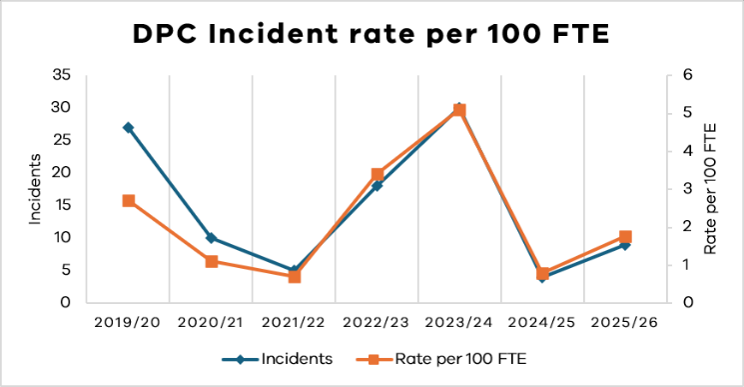
The overall incident rate increased from 0.8 per 100 FTE in 2024–25 to 1.7 per 100 FTE in 2025–26, with 9 incidents reported during the year. This increase may reflect improved awareness of psychosocial hazards and reporting processes, which may have led to increased reporting of issues that might previously not have been raised. Figure 1 shows this trend.
DPC’s performance against OHS management measures is outlined in Section 6, Appendix 3: Occupational health and safety data.
Commitment to public sector values and workforce integrity
The Public Administration Act established the VPSC to enhance public sector efficiency, effectiveness and capability while advocating for professionalism and integrity. In alignment with the VPSC’s employment standards, DPC has implemented policies and practices that ensure fair treatment, provide career opportunities and facilitate the early resolution of workplace issues.
DPC actively educates employees on avoiding conflicts of interest, handling offers of gifts and addressing misconduct. The department is committed to upholding principles of merit and equity in staff appointments. Recruitment processes are designed to ensure that all applicants are assessed fairly and consistently against key selection criteria and other relevant accountabilities, without discrimination.
Employees are also accurately classified in workforce data collections. For a detailed breakdown of DPC’s workforce data, refer to Section 6, Appendix 2: Workforce data.
Workforce inclusion policy
DPC are committed to providing a workplace which is safe, inclusive, and respectful.
This year we introduced our Diversity, Equity and Inclusion (DEI) Strategy 2025–29 which outlines our strategic vision to create a diverse, equitable and inclusive workplaces where all people feel like they belong and are treated with dignity and respect.
The strategy builds on our previous work and aligns where possible with the department’s obligations under the Gender Equality Act 2020.
The Strategy was developed following extensive research and consultation including Executive Leadership group briefings, a desktop review of whole of Victorian Government DEI strategies and research, analysis of 2024 People Matter Survey data by diversity, a series of staff workshops and playback sessions, focus groups with staff networks (including the Combined Enablers Network) and interviews with DEI Executive Champions.
The priority diverse cohorts under the Strategy include:
- Disability Access and Inclusion
- LGBTIQA+ Inclusion
- Cultural Diversity
- Gender Equality.
The strategic vision is underpinned by five key focus areas which are:
- Visible leadership and accountability for DEI
- Attracting, developing, and retaining a diverse and talented workforce
- Ensure equity in the workplace
- Creating culturally safe and respectful workplaces
- Measuring, monitoring and reporting on DEI strategy.
Each focus area has dedicated actions and outcomes. In line with the Corporate Shared Services function, the strategy outlines a clear governance and accountability framework for implementing the strategy.
Gender equality
DPC recognises the importance of gender diversity within its workforce and is committed to strategies that promote opportunities for all employees, including those who identify as gender diverse. As at the end of June 2026, women held 55.1% of these positions.
During 2025–26, DPC developed its new Gender Equity Action Plan which includes strategies aligned to the Commission’s gender equality indicators. The plan followed extensive consultation with various stakeholders including the Board of Management, staff, the DPC People Committee, and the Community and Public Sector Union (CPSU). It recognises that gender equality is strengthened when it reflects the diversity of our people, including Aboriginality, age, disability gender identity, race, religion, and sexual orientation and when all employees feel safe, valued, and supported.
DPC’s new Gender Equity Action Plan builds on the progress and achievements of the previous plan and has been developed in partnership with our staff and leaders. DPC is strongly committed to building an organisation where gender does not determine access to opportunity, recognition, and career progression.
Disability inclusion and employment
In early 2026, DPC launched the Diversity, Equity and Inclusion Strategy 2025–29 which sets out how we will continue to strengthen inclusion and support a culture where people feel valued and supported. In addition, in collaboration with DGS, DPC has:
- Reduced barriers to persons with a disability obtaining and maintaining employment by promoting and educating employees and managers on the Common Workplace Adjustment Policy
- Promoted other internal and external training and awareness opportunities to build confidence in recruiting, managing, and working with employees with disability
- Maintained an Executive Champion for Disability who regularly meets with members of the Enablers Network (a staff network for persons with a disability, their carers and allies) as a forum that represents the needs, interests, and concerns of employees with lived experience of a disability
- Continued to support DPC’s LGBTIQA+ staff and their allies through the DPC / DGS LGBTIQA+ Network and the work of the DPC Executive Champion for LGBTIQA+ Inclusion
- Established an Executive Champion for Cultural Diversity who sponsors the DPC Multicultural Staff Network, which brings together culturally diverse staff and allies to connect, share experiences and ideas, and help build a more inclusive workplace.
During 2025–26, DGS Corporate Shared
Services supported DPC’s commitments by:
- reviewing various policies with an
inclusive lens - embedding disability and other diversity considerations in manager tools, learning resources and supports.
Workforce data showed that 2.0% of DPC employees had disclosed a disability in 2025–26, compared to 2.6% in 2024–25. Separately however, the 2026 People Matter Survey reported that 10.0% of staff identified as having a disability. This discrepancy is likely due to the anonymity of survey responses. DPC remains committed to fostering a culture where staff feel comfortable sharing diversity information to better inform future workplace inclusion strategies.
Aboriginal and Torres Strait Islander staff inclusion and employment
DPC is committed to improving the recruitment and retention of Aboriginal and Torres Strait Islander staff by fostering a culturally safe workplace, strengthening cultural capability and providing flexible and progressive career opportunities. Barring Djinang is the Victorian public sector’s five-year Aboriginal employment strategy, which sets a target of 2.0% Aboriginal employment across the sector.
In 2025–26, DPC exceeded this target, with 3.5% of staff identifying as Aboriginal and/or Torres Strait Islander. In the 2026 People Matter Survey, 4.0% of respondents disclosed they were Aboriginal and/or Torres Strait Islander.
Workforce inclusion policy progress
The table below1 outlines DPC’s progress against key workforce inclusion targets, relating to gender profiles at the executive level, employment of people with disability, and employees who identify as Aboriginal and/or Torres Strait Islander. Figures are drawn from payroll data as at the end of the last full pay period in June each year.
| Workforce Inclusion Policy initiative | Target | 2025–26 | 2024–25 |
| Gender profile at executive levels | Representation of at least 50% women in executive officer roles | 55.122 | 57.9 |
| People with disability | People with disability at DPC increases to 12% by 2025 | 1.73 | 2.0 |
| Aboriginal and/or Torres Strait Islander staff | Barring Djinang has adopted an Aboriginal employment target of 2% for the Victorian public sector | 3.04 | 3.5 |
Notes:
1. This table excludes Yoorrook Justice Commission staff.
2. DPC's representation of women at the executive level decreased primarily due to relatively higher rate of executive women choosing to leave the department for employment with another VPS employer.
3. DPC's percentage of staff with disability decreased due to unrelated individual employee departures which DPC was unable to offset through recruitment during the reporting period.
4. DPC's Aboriginal and/or Torres Strait Islander staffing levels decreased proportionally between June 2025 to June 2026, reflecting staff departures associated with organisational change processes undertaken in 2026 in DPC's First Peoples - State Relations group under clause 11 of the VPS Enterprise Agreement 2024.
Compliance with the Carers Recognition Act
DGS Corporate Shared Services supports DPC in taking practical measures to meet obligations under the Carers Recognition Act 2012 (the Act). These include:
- Considering the care relationships principles set out in the Act when setting policies and providing services, for example:
- A DGS Common Policy on flexible work, which ensures flexible work arrangements are embedded within DGS’ working culture (in line with requirements under the Gender Equality Act) and are available to all staff for any reason including supporting employees with family and caring responsibilities
- Embedding a hybrid working model to support diversity, inclusion and a more equitable workplace
- Ongoing provision of the Parental Leave Transition Support Coaching Program.
- Ensuring our staff have an awareness and understanding of the care relationship principles set out in the Act, for example:
- Championing the Enablers Network, a network run by persons with a disability for persons with a disability, with an executive sponsor, which is open to all staff including carers and allies
- Providing support to all employees through the Peer Support Program and the Employee Assistance Program.
Section 2: Key initiatives and performance measures
Progress towards achieving departmental objectives
DPC’s achievements over the past year, in alignment with our overarching departmental objectives
Performance against output performance measures
This section details the outputs delivered by DPC, with the performance measures and associated costs for each output. It presents the actual performance results against output targets over the year ending 30 June 2026.
Progress towards achieving departmental objectives
This section outlines DPC’s key achievements over the past year, aligned with our overarching departmental objectives. The initiatives highlighted are primarily drawn from the DPC Corporate Plan 2025–29 and are grouped by output to demonstrate how each contributes to the delivery of our objectives.
This section also reports on performance against departmental objective indicators, providing insight into DPC’s overall effectiveness in delivering services.
Departmental objectives, indicators and outputs
DPC’s medium-term objectives, objective indicators and linked outputs as of 30 June 2026 are:
| Objectives | Indicators | Outputs |
| Stronger policy outcomes for Victoria |
| Economic policy advice and support |
| Social policy advice and intergovernmental relations | ||
| Multicultural affairs policy and programs | ||
| Ensuring First Peoples in Victoria are strong and self-determining |
| Self-determination policy and reform advice and programs |
| Traditional Owner engagement and cultural heritage management programs | ||
| Improved public administration and support the Victorian public service |
| Executive Government advice and services |
| Public sector administration advice and support | ||
| Chief Parliamentary Counsel services | ||
| State electoral roll and electoral events |
Stronger policy outcomes for Victoria — progress
This objective leads whole-of-government economic and social policy delivery and reform. It leads the public sector response to significant state and Commonwealth issues, policy challenges and projects. It delivers policies and programs that promote fairness, inclusion and participation of Victoria’s culturally diverse communities.
First Peoples in Victoria are strong and self-determining — progress
First Peoples in Victoria are strong and self-determining — progress
Improved public administration and support for the Victorian Public Service — progress
Improved public administration and support for the Victorian Public Service — progress
Stronger policy outcomes for Victoria — progress
This objective leads whole-of-government economic and social policy delivery and reform. It leads the public sector response to significant state and Commonwealth issues, policy challenges and projects. It delivers policies and programs that promote fairness, inclusion and participation of Victoria’s culturally diverse communities.
Key initiatives
In 2025–26, DPC delivered the following key initiatives in support of the departmental objective for Stronger Policy Outcomes for Victoria.
Output: Economic policy advice and support
Provide advice on current and future economic challenges and opportunities, including to support the implementation of the government’s Fiscal Strategy, whole-of-government savings and efficiencies initiatives, and Economic Growth Statement
In 2025–26, DPC continued to work closely with DTF and other departments to support delivering the government’s five-step fiscal strategy and policy priorities in a challenging economic climate. This included advising on budget and fiscal strategy, industrial and economic growth opportunities, employment, training and skills, higher education, consumer affairs, local government, industrial relations, building reform, and transport policy and infrastructure delivery.
In 2025–26 DPC worked with DTF on government's commitments in the Economic Growth Statement to reduce regulatory burden for businesses by $500m by 2030 and to halve the number of business regulators by 2030. DPC has worked with DTF on a number of regulatory consolidations including establishment of Safe Food Victoria on 1 July 2026, absorbing Recycling Victoria into the Environment Protection Authority on 1 July 2026, moving the regulatory functions of Parks Victoria into the Conservation Regulator in June 2026 and transferring Mine Land Rehabilitation Authority functions to Department of Energy, Environment and Climate Action (DEECA) on 1 April 2026.
Support reform of the government’s budgeting and financial management framework, and encourage efficient government operations, including through the digitising of government services
DPC worked closely with DTF to support the passage of the Financial Management Legislation Amendment Act 2025, which strengthens the financial accountability of departments and agencies and reinforces the government’s focus on fiscal sustainability and accountability. The Act amends the Financial Management Act 1994.
DPC worked with DGS to support centralisation of IT services, and the delivery of new products and services through Service Victoria.
Provide advice to support the efficient operation of markets, while maintaining appropriate protections for consumers
DPC has worked with other government departments to improve the design of government regulations to protect consumers, while minimising the costs to businesses and the community. In 2025–26, DPC worked with DGS to deliver government’s key commitments for consumer reforms through the Consumer Legislation Amendment Bill 2026, introduced into Parliament in early June 2026. The Bill will improve outcomes for Victorian renters and increase protections for residents of residential parks; increase transparency and availability of information for consumers in the property market and increase professionalism in the sector; improve the experience of Victorians living in owners corporations, particularly those experiencing financial hardship; and strengthen consumer protections and modernise regulations related to motor car trading.
DPC also worked closely with DJCS to strengthen powers to address the sale of illicit tobacco, including the introduction of closure powers.
Provide advice to deliver a renewable energy transition and achieve emissions reduction across the economy to reach the government’s target of net-zero emissions by 2045, support delivery of the government’s environmental and agricultural priorities and maintain the sustainable use of Victoria’s natural resources in a changing climate
DPC has worked with DEECA to progress implementation of Victoria’s Renewable Energy Transformation Agreement with the Commonwealth Government to deliver renewable energy investment in the state.
DPC has also supported DEECA to progress the development of the offshore wind industry in Victoria and provided support to the Premier as a shareholder of the State Electricity Commission.
DPC has also worked closely with DEECA to support the release of key government policy documents, including the:
- Victoria’s Climate Change Strategy
2026–2030 and second set of five-year emissions reduction sector pledges for
2026–2030, released in November 2025 - Gas Substitution Roadmap update, released in December 2025
- Victorian Energy Jobs Plan, released in June 2026
- Guide for consumers ‘Your Energy, Your Savings: Understanding Victoria’s energy transition and how you can benefit’, released in June 2026.
In 2025–26 DPC continued to provide secretariat support to the Premier’s Drought Response Taskforce. This advisory group led consultation and engagement with drought impacted farmers, communities, councils and stakeholders, and provided advice to government. With advice from the Taskforce, DPC worked closely with DEECA and DTF to provide up to $146.5 million for drought support. This funding has been critical to help farmers and communities prepare, respond and recover from drought.
Support delivery of the government’s transport infrastructure program and coordinate a range of reforms to improve mobility around the state, and the safety, liveability and sustainability of Victoria’s built environment, including implementation of Victoria’s Housing Statement
DPC continued to monitor the implementation of the government’s transport infrastructure program during 2025–26 including the opening of the Metro Tunnel and West Gate Tunnel. DPC continues to provide advice on the Suburban Rail Loop, North East Link and Melbourne Airport Rail projects.
DPC continued to monitor and provide advice to government on infrastructure delivery challenges, including material cost increases and labour supply shortages. DPC has also continued to work with DTP to support the implementation of the new public transport ticketing contract, management of contracts for delivery of new public transport rolling stock and the re-contracting of operations and maintenance for Melbourne’s Metropolitan train franchise.
In 2025–26, DPC monitored the implementation of Victoria’s Housing Statement and associated initiatives. These initiatives are being delivered by relevant ministers and their portfolio departments. DPC monitored housing completion data and worked with DTP to support delivery of the Train and Tram Zone Activity Centre program and the Planning Amendment (Better Decisions Made Faster) Act 2026. DPC also worked with relevant stakeholders to implement the government’s building reform program, including development and passage of the Building and Plumbing Administration and Enforcement Act 2026, and associated regulations.
DPC also supported DGS to deliver the commitment in Victoria’s Housing Statement
to establish a Portable Rental Bond Scheme allowing renters to transfer their existing bond to a new rental agreement, ensuring renters don't pay a double bond when they want to move rental properties. DPC worked with DGS on design of an efficient, fair and financially sustainable scheme. The scheme launched on
1 July 2026 following legislative and regulatory changes and system deployment.
Support delivery of the government’s industry and innovation agenda, including driving investment in jobs, and providing advice to deliver the government’s skills and workforce priorities
DPC supported delivery of the Economic Growth Statement, the Premier’s Business Council and the Premier’s Business Forums which were held between September to December 2025. DPC worked closely with DJSIR and DTF in the establishment and operationalisation of Innovation Victoria – a single agency for entrepreneurs, founders and investors that consolidates Breakthrough Victoria and LaunchVic. DPC also worked closely with the Department of Jobs, Skills, Industry and Regions (DJSIR), DTF and other departments to deliver a range of modern industry policies and announcements, including the AI Mission Statement and the Sustainable Data Centre Action Plan. DPC continued working with DJSIR on delivering and monitoring work in the health and medical research, mRNA, defence, data centres and artificial intelligence spaces.
In 2025–26 DPC also worked closely with DTF and DJSIR to respond to local skills and workforce needs, progress reforms to improve Victoria’s Skills and TAFE system, and create job opportunities through small business, employment, and migration initiatives. DPC supported implementing the National Skills Agreement including several Centres of Excellence, maintaining an effective Free TAFE for priority courses initiative, and responding to critical skills and workforce needs. DPC has provided strategic guidance on how Victoria’s Skills and TAFE system can better support workforces in government priorities, such as clean energy, care economy and housing.
In 2025–26, DPC developed the government's work from home legislation, including wide consultation, analysis of the survey on the reforms, and preparation of legislation for introduction into Parliament.
DPC also worked closely with DTF to improve workers’ rights in the workplace through reforms regarding the use of non-disclosure agreements relating to sexual harassment in workplaces, and progress work to protect workers from risks introduced by Artificial Intelligence (AI).
Advise, deliver and facilitate engagement with international stakeholders in Victoria and overseas, particularly by the Premier, Deputy Premier and the Governor, that promote trade and investment, continue to build the state’s vibrant multicultural fabric and achieve other priority whole-of government objectives
DPC supported whole-of-government cooperation with key international partners to promote trade, investment, cultural, and people to-people ties that benefit all Victorians. In
2025–26, this included the release of Victoria's China Strategy: For a New Golden Era, informed by extensive consultation across government, industry, and community and an official visit by the Premier. DPC also supported follow-on activities associated with Victoria’s India Strategy: Our Shared Future 2025–30 (released in 2024–25).
These whole-of government strategies outline a strategic framework guiding Victoria's engagement with key international partners. DPC also facilitated engagement in Victoria and overseas between international dignitaries and senior Victorian leaders, including the Premier, Deputy Premier, and Governor of Victoria.
Output: Social policy and intergovernmental relations
Support the delivery of key social policy reforms to improve outcomes for Victorians
In 2025–26, DPC supported the independent Rapid Child Safety Review and reform of the child safety system. It worked with the Department of Families, Fairness and Housing, the Department of Education (DE), DGS and independent bodies including the Social Services Regulator and the Commission for Children and Young People to progress recommendations from the independent Rapid Child Safety Review and deliver recommended reforms. This included new legislation, expanded powers for the Social Services Regulator and a new independent early childhood regulator.
In 2025–26, DPC supported the Forum for Truth and Recognition to deliver its report. This was a key commitment arising from the response to the Board of Inquiry into historical child sexual abuse in Beaumaris Primary School and certain other government schools. Following the Forum for Truth and Recognition’s Final Report, DPC supported the Government’s response to the Forum’s recommendation, including preparing for the Parliamentary Apology to victims and survivors of historical child sexual abuse in Victorian government schools.
DPC supported DFFH to introduce the Supporting Stable and Strong Families scheme. This new whole of public sector model creates shared responsibility for departments to improve outcomes for at-risk children, young people, care leavers and families.
DPC continued to support Victoria’s social housing agenda, including through the Big Housing Build, and through work to secure funding from the Commonwealth for more social and affordable housing.
Support the Department of Health to deliver key commitments to improve the health and wellbeing of Victorians.
DPC has continued to support the Department of Health deliver key commitments to improve the health and wellbeing of all Victorians. Highlights in 2025–26 included supporting the Department of Health to:
- open the new Footscray Hospital on 18 February 2026 and the Peninsula University Hospital (formerly Frankston Hospital) on 20 January 2026
- open three new Community Hospitals in Craigieburn, Cranbourne and Mernda between August and November 2025
- refine and release the refreshed Victorian Palliative and End of Life Care Framework 2026–36 during National Palliative Care Week, which was in May 2026
- develop legislative amendments to the Voluntary Assisted Dying Act 2017 to remove unnecessary barriers to accessing Voluntary Assisted Dying services, improve clarity for practitioners, strengthen safety measures and make the system fairer and more compassionate
- develop the new Health Safeguards for People Born with Variations in Sex Characteristics Act 2026, which will prevent permanent non-consensual treatments that can be deferred, to avoid harm for people with variations in sex characteristics
- release the Specialist Care Reform Blueprint, to make sure Victorians get the specialist care they need, faster and closer to home
- release the Bridging the Gender Pain Gap reportfollowing the Inquiry into Women's Pain, alongside actions to address key recommendations, including the rollout of 'green whistle' pain relief for IUD procedures, development of a statewide Women's Pain Standard, and establishment of a dedicated children and adolescent pain clinic at the Royal Children's Hospital from 2026.
DPC also supported VIDA Health to progress major infrastructure projects including the new Melton Hospital which is now in construction and on track for completion in 2029, and the Austin Hospital completing early works and commencing main works in January 2026.
Worked with the Department of Education to deliver key education and early childhood policy reforms
In 2025–26, DPC continued to support the delivery of key education policy reforms, strengthening the education system for children and young people. These reforms included:
- supporting DE to continue negotiations for a new Victorian Government Schools Agreement, Victorian Early Childhood Teachers and Educators Agreement and Early Education Employees Agreement.
- continuing to inform the design and ongoing implementation of the Best Start, Best Life early childhood education agenda. This includes rolling out universal Three-Year-Old Kinder across Victoria, delivering more hours of Four-Year-Old Kinder across rural and regional areas and to priority cohorts, delivering Free Kinder for families with three and four-year-olds, and delivering new government owned and operated early learning and childcare centres in the communities where they are needed most.
- supporting whole-of-government system design for new Thriving Kids supports for children under eight with developmental delay and autism.
During the reporting period, DPC also continued to support the Children’s Portfolio Coordination to provide strategic policy and project coordination for initiatives supporting children aged 0 to 12 and their families. This included helping launch a new digital version of the green book.
Support the ongoing implementation of recommendations from the Royal Commission into Victoria’s Mental Health System, as well as the progression of alcohol and other drug-system reforms
In 2025–26, DPC continued to support the ongoing implementation of mental health reform initiatives from the Royal Commission into Victoria’s Mental Health System. The 10-year reform journey from the Royal Commission has reached the five-year mark and has helped to build a system that delivers timely, community-based care for all Victorians.
Key achievements for DPC in 2025–26 included supporting the Department of Health’s landmark mental health and alcohol and other drugs services and reform, such as:
- operationalising seven new Mental Health and Wellbeing Locals supporting Victorians experiencing mental ill health or psychological distress
- continuation of the Statewide Action Plan, including implementation of the Victorian Take-Home Naloxone Program.
Support the Department of Justice and Community Safety with key reforms in the justice system, respond to emergencies and strengthen the disaster resilience and safety of all Victorians.
In 2025–26, DPC continued to support implementation of reforms across the Victorian justice system, including strengthened youth offences and additional police and Protective Service Officers. DPC also supported the increase in justice system capacity in response to strengthened bail laws, to address the increases in accused adults and young people on remand.
In December 2025, the Violence Reduction Unit was established as an Administrative Office of DPC to tackle and prevent violent youth crime through early intervention.
DPC also supported the Victorian Government’s response to the antisemitic terror attack in Bondi in December 2025, including:
- supporting the introduction of legislation to strengthen firearms laws as agreed at National Cabinet
- helping in the appointment of the Commissioner for Preventing and Countering Violent Extremism
- acceleration of implementation of a civil anti-vilification scheme.
In ensuring the safety of Victorians, DPC facilitates the Foreign Interference Community of Practice which builds capacity across the Victorian Government regarding foreign interference, mis and disinformation and cyber threats. DPC also continued to provide protective security measures for government personnel through coordinating security clearance vetting for VPS personnel, and the Member of Parliament Residential Security Program.
Output: Multicultural affairs
policy and programs
Tackle racism, promote multiculturalism and celebrate diverse communities to help build belonging for Victorians
In 2025–26, DPC continued to implement Victoria's anti-racism strategy 2024–29, which sets out a five-year plan for preventing racism and faith-based discrimination in our state.
The Anti-Racism Taskforce has continued to provide expert guidance on the strategy's implementation.
Under Victoria's anti-racism strategy, DPC has supported delivery of whole-of-government flagship actions, including:
- administering the Local Anti-Racism Initiatives Grants Program, distributing $2.44 million over 2024–25 and 2025–26 to support grassroots responses to racism through activities across art, media, sport and education
- a statewide anti-racism campaign in community sport, launched in June 2026
- a program to build the capacity of frontline police to take human-rights centred approaches when engaging with First Peoples and multicultural communities
- an anti-racism scheme to build the capability of workplaces to be culturally safe and inclusive, led by the Victorian Equal Opportunity and Human Rights Commission.
In 2025–26, DPC also continued to implement funding to support community-led initiatives to combat antisemitism and Islamophobia.
DPC chaired the Local Escalation and Help Group, bringing together members of the Jewish Community, Victorian Government agencies and Victoria Police. The group met seven times during the reporting period, creating a direct communication channel between the Jewish community and the public service (including Victoria Police) on critical issues.
DPC also convened the Multicultural and Multifaith Law Reform Consultative Committee to provide advice on relevant legislative reform across all portfolios.
During the year DPC commenced implementation of actions arising from Victoria’s Multicultural Review. This included consultation with over 380 community members, sector representatives and advisory forums on the development of Victoria’s first Multicultural Strategy, and the Multicultural Victoria Amendment Bill 2026.
DPC administered a range of grant programs that strengthen and promote multiculturism in Victoria including established programs such as the Multicultural Festivals and Events program, the Multicultural Seniors Support program and the Multicultural Infrastructure and Security program.
In response to Victoria’s Multicultural Review, DPC has launched the Multicultural Capacity Building Program, providing funding to multicultural community organisations to strengthen their capacity and continue to create positive change for communities.
The list of allocations to multicultural community organisations can be found in Section 6, Appendix 4.
Progress towards achieving
the objective
The objective indicators, associated data sets and descriptions below show how the following outputs contribute to DPC’s Stronger Policy Outcomes for Victoria departmental objective:
- Economic policy advice and support
- Social policy and intergovernmental relations
- Multicultural affairs policy and programs.
Objective indicator: Advice contributes to the achievement of government policies and priorities relating to economic and social outcomes, intergovernmental relations, and emergency management
Throughout 2025–26, DPC’s policy advice to the Premier, Cabinet, portfolio ministers, and key governing boards and committees continued to shape the government’s agenda in the medium- to long-term:
- Advice supported the development of the Government response to the Independent Review of the Victorian Public Service.
- DPC advice supported the government to respond to the national fuel crisis, including appointing a State Energy Controller and amendments to the Fuel Emergency Act 1977.
- DPC also continued efforts to support victim survivors of family violence, and to strengthen prevention of family violence through delivering the Strengthening Women’s Safety Package.
- DPC played a key role supporting Victoria’s negotiation of, and agreement to, several high value intergovernmental agreements with the Commonwealth. Of particular note were:
- the renewed, five-year National Health Reform Agreement, agreed at National Cabinet on 30 January 2026, that will see increased funding to Victorian hospitals.
- a renewed, five-year agreement from 2025–26 on Family, Domestic and Sexual Violence Responses to continue critical frontline services
- the amendments to the National Firearms Agreement, agreed at National Cabinet in August 2026, to improve public safety by strengthening the safe and responsible possession and use of firearms.
- DPC coordinated Victoria’s engagement with the Royal Commission on Antisemitism and Social Cohesion, including leading key governance forums, supporting responses to Notices and supporting hearings.
- During the January 2026 bushfires, DPC supported arrangements to ensure the provision of resources for relief and recovery programs to affected communities, businesses, wildlife and parklands.
- Facilitated senior officials-level exercises of key emergency management functions.
- Advice supported the centralisation of IT services under DGS.
DPC’s advice to the Government also supported the Victorian response to the H5N1 bird flu outbreaks in 2025 and 2026 and coordination with other states, territories and the Commonwealth.
DPC’s contribution to this objective indicator is also demonstrated through the following economic data.
DPC coordinated intergovernmental negotiations relating to health and disability reforms. On 30 January 2026, National Cabinet agreed to a Heads of Agreement on the National Health Reform Agreement, NDIS reforms and Foundational Supports.
| Data set | Unit | 2022–23 | 2023–24 | 2024–25 | 2025–26 |
| Gross state product growth1 | per cent | 3.6 | 1.4 | 1.1 | 1.75(est)2 |
| Employment growth – Victoria – Seasonally adjusted3 | per cent | 3.7 | 2.2 | 1.9 | 1.0 |
1 Australian Bureau of Statistics (2024–25 financial year) Australian National Accounts: State Accounts (Catalogue number 5220.0; Table 1: Gross State Product, Chain volume measures and current prices; Series ID: A2336356T), ABS website, accessed 5 August 2026.
2 2026–27 Victorian Budget Paper No. 2 — Strategy and Outlook (Table 2.1: Victorian economic forecasts)
3 Australian Bureau of Statistics Labour Force, Australia (Catalogue 6202.0; Table 003: Labour force status by Sex, Victoria; Series ID: A84423349V), ABS website, accessed 5 August 2026.
Objective indicator: Decrease experiences of discrimination
Throughout 2025–26, DPC’s policy advice to the Premier, Cabinet, portfolio ministers, and key governing boards and committees continued to shape the government’s agenda in the medium- to long-term by:
- Implementation of Victoria’s Anti-Racism Strategy 2024–29, with oversight and guidance from the Anti-Racism Taskforce.
- Continuing to support community-led initiatives to tackle Islamophobia and antisemitism.
- Supporting Local Anti-Racism Support Networks, as part of the government’s response to the Inquiry into Anti-Vilification Protections.
- Chairing the Local Escalation and
Help group, bringing together key Jewish community leaders and local and state government representatives to discuss key issues impacting Victoria’s Jewish community. - Enabling the delivery of targeted initiatives under the Victorian African Communities Action Plan, including culturally responsive support for employment, mental health, alcohol and drugs and education, and supporting the Victorian African Communities Committee.
- Supporting Victoria’s engagement with the Commonwealth and other jurisdictions on key matters impacting Victoria’s refugee, asylum seeker and migrant communities, including through whole-of-government submissions to the Commonwealth’s 2025–26 Humanitarian Settlement Program.
- Facilitating intergovernmental policy reform on language services to strengthen equitable access to government supports for culturally and linguistically diverse Victorians.
Despite this work, multicultural and multifaith communities and First Peoples continue to experience racism, discrimination and substantial barriers to full social and economic participation.
The antisemitic terror attack in Sydney in December 2025 deeply impacted the Victorian Jewish communities’ sense of safety. The Islamophobia Register’s Islamophobia in Australia 2023–24 Report highlights that Islamophobia is at the highest rates ever recorded. Local and global events have intensified these experiences, leading to strained interfaith and intercultural connections.
In 2025–26 DPC continued to deliver multi-year funding the Government committed as part of the 2024/25 State Budget to:
- Tackle racism and discrimination to build a safer, fairer and more inclusive state. This included grants to tackle racism at the local level, a new anti-racism campaign for community sport, a program to prevent racism in workplaces and anti-racism training for frontline police.
- Support vital community-led measures to combat antisemitism and Islamophobia.
DPC also supported the delivery of commitments arising from the 2025 Multicultural Review, including implementing a social cohesion values commitment for funding agreements in the Multicultural and Multifaith Victoria ministerial portfolio; establishing a Multicultural Communities Capacity Fund; and investing in a $925,000 Multicultural Museums Program. DPC’s contribution to this objective indicator is also demonstrated through the following data:
| Data set | Unit | 2022–23 | 2023–24 | 2024–25 | 2025–26 |
| Consultations with communities on issues relevant to multicultural and multifaith communities | number | 77 | 79 | 188 | 192 |
First Peoples in Victoria are strong and self-determining — progress
This objective focuses on improving outcomes and services for First Peoples through prioritising actions to enable self-determination, including advancing Treaty, protecting and promoting cultural rights, recognising land and native title rights, and supporting ongoing monitoring and implementation of Yoorrook Justice Commission recommendations. It provides culturally safe systems and services and transfers power and resources to communities. It also focuses on delivering Victoria’s Treaty process through the implementation of the first Statewide Treaty, including the establishment of Gellung Warl, and preparing for Traditional Owner and ongoing Statewide Treaties.
Key intiatives
In 2025–26, DPC delivered the following key initiatives in support of the departmental objective that FirstPeoples in Victoria are Strong and Self-determining.
Output: Self-determination policy and reform advice and programs
Support strong policy outcomes for First Peoples that promote self-determination and address injustice, by driving whole-of- government policy and reform in the First Peoples portfolio
In 2025–26, DPC funded and worked closely with Ngaweeyan Maar-oo, the Koorie Caucus of the Closing the Gap Partnership Forum (Partnership Forum), to action key commitments under the National Agreement on Closing the Gap. These included funding 10 Aboriginal Community Controlled Organisation-led sector strengthening projects developed by Ngaweeyan Maar-oo and its member organisations.
Coordinate implementation across government of the National Agreement on Closing the Gap, including supporting the Partnership Forum on Closing the Gap as the Victorian Government’s formal shared decision-making forum
In partnership with Ngaweeyan Maar-oo, the Koorie Caucus of the Partnership Forum on Closing the Gap, DPC has continued to support the Partnership Forum as the Victorian Government’s formal shared decision-making forum for delivering commitments under the National Agreement on Closing the Gap. This included supporting four meetings of the Partnership Forum in 2025–26.
In 2025–26, DPC continued working with Ngaweeyan Maar-oo to develop Victoria’s new Closing the Gap Implementation Plan, due for release in 2026. The plan outlines coordinated, whole-of-government actions over the next five years to drive progress on Closing the Gap.
Advance Aboriginal self-determination and improved outcomes in line with commitments made by the Victorian Government
In 2025–26, DPC delivered the Victorian Government Aboriginal Affairs Report 2025 which was tabled in Parliament on 18 June 2026. The Report tracks the Government’s progress against commitments under the Victorian Aboriginal Affairs Framework (the Framework), the Self-Determination Reform Framework and the National Agreement on Closing the Gap. The Report demonstrates that performance against the Framework’s 111 measures is varied. Compared to the last reporting period, 24 measures improved, 26 worsened and 8 were stable. There were 30 measures that did not have updated data available, and 23 were unable to be categorised (for example, because the measure is descriptive). Over the longer term, 30 measures have improved, 19 have worsened and 7 remain stable. Thirty-one measures did not have data available and 24 were unable to be categorised.
Support strong policy outcomes for Traditional Owners that promote self-determination and advance Traditional Owner rights
In 2025–26, DPC led work towards implementing recommendations from the First Principles Review of the Traditional Owner Settlement Act 2010 (TOS Act). DPC engaged with the First Peoples’ Assembly of Victoria, consulted with Traditional Owner groups and updated the State’s TOS Act agreement templates, to advance Traditional Owner rights.
Support non-formally recognised Traditional Owner groups to access the independent legal and research services required to gain recognition and activate rights
In 2025–26, DPC continued to fund the First Nations Legal and Research Services (FNLRS) to work with Traditional Owners to achieve legal recognition and prepare for Treaty negotiations.
FNLRS supported Traditional Owners in four areas of Victoria without any legal recognition – mid north-west, central north, northeast and far east Gippsland.
Key activities throughout this period included FNLRS:
- organising numerous meetings and materials to strengthen Traditional Owner groups’ knowledge base and empower their decision-making about Country, culture and community
- producing research reports to inform strong collective identity and connection to culture, with a particular focus on preparing reports needed for native title applications
- providing legal advice and other logistical support, to help advance native title processes
- delivering Treaty-related engagement, communication, and administrative-support activities, consistent with a role FNLRS agreed with Treaty Authority, Self-Determination Fund, and First Peoples Assembly of Victoria.
Support the Minister for First Peoples to respond to native-title claims made in the Federal Court of Australia
In 2025–26, the State of Victoria was the first respondent to the following native title determination applications in the Federal Court:
- Barapa Barapa peoples #1 and #2
- Boonwurrung people
- Carl Rowan
- Dhudhuroa, Waywurru, and Ngurai Illum people
- Eastern Maar/Gunditjmara people (Area C)
- First Peoples of the Millewa-Mallee
- Mid North West Nations
- Taungurung people
- Wamba Wemba people
- Wadawurrung people
- Wuwundjeri Woi-wurrung people.
The First Peoples of the Millewa-Mallee claim was determined by consent on 18 July 2025, with the Federal Court recognising that the First Peoples of the Millewa-Mallee hold native title over Crown land and waters in the north-western corner of Victoria along and south of the Murray River.
This determination was the first time the Federal Court had recognised native title along the Murray River in Victoria and also the first recognition of exclusive possession native title rights in Victoria. The First Peoples of the Millewa-Mallee determination brings Victoria in line with other Australian jurisdictions in recognising exclusive possession native title rights, the highest form of native title recognition available under the Native Title Act.
Recognition and Settlement Agreements (RSAs) under the TOS Act seek to formally acknowledge the rights of Traditional Owners and to establish a framework for the settlement of claims outside of the court system
In 2025–26, DPC continued to implement four existing RSAs with Dja Dja Wurrung, Taungurung, Gunaikurnai, and the Wotjobaluk, Jaadwa, Jadawadjali, Wergaia, and Jupagulk Peoples.
In 2025–26, DPC supported the Government to:
- reach agreement with the Wotjobaluk, Jaadwa, Jadawadjali, Wergaia, and Jupagulk People on an expanded RSA settlement agreement, including a Land Use Activity Agreement
- reach agreement with the Gunaikurnai People on an expanded RSA settlement agreement, including a Natural Resource Agreement
- continue negotiations for new or revised RSAs with Dja Dja Wurrung, Eastern Maar, Gunditjmara and Taungurung peoples.
Lead the whole-of-government response to the Yoorrook Justice Commission (Commission), Australia’s first formal truth-telling inquiry into historical and ongoing injustices experienced by First Peoples in Victoria since colonisation
In 2025–26, DPC continued to play a central role in coordinating the whole-of-government response to the Commission. The Commission concluded in June 2025 with the delivery of its final interim report, Yoorrook for Transformation, and final report and official public record, Yoorrook: Truth be Told. DPC continued to support the State’s commitment to truth-telling by:
- Coordinating whole-of-government consideration and action in response to the Commission’s final reports and recommendations.
- Supporting community engagement with the Commission’s final report and official public record, Yoorrook: Truth Be Told. The Victorian Government funded the distribution of more than 250 printed copies to libraries across the state, and over 130 copies to the First Peoples’ Assembly of Victoria, Aboriginal Community Controlled Organisations and Traditional Owner groups.
Support self-governance and self determination at the Lake Tyers and Framlingham Aboriginal Trusts
In 2025–26, DPC continued to administer the Aboriginal Lands Act 1970 on behalf of the Minister for First Peoples, which regulates and administers the Framlingham and Lake Tyers Aboriginal Trusts.
DPC supported the Trusts to strengthen their governance arrangements and shareholding systems and, in doing so, meet the new standards introduced through implementation of the Phase One recommendations of the 2021 Independent Review. In addition, DPC engaged with Trust shareholders on Phase Two recommendations, which focus on further enhancing governance arrangements.
In 2025–26, DPC oversaw funding agreements to enable the Trusts to provide services to shareholders and residents and to meet statutory obligations under the Aboriginal Lands Act 1970. The agreements supported the delivery of municipal and essential services for the Trusts’ residents, including access to clean drinking water, maintenance of roads, bushfire management, and waste management.
DPC also oversaw a project to replace the Lake Tyers Aboriginal Trust’s jetty. The jetty is critical emergency services infrastructure in a highly bushfire prone area. The new jetty also supports greater access to Lake Tyers, enabling cultural and ecological monitoring to be carried out. At the Framlingham Aboriginal Trust, DPC oversaw a project to deliver critical wastewater and stormwater infrastructure upgrades, which is nearing completion.
Lead Treaty negotiations on behalf of the State of Victoria in line with Treaty legislation and the Treaty Negotiation Framework
In 2025–26, DPC continued to lead Statewide Treaty negotiations on behalf of the State of Victoria with the First Peoples’ Assembly of Victoria Ltd (Assembly). Negotiations in 2025 focused on delivery of a Statewide Treaty Bill to evolve the Assembly Ltd into an ongoing representative body for First Peoples. The Statewide Treaty Bill was introduced into the Victorian Parliament on 9 September 2025 and passed both Houses of Parliament on 30 October.
The Statewide Treaty Act 2025 was given Royal Assent on 13 November 2025. The Statewide Treaty was signed by the Victorian Government and the Assembly on the same day.
On 12 December 2025, DPC supported delivery of ‘Victoria's Treaty: It's Here’, a ceremonial signing and public event at John Cain Arena to celebrate the commencement of the Statewide Treaty.
The Statewide Treaty signals a new relationship between the Victorian Government and First Peoples, based on respect, trust and integrity.
Represent the State in Traditional Owner Treaty negotiations with First Peoples’ Treaty Delegations. Delegations comprise all Traditional Owners seeking to negotiate a Treaty over the area of land and waters identified
Under the Treaty Negotiation Framework, Victoria’s Treaty process includes both an overarching Statewide Treaty and Traditional Owner Treaties. In 2025–26, six Traditional Owner Groups have been registered on the Treaty Authority’s Negotiations Register and four have progressed to the second stage of notifying their intent to form a First Peoples’ Treaty Delegation.
In response to these entries onto the Negotiations Register and in accordance with clause 13.1(a) of the Treaty Negotiation Framework, DPC is leading work on behalf of the State to commence early preparations towards complying with Minimum Standards required to enter into Traditional Owner Treaty negotiations. Accordingly, DPC is working to notify the relevant government departments and bodies as these notifications from the Treaty Authority are received.
Lead whole-of-government engagement to ensure a coordinated and focused approach to Statewide and Traditional Owner Treaties
Throughout Statewide Treaty negotiations, DPC led a coordinated whole-of-government approach, includingclear governance structures and authorisation pathways to ensure Treaty negotiations could progress efficiently, and all parts of the government were engaged to respond to Treaty negotiations.
In the second half of 2025–26 as the focus has shifted to Statewide Treaty implementation,DPC has continued to lead coordination across government, working with Victorian Government departments and Victoria Police to ensure policies and reform proposals align with Treaty, and support early engagement with the First Peoples’ Assembly of Gellung Warl.
Support, monitor and report on the implementation of Treaties post-agreement
In 2025–26, initial work by DPC following the passage of the Statewide Treaty Act 2025 has focused on establishing the processes, systems and guidance required to support the implementation of Statewide Treaty commitments and new obligations in the legislation. This includes:
- supporting the Assembly as they operationalise Gellung Warl from 1 May 2026
- processes to support the tabling of Statements of Treaty Compatibility from 1 May 2026
- supporting Gellung Warl to establish a new First Peoples Infrastructure Fund from 1 July 2026
- supporting the transition of the State’s program of First Peoples’ events to be delivered by Gellung Warl from 1 July 2026
- supporting the relevant Victorian government departments to prepare for the implementation of Immediate Statewide Treaty Reforms, in line with Schedule B of the Statewide Treaty.
On 9 December 2025, DPC supported former Premier Allan to deliver a formal apology to First Peoples in the Victorian Parliament, acquitting a commitment in the Statewide Treaty and a recommendation of the Yoorrook Justice Commission.
Support the Minister for First Peoples to inform the Victorian public about the Treaty process
DPC continues to lead the Victorian Government’s public communications and engagement on Treaty to ensure Victorians have access to up-to-date and accurate information on Treaty. This includes public communications, online resources, and engagement with local councils, community, and industry.
In 2025–26, DPC:
- supported the release of three Joint Statements and other media releases to keep the Victorian public informed on the progress of Treaty negotiations
- continued to deliver its program of information sessions about the Treaty process with local government, community and business leaders, including in Bendigo, Swan Hill, Ballarat, Ringwood and Metropolitan Melbourne partnering with Reconciliation Victoria, and online with the Victorian Farmers Federation and the Victorian Chamber of Commerce and Industry
- maintained the Treaty Victoria website as a central source of information on Victoria Treaty process and negotiations.
Build understanding of Treaty across the Victorian Public Service through a Treaty Education Program
DPC’s Treaty Education Program is aimed at enhancing Treaty literacy across the Victorian public service. As of June 2026, DPC has supported 580 employees of the VPS to undertake at least one of the Understanding Treaty micro-credentials delivered by the University of Melbourne.
Throughout 2025–26,DPC’sTreaty Education program has been updated to reflect the newVictorian Treaty context, including a suite of learning opportunities tailored to different levels of experience and responsibility. Participants have reported increased confidence in engaging with Treaty-related work and a stronger understanding of how Treaty intersects with their roles.
Recognise the achievements of Aboriginal Victorians and celebrate the diversity of Aboriginal culture in Victoria through Aboriginal cultural events and awards
The First Nations cultural events and awards program celebrates the achievements and honours the sacrifices of First Nations people; promotes and celebrates examples of excellence among First Nations communities; provides practical and meaningful opportunities for First Nations communities, the broader Victorian community and the Victorian Government to recognise and celebrate First Nations cultures and histories in Victoria; and strengthens the Victorian Government’s relationship with First Nations Victorians from across the state.
In 2025–26, the Victorian Government delivered four First Nations cultural events and awards, including the Victorian Aboriginal Honour Roll, recognising 10 First Nations leaders for their important contributions to the State; Ricci Marks Awards, recognising the achievements and aspirations of three young First Nations award recipients; the Victorian Aboriginal Remembrance Service, honouring First Nations service men and women; and the NAIDOC State Reception, celebrating First Peoples’ cultures, communities and voices.
The Victorian Government also supported the Victorian NAIDOC Committee to deliver a program of events for NAIDOC Week, including the Victorian NAIDOC Awards, NAIDOC Pride Event, NAIDOC Flag Raising Ceremony and the NAIDOC March.
Under the Statewide Treaty, the responsibility for delivering First Peoples’ recognition and events is transferring to Gellung Warl from 1 July 2026.
Output: Traditional Owner engagement and cultural heritage management programs
Drove and supported strong cultural heritage management and protection under Victoria’s Aboriginal cultural heritage system
In 2025–26, DPC continued to support the protection and management of Victoria’s Aboriginal cultural heritage. DPC administers the regulatory, enforcement and approval processes of the cultural heritage management system under the Aboriginal Heritage Act 2006.
The following statutory activities were delivered in 2025–26:
- recorded 1,133 Aboriginal places on the Victorian Aboriginal Heritage Register, bringing the number of Aboriginal places and objects recorded to just over 43,500
- made decisions on 66 cultural heritage management plans and nine amendments to plans prepared in parts of Victorian where there is no Registered Aboriginal Party
- issued 10 cultural heritage permits
- made decisions on 57 preliminary Aboriginal heritage tests, providing developers and land users with certainty about whether a cultural heritage management plan is required for a proposed activity.
In 2025–26 DPC also supported cultural heritage management by:
- Supporting Registered Aboriginal Parties (RAPs) to carry out their functions under the Aboriginal Heritage Act, including delivering:
- sixteen capacity development projects to Traditional Owner organisations to support their protection and management of Aboriginal cultural heritage
- training in identifying and recording archaeological sites and Aboriginal cultural places
- Geographic Information Systems training sessions for Registered Aboriginal Parties across the state
- stone tool identification workshop, providing Aboriginal participants with the skills to identify and record stone tools and artefacts.
- Delivering the Certificate IV in Cultural Heritage Management through a partnership with La Trobe University and administering two workshops with Aboriginal people interested in pursuing a career in Aboriginal cultural heritage management
- Supporting two RAP forums, providing RAPs with opportunities to share knowledge and improve protection outcomes for Aboriginal cultural heritage across the state. DPC also continued to provide advice and support to RAPs carrying out their duties under the Aboriginal Heritage Act.
DPC has undertaken its enforcement and compliance responsibilities during the reporting period. This included completing 99 investigations into reports of non-compliance with the Aboriginal Heritage Act across Victoria and subsequent enforcement actions.
Other activities in 2025–26 under this initiative included:
- driving a proactive enforcement and compliance strategy, preventing the occurrence of offences under the Aboriginal Heritage Act and supporting improved ongoing compliance and protection of Aboriginal cultural heritage
- supporting Traditional Owners to better protect Victoria’s most significant Aboriginal cultural heritage places, such as progressing the development of Ongoing Protection Declarations at significant Victorian cultural landscapes, as well as the ongoing management of places with existing Ongoing Protection Declarations.
Delivering reforms to the cultural heritage system to provide more certainty earlier in the process and protect Aboriginal cultural heritage
Reforms delivered in 2025–26 include:
- Protecting Aboriginal cultural heritage through the Strategic Aboriginal Heritage Assessment program. Mapping cultural heritage during the early planning phase will enable identification of sensitive areas from the start.
- Expanding the number of places available in the Certificate IV in Aboriginal Cultural Heritage Management in 2026 and 2027. Expansion of the Certificate IV program will increase the heritage advisor and RAP workforce capacity.
- Funding for a new role in government to serve as a ‘front door’ providing guidance and assistance for developers using the cultural heritage system.
- Delivery of clear guidelines on standards and processes, to provide more certainty about Cultural Heritage Management Plans across Victoria.
Support Aboriginal organisations to build, repair, refurbish or expand community infrastructure.
The Aboriginal Community Infrastructure Program (ACIP) funds First Nations organisations to build new community infrastructure; repair, refurbish or expand existing infrastructure; or undertake infrastructure planning and design activities for future infrastructure to improve service delivery and meet the needs of First Nations people in Victoria.
In 2025–26, the Victorian Government announced funding for 13 First Nations organisations through Round 8 of the ACIP, worth a total of $4.9 million. Notably, six of the organisations were first-time ACIP recipients.
The ACIP also supported 13 First Nations organisations to complete their ACIP projects in 2025–26. Examples of completed capital works and upgrades and repairs and minor works projects in 2025–26 include:
- Goolum Goolum Aboriginal Cooperative
Goolum Goolum Aboriginal Cooperative (Goolum Goolum) redevelopment of Horsham’s former roller-skating rink to become their Dalki Ghuli Community Hub. Dalki Ghuli is a place where community can gather and connect at the café, or attend a broad range of integrated social services, from an early years playgroup to programs for families and Elders. The design of Dalki Ghuli celebrates Country and culture, and includes versatile community meeting and activity spaces, an outdoor play space, office amenities for staff, and a commercial kitchen to support the café and Goolum Goolum’s catering offerings.
- Worawa Aboriginal College
Worawa Aboriginal College renovated their Professional Learning Institute in Healesville to improve functionality and better meet the accessibility needs of visitors and Elders. Works included upgrades to the main conference room, creation of new accessible toilets, a new food preparation space, accessible entry ramps, and expansion of the rear decking with new substructure and stairs. The Professional Learning Institute is designed to honour those who ‘walked the land’, and provides structured learning for organisations, schools and other groups to celebrate and build awareness and knowledge of First Nations cultures and perspectives.
- Connecting Home Limited
Connecting Home Limited upgraded and refreshed the footprint of their Epping workplace to enhance the delivery of culturally safe, wrap-around services for Stolen Generations survivors. The building works included installation of a lift, refurbishment of their first-floor offices and meeting rooms, as well as new accessibility features and adjustments to improve privacy for clients.
- Mallee District Aboriginal Services
Mallee District Aboriginal Services refurbished their all-mob community kitchen and café in Mildura to create a welcoming and culturally safe space where community can connect, gather and eat nutritious food. The works included a full kitchen reconfiguration and re-fit, as well as the installation of a new cool room, air conditioning, storage, benches and bi-fold windows. The upgrades have increased the supply of meals, catering and refreshments, and have enabled more training and employment opportunities for community.
ACIP Round 8 was the last funding round administered by the State. Under the Statewide Treaty Agreement, the responsibility for delivering infrastructure investment for First Nations organisations is transferring to Gellung Warl from 1 July 2026.
Support the Victorian Aboriginal Heritage Council to progress and fulfil its statutory functions.
In 2025–26, DPC continued to support the Victorian Aboriginal Heritage Council to fulfil its statutory functions under section 132 of the Aboriginal Heritage Act.
Within this reporting period, the council received 16 reports of Ancestral Remains discoveries under section 17 of the Act. Following last year’s reinterment of 15 Ancestors within RAP Country, the Council has progressed conversations with four RAPs seeking to progress the return of their Ancestors back to Country. The Council repatriated 14 Ancestors back to Traditional Owners of East Arnhem Land and is in conversations with one other Traditional Owner group of the region.
The Council approved grants of up to $250,000 each to six RAPs totalling $1.3 million to support activities on Country that seek to protect and conserve Aboriginal cultural heritage. Funding for the grants was sourced from the Aboriginal Cultural Heritage Fund.
The Council progressed the Review of the Care and Return of Ancestral Remains Within Australia project currently being overseen by the Caring for and Returning Ancestral Remains Governance Committee, a subcommittee of the Indigenous Heritage Chairs of Australia and New Zealand forum. The project includes a review of the legislation in each jurisdiction as it relates to the care, management and return of Ancestral Remains.
The Council has now appointed 12 RAPs covering 77.5% of Victoria. Statutory approvals for the remainder of Victoria remains the responsibility of DPC.
Progress towards achieving the objective
The objective indicator, associated data sets and descriptions below show how the following outputs contribute to DPC’s First Peoples are Strong and Self-determining departmental objective:
- Self-determination policy and reform advice and programs
- Traditional owner engagement and cultural heritage management programs.
Throughout 2025-26, DPC's policy advice to the Premier, Cabinet, portfolio ministers, and key governing boards and committees continued to shape the government's agenda in the medium to long-term by:
- Upholding commitments to self-determination and equitable outcomes through work on the Victorian Aboriginal Affairs Framework 2018–2025 and the National Agreement on Closing the Gap.
- Coordinating the Victorian Government’s response to the Yoorrook Justice Commission’s final reports and recommendations.
- Reporting on the Government's progress against the Victorian Aboriginal Affairs Framework through the Victorian Government Aboriginal Affairs Report.
- Protecting Victoria’s significant Aboriginal cultural heritage by managing the regulatory, enforcement and approval processes under the Aboriginal Heritage Act.
- Signing and implementing Australia’s first Treaty in the Statewide Treaty.
DPC’s contribution to this objective indicator is also demonstrated through the following data:
Objective indicator: First Peoples in Victoria have increased control over decisions that impact their lives
| Data set | Unit | 2022-23 | 2023-2024 | 2024-25 | 2025-26 |
| Capacity-building activities provided for Traditional Owners to support the management and protection of Aboriginal cultural and intangible heritage | number | 16 | 16 | 16 | 16 |
Improved public administration and support for the Victorian Public Service — progress
This objective fosters and promotes a high-performing public service. It ensures effective whole-of-government performance and outcomes and supports the effective administration of government. It protects and promotes the values of good governance, integrity and accountability across the public service to foster and maintain public trust in government. It maintains compliance with government advertising and communication guidelines to support effective financial management, probity, and accountability of government advertising.
Key initiatives
In 2025–26, DPC delivered the following key initiatives in support of the departmental objective of Improved Public Administration and Support for the Victorian Public Service.
Output: Executive government advice and services
Provide legal and policy advice to support the Premier, DPC’s ministers and the department more broadly
In 2025–26, DPC’s key achievements included:
- Leading development of a package of electoral reforms including the Electoral Amendment Act 2026, Electoral Further Amendment Act 2026 and the Electoral Amendment (Miscellaneous Matters) Act 2026, which collectively implemented a political donations, disclosure and state funding regime, and abolished Group Ticket Voting in Victoria.
- Supporting the development and introduction of the Equal Opportunity Amendment (Work from Home) Bill 2026 and the passage of the Multicultural Victoria Amendment Act 2026, as well as other legislative and regulatory reform projects across DPC.
- Advising on corporate and employment law matters, including the shared services arrangement between DGS and DPC and contractual arrangements for state funerals.
- Advising the department and the Premier in relation to inquiries under the Inquiries Act 2014, such as the establishment of the Royal Commission on Antisemitism and Social Cohesion, the Board of Inquiry into the McCrae landslide, and the Rapid Child Safety Review.
Provide clear, timely and practical guidance, expertise and support to our stakeholders in relation to Cabinet, Parliament, legislation, Executive Council and ministerial correspondence-related matters
In 2025–26, DPC provided expert guidance to support Cabinet, Parliament, Executive Council and ministerial correspondence matters. This included providing administrative support to the Cabinet, the Premier and DPC ministers, as well as other departments and the ministry where needed. DPC also provided high-quality administrative support for the Governor in relation to Executive Council matters.
Provide advice and guidance to improve Victoria’s parliamentary integrity and standards regime
In 2025–26, DPC continued to provide guidance and advice on parliamentary standards, including shadowing the Parliamentary Workplace Standards and Integrity Commission. DPC also supported the ongoing administration of the Ministerial Code of Conduct, including regular reporting obligations and ministerial and parliamentary secretary induction and training sessions.
Provide guidance and advice on public sector executive workforce policies to ensure consistent and transparent executive employment and remuneration practices across the public sector
In 2025–26, DPC continued to provide guidance and advice to ensure consistent and transparent executive employment and remuneration practices across the Victorian Public Service and public entities.
DPC reviewed and updated the standard employment contract and handbooks for public sector executives. The new contracts reflect best practice and support employers to maintain a high-performing executive workforce.
DPC also continued to support the Premier and Secretary in managing their employment powers and responsibilities for public service body heads.
Provide expert whole-of-government governance advice on the operation of Victorian public sector entities, best practice governance arrangements and Victorian Government board appointments
In 2025–26, DPC facilitated updates to the Premier’s Appointment and Remuneration Guidelines, including new guidance on appointing and remunerating single officer roles, such as Commissioners, Inspectors General and other statutory officer holders. The new guidance helps foster consistency, fairness and transparency across government in appointing single officer roles.
To assist best practice public entity governance, DPC implemented a review and revitalisation of its public website on creating and reviewing Victorian public entities. The revised website provides comprehensive guidance on critical considerations in establishing new entities, such as understanding appropriate legal structures and applying whole-of-government legislation and policies.
Advocate for Victoria’s interests in intergovernmental relations, and work collaboratively with other jurisdictions and the Commonwealth Government on Victorian, state and territory, and National Cabinet priorities
In 2025–26, DPC continued to lead advice to the Premier and senior departmental officials to support Victoria’s participation in National Cabinet, the Council for the Australian Federation, and other senior officials’ forums. During the reporting period, DPC facilitated Victoria’s engagement with the Commonwealth and other jurisdictions through more than 100 intergovernmental meetings.
DPC also provided strategic intergovernmental advice to advance Victoria’s priorities and maximise outcomes for the Victorian community. Key areas of focus in 2025–26 included health and disability reform, fuel security and firearms reform initiatives.
Finally, DPC supported departments and ministers in negotiating significant intergovernmental agreements to secure appropriate Commonwealth investment including record funding for hospitals under the National Health Reform Agreement.
Lead and advise Victorian Government departments and agencies on best practice and setting standards in advertising and research, governance, strategic communications, media strategy and insights
As part of its strategic governance and central advisory role for government advertising, in 2025–26, DPC ensured government advertising campaigns complied with the Victorian Government Communication Guidelines and relevant legislation. DPC provided best practice advice to government on the development of advertising campaigns, media buying, campaign evaluation, and communicating with diverse and regional audiences.
During 2025–26, DPC developed a new whole-of-government social media operational policy. The policy and associated guidelines were subsequently published in August 2026. The policy and guidelines provide best-practice guide advice for how departments and agencies moderate social-media content, as well as a new governance framework.
Strategic communications and media relations support was provided to all areas of the department and to DPC ministers on a range of priorities, including:
- The investigation of alleged incidents in childcare centres and the Rapid Child Safety Review and Victorian Government response.
- Victoria’s Multicultural Review and the Victorian Government’s response.
- Consultation on work from home reforms.
- The establishment of the Violence Reduction Unit.
- The continuation of the cost-of-living campaign and new campaign on the redeployment of Protective Service Officers.
Provide advice on protocol matters to the public service and deliver events of major state significance
In 2025–26, DPC provided strategic advice and oversight of the protocol policies and functions of the Victorian Government, along with the delivery of state significant events.
Events and state services delivered included:
- Victoria’s Australia Day public events as part of the National Australia Day Council program
- delivery of Victoria’s Treaty: It’s Here event to mark the commencement of Australia’s first treaty
- state services to honour the lives of:
- The Honourable Brian James Dixon
- Mr Allan Moffat OBE
- The Hon. Robert Knowles AO
- The Hon. Norman Henry Lacy
- Mr Neale Daniher AO
- celebrating multicultural and multifaith communities at the:
- Premier's Diwali State Reception 2025
- Year of the Horse - Premier's Celebration Gala 2026
- Victorian Iftar Dinner 2026
- Vaisakhi Volunteer Appreciation Reception 2026
- Victorian Christian Communities Dinner 2026
DPC provided protocol support to the Victorian Government for the:
- Victorian State Vigil at St Paul’s Cathedral on the National Day of Mourning for the Victims of the Bondi Terrorist Attacks.
- Visit to Australia by the President of the State of Israel, His Excellency Mr Isaac Herzog.
- Visit to Australia by Their Majesties The King and Queen of Denmark.
Deliver a whole-of-government communications strategy to support Victoria’s path to Treaty
In 2025–26, activities in the strategy were designed to inform Victorians about Treaty, supporting audiences who are interested in Aboriginal Affairs to engage, prevent and address misinformation and foster understanding and respect for Aboriginal Victorians and culture.
The strategy focused on proactive digital engagement through tools such as the Treaty Victoria email program, an expanded and regularly updated website, enhanced social media activity, Joint Statements, coordinated media opportunities and shareable stakeholder communications products. This approach ensures that stakeholder engagement remains impactful, inclusive, and aligned and responsive to the evolving needs of the process and audiences.
The public communications campaign has worked to ensure Victorians have information about the foundations for Treaty-making, the Treaty negotiation process and the benefits of Treaty, and will continue to build awareness and understanding following the public release of the Statewide Treaty and passage of legislation through Parliament.
Deliver a whole-of-government communications strategy to improve access to information for people with disability
DPC led a program of work to build accessible communications capability and capacity across the VPS, which included the development of a whole-of-Victorian Government accessible communications policy. In 2025–26, the Victorian Government Accessible Communications Policy was published on the Victorian Government website, which aims to ensure all Victorians can access and understand government information.
Oversee the government’s Regional Press Policy, Regional Advertising Policy and Multicultural Advertising Policy to ensure all Victorians have relevant and timely access to information
DPC oversaw government compliance with a range of advertising policies in 2025–26, to ensure all Victorians have access to relevant and timely information, including supporting local and regional newspapers.
DPC reviewed all Victorian Government advertising campaigns undertaken in
2025–26 to ensure they included a minimum 15 % expenditure on regional and rural media and a minimum 15% expenditure on multicultural media.
Supports the Governor of Victoria in all aspects of their role for the benefit of Victoria
The Office of the Governor continued to support the Governor of Victoria, Her Excellency Professor the Honourable Margaret Gardner AC, across her constitutional, ceremonial, community and international duties.
Activities in 2025–26 included hosting a Games on the Green Cricket Day for school students, the signing of the Statewide Treaty Bill, the Australia and Malaysia Foreign Minsters’ Bilateral meeting, launch of the Australian Performing Arts Museum and events for the Emergency Services Foundation, Victorian Farmers affected by drought and the Centenary of the Royal Australian Corps of Signals.
Engagement with regional Victoria included official visits to Mount Alexander and Macedon Ranges; Moira, Greater Shepparton and Benalla; Bendigo; Yarra Valley, Glenelg and South Grampians; Yarriambiack and Horsham. Additional regional visits included bushfire affected communities in Harcourt and Castlemaine; as well as communities across the shires of Mithcell, Strathbogie, Mansfield and Murrindindi. In addition, the Governor visited areas affected by flash flooding events in Colac Otway and Surf Coast shires.
The Governor’s international duties included official visits to Malaysia and Indonesia focusing on a range of priority sectors including infrastructure development, educational and cultural exchange and healthcare. The Governor also visited Victoria’s largest two-way trading partner, China to promote stronger economic and cultural engagement, including with Victoria’s oldest and newest sister-state relationships in Jiangsu province and Sichuan province; where the Governor participated in celebrations to mark the official 10-year anniversary.
Official visitors received at Government House included the Vice Governor of Aichi Prefecture, Japan; the Foreign Secretary and Defence Secretary, United Kingdom; Vice President of the Republic of El Salvador, Her Royal Highness The Princess Royal and Sir Tim Laurence, Their Majesties King Frederik X and Queen Mary of Denmark, Dame Susan Langley DBE, Lady Mayor of London; His Excellency Mr Isaac Herzog, President of the State of Israel; the Ambassadors of China, Italy, Lebanon, Philippines, Ireland, Afghanistan, Denmark, and to the United Arab Emirates and the Association of Southeast Asian Nations (ASEAN); as well as the High Commissioners for Bangladesh, Canada, India, Kenya.
Output: Public sector administration advice and support
Enhance public sector integrity and governance capability
DPC unifies government’s efforts to promote good governance and effective public administration. The department maintains whole-of-Victorian-government guidance and provides advice that fosters high-quality decision-making and policy-making, government integrity and accountability, and trust in public institutions.
Key DPC achievements in 2025–26 include:
- administering whole-of-government guidelines, including the Appointment and Remuneration Guidelines, to support good governance in non-departmental entities
- publishing the updated Appointment and Remuneration Guidelines to strengthen the integrity of appointments and ensure a fair and consistent approach across non departmental entities
- supporting ongoing administration of the Ministerial Code of Conduct, including quarterly publications of ministerial diaries and the publication of the Ministerial Register of Interests and the Ministerial Register of Gifts, Benefits and Hospitality.
- providing guidance and advice on public sector executive workforce policies to ensure consistent and transparent executive employment and remuneration practices across the public sector.
Output: Chief Parliamentary Counsel Services
Build capacity in legislative drafting to provide drafting and legislative services to implement the government’s legislative program, support Parliament and to provide public access to Victorian legislation
In 2025–26, the Office of the Chief Parliamentary Counsel (OCPC) drafted a variety of legislation to implement major government policy initiatives and reforms. OCPC drafted 60 government bills in the reporting period, including the passage of the Statewide Treaty Act 2025. Other legislation included bail and justice legislative reforms, significant amendments to legislation relating to childcare services and education and to dangerous goods and environmental legislation. In addition, 193 statutory rules were drafted and made.
OCPC continued to provide drafting services to Parliament throughout 2025–26 to facilitate the passage of Victorian Government legislation, the preparation of House amendments and the drafting and introduction of Private Members’ Bills. The demand for drafting services from opposition, non-government parties and independent members of parliament has continued to increase compared to previous years.
OCPC has continued to focus on building the office's drafting capacity to ensure that it can continue to meet expectations and demands into the future.
Progress towards the objective
The objective indicator, associated data sets and descriptions below show how the following outputs contribute to DPC’s Improved Public Administration and Support for the Victorian Public Service departmental objective:
- Executive government advice and services
- Public sector administration advice and support
- Chief Parliamentary Counsel services
- State electoral roll and electoral events.
Objective indicator: Support for Cabinet, committee members and Executive Council is valued and informs decision making
Throughout 2025–26, DPC’s policy advice to the Premier, Cabinet and its committees, and Executive Council has supported decision-making through augmenting departmental submissions, identifying risks and their management, and linking related work.
DPC’s contribution to this objective indicator is also demonstrated through the following data:
| Data set | Unit | 2022–23 | 2023–24 | 2024–25 | 2025–26 |
| Number of briefs supporting Cabinet and Cabinet committee decision making | number | 913 | 1,149 | 1,176 | 1,052 |
Objective indicator: Agency compliance with government advertising and communication guideline
Throughout 2025–26, DPC’s policy advice to the Premier, Cabinet, portfolio ministers and key governing boards and committees continued to shape the government’s agenda in the medium- to long-term by supporting the efficient development of campaign creative and media buying across government and providing strategic advice on communicating with all Victorians, including diverse and regional audiences.
DPC’s contribution to this objective indicator is also demonstrated through the following data:
| Data set | Unit | 2022–23 | 2023–24 | 2024–25 | 2025–26 |
| Relevant communication activity compliant with government advertising and communication guidelines | per cent | 100 | 100 | 100 | 100 |
Objective indicator: Victoria’s electoral system is supported by an accurate and secure electoral roll, electoral services and conduct of fair and impartial elections
DPC’s contribution to this objective indicator is demonstrated through the following data:
| Data set | Unit | 2022–23 | 2023–24 | 2024–25 | 2025–26 |
| Election events conducted by the Victorian Electoral Commission, including state elections and by-elections, local government elections, by-elections and countbacks, and statutory elections or polls | number | 26 | 24 | 474 | 13 |
Objective indicator: Provision of high-quality legislative drafting and publication services
DPC’s contribution to this objective indicator is demonstrated through the following data:
| Data set | Unit | 2022–23 | 2023–24 | 2024–25 | 2025–26 |
| Bills and statutory rules drafted or settled that meet the required standard | per cent | 99 | 100 | 99 | 99 |
Objective indicator: Advice contributes to the achievement of government policies and priorities relating to public sector governance
Throughout 2025–26 DPC’s policy advice to the Premier, Cabinet, portfolio ministers, and key governing boards and committees has continued to support the government’s agenda in the medium- to long-term.
Performance against output performance measures
This section details the outputs delivered by DPC, with the performance measures and associated costs for each output. It presents the actual performance results against output targets over the year ending 30 June 2026.
Explanations about DPC’s performance against output performance measures are provided where there are variances of more than 5% between targets and results.
Output changes
DPC did not make any changes to its output structure in 2025–26.
Economic policy advice and support
This output contributes to the delivery of strategic, timely and comprehensive analysis and advice on economic policy to support government decision making.
Social policy and intergovernmental relations
This output contributes to delivering strategic, timely and comprehensive analysis and advice on social policy to support government decision making.
Multicultural affairs policy and programs
This output provides policy advice on multicultural affairs and social cohesion in Victoria.
Self-determination policy and reform advice and programs
This output supports the Victorian Government’s commitment to self-determination for First Peoples and to improving long-term social and economic outcomes.
Traditional Owner engagement and cultural heritage management programs
This output supports the government’s commitment to protecting Aboriginal cultural rights.
Executive government advice and services
This output contributes to the provision of strategic, timely and comprehensive support to Cabinet and Cabinet committees
Public sector administration advice and support
This output provides advice and support to relevant stakeholders
Chief Parliamentary Counsel services
This output provides bills for introduction in Parliament, including providing quality and timely legislative drafting services
State electoral roll and electoral events
This output provides a high-quality electoral system that supports democracy in Victoria
Economic policy advice and support
This output contributes to the delivery of strategic, timely and comprehensive analysis and advice on economic policy to support government decision-making.
| Performance measure | Unit | 2025-26 target | 2025-26 actual | Variance | Result |
| Quality | |||||
| Key stakeholder satisfaction with advice and support relating to economic policy | per cent | 85 | 82 | -3.3% | ○ |
| Timeliness | |||||
| Provision of economic policy briefings within agreed timeframes | per cent | 85 | 86 | 1.2% | ✓ |
| Cost | |||||
| Total output cost The 2025–26 actual was higher than the target primarily due to operational cost pressures associated with staffing expenses. This was partly offset by delays in delivery of the Economic Growth Statement initiative, with unapplied appropriations requested for carryover into 2026–27. | $ million | 20.1 | 22.5 | 12.0% | ■ |
Results legend
✓ Performance target achieved or exceeded in a desirable way
○ Performance target not achieved - within 5 per cent or $50 million (cost measures only) variance
■ Performance target not achieved - exceeds 5 per cent or $50 million (cost measures only) variance
Social policy and intergovernmental relations
This output contributes to delivering strategic, timely and comprehensive analysis and advice on social policy and intergovernmental relations to support government decision making. It also contributes to the strategic coordination of emergency management strategies and planning across the Victorian public sector.
| Performance measure | Unit | 2025–26 target | 2025–26 actual | Variance | Result |
| Quantity | |||||
| Whole-of-government emergency management forums, meetings and exercises facilitated | number | 20 | 20 | 0.0% | ✓ |
| Quality | |||||
| Key stakeholder satisfaction with advice and support relating to social policy | per cent | 85 | 85 | 0.0% | ✓ |
| Timeliness | |||||
| Provision of social policy briefings within agreed timeframes | per cent | 85 | 83 | -2.4% | ○ |
| Cost | |||||
| Total output cost The 2025–26 actual was higher than the target, due to funding allocated following the 2025/26 State Budget for the Forum for Truth and Recognition to implement Recommendation 3 of the Victorian Government's response to the Board of Inquiry into historical child sexual abuse in Beaumaris Primary School and certain other government schools, and expenditure committed by the Violence Reduction Unit. These additional costs are offset by lower than budgeted expenditure on staffing. | $ million
| 22.4
| 31.3
| 39.7%
| ■
|
Results legend
✓ Performance target achieved or exceeded in a desirable way
○ Performance target not achieved — within 5 per cent or $50 million (cost measures only) variance
■ Performance target not achieved — exceeds 5 per cent or $50 million (cost measures only) variance
Multicultural affairs policy and programs
This output provides policy advice on multicultural affairs and social cohesion in Victoria, including settlement coordination for newly arrived migrants and refugees, and delivers a range of programs to directly support Victoria’s multicultural communities. It also supports Victoria’s whole of government approach to multiculturalism. The output includes monitoring of government departments’ responsiveness to Victorians from culturally, linguistically and religiously diverse backgrounds.
| Performance measure | Unit | 2025-26 target | 2025-26 actual | Variance | Result |
| Quantity | |||||
Community participation in multicultural events (attendance at multicultural affairs events) The 2025–26 actual is higher due to overall attendance exceeding targets, reflecting strong community demand and successful delivery of funded events across the program. | number (million) | 1.3 | 2.1 | 62.4% | ✓ |
Consultations with communities on issues relevant to multicultural and multifaith communities The 2025–26 actual is higher than the target due to the scale of multicultural consultations that were undertaken throughout the year, including through Victoria’s Multicultural Review and draft Bill to amend the Multicultural Victoria Act 2011. | number | 75 | 192 | 156.0% | ✓ |
Number of people engaged through Cultural Diversity Week events and engagement The 2025–26 actual is higher than the target due to higher than expected digital engagement. | number | 50,000 | 82,792 | 65.6% | ✓ |
Number of projects delivered in partnerships with multicultural and multifaith communities The 2025–26 actual is higher than the target due to increased projects to provide supports to the Jewish community following the Bondi terror attack in December 2025; and funding rephased from 2024–25 into 2025–26 to enable completion of project milestones for the Delivering commitments to Victoria’s multicultural communities’ initiative. | number | 30 | 34 | 13.3% | ✓ |
| Quality | |||||
Proportion of approved grant funding provided to organisations in regional/ rural areas The 2025–26 actual is higher due to the introduction of the Multicultural Capacity Building Program in the second half of the financial year. The additional funding allocated through this program contributed to the overall funding delivered, including to regional recipients, resulting in performance exceeding the original target. | per cent | 20 | 23 | 15.0% | ✓ |
| Cost | |||||
Total output cost The 2025–26 actual is higher than the target due to budget rephasing to enable successful project delivery of 2022 state election commitments funded through the 2023/24 State Budget and additional commitments including the $5 million Multicultural Capacity Building Program as part of the Government’s response to Victoria’s Multicultural Review. | $ milllion | 48.2 | 67.1 | 28.2% | ■ |
Results legend
✓ Performance target achieved or exceeded in a desirable way
■ Performance target not achieved — exceeds 5 per cent or $50 million (cost measures only) variance
Self-determination policy and reform advice and programs
This output supports the Victorian Government's commitment to self-determination for First Peoples and to improving long-term social and economic outcomes. This includes progress towards Treaty; engaging with the Yoorrook Justice Commission; and work to reform government to enable self-determination, as well as undertaking outcomes-focused reporting across the portfolio.
| Performance measure | Unit | 2025-26 target | 2025-26 actual | Variance | Result |
| Quantity | |||||
| Meetings held to coordinate shared decision making with Aboriginal communities and WOVG implementation of the National Agreement on Closing the Gap priorities to improve outcomes for First Peoples | number | 4 | 4 | 0.0% | ✓ |
Number of meetings held with departments to support WOVG coordination and engagement in Treaty negotiations The 2025–26 actual is higher than the target due to intensive engagement with government departments on the Statewide Treaty Bill and Statewide Treaty, in accordance with the Victorian Government’s Statewide Treaty Negotiations and Authorisations Model and in response to Treaty implementation requirements. | number | 70 | 132 | 88.6% | ✓ |
Number of meetings between First Peoples' negotiating parties and the State of Victoria for the purpose of negotiating or preparing for Treaty agreements. The 2025–26 actual is higher than the target due to negotiations required to reach agreement on the Statewide Treaty Bill, Statewide Treaty and related legislative matters, the State Apology to First Peoples and the ‘Victoria’s Treaty: It’s Here’ public event. | number | 45 | 62 | 37.8% | ✓ |
| Quality |
|
|
| ||
Government stakeholder satisfaction with coordination of Victorian Government’s response to the Yoorrook Justice Commission The 2025–26 actual is higher than the target due to strong satisfaction across government with DPC’s performance in coordinating the Victorian Government response to the Yoorrook Justice Commission. | per cent | 80 | 100 | 25.0% | ✓ |
| Timeliness |
|
|
| ||
| Delivery of a public report on outcomes for Aboriginal Victorians to be tabled in Parliament by 30 June each financial year | number | 1 | 1 | 0.0% | ✓ |
| Cost | |||||
Total output cost The 2025–26 actual is lower than the target, primarily due to delays in the delivery of the initiatives 'Delivering safe and self-governing Aboriginal Trusts', and 'Self-determination and delivering on Victoria's commitment to Closing the Gap', with the unapplied appropriations for the latter initiative requested for carryover into 2026–27; and funding relinquished to DGS to support the centralisation of government accommodation management. | $ million | 100.6 | 93.8 | -6.4% | ■ |
Results legend
✓ Performance target achieved or exceeded in a desirable way
■ Performance target not achieved - exceeds 5 per cent or $50 million (cost measures only) variance
Traditional Owner engagement and cultural heritage management programs
This output supports the government’s commitment to protecting Aboriginal cultural rights, including supporting Traditional Owners and First Peoples organisations to deliver self-determined initiatives for their communities. This includes the protection and management of Aboriginal cultural heritage and strengthening Aboriginal community organisations.
| Performance measure | Unit | 2025–26 target | 2025–26 actual | Variance | Result |
| Quantity |
|
|
|
| |
Average weekly hours of case management provided to members of the Stolen Generations The 2025–26 actual is higher than the target as Connecting Home Limited received funding to deliver the Redress for Historical Institutional Abuse. This enabled Connecting Home to temporarily increase its case management services. Connecting Home is unable to separate the redress case management hours from the total because their clients have overlapping and intertwined case management needs, and the services provided are integrated and holistic. | number | 85 | 127 | 49.4% | ✓ |
| Capacity-building activities provided for Traditional Owners to support the management and protection of Aboriginal cultural and intangible heritage | number | 16 | 16 | 0.0% | ✓ |
Number of family history investigations conducted by the Koorie Family History Service on behalf of members of the Stolen Generations and their descendants The 2025–26 actual is higher than the target due to increased demand for family history investigations provided by the Koorie Family History Service. This is caused in part by increased referrals from other services and implementation of the Stolen Generations Reparations Package. The Koorie Family History Service does not actively recruit clients, therefore the actual is determined by interest from the community at the time. | number | 400 | 602 | 50.5% | ✓ |
Number of Recognition and Settlement Agreements that commence The 2025–26 actual is lower than the target because negotiations with four Traditional Owner groups did not conclude. | number | 3 | 2 | -33.3% | ■ |
| Removal of first mortgages on titles of property owned by Aboriginal Community Controlled Organisations | number | 2 | 2 | 0.0% | ✓ |
| Quality | |||||
The service provision of the Office of the Victorian Aboriginal Heritage Council enables the Victorian Aboriginal Heritage Council to undertake its statutory responsibilities The 2025–26 actual is higher than the target due to increased satisfaction by the Victorian Aboriginal Heritage Council with the performance of staff supporting the Victorian Aboriginal Heritage Council. | per cent | 80 | 90 | 12.5% | ✓ |
| Timeliness | |||||
| Assessments completed by First Peoples-State Relations within the legislative timeframe – cultural heritage management plans, cultural heritage permits, preliminary Aboriginal heritage tests | per cent | 100 | 100 | 0.0% | ✓ |
| Average days to process applications to register an Aboriginal Place (Cultural Heritage Management Plan related) on the Victorian Aboriginal Heritage Register | days | 60 | 60 | 0.0% | ✓ |
| Average number of days for payments to be completed upon approval by DPC of funding recipients' milestone reporting | days | <30 | 5 | 83.0% | ✓ |
| Proportion of native title negotiations progressed in accordance with the department’s annual work plan and timeframes monitored by the Federal Court | per cent | 100 | 100 | 0.0% | ✓ |
| Cost |
|
|
| ||
| Total output cost The 2025–26 actual is higher than the target, primarily due to funding released from contingency following the 2025/26 State Budget, largely to support an expanded settlement package with the Gunaikurnai People to enhance their Recognition and Settlement Agreement under the Traditional Owner Settlement Act 2010; and unapplied appropriations carried over from 2024–25 to 2025–26 to support delivery of remaining milestones under the Act. | $ million | 35.7 | 59.2 | 65.8 | ■ |
Results legend
✓ Performance target achieved or exceeded in a desirable way
■ Performance target not achieved — exceeds 5 per cent or $50 million (cost measures only) variance
Executive government advice and services
This output contributes to:
- providing strategic, timely and comprehensive support to Cabinet and Cabinet committees
- providing support to the Governor and maintaining Government House and its collections as a heritage asset of national importance
- delivering analysis and advice to support evidence-based decision making across the public sector
- providing whole-of-government community engagement and communications activity.
| Performance measure | Unit | 2025–26 target | 2025–26 actual | Variance | Result |
| Quantity | |||||
Number of briefs supporting Cabinet and Cabinet committee decision making The 2025–26 actual is lower than the target because departments submitted fewer briefs for Cabinet and Cabinet committee consideration than anticipated. | number | 1,200 | 1,052 | -12.3% | ■ |
| Office of the Governor: Increase in the annual number of guests and visitors to Government House | per cent | 5 | 5 | 0% | ✓ |
Whole of government forums, meetings and advisory groups chaired. The 2025–26 actual is higher than the target due to a greater than expected number of meetings chaired by the Social Policy group in the second half of 2025–26. | number | 85 | 96 | 12.9% | ✓ |
| Quality | |||||
Key stakeholder satisfaction with delivery of state events The 2025–26 actual is higher than the target as all state events were delivered to the satisfaction of stakeholders. | per cent | 80 | 100 | 25.0% | ✓ |
| Office of the Governor: Government House accessibility and useability meet standards in asset management strategy | per cent | 79 | 79 | 0.0% | ✓ |
| Office of the Governor: Government House gardens and grounds meet standards in asset management strategy | per cent | 85 | 85 | 0.0% | ✓ |
| Relevant communication activity compliant with government advertising and communication guidelines | per cent | 100 | 100 | 0.0% | ✓ |
| Timeliness | |||||
| Office of the Governor: Support the Governor’s community engagement activities by arranging all internal and external events in a timely manner | per cent | 100 | 100 | 0.0% | ✓ |
| Timely delivery of state events and functions | per cent | 100 | 100 | 0.0% | ✓ |
| Cost | |||||
Total output cost The 2025–26 actual is higher than the target, primarily due to supplementation funding provided following the 2025/26 State Budget for: 1. implementation of the government's strategic communication opportunities 2. workforce separations costs associated with budget reprioritisations implemented by DPC 3. costs associated with DPC's role in monitoring departments' implementation of structural changes recommended by the Independent Review of the Victorian Public Service. 4. costs associated with conducting state memorial services and events to commemorate and celebrate the lives of outstanding Victorians 5. staffing costs for ministerial office staff and parliamentary advisers. | $ million | 111.6 | 124.2 | 11.3% | ■ |
Results legend
✓ Performance target achieved or exceeded i a desirable way
■ Performance target not achieved - exceeds 5 per cent or $50 million (cost measures only) variance
Public sector administration advice and support
This output provides advice and support on issues relevant to public sector administration, governance, service delivery and workforce matters. It also addresses matters of public sector professionalism and integrity. This includes conducting related research, data collection and analysis, and reporting and disseminating findings.
| Performance measure | Unit | 2025-26 target | 2025-26 actual | Variance | Result |
| Quantity |
| ||||
VPSC: Percentage of new-to-VPS executives participating in the induction program The 2025–26 actual is slightly below the target, with 31 of 34 nominated executives participating in the induction program. This reflects organisational changes during the reporting period that affected the executive cohort and participation in induction activities. | per cent | 95 | 91 | -4.2% | ○ |
| Quality | |||||
VPSC: Overall satisfaction with engagement, consultation and responsiveness in relation to VPS
| per cent | 85 | 84 | -1.8% | ○ |
Victorian Government agency stakeholder satisfaction with the quality of advice and support relating to public administration and whole of government governance The 2025–26 actual is higher than the target, which may reflect the lower survey response rate and its potential impact on the representativeness of the satisfaction results. | per cent | 90 | 100 | 10.0% | ✓ |
VPSC: Percent of Victorian public sector annual workforce data collected and validated by the end of February each year The 2025–26 actual is higher than the target due to the ongoing improvement in processes. | per cent | 95 | 100 | 5.3% | ✓ |
| Cost | |||||
Total output cost The 2025–26 actual is higher than the target, primarily due to workforce separations costs associated with budget reprioritisations implemented by the VPSC following the 2025/26 State Budget; and costs associated with the VPSC’s role in implementing the Independent Review of the Victorian Public Service. | $ million | 9.3 | 13.6 | 46.5% | ■ |
Results legend
✓ Performance target achieved or exceeded in a desirable way
○ Performance target not achieved — within 5 per cent or $50 million (cost measures only) variance
■ Performance target not achieved — exceeds 5 per cent or $50 million (cost measures only) variance
Chief Parliamentary Counsel services
This output provides bills for introduction in Parliament, including providing quality and timely legislative drafting services; hard copy and electronic publication of Acts and statutory rules; and maintaining a database of Victorian legislation and legislative information at www.legislation.vic.gov.au.
| Performance measure | Unit | 2025-26 target | 2025-26 actual | Variance | Result |
| Quantity | |||||
| Acts and statutory rules published electronically and in hard copy without error | per cent | 96 | 100 | 4.2% | ✓ |
Formal advice provided on legislation The 2025–26 actual is higher than the target due to the high volume of draft Drafting Instructions, particularly for omnibus Bills, and the advice provided on proposals that did not proceed to final Bill stage. | number | 500 | 717 | 43.4% | ✓ |
Number of sets of House Amendments drafted for Members of Parliament The 2025–26 actual is higher than the target due to the overall increase in House Amendments by both the Government and Private Members on Bills, and the Voluntary Assisted Dying Amendment Bill 2025 had a conscience vote that substantially increased the number of House Amendments circulated. | number | 75 | 146 | 94.7% | ✓ |
Statutory rules made and bills prepared and introduced into Parliament The 2025–26 actual is higher than the target due to the truncated Parliamentary sitting year, which resulted in an increased volume of Government and Private Member Bills being progressed before the election and caretaker period. In addition, a number of sunsetting and other statutory rules were extended, remade or made ahead of the caretaker period. | number | 220 | 266 | 20.9% | ✓ |
| Quality | |||||
| Bills and statutory rules drafted or settled that meet the required standard | per cent | 97 | 99 | 2.1% | ✓ |
| Timeliness | |||||
| Bills and statutory rules drafted or settled within the required timeframe | per cent | 97 | 99 | 2.1 | ✓ |
| Electronically published versions of principal Acts and statutory rules published within three business days of coming into operation and new Acts and statutory rules published within 24 hours of making | per cent | 96 | 100 | 4.2% | ✓ |
| Cost | |||||
Total output cost The 2025–26 actual is lower than the target, primarily due to funding relinquished to DGS to support the centralisation of government accommodation management. | $ million | 9.3 | 8.5 | -8.8% | ✓ |
Results legend
✓ Performance target achieved or exceeded in a desirable way
State electoral roll and electoral events
This output provides a high-quality electoral system that supports democracy in Victoria through administering an accurate and secure electoral roll, electoral services to ensure fair and equitable representation, the conduct of fair and impartial elections and encouraging greater participation in civic life through education and awareness activities and improving ease of access.
| Performance measure | Unit | 2025-26 target | 2025-26 actual | Variance | Result |
| Quantity | |||||
Election events conducted by the VEC, including state elections and by-elections, local government elections, by-elections and countbacks, and statutory elections or polls The 2025–26 actual is lower than the target due to fewer local councillor resignations than forecast, resulting in fewer by-elections and countbacks than anticipated. | number | 30 | 13 | -56.7% | ■ |
| Quality | |||||
| Election events invalidated by a court of disputed returns as a result of a proven claim against the VEC’s conduct of that event | number | 0 | 0 | 0.0% | ✓ |
| The VEC is trusted to deliver electoral services with integrity and high quality, as measured by the VEC's reputation index score | per cent | 80 | 79 | -0.7% | ○ |
| Timeliness | |||||
Meets timeframes for all enrolment and close of roll activity in the maintenance and accuracy of the register of electors The 2025–26 actual is higher than the target as no significant statewide electoral events occurred during the reporting period. | per cent | 95 | 100 | 5.3% | ■ |
| Cost | |||||
Total output cost The 2025–26 actual is higher than the target, primarily due to special appropriations funding brought forward from 2026–27 to 2025–26 to enable the VEC to undertake preparation activities for the 2026 state election; and supplementation funding provided to the VEC, largely to lease a new central activity site to support major election events, establish in-house printing capability, address operational cost pressures and meet by-election requirements. | $ million | 42.3 | 129.5 | 206.2% | ■ |
Results legend
✓ Performance target achieved or exceeded in a desirable way
○ Performance target not achieved — within 5 per cent or $50 million (cost measures only) variance
■ Performance target not achieved — exceeds 5 per cent or $50 million (cost measures only) variance
Section 3: Financial overview and expenditure
Financial overview
An overview of DPC’s financial results, detailing its operational and budgetary objectives for the financial year ended 30 June 2026
Financial performance
An overview of DPC’s financial results, detailing its operational and budgetary objectives for the financial year ended 30 June 2026
Financial management compliance
Attestation for compliance with Ministerial Standing Direction 5.1.4
Other expenditure and costs
Other expenditure and costs of DPC in 2025-26
Financial overview
An overview of DPC’s financial results, detailing its operational and budgetary objectives for the financial year ended 30 June 2026
DPC’s five-year financial summary
The following table summarises DPC’s financial results for 2025–26, with comparative results for the preceding four reporting periods. The results are prepared on the same basis as DPC’s financial statements in Section 4. A summary of the significant changes in DPC’s financial position is noted in the table below.
| Department-controlled activities | 2025-261 | 2024-252 | 2023-243 | 2022-234 | 2021-225 |
| Income from government | 528,327 | 551,677 | 453,975 | 704,136 | 650,501 |
| Total income from transactions | 579,018 | 584,742 | 482,262 | 732,602 | 694,868 |
| Total expenses from transactions | (580,556) | (583,227) | (482,734) | (730,538) | (675,126) |
| Net result from transactions | (1,538) | 1,515 | (472) | 2,064 | 19,742 |
| Net result for the period | (2,438) | 1,635 | (359) | 2,428 | 21,986 |
| Net cash flow from operating activities | 8,590 | (5,138) | 3,995 | 17,062 | 29,706 |
| Total assets | 384,848 | 385,992 | 412,004 | 351,436 | 1,118,658 |
| Total liabilities | 76,789 | 75,634 | 112,860 | 52,688 | 106,858 |
1 The net decrease in income and expenditure in 2025–26 is primarily driven by a reduction in overall operating activity following the decommissioning of the Yoorrook Justice Commission in June 2025, offset by increased election activities, accommodation recognised as free of charge and grant inflows. There were no significant year-on-year movements in assets or liabilities in 2025–26.
2 The increase in 2024–25 income and expenditure was due to increased election activities. The assets and liabilities decreased due to the timing of payments associated with the operational infrastructure charge payable to DGS and payments associated with the Multicultural Affairs functions that transferred from DFFH in the prior year.
3 The decrease in 2023–24 income and expenditure was due to a decrease in the overall level of operations. The 2022–23 result included the first six months of activity for major functions that transferred to DGS as part of machinery of government changes effective from 1 January 2023, as well as increased election activities. The assets and liabilities increased due to the timing of payables associated with the Multicultural Affairs functions that transferred from DFFH.
4 The increase in 2022–23 income and expenditure were due to expenses incurred by the Victorian Electoral Commission associated with the 2022 state election. The assets and liabilities decreased because of the transfer of functions from DPC due to machinery of government changes effective from 1 January 2023.
5 The increase in 2021–22 income and expenditure was mainly due to new government initiatives delivered during the year, including digital vaccination certification, the business licensing initiative and the development of the Digital Victoria Marketplace. In addition, there was an increase associated with 2022 state election readiness. Assets increased due to the revaluation of property, plant and equipment following a formal valuation. Departmental liabilities increased due to higher employee leave liabilities and provisions for early retirement packages announced during the year.
Financial performance
An overview of DPC’s financial results, detailing its operational and budgetary objectives for the financial year ended 30 June 2026
Overview and administrative arrangements
This section presents an overview of DPC’s financial results, detailing its operational and budgetary objectives. It includes an analysis of DPC’s operating results and financial position, highlighting significant factors that affect DPC’s financial information.
The results and information have been prepared on the same basis as DPC’s financial statements, which are available in Section 4 of this report.
Financial performance — operating statement
DPC recorded a net loss result from operations of $1.5 million in 2025–26. The result is primarily due to the timing of trust funds operations, where funds received and recognised in prior year were spent during 2025–26.
The sources of income available to DPC during 2025–26 are demonstrated in Figure 2. DPC’s main source of income in 2025–26 was from government appropriations, which accounted for 91% of income. The balance was derived from resources received free of charge, government grants, and services.
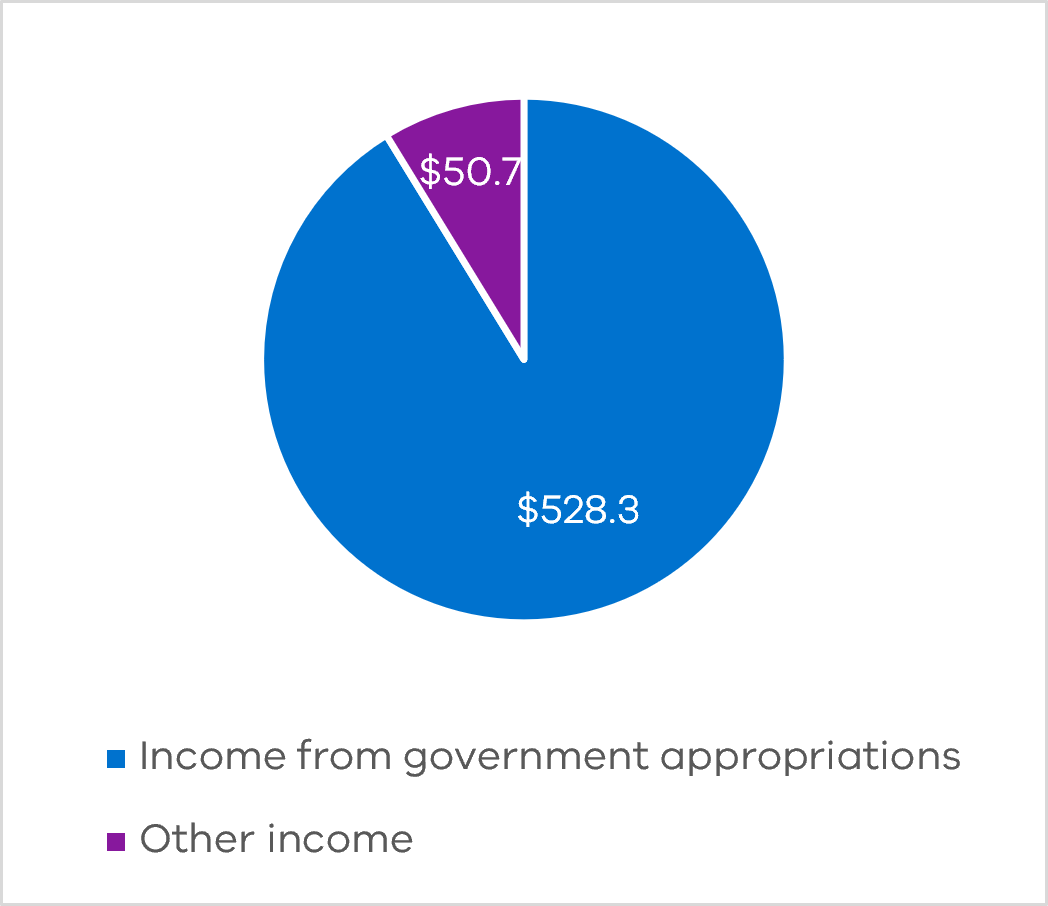
Figure 2. Sources of income ($ million)
Compared with 2024–25, the net decrease in DPC's income in 2025–26 is primarily due to lower output appropriations following the decommissioning of the Yoorrook Justice Commission in June 2025, offset by increases driven by state election activities, accommodation recognised as free of charge, and grant inflows.
The chart below shows the distribution of DPC’s expenses in delivering the department’s services.
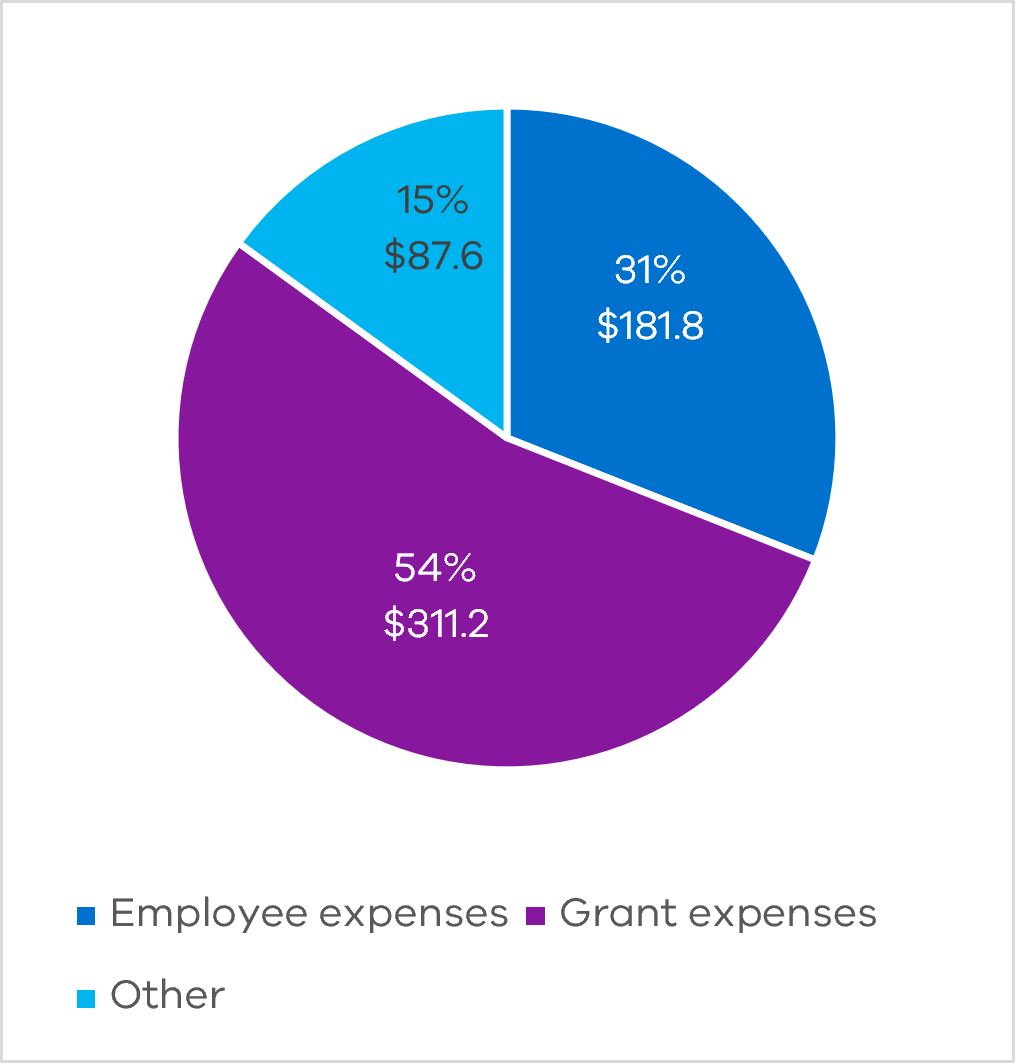
Figure 3. Expenses ($ million)
DPC’s total expenses decreased by $2.7 million in 2025–26 compared with 2024–25. This was primarily due to the conclusion of the Yoorrook Justice Commission's formal operations and its decommissioning in June 2025, resulting in a reduction in service delivery and associated operational expenditure during the year.
Financial position — balance sheet
DPC’s net assets remained broadly consistent in 2025–26, with no significant change compared with 2024–25.
Cash flows
DPC recorded a net cash inflow from operating activities of $8.6 million in 2025–26, an increase of $13.7 million compared with 2024–25. The increase was primarily due to the timing of trust fund receipts associated with the Community Support Fund, which supports commitments to Victoria’s multicultural communities, and the timing of liabilities settled during the financial year.
Subsequent events
Refer to the section on subsequent events at Note 8.12 in DPC’s financial statements.
Capital projects / asset investment programs
During 2025–26, DPC did not have any capital projects, reaching practical or financial completion, that met the disclosure threshold of $10 million or greater.
Financial management compliance
Attestation for compliance with Ministerial Standing Direction 5.1.4
Department of Premier and Cabinet
I, Chris Barrett, the Secretary of the Department of Premier and Cabinet, certify that the Department of Premier and Cabinet has no Material Compliance Deficiency with respect to the applicable Standing Directions under the Financial Management Act 1994 and Instructions.
Chris Barrett
Secretary
Department of Premier and Cabinet
Melbourne
18 September 2026
Victorian Multicultural Commission
I, Vivienne Nguyen, the Chairperson of the Victorian Multicultural Commission, certify that the Victorian Multicultural Commission has no Material Compliance Deficiency with respect to the applicable Standing Directions under the Financial Management Act 1994 and Instructions.

Vivienne Nguyen AM
Chairperson
Victorian Multicultural Commission
Melbourne
1 July 2026
Other expenditure and costs
Consultancy expenditure
In 2025–26 there were six consultancies engaged with a total approved value at $10,000 or greater.
The total expenditure incurred during 2025–26 in relation to these consultancies was $0.346 million (excluding GST).
Details of consultancies (valued at $10,000 or greater)
| Consultant | Purpose of consultancy | Total approved | Expenditure | Future |
| Dr Vincent Clark Archaeology & Heritage Pty Ltd | Richardsons Lagoon Conservation Management Plan. | 276,950 | 96,933 | - |
| Extent Heritage Pty Ltd | Aboriginal cultural heritage landscape assessment of Barton Station surrounds. | 95,616 | 28,686 | - |
| George Lekakis AO Management & Professional Consulting | Undertake Victoria’s Multicultural Review | 25,000 | 5,000 | - |
| Lionheart Consulting Australia | Rapid Child Safety Review | 129,500 | 129,500 | - |
| Pam White | Rapid Child Safety Review | 40,695 | 37,004 | - |
| Mott MacDonald Australia Pty Ltd | Understanding industry views of infrastructure delivery | 48,904 | 48,904 | - |
| Totals | Total number of consultancies: 6 | 616,665 | 346,026 | - |
Details of consultancies under $10,000
In 2025–26 there were three consultancies engaged with a total approved value of less than $10,000. The total expenditure incurred during 2025–26 in relation to these consultancies was $16,032 (excl. GST).
Government advertising expenditure
During 2025–26, there were three government advertising campaigns with total media spend of $100,000 or greater (exclusive of GST). The details of each campaign are outlined below.
| Name of campaign | Campaign summary | Start / end date | Advertising (media) expenditures (excl GST) | Creative and campaign development expenditure | Research expenditure | Post campaign evaluation | Print and collateral | Other expenditure | Total |
| Real Help, Right Now’ — Cost of Living campaign – Phase 2 2025–26 | Campaign to raise awareness of cost-of living support available to all Victorians | 06/07/25 to 31/08/25 | Approved: $873,000
Actual: $750,626 | Planned: $60,000
Actual: $63,542 | Planned: $0 Actual: $0 | Planned: $0
Actual: $0 | Planned: $0 Actual: $0 | Planned: $75,000
Actual: $75,000 (for social moderation and translation phone services) | Planned: $1,008,000
Actual: $889,168 |
| Real Help, Right Now’ — Cost of Living campaign – Phase 3 2025–26 | Campaign to raise awareness of cost-of-living support available to all Victorians | 15/10/25 to 17/12/25 | Approved: $1,000,000
Actual: $881,266 | Planned: $72,292
Actual: $72,752 | Planned: $0 Actual: $0 | Planned: $17,470
Actual: $17,470 | Planned: $0 Actual: $0 | Planned: $31,509
Actual: $31,509 (CALD social moderation) | Planned: $1,002,997
$1,002,997 |
| Real Help, Right Now’ — Cost of Living campaign – Phase 4 2025–26 | Campaign to raise awareness of cost-of-living support available to all Victorians | 12/04/26 to 30/06/26 | Approved: $1,000,000
Actual: $608,665 | Planned: $264,000 Actual: $283,633 | Planned: $0
Actual: $0 | Planned: $20,000
Actual: $16,470 | Planned: $0
Actual: $0 | Planned: $0
Actual: $11,238 (Social moderation & phone translation services) | Planned: $1,284,000
Actual: $920,006 |
Grants and transfer payments
DPC has provided assistance through grants and transfer payments during the reporting period. The financial assistance provided in 2025–26 is listed in Section 6, Appendix 4: Grants and transfer payments.
Information and communications technology expenditure
For the 2025–26 reporting period, DPC had total information and communications technology (ICT) expenditure of $12.05 million, with details shown below.
Expenditure | |
| All operational ICT expenditure | |
| Business as usual (BAU) ICT expenditure (total) | 11,450 |
| ICT expenditure related to projects to create or enhance ICT capabilities | |
| Operational expenditure | 559 |
| Capital expenditure | 46 |
| Non-BAU ICT expenditure (total) | 604 |
ICT expenditure refers to DPC’s costs in providing business-enabling ICT services. It comprises BAU ICT expenditure and non-BAU ICT expenditure:
- Non-BAU ICT expenditure relates to extending or enhancing DPC’s current ICT capabilities.
- BAU ICT expenditure is all remaining ICT expenditure, which primarily relates to ongoing activities to operate and maintain the current ICT capability.
Major contracts
DPC is required to disclose, in accordance with the requirements of government policy and accompanying guidelines, all contracts greater than $10 million entered into during the financial year.
DPC did not enter into any new contracts greater than $10 million during 2025–26.
Reviews and studies expenditure
During 2025–26, there were four reviews and studies undertaken. The total expenditure incurred during 2025–26 was $179,286 (excl. GST). Details of individual reviews and studies are outlined below.
| Name of the review (portfolio(s) and output(s)/agency responsible | Reasons for review/study | Terms of reference/scope | Timeline | Anticipated outcomes | Estimated cost for the year | Final cost if completed | Publicly available (Y/N) and URL |
Multicultural Film Festival - Provision of Project Evaluation Report (Portfolio: Multicultural Affairs) | Evaluation of the Multicultural Film Festival 2026. | Evaluation of the 2026 Multicultural Film Festival to assess project outcomes, key learnings, and inform future delivery. | October 2025 – July 2026 | To make recommendations for future delivery of similar projects. | $5,232 | $5,232 | No |
Operational review: Strengthening Victoria’s Regional Advisory Councils (Portfolio: Multicultural Affairs) | Improve the governance, operations and structure of Regional Advisory Councils (RACs). | Hold consultations with RAC members and Victorian Multicultural Commission staff to identify RAC governance improvement areas. | June 2025 – August 2025 | Recommendations included in Victoria’s 2025 Multicultural Review with improvement areas. | $2,550 | $5,300 | No |
Rapid Child Safety Review (Portfolio: Premier) | On 2 July 2025, the Victorian Government commissioned an independent Rapid Child Safety Review in response to allegations of child sexual abuse in early childhood, education and care settings. | Draft the report of the Rapid Child Safety Review. Conduct research and other briefing in support of the Review Panel. Lead and support targeted stakeholder engagement. Identify immediateactions to improve the safety of children in early childhood education and care settings. | July 2025 – August 2025 | To look at immediate steps the Victorian Government could take, and advocate nationally, to improve child safety in early childhood education and care settings in Victoria. | $166,504 | $166,504 | Yes https://www.vic.gov.au/rapid-child-safety-review |
Victoria’s Multicultural Review (Portfolio: Multicultural Affairs) | To recommend ways the government could strengthen its support to multicultural and multifaith communities. It was announced by the Premier in December 2024 as part of a suite of measures to strengthen social cohesion across Victoria. | To review Victoria’s multicultural policies, institutions and personnel, to ensure they are equipped. To reject division, build bridges and resolve conflicts. | December 2024 – September 2025 | A review of Victoria’s multicultural policies and institutions to strengthen support for multicultural and multifaith communities. | $5,000 | $25,000 | Yes www.vic.gov.au/victorias-multicultural-review |
Section 4: Financial statements
Accountable Officer’s and Chief Financial Officer’s declaration
The declaration of the Accountable Officer and Chief Financial Officer
Independent audit report for the year ended 30 June 2026
Independent audit report for the year ended 30 June 2026
Comprehensive operating statement
DPC operating statement for the financial year ended 30 June 2026
Balance sheet
as at 30 June 2026
Cash flow statement
for the financial year ended 30 June 2026
Statement of changes in equity
for the financial year ended 30 June 2026
Notes to the financial statements
for the financial year ended 30 June 2026
Accountable Officer’s and Chief Financial Officer’s declaration
The attached financial statements for the Department of Premier and Cabinet have been prepared in accordance with Direction 5.2 of the Standing Directions of the Minister for Finance under the Financial Management Act 1994, applicable Financial Reporting Directions, Australian Accounting Standards including Interpretations, and other mandatory professional reporting requirements.
We further state that, in our opinion, the information set out in the comprehensive operating statement, balance sheet, cash flow statement, statement of changes in equity and accompanying notes, presents fairly the financial transactions during the year ended 30 June 2026 and financial position of the department at 30 June 2026.
At the time of signing, we are not aware of any circumstance that would render any particulars included in the financial statements to be misleading or inaccurate.
We authorise the attached financial statements for issue on 18 September 2026.

Anthony Bale
Chief Financial Officer
Department of Premier and Cabinet
Melbourne
18 September 2026
Chris Barrett
Secretary
Department of Premier and Cabinet
Melbourne
18 September 2026
Independent audit report for the year ended 30 June 2026
Comprehensive operating statement
| Notes | 2026 | 2025 | |
Continuing operations |
|
| |
| Income from transactions |
|
| |
| Output appropriations | 2.1 | 374,859 | 404,884 |
| Special appropriations | 2.1 | 153,468 | 146,793 |
| Grants | 24,932 | 12,325 | |
| Resources received free of charge | 23,361 | 11,535 | |
| Other income | 2,398 | 9,205 | |
| Total income from transactions | 579,018 | 584,742 | |
|
| ||
| Expenses from transactions |
|
| |
| Grant expenses | 3.1 | 311,198 | 308,226 |
| Employee expenses | 3.2 | 181,806 | 192,711 |
| Depreciation and amortisation | 5.3 | 4,640 | 7,271 |
| Interest expense | 272 | 245 | |
| Other operating expenses | 3.3 | 82,640 | 74,774 |
| Total expenses from transactions | 580,556 | 583,227 | |
|
| ||
| Net result from transactions (net operating balance) | (1,538) | 1,515 | |
|
| ||
| Other economic flows included in net result |
|
| |
| Net gain/(loss) on non-financial assets | 8.1 | (1,203) | 61 |
| Other gains on other economic flows | 8.1 | 303 | 59 |
| Total other economic flows included in net result | (900) | 120 | |
|
| ||
| Net result | (2,438) | 1,635 | |
|
| ||
| Other economic flows — other comprehensive income |
|
| |
| Changes in physical asset revaluation surplus | 5.1.1 | - | 9,579 |
| Total other economic flows — other comprehensive income | - | 9,579 | |
|
| ||
| Comprehensive result | (2,438) | 11,214 |
The accompanying notes form part of these financial statements.
Balance sheet
as at 30 June 2026
| Notes | 2026 | 2025 | |
| Assets |
|
| |
| Cash and deposits |
|
| |
| Receivables | 7.2.1 | 29,148 | 23,051 |
| Total financial assets | 6.1 | 88,354 | 92,559 |
117,502 | 115,610 | ||
|
| ||
| Non-financial assets |
|
| |
| Property, plant and equipment | 5.1 | 266,582 | 268,036 |
| Intangible assets | 5.2 | 415 | 2,155 |
| Other non-financial assets | 349 | 191 | |
| Total non-financial assets | 267,346 | 270,382 | |
|
| ||
| Total assets | 384,848 | 385,992 | |
| Liabilities |
|
| |
| Payables | 6.2 | 30,541 | 32,907 |
| Borrowings | 7.1 | 4,199 | 4,392 |
| Employee benefits | 6.3 | 39,497 | 36,042 |
| Other provisions | 2,552 | 2,293 | |
| Total liabilities |
| 76,789 | 75,634 |
| Net assets | 308,059 | 310,358 | |
| Equity | |||
| Accumulated surplus | 85,051 | 87,350 | |
| Physical asset revaluation surplus | 221,334 | 221,334 | |
| Contributed capital | 1,674 | 1,674 | |
| Total equity | 308,059 | 310,358 | |
| Net worth | 308,059 | 310,358 |
The accompanying notes form part of these financial statements.
Cash flow statement
for the financial year ended 30 June 2026
| 2026 | 2025 | |
| Cash flows from/(used in) operating activities |
|
| |
| Receipts |
|
| |
| Receipts from government | 551,238 | 595,431 | |
| Receipts from other entities | 2,350 | 3,404 | |
| Goods and services tax recovered from the Australian Taxation Office | 9,888 | 11,344 | |
| Interest received | 49 | 57 | |
| Total receipts | 563,524 | 610,236 | |
| Payments |
|
| |
| Payments to suppliers and employees | (248,694) | (306,382) | |
| Payments of grant expenses | (305,967) | (308,747) | |
| Interest and other costs of finance paid | 7.1.2 | (272) | (245) |
| Total payments | (554,934) | (615,374) | |
| Net cash flows from/(used in) operating activities | 7.2.2 | 8,590 | (5,138) |
Cash flows from/(used in) investing activities | |||
| Purchases of non-financial assets | (2,208) | (2,103) | |
| Capital grants to portfolio agencies | (11,118) | (6,511) | |
| Proceeds from disposal of motor vehicles | 563 | 589 | |
| Net cash flows from/(used in) investing activities | (12,763) | (8,025) | |
Cash flows from/(used in) financing activities | |||
| Special appropriations for capital expenditure purposes | 2.2.2 | 11,118 | 6,511 |
| Repayment of principle portion of lease liabilities1 | (849) | (1,620) | |
| Net cash flows from/(used in) financing activities | 10,269 | 4,891 | |
| Net (decrease)/increase in cash and cash equivalents | 6,096 | (8,272) | |
| Cash and cash equivalents at the beginning of the financial year | 23,052 | 31,323 | |
| Cash and equivalents at the end of the financial year | 7.2.1 | 29,148 | 23,051 |
The accompanying notes form part of these financial statements.
1 The department has recognised cash payments for the principal portion of lease payments as financing activities; cash payments for the interest portion as operating activities consistent with the presentation of interest payments and short-term lease payments for leases and low-value assets as operating activities.
Statement of changes in equity
for the financial year ended 30 June 2026
Notes | Physical | Contributed | Accumulated | Total | |
| Balance at 30 June 2024 | 211,755 | 1,674 | 85,715 | 299,144 | |
| Net result for the year | - | - | 1,635 | 1,635 | |
| Special appropriations - capital | 2.2.2 | - | 6,511 | - | 6,511 |
| Capital distributions to portfolio agencies1 | - | (6,511) | - | (6,511) | |
| Changes in physical asset revaluation surplus | 5.1.1 | 9,579 | - | - | 9,579 |
|
|
|
| ||
| Balance at 30 June 2025 | 221,334 | 1,674 | 87,350 | 310,358 | |
| Net result for the year | - | - | (2,438) | (2,438) | |
| Special appropriations - capital | 2.2.2 | - | 11,118 | - | 11,118 |
| Capital distributions to portfolio agencies1 | - | (11,118) | - | (11,118) | |
| Derecognise section 53(1)(b) entity2 | - | - | 140 | 140 | |
| Balance at 30 June 2026 | 221,334 | 1,674 | 85,051 | 308,059 |
The accompanying notes from part of these financial statements.
1 This comprises of capital funding on-passed to portfolio agency, Victorian Electoral Commission - $11.1 million (2025- $6.5 million).
2 This comprises the derecognition of the Parliamentary Workplace Standards and Integrity Commission following the transfer of responsibility for operational and financial management support to the Department of Parliamentary Services pursuant to a ministerial decision.
Notes to the financial statements
for the financial year ended 30 June 2026
1. About this report
The Department of Premier and Cabinet
(the 'department') is a government department of the State of Victoria (the 'state') established pursuant to an order made by the Premier under the Administrative Arrangements Act 1983. It is an administrative agency acting on behalf of the Crown.
The principle address of the department is:
Department of Premier and Cabinet
1 Treasury Place
Melbourne VIC 3002
A description of the department's operations and its principle activities are included in the Report of Operations, which does not form part of these financial statements.
Basis of preparation
These financial statements are in Australian dollars and the historical cost convention is used unless a different measurement basis is specifically disclosed in the note associated with the item measured on a different basis.
The accrual basis of accounting has been applied in preparing these financial statements whereby assets, liabilities, equity, income and expenses are recognised in the reporting period to which they relocate, regardless of when cash is received or paid.
Consistent with the requirements of Australian Accounting Standards Board (AASB) 1004: Contributions, contributions by owners (that is, contributed capital and its repayment) are treated as equity transactions and , therefore, do not form part of the income and expenses of the department.
Additions to net assets that have been designated as contributions by owners are recognised as contributed capital. Other transfers that are in the nature of contributions to or distributions by owners have also been designated as contributions by owners.
Judgements, estimates and assumptions are required to be made about financial information being presented. The significant judgements made in preparing these financial statements are disclosed in the notes where amounts affected by those judgemnts are disclosed. The significant judgement applied to value property, plant and equipment is disclosed in Note 5.5 and Note 5.5.1 of the financial statements. Estimates and associated assumptions are based on professional judgements derived from historical experience and various other factors that are believed to be reasonable under the circumstances. Actual results may differ from these estimates.
Revisions to a accounting estimates are recognised in the period in which those estimates are revised and in future periods that are affected by the revision. Judgements and assumptions made by management in applying Australian Accounting Standards that have significant effects on the financial statements ad estimates are disclosed in the notes to which they relate.
These financial statements cover the department as an individual reporting entity and include all its activities. The results of the portfolio entities are not consolidated in the department's financial statements because they prepare their own financial reports. The department's portfolio results (Including the portfolio entities) are included in the Annual Report, Appendix 1: Budget portfolio outcomes, which does not form part of the financial statements and is not subject to audit by the Victorian Auditor-General's Office.
Pursuant to section 53(1)(b) of the Financial Management Act 1994, the results of the following entities are reported in aggregate as part of the department's financial statements:
- The Victorian Multicultural Commission was established under the Multicultural Victoria Act 2011.
- The Parliamentary Workplace Standards and Integrity Commission was established on 31 December 2024 under the Parliamentary Workplace Standards and Integrity Act 2024. It is included in the comparative figures to this report until 30 June 2025, after which responsibility for operational and financial management support transferred to the department of Parliamentary Services pursuant to a ministerial decision.
The administered activities of the department are separately disclosed in Note 8.8 Administered Items. The department remains accountable for administered items but does not recognise these in its financial statements.
Compliance information
These general-purpose financial statements have been prepared on a going concern basis in line with the Financial Management Act 1994 and applicable Australian Accounting Standards including interpretations issued by the AASB. They are presented in a manner consistent with the requirements of AASB 1049: Whole of Government and General Government Sector Financial Reporting.
Where appropriate, those Australian Accounting Standards paragraphs applicable to not-for-profit entities have been applied. Accounting policies selected and applied in these financial statements ensure the resulting financial information satisfies the concepts of relevance and reliability, thereby ensuring the substance of the underlying transactions or other events is reported.
Machinery of government changes
Transfers of net assets arising from administrative restructurings are treated as distributions to or contributions by owners. Transfers of net liabilities arising from administrative restructurings are treated as distributions to owners.
Rounding of amounts
All amounts in the financial statements have been rounded to the nearest $1,000 unless otherwise stated. Figures in the financial statements may not equate due to rounding.
Other accounting policies
Material accounting policies that summarise recognition and measurement basis used and relevant to an understanding of these financial statements, are provided throughout the notes to the financial statements.
2. Funding of our services
Introduction The role of the department is to work for the people of Victoria by leading the public service and supporting the government of the day to achieve its strategic objectives. To deliver on these strategic objectives, the department receives income predominantly in the form of parliamentary appropriations. Structure of this section 2.1 Income that funds the delivery of services 2.2. Summary of compliance with annual parliamentary and special appropriations. Key accounting recognition and measurement criteria The revenue items that have specific recognition criteria are further described in Note 2.1. Where applicable, amounts disclosed as income are net of returns, allowances, duties and taxes. Amounts of income where the department does not have control are separately disclosed as administered income (refer to Note 8.8 Administered Items). |
2.1. Income that funds the delivery of services
| Notes | 2026 | 2025 | |
| Output appropriations | 2.2.1 | 374,859 | 404,884 |
| Special appropriations | 2.2.2 | 153,468 | 146,793 |
| Total appropriations | 528,327 | 551,677 |
Appropriations
Once annual parliamentary appropriations are approved by the Treasurer, they become controlled by the department and are recognised as income when applied for the purposes defined under the relevant legislation governing the use of the appropriation.
The department receives the following forms of appropriation:
- Output appropriations — Income for the outputs (i.e. services) the department provides to the government is recognised when those outputs have been delivered and the relevant minister has certified delivery of those outputs in line with specified performance criteria.
- Special appropriations — Income related to special appropriations is recognised when the amounts appropriated for that purpose are due and payable by the department.
2.2. Summary of compliance with annual parliamentary and special appropriations
2.2.1 Summary of annual appropriations
The following table discloses the details of the various annual parliamentary appropriations the department received for the financial year.
In accordance with accrual output-based management procedures, ‘provision of outputs’ and ‘additions to net assets’ are disclosed as ‘controlled’ activities of the department. Administered transactions are those that are undertaken on behalf of the state over which the department has no control or discretion.
| Appropriation Act | Financial Management Act | |||||||
| Annual
| Net transfers between
| Advance from Treasurer
| Section 301
| Section 322
| Total
| Total | Variance3 |
| 2026 controlled |
|
|
|
|
|
|
|
|
| Output appropriations | 318,128 | - | 71,729 | - | 2,575 | 392,432 | 374,859 | 17,573 |
| Additions to net assets | - | - | - | - | - | - | - | - |
| 2026 total | 318,128 | - | 71,729 | - | 2,575 | 392,432 | 374,859 | 17,573 |
|
|
|
|
|
|
|
| |
| 2025 controlled |
|
|
|
|
|
|
|
|
| Output appropriations | 387,618 | (25,532) | 38,927 | 10,606 | 6,048 | 417,667 | 404,884 | 12,783 |
| Additions to net assets | 10,278 | - | - | (10,606) | 1,000 | 672 | - | 672 |
| 2025 total | 397,896 | (25,532) | 38,927 | - | 7,048 | 418,339 | 404,884 | 13,455 |
1 Under section 30, the department may transfer an amount from one appropriation item to another in the current year. All expenses and obligations to which any section 30 transfer is applied must be reported in the financial year in which the transfer was made.
2 Section 32 constitutes the approved carryover of unapplied appropriations from the prior year to be applied against outputs in the current year.
3 Variances in controlled output appropriations in 2026 controlled relates to unapplied appropriations carried over from 2025–26 to 2026-27 for delivery next year. This mainly relates to Self‑determination policy and reform advice and programs output, Multicultural affairs policy and programs output and Social Policy functions.
2.2.2. Summary of special appropriations
The following table discloses the details of compliance with special appropriations.
| Authority | Purpose | Appropriations applied | |
2026 | 2025 | ||
| Controlled |
|
| |
| Constitution Act, No. 8750 of 1975 — Executive Council | Salary for Clerk of the Executive Council | 50 | 50 |
| Constitution Act, No. 8750 of 1975 — Governor's salary | Salary payments to the Governor of Victoria | 557 | 559 |
| Electoral Act, No. 23 of 2002 | Operating costs incurred by the Victorian Electoral Commission | 134,406 | 124,098 |
| Section 10 of the Financial Management Act | Appropriation of Commonwealth Grants | 2,000 | 3,978 |
| Statewide Treaty Act No. 45 of 2025, section 144 | Costs incurred by Gellung Warl for establishment, performance of its functions and exercise of its powers | 3,000 | - |
| Treaty Authority and Other Treaty Elements Act 2022, Section 16 | Operating costs incurred by the Treaty Authority | 13,454 | 18,109 |
| Total controlled | 153,468 | 146,793 | |
| Administered | |||
| Inquiries Act No. 67 of 2014, Section 58 | Expenses And Financial Obligations of Board of Inquiry | 2,078 | 2,053 |
| Electoral Act, No. 23 of 2002 | Electoral entitlements | 13,169 | 13,360 |
| Total administered | 15,248 | 15,413 | |
| Capital — controlled | |||
| Electoral Act, No 23 of 2002 | Capital costs incurred by the Victorian Electoral Commission | 11,118 | 6,511 |
| Total capital — controlled | 11,118 | 6,511 | |
3. Cost of delivering our services
Introduction The funds that enable the provision of services are disclosed in Note 2. In this section the costs associated with the provision of services are recorded. Structure of this section Key accounting recognition and measurement criteria
|
3.1 Grant expenses
2026 | 2025 | |
| Grants to portfolio agencies1 | 144,342 | 138,616 |
| Grants to other entities | 166,856 | 169,610 |
| Total grant expenses | 311,198 | 308,226 |
Grant expenses are contributions of the department's resources to another party for specific or general purposes where there is no expectation that the amount will be repaid in equal value (either by goods or services). Grant expenses also include grants paid to entities within the department's portfolio.
Grants can either be operating or capital in nature. Grants can be paid as general-purpose grants, which refers to grants that are not subject to conditions for their use. Alternatively, they may be paid as specific purpose grants, which are paid for a particular purpose and have conditions attached to their use.
Grant expenses are recognised in the reporting period in which they are paid or payable. Grants can take the form of money, assets, goods or services.
3.2. Employee expenses
2026 | 2025 | |
| Salaries and wages, annual leave and long service leave | 159,478 | 170,339 |
| Termination benefits | 5,931 | 4,955 |
| Defined contribution superannuation expenses | 16,273 | 17,291 |
| Defined benefit superannuation expense | 124 | 126 |
| Total employee expenses | 181,806 | 192,711 |
Employee expenses comprise all costs related to employment including wages and salaries, superannuation, fringe benefits tax, leave entitlements, redundancy payments, WorkCover premiums and other on-costs.
The amount recognised in the comprehensive operating statement in relation to superannuation includes employer contributions for members of both defined benefit and defined contribution superannuation plans that are paid or payable during the reporting period.
3.3. Other operating expenses
2026 | 2025 | |
| Purchases of services and supplies | 68,500 | 62,830 |
| Information technology expenses | 2,779 | 2,264 |
| Marketing and promotion | 7,588 | 5,142 |
| Short-term lease expenses and low-value assets | 63 | 54 |
| Office accommodation expenses | 3,582 | 4,484 |
| Bad debts expense | 128 | - |
| Total other operating expenses | 82,640 | 74,774 |
Other operating expenses generally represent the day-to-day running costs incurred in normal operations and are recognised as expenses in the reporting period in which they are incurred. It also includes bad debts expense from transactions that are mutually agred.
4. Output information
Introduction The department is predominately funded by accrual-based parliamentary appropriations for providing outputs. This section provides a description of the departmental outputs delivered during the financial year and the costs incurred in delivering those outputs. Structure of this section |
4.1. Departmental outputs
The department supports the ministerial portfolios of Premier, Deputy Premier, Multicultural Affairs, and First Peoples.
Departmental outputs during the financial year ended 30 June 2026 and their objectives are summarised below.
Economic policy advice and support
This output contributes to delivering strategic, timely and comprehensive analysis and advice on economic policy to support government decision making.
Social policy advice and intergovernmental relations
This output contributes to delivering strategic, timely and comprehensive analysis and advice on social policy and intergovernmental relations to support government decision making. This output also contributes to the strategic coordination of emergency management strategies and planning across the Victorian public sector.
Multicultural affairs policy and programs
This output provides policy advice on multicultural affairs and social cohesion in Victoria, including settlement coordination for newly arrived migrants and refugees and delivers a range of programs to directly support Victoria's multicultural communities. It also supports Victoria's whole-of-government approach to multiculturalism. The output includes monitoring of government departments' responsiveness to Victorians from culturally, linguistically and religiously diverse backgrounds.
Self-determination policy and reform advice and programs
This output supports the Victorian Government's commitment to self-determination for First Peoples and to improving long-term social and economic outcomes. This includes progress towards treaty; and work to reform government to enable self-determination, as well as undertaking outcomes-focused reporting across the portfolio.
Traditional owner engagement and cultural heritage management programs
This output supports the governments's commitment to protecting Aboriginal cultural rights, including supporting Traditional Owners and First Peoples organisations to deliver self-determined initiatives for their communities. This includes the protection and management of Aboriginal cultural heritage and strengthening Aboriginal community organisations.
Executive Government advice and services.
This output contributes to providing strategic, timely and comprehensive support to Cabinet and Cabinet Committees, providing support to the Governor and maintaining Government House and its collections as a heritage asset of national importance, delivering analysis and advice to support evidence-based decision making across the public sector and providing whole of government community engagement and communications activity.
Public sector administration advice and support
This output provides advice and support on issues relevant to public sector administration, governance, service delivery and workforce matters. It also addresses matters of the public sector professionalism and integrity. this includes conducting related research, data collection and analysis, and reporting and disseminating findings.
Chief Parliamentary Counsel services
This output provides bills for introduction in Parliament, including providing quality and timely legislative drafting services, hard copy and electronic publication of Acts and statutory rules, and maintaining a database of Victorian legislation and legislative information at www.legislation.vic.gov.au.
4.2. Changes in departmental outputs
There were no changes made to output groups in 2025–26 financial year.
4.3. Department outputs – controlled income and controlled expenses
Economic Policy | Social Policy Advice and Intergovernmental Relations | Multicultural Affairs Policy and Programs | Self-Determination Policy and Reform Advice and Programs | Traditional Owner Engagement and Cultural Heritage Management Programs | Executive Government Advice and Services | |||||||
2026 | 2025 | 2026 | 2025 | 2026 | 2025 | 2026 | 2025 | 2026 | 2025 | 2026 | 2025 | |
| Income from transactions | ||||||||||||
| Output appropriations | 22,514 | 23,335 | 31,300 | 26,674 | 40,800 | 41,030 | 77,339 | 90,922 | 57,208 | 56,821 | 132,271 | 151,942 |
| Special appropriations | - | - | - | - | - | - | 16,454 | 18,109 | 2,000 | 3,978 | 135,014 | 124,706 |
| Grants | 512 | - | 1,000 | - | 21,605 | 11,181 | 490 | - | 325 | - | 1,000 | 1,144 |
| Resources received free of charge | - | - | - | - | - | - | - | 303 | - | - | 23,361 | 11,232 |
| Other income | - | 5,736 | - | - | 345 | 248 | 1,509 | 2,776 | - | 8 | 545 | 438 |
| Total income from transactions | 23,026 | 29,071 | 32,300 | 26,674 | 62,750 | 52,459 | 95,792 | 112,111 | 59,533 | 60,806 | 292,191 | 289,462 |
| Expenses from transactions | ||||||||||||
| Grants expenses | 4,309 | 2,778 | 3,660 | 2,190 | 49,617 | 38,634 | 65,903 | 71,107 | 40,475 | 38,855 | 147,234 | 154,662 |
| Employee expenses | 17,111 | 17,640 | 20,939 | 20,918 | 9,391 | 9,092 | 14,898 | 22,669 | 14,168 | 14,832 | 93,205 | 95,513 |
| Depreciation and amortisation | 74 | 32 | 27 | 18 | 26 | 21 | 22 | 2,860 | 374 | 670 | 4,096 | 3,629 |
| Interest expense | 18 | 6 | 5 | 4 | 6 | 4 | 7 | 49 | 42 | 13 | 189 | 166 |
| Other operating expenses | 3,112 | 3,690 | 7,668 | 5,018 | 3,365 | 4,460 | 13,203 | 14,383 | 4,150 | 6,429 | 49,836 | 38,725 |
| Total expenses from transactions | 24,624 | 24,145 | 32,299 | 28,149 | 62,405 | 52,211 | 94,033 | 111,069 | 59,208 | 60,799 | 294,560 | 292,695 |
| Net result from transactions (net operating balance) | (1,598) | 4,926 | 1 | (1,476) | 345 | 248 | 1,759 | 1,042 | 325 | 7 | (2,370) | (3,233) |
| Other economic flows included in net result | ||||||||||||
| Net gain/(loss) on non-financial assets | (1) | (1) | - | 3 | - | 30 | (2) | (341) | - | 57 | 129 | 358 |
| Other gains on other economic flows | (9) | 8 | (86) | 8 | 80 | 3 | 161 | 6 | 98 | 6 | 135 | 24 |
| Total other economic flows included in net result | (9) | 7 | (86) | 11 | 80 | 33 | 159 | (335) | 98 | 63 | 264 | 382 |
| Net result | (1,607) | 4,933 | (85) | (1,465) | 426 | 281 | 1,919 | 707 | 423 | 70 | (2,105) | (2,851) |
| Other economic flows - other comprehensive income | ||||||||||||
| Changes in physical asset revaluation surplus | - | - | - | - | - | - | - | - | - | - | - | 9,579 |
| Total other economic flows - other comprehensive income | - | - | - | - | - | - | - | - | - | - | - | 9,579 |
| Comprehensive result | (1,607) | 4,933 | (85) | (1,465) | 426 | 281 | 1,919 | 707 | 423 | 70 | (2,105) | 6,728 |
| Public Sector Administration Advice and Support | Chief Parliamentary Counsel Services | Total | ||||
2026 | 2025 | 2026 | 2025 | 2026 | 2025 | |
| Income from transactions | ||||||
| Output appropriations | 4,941 | 5,356 | 8,485 | 8,804 | 374,859 | 404,884 |
| Special appropriations | - | - | - | - | 153,468 | 146,793 |
| Grants | - | - | - | - | 24,932 | 12,325 |
| Resources received free of charge | - | - | - | - | 23,361 | 11,535 |
| Other income | - | - | - | - | 2,399 | 9,205 |
| Total income from transactions | 4,941 | 5,356 | 8,485 | 8,804 | 579,019 | 584,742 |
| Expenses from transactions | ||||||
| Grants expenses | - | - | - | - | 311,198 | 308,226 |
| Employee expenses | 4,430 | 4,546 | 7,665 | 7,501 | 181,806 | 192,711 |
| Depreciation and amortisation | 21 | 8 | 1 | 32 | 4,640 | 7,271 |
| Interest expense | 5 | 2 | - | - | 272 | 245 |
| Other operating expenses | 487 | 799 | 819 | 1,271 | 82,640 | 74,774 |
| Total expenses from transactions | 4,942 | 5,355 | 8,485 | 8,804 | 580,557 | 583,227 |
| Net result from transactions (net operating balance) | (1) | - | - | - | (1,538) | 1,515 |
| Other economic flows included in net result | ||||||
| Net gain/(loss) on non-financial assets | - | - | (1,329) | (46) | (1,203) | 61 |
| Other gains on other economic flows | (2) | 1 | (76) | 4 | 303 | 59 |
| Total other economic flows included in net result | (2) | 1 | (1,405) | (42) | (900) | 120 |
| Net result | (3) | 2 | (1,405) | (42) | (2,438) | 1,635 |
| Other economic flows - other comprehensive income | ||||||
| Changes in physical asset revaluation surplus | - | - | - | - | - | 9,579 |
| Total other economic flows - other comprehensive income | - | - | - | - | - | 9,579 |
| Comprehensive result | (3) | 2 | (1,405) | (42) | (2,438) | 11,214 |
5. Key assets to support output delivery
Introduction Structure of this section |
5.1. Property, plant and equipment
Key accounting recognition and measurement criteria
Items of property, plant and equipment are measured initially at cost and subsequently revalued at fair value less accumulated depreciation and impairment. Where an asset is acquired for nominal cost, the cost is its fair value at the date of acquisition. Assets transferred from/to other departments as part of machinery of government changes are transferred at their carrying amount.
The cost of leasehold improvement s is capitalised and depreciated over the shorter of the remaining lease term or estimated useful life.
The initial cost of leased motor vehicles is measured at amounts equal to the fair value of the leased asset or, if lower, the present value of the minimum lease payments determined at the inception of the lease.
Leases recognised as right-of-use assets are initially measured at cost. This represents the present value of expected future payments resulting from the lease contracts.
In reporting periods subsequent to initial recognition, property, plant and equipment are measured at fair value less accumulated depreciation and impairment. fair value is determined based on the asset's highest and best use (considering legal or physical restrictions imposed on the asset, public announcements or commitments made in relation to the intended use of the asset) and is summoned by asset category.
| Gross carrying amount | Accumulated depreciation | Net carrying amount | ||||
2026 | 2025 | 2026 | 2025 | 2026 | 2025 | |
| Land1 | 170,851 | 170,851 | - | - | 170,851 | 170,851 |
| Buildings (including heritage buildings)1 2 | 88,218 | 88,905 | (4,177) | (3,805) | 84,041 | 85,100 |
| Building construction in progress | 2,107 | 2,300 | - | - | 2,107 | 2,300 |
| Office equipment and computer equipment | 5,759 | 5,750 | (5,645) | (5,586) | 114 | 164 |
| Plant and equipment works in progress | 17 | - | - | - | 17 | - |
| Leased motor vehicles2 | 2,032 | 2,180 | (472) | (538) | 1,560 | 1,642 |
| Other heritage assets1 | 8,239 | 8,239 | (347) | (260) | 7,892 | 7.979 |
| Net carrying amount | 277,223 | 278,225 | (10,641) | (10,189) | 266,582 | 268,036 |
1 Land, buildings and other heritage assets at Government House were valued at 30 June 2022 by the Valuer-General of Victoria. The department does not hold any other land or buildings. Since formal valuation, a managerial valuation adjustment was done for buildings as of 30 June 2025 due to the movement in fair value being more than 10% but less than 40%.
2 As a result of a change in FRD 104 Leases effective for reporting periods from 30 June 2026, right-of-use assets are measured at cost for reporting period 2026. The comparative information for reporting period 2025 is not restated and is reported at the previously determined fair value. For further information, refer to note 8.9.
Land and buildings (including heritage buildings)
Land and buildings are classified as specialised land and specialised buildings due to restrictions on the use of these assets. They are valued at fair value. For land valuation purposes, the market approach is used, although this is adjusted for any community service obligations to reflect the specialised nature of the land being valued. Buildings are valued using the current replacement cost method and some components of Government House are valued using the reproduction cost method.
For more information on valuation techniques, inputs and processes, refer to Note 5.5.
Office equipment and computer equipment
Fair value for office equipment and computer equipment that are specialised in use(such that it is rarely sold other than as part of a going concern) is determined using the current replacement cost method.
Motor vehicles
Vehicles are valued using the current replacement cost method. The department acquires new vehicles and at times disposes of them before the end of their economic life. The process of acquisition, use and disposal in the market is managed by departmental fleet managers, who set relevant depreciation rates during the life of the asset to reflect the use of the vehicles.
Other heritage assets
These assets are reported at fair value using the market approach. The market approach compares the value of the assets with comparable assets that have sold in the marketplace.
For more information on valuation techniques, inputs and processes, refer to Note 5.5.
Right-of-use assets acquired by lessees
The department initially recognise a right-of-use asset and a lease liability at the lease start date. The right-of-use asset is initially measured at cost, which comprises the initial amount of the lease liability adjusted for:
- any lease payments made at or before the start date less any lease incentive received
- any initial direct costs incurred
- an estimate of costs to dismantle and remove the underlying asset or to restore the underlying asset or the site on which it is located.
The department subsequently depreciates the right-of-use assets on a straight-line basis from the lease start date to the earlier of the end of the useful life of the right-of-use asset or the end of the lease term.
In addition, right-of-use assets are periodically reduced by impairment losses, if any, and adjusted for certain remeasurements of the lease liabilities.
Refer to the table at 5.1.1.1 for reconciliation of movements in carrying amounts of the departments right-of-use assets.
5.1.1. Reconciliation of movements in carrying amount of property, plant and equipment
Land at | Buildings | Building | Office | Plant and | Leased | Other | Total | |
| 2026 | ||||||||
| Carrying amount as at the start of the year | 170,851 | 85,100 | 2,300 | 164 | - | 1,642 | 7,979 | 268,036 |
| Additions | - | 7 | 2,651 | 18 | 17 | 896 | - | 3,588 |
| Disposals/write-offs | - | - | - | - | - | (677) | - | 3,588 |
| Transfers between classes | - | 2,844 | (2,844) | - | - | - | - | - |
| Depreciation/amortisation expense | - | (3,910) | - | (67) | - | (301) | (87) | (4,365) |
| Carrying amount at the end of 2026 | 170,851 | 84,041 | 2,107 | 114 | 17 | 1,560 | 7, 892 | 266,582 |
1 This includes right-of-use assets relating to accommodation leases of the department (refer to 5.1.1.1 for further details).
2 As a result of a change in FRD 104 Leases effective for reporting periods from 30 June 2026, right-of-use assets are measured at cost for reporting period 2026. The comparative information for reporting period 2025 is not restated and is reported at the previously determined fair value. For further information, refer to note 8.9.
Land at | Buildings | Building | Office | Plant and | Leased | Other | Total | |
| 2025 | ||||||||
| Carrying amount as at the start of the year | 170,851 | 73,326 | 6,106 | 181 | 80 | 1,647 | 8,108 | 260,299 |
| Additions | - | 2,952 | 2,217 | 14 | - | 904 | - | 6,087 |
| Disposals/write-offs | - | - | (225) | - | - | (565) | (42) | (832) |
| Transfers between classes | - | 5,742 | (5,798) | 136 | (80) | - | - | - |
| Fair value of assets provided free of charge or for nominal considerations | - | (303) | - | - | - | - | - | (303) |
| Revaluation | - | 9,579 | - | - | - | - | - | 9,579 |
| Depreciation/ amortisation expense | - | (6,196) | - | (167) | - | (344) | (87) | (6,794) |
| Carrying amount at the end of 2025 | 170,851 | 85,100 | 2,300 | 164 | - | 1,642 | 7,979 | 268,036 |
5.1.1.1. Reconciliation of movement in carrying amount of right-of-use assets: buildings and vehicles
The following table is a subset of buildings and leased motor vehicles included in Note 5.1.1 for right-of-use assets.
Buildings1 | Leased motor | |
| Opening balance — 1 July 2025 | 2,625 | 1,642 |
| Additions | - | 896 |
| Disposals | - | (677) |
| Depreciation | (322) | (301) |
| Closing balance — 30 June 2025 | 2,303 | 1,560 |
|
| |
| Opening balance — 1 July 2024 | 1,055 | 1,647 |
| Additions |
|
|
| Disposals |
|
|
| Fair value of assets provided free of charge or for nominal considerations | (303) | - |
| Depreciation | (1,021) | (344) |
| Closing balance — 30 June 2025 | 2,625 | 1,642 |
1 As a result of a change in FRD 104 Leases effective for reporting periods from 30 June 2026, right-of-use assets are measured at cost for reporting period 2026. The comparative information for reporting period 2025 is not restated and is reported at the previously determined fair value. For further information, refer to note 8.9.
5.2. Intangible assets
Key accounting recognition and measurement criteria
Purchased intangible assets are initially recognised at cost. Subsequently, intangible assets with finite useful lives are carried at cost less accumulated amortisation and accumulated impairment losses. Depreciation and amortisation begin when the assets are available for use — that is, when they are in the location and condition necessary for them to be capable of operating in the manner intended by management.
Internally generated intangible assets arising from development (or from the development phase of an internal project) are recognised if, and only if, all the following are demonstrated:
- there is a technical feasibility of completing the intangible asset for use of scale
- there is an intention to complete to complete the intangible asset for use of scale
- there is an ability to use or sell the intangible asset
- the intangible asset will generate probable future economic benefits
- there is an ability to use or sell the intangible asset
- the intangible asset will generate probable future economic benefits
- there is availability of adequate technical, financial and other resources to complete the development and to use or sell the intangible asset
- there is an ability to reliably measure the expenditure attributable to the intangible asset during its development.
Internally generated intangible assets with finite useful lives, are amortised ona straight-line basis over their useful lives.
Intangible assets with infinite useful lives (and intangible assets not yet available for use) are tested for impairment annually or whenever there is an indication that the asset may be impaired.
| Capitalised software | Intangible under development | Total | ||||
2026 | 2025 | 2026 | 2025 | 2026 | 2025 | |
| Opening balance of gross carrying amount | 7,585 | 6,737 | 1,476 | 2,244 | 9,061 | 8,981 |
| Additions | - | - | 11 | 85 | 11 | 85 |
| Write-offs | - | - | (148) | (5) | (148) | (5) |
| Impairment losses charged to net result1 | - | - | (1,329) | - | (1,329) | - |
| Transfer between classes | - | 848 | - | (848) | - | - |
| Closing balance of gross carrying amount | 7,585 | 7,585 | 11 | 1,476 | 7,595 | 9,061 |
| Opening balance of accumulated amortisation | (6,906) | (6,429) | - | - | (6,906) | (6,429) |
| Amortisation of intangible assets charged | (275) | (477) | - | - | (275) | (477) |
| Closing balance of accumulated amortisation | (7,181) | (6,906) | - | - | (7,181) | (6,906) |
| Net book value at end of financial year | 404 | 679 | 11 | 1,476 | 414 | 2,155 |
1 Impairment losses are included in the line item ‘net gain/(loss) on non-financial assets’ in the comprehensive operating statement. Due to the unforeseen complexities during the delivery phase of the new Work Management and Legislative Database System, it was determined that the software under development would be decommissioned and as such, an impairment loss was recognised for the period based on its recoverable amount.
5.3. Depreciation and amortisation
2026 | 2025 | |
| Buildings (including heritage buildings) | 3,910 | 6,196 |
| Office equipment and computer equipment | 67 | 167 |
| Leased motor vehicles | 301 | 344 |
| Other heritage assets | 87 | 87 |
| Intangible assets | 275 | 477 |
| Total depreciation and amortisation | 4,640 | 7,271 |
All buildings, office and computer equipment and other non-financial physical assets that have finite useful lives are depreciated and intangible assets are amortised over their useful lives.
Depreciation and amortisation are generally calculated on a straight-line basis, at rates that allocate the asset's value less any estimated residual value, to its useful life. Depreciation and amortisation begin when the asset is first available for use in the location and condition necessary for it to be capable of operating in the manner intended by the department.
Useful life of assets
Typical current and prior year estimated useful lives for the different asset classes are included in the table below.
2026 | 2025 | |
| Buildings | 5-55 | 3-55 |
| Office equipment and computer equipment | 1-30 | 1-30 |
| Leased motor vehicles | 1-5 | 1-5 |
| Other heritage assets | 99–100 | 99–100 |
| Intangible assets | 7-10 | 7-10 |
Right-of-use assets are generally depreciated over the shorter of the asset’s useful life and the lease term. Where the department obtains ownership of the underlying leased asset or if the cost of the right-of-use asset reflects that the entity will exercise a purchase option, the entity depreciates the right-of-use asset over its useful life.
Impairment of intangible assets — Intangible assets are tested for impairment whenever there is an indication that the asset may be impaired.
The assets concerned are tested as to whether their carrying value exceeds their recoverable amount. Where an asset’s carrying value exceeds its recoverable amount, the difference is considered to be an impairment and is written off as an ‘other economic flow’ in the comprehensive operating statement, except to the extent that it can be offset against an asset revaluation surplus applicable to that class of asset.
The recoverable amount for most assets is measured at the higher of current replacement cost and fair value less costs to sell.
Impairment of property, plant and equipment— The recoverable amount of primarily non-cash-generating assets of not-for-profit entities, which are typically specialised in nature and held for continuing use of their service capacity, is expected to be materially the same as fair value determined under AASB 13 Fair Value Measurement, with the consequence that AASB 136 does not apply to such assets that are regularly revalued.
Assets subject to restriction on use — Heritage assets held by the department generally cannot be modified or disposed of unless ministerial approval is obtained.
5.5. Fair value determination
The department determines the policies and procedures for fair value measurements such as property, plant and equipment in line with the requirements of AASB 13 Fair Value Measurement and the relevant Financial Reporting Directions issued by the Department of Treasury and Finance.
In determining fair values, a number of inputs are used. To increase consistency and comparability in the financial statements, these inputs are categorised into three levels, also known as the fair value hierarchy:
- Level 1 — quoted (unadjusted) market prices in active markets for identical assets or liabilities.
- Level 2 — valuation techniques for which the lowest level input that is significant to the fair value measurement is directly or indirectly observable.
- Level 3 — valuation techniques for which the lowest level input that is significant to the fair value measurement is unobservable.
Fair value measurement hierarchy
| Fair value measurement at end of reporting period using: | ||||
Carrying | Level 1 | Level 2 | Level 3 | |
| 2026 | ||||
| Land at fair value | 170,851 | - | - | 170,851 |
| Buildings at fair value1 | 84,041 | - | - | 84,041 |
| Other heritage assets at fair value | 7,892 | - | 7,892 | - |
| Office equipment and computer equipment | 114 | - | - | 114 |
| Leased motor vehicles1 | 1,560 | - | - | 1,560 |
| Total | 264,458 | - | 7,892 | 256,566 |
| 2025 | ||||
| Land at fair value | 170,851 | - | - | 170,851 |
| Buildings at fair value | 85,100 | - | - | 85,100 |
| Other heritage assets at fair value | 7,979 | - | 7,979 | - |
| Office equipment and computer equipment | 164 | - | - | 164 |
| Leased motor vehicles | 1,642 | - | - | 1,642 |
| Total | 265,735 | - | 7,979 | 257,756 |
1 As a result of a change in FRD 104 Leases effective for reporting periods from 30 June 2026, right-of-use assets are measured at cost for reporting period 2026. The comparative information for reporting period 2025 is not restated and is reported at the previously determined fair value. For further information, refer to note 8.9.
There have been no transfers between levels during the period.
The department determines whether transfers have occurred between levels in the hierarchy by reassessing the categorisation at the end of each reporting period (based on the lowest level input that is significant to the fair value measurement as a whole).
The Valuer-General Victoria (VGV) is the department’s independent valuation agency. The department engages VGV to carry out professional valuations on a five-year cycle. In the interim years the department, in conjunction with VGV, monitors changes in the fair value of each class of asset through relevant data sources to determine whether a revaluation is required. If a valuation is required, then the department will either carry out a managerial valuation or engage with VGV to value those asset classes.
AASB 2022-10 Amendments to Australian Accounting Standards – Fair Value Measurement of Non-Financial Assets of Not-for-Profit Public Sector Entities amended AASB 13 by adding Appendix F Australian implementation guidance for not-for-profit public sector entities. Appendix F explains and illustrates the application of the principles in AASB 13 on developing unobservable inputs and the application of the cost approach. These clarifications are mandatorily applicable to annual reporting periods beginning on or after 1 January 2024.
FRD 103 permits the department to apply Appendix F of AASB 13 prospectively in its next scheduled formal revaluation or interim revaluation (whichever is earlier). In the current reporting period, a full revaluation is not required. The department conducted a fair value assessment using the regular indices for land and buildings from the VGV. Following the assessment and as per FRD 103, no managerial valuation adjustment was done due to the movement in fair value being less than 10 per cent. In accordance with FRD 103, the department will apply Appendix F of AASB 13 prospectively in its next scheduled formal revaluation in 2027. The department does not expect the impact to be material to the financial statements.
The reconciliation of all movements of fair value assets is shown in the table at 5.1.1.
5.6. Valuation techniques, inputs and processes
Land and buildings (including heritage buildings)
The market approach is used to value land, although this is adjusted for any community service obligations to reflect the use of the land being valued.
The community service obligations adjustment reflects the valuer’s assessment of the impact of restrictions associated with an asset to the extent that it is equally applicable to market participants. This approach is in light of the highest and best use consideration required for fair value measurement. Relevant valuation factors include what is physically possible, legally permissible and financially feasible. Such adjustments of community service obligations are considered significant unobservable inputs; valuation of specialised land is classified at level 3 in the fair value measurement hierarchy.
For the department’s buildings, the current replacement cost method is used and reproduction cost method used for some components of the Government House, adjusting for useful life and associated depreciation. Such adjustments are considered significant unobservable inputs; buildings are classified at level 3 in the fair value measurement hierarchy.
VGV performed an independent valuation of land and buildings. The effective date of the valuation was 30 June 2022.
Other heritage assets
Other heritage assets include artwork. For artwork, valuation of the assets is determined by a comparison with similar examples of the artist’s work in existence throughout Australia and research on recent prices paid for similar examples offered at auction or through art galleries.
These assets have been assessed with reference to similar assets and do not contain significant unobservable inputs. They are classified at level 2 in the fair value measurement hierarchy.
5.6.1. Description of significant unobservable inputs to level 3 valuations
| 2025 and 2026 | Valuation technique | Significant unobservable inputs | 2026 Range | 2025 Range | Sensitivity of fair value measurement to changes in significant unobservable inputs |
| Land | Market approach | Direct cost per square metre | $3,500/m2 | $3,500/m2 | A significant increase or decrease in direct cost per square metre adjustment would result in a significant higher or lower fair value |
| Community service obligation (CSO) adjustment | Government House — 60% reduction | Government House — 60% reduction | A significant increase or decrease in the CSO adjustment would result in a significantly lower or higher fair value. | ||
| Buildings | Current replacement cost | Useful life of specialised buildings | 3 to 55 years | 5 to 55 years | A significant increase or decrease in the estimated useful life of the asset would result in a significantly higher or lower valuation. |
| Office equipment and computer equipment | Current replacement cost | Cost per unit | $4,000–$148,000 per unit | $4,000–$148,000 per unit | A significant increase or decrease in cost per unit would result in a significantly higher or lower fair value. |
| Useful life of office equipment and computer equipment | 1 to 30 years | 1 to 30 years | A significant increase or decrease in the estimated useful life of the asset would result in a significantly higher or lower valuation. | ||
| Leased motor vehicles | Current replacement cost | Cost per unit | $30,000–$113,000 per unit | $25,000–$115,000 per unit | A significant increase or decrease in the cost per unit would result in a significantly higher or lower fair value. |
| Useful life of leased motor vehicles | 1 to 5 years | 1 to 5 years | A significant increase or decrease in the estimated useful life of the asset would result in a significantly higher or lower valuation. |
6. Other assets and liabilities
Introduction This section sets out the other assets and liabilities that arose from the department’s operations and help to contribute to the successful delivery of output operations. Structure of this section 6.1 Receivables 6.2 Payables 6.3 Employee benefits Key accounting recognition and measurement criteria Contractual receivables are classified as financial instruments and categorised as ‘financial assets at amortised cost’. They are initially recognised at fair value plus any directly attributable transaction costs. Subsequent to initial recognition, they are measured at amortised cost using the effective interest method, less any impairment. The department currently holds financial instruments where the carrying amounts approximate to fair value due to their short-term nature or due to an expectation that they will be paid in full by the end of the 2026-27 reporting period. Statutory receivables do not arise from contracts and are recognised and measured similarly to contractual receivables (except for impairment) but are not classified as financial instruments. Amounts recognised as receivable from the Victorian Government represent funding for all commitments incurred and are drawn from the Consolidated Fund when the commitments fall due. Contractual payables are classified as financial instruments and measured at amortised cost. Accounts payable represent liabilities for goods and services provided to the department in the reporting period that are unpaid at the end of the reporting period. Statutory payables are recognised and measured similarly to contractual payables but are not classified as financial instruments nor included in the category of financial liabilities at amortised cost because they do not arise from contracts. |
6.1. Receivables
2026 | 2025 | |
| Contractual | ||
| Receivables | 13,181 | 15,563 |
| Statutory | ||
| Amounts owing from the Victorian Government1 | 72,315 | 75,649 |
| GST recoverable | 2,858 | 1,347 |
| Total receivables | 88,354 | 92,559 |
| Represented by: | ||
| Current receivables | 84,532 | 88,319 |
| Non-current receivables | 3,822 | 4,240 |
1 Represents the balance of available appropriations relating to providing outputs as well as funds available for capital purchases, for which payments had not been disbursed at the balance date and accordingly had not been drawn from the Consolidated Fund.
6.1.1. Ageing analysis of contractual receivables
The average credit period for sales of goods/services and for other receivables is 30 days. There are no material financial assets that are individually determined to be impaired. Currently the department does not hold any collateral as security nor credit enhancements relating to any of its financial assets.
6.2. Payables
2026 | 2025 | |
| Contractual | ||
| Supplies and services | 30,320 | 30,253 |
|
| |
| Statutory |
|
|
| Amounts payable to other government agencies | 221 | 2,654 |
| Total payables | 30,541 | 32,907 |
|
| |
| Represented by: |
|
|
| Current payables | 30,541 | 32,907 |
6.4. Employee benefits
Key accounting recognition and measurement criteria
Provision is made for benefits payable to employees in respect of annual leave and long service leave for services rendered up to the reporting date.
The annual leave liability is classified as a current liability and measured at the undiscounted amount expected to be paid, because the department does not have an unconditional right to defer settlement of the liability for at least 12 months after the end of the reporting period.
No provision has been made for sick leave because all sick leave is non-vesting and it is not considered probable that the average sick leave taken in the future will be greater than the benefits accrued in future periods. Because sick leave is non-vesting, an expense is recognised in the comprehensive operating statement when sick leave is taken.
Unconditional long service leave is disclosed as a current liability, even where the department does not expect to settle the liability within 12 months because it will not have the unconditional right to defer the settlement of the entitlement should an employee take leave within 12 months.
The components of the current long service leave liability are measured at either:
- undiscounted value — if the department expects to wholly settle within 12 months
- present value — if the department does not expect to wholly settle within 12 months.
Conditional long service leave is disclosed as a non-current liability. There is a conditional right to defer the settlement of the entitlement until the employee has completed the requisite years of service. This non-current long service leave is measured at present value.
Any gain or loss following revaluation of the present value of the non-current long service leave liability is recognised in the comprehensive operating statement as a gain or loss from continuing operations, except to the extent that a gain or loss arises due to changes in bond interest rates for which it is then recognised as ‘other economic flow’ in the net result.
Employment on-costs such as payroll tax, workers compensation and superannuation are disclosed separately as a component of the provision for employee benefits.
2026 | 2025 | |
| Current provisions | ||
| Annual leave | ||
| Unconditional and expected to settle within 12 months | 9,723 | 9,103 |
| Unconditional and expected to settle after 12 months | 5,170 | 4,342 |
| Long service leave | ||
| Unconditional and expected to settle within 12 months | 3,447 | 2,899 |
| Unconditional and expected to settle after 12 months | 11,717 | 10,460 |
| Provision for on-costs | ||
| Unconditional and expected to settle within 12 months | 2,462 | 2,231 |
| Unconditional and expected to settle after 12 months | 3,156 | 2,767 |
| Total current provisions for employee benefits | 35,675 | 31,802 |
| Non-current provisions | ||
| Long service leave | 3,220 | 3,572 |
| Provision for on-costs | 602 | 668 |
| Total non-current provisions for employee benefits | 3,822 | 4,240 |
| Total provisions for employee benefits | 39,497 | 36,042 |
The department does not recognise any superannuation fund defined benefit liabilities because it has no legal or constructive obligation to pay such future benefits to its employees. Instead, the Department of Treasury and Finance discloses in its annual financial statements the net defined benefit cost related to the members of these plans as an administered liability (on behalf of the State of Victoria as the sponsoring employer).
7. Our financing activities
Introduction This section provides information on the sources of the department’s financing activities during the financial year. This section also includes disclosures of balances that are classified as financial instruments (including cash balances) and additional information on managing exposures to financial risk. Structure of this section 7.1 Borrowings 7.2 Cash balances and cash flow information 7.3 Financial instruments and financial risk management 7.4 Commitments for expenditure 7.5 Trust account balances relating to trust accounts controlled by the department |
7.1. Borrowings
Key accounting recognition and measurement criteria
Borrowings are classified as financial instruments.
All interest-bearing borrowings are initially recognised at the fair value of the consideration received less directly attributable transaction costs. The measurement basis subsequent to initial recognition is at amortised cost. The classification depends on the nature and purpose of the interest-bearing liabilities. The department determines the classification of its interest-bearing liabilities at initial recognition.
Leases recognised under AASB 16 Leases are initially measured at the present value of the lease payments unpaid at the start date, discounted using an interest rate implicit in the lease if that rate is readily determinable or at the department’s incremental borrowing rate.
Interest expenses include costs incurred in connection with borrowing funds or the notional interest cost in leases recognised under AASB 16 Leases. Interest expenses are recognised in the period in which they are incurred.
2026 | 2025 | |
| Current borrowings | ||
| Lease liabilities | 876 | 815 |
| Total current borrowings | 876 | 815 |
| Non-current borrowings | ||
| Lease liabilities | 3,323 | 3,577 |
| Total non-current borrowings | 3,323 | 3,577 |
| Total borrowings | 4,199 | 4,392 |
The department leases various properties and motor vehicles. The lease contracts are typically made for fixed periods of 1–5 years (2025: 1–5 years) with an option to renew the lease after that date.
7.1.1. Right-of-use assets resulting from leases
Right-of-use assets are presented in Note 5.1.1.1.
7.1.2. Amounts recognised in the comprehensive operating statement relating to leases
The following amounts are recognised in the comprehensive operating statement relating to leases.
2026 | 2025 | |
| Interest expense on lease liabilities | 272 | 245 |
| Expenses relating to short term leases and leases of low-value assets | 63 | 54 |
| Total amount recognised in the comprehensive operating statement | 335 | 299 |
7.1.3. Amounts recognised in the cash flow statement relating to leases
The following amounts are recognised in the cash flow statement relating to leases.
2026 | 2025 | |
| Total cash outflow for leases | (1,184) | (1,919) |
Leases
For any new contracts entered into, the department considers whether contracts contain leases. A lease is defined as a contract that conveys the right to use an asset (the underlying asset) for a period of time in exchange for consideration. To apply this definition the department assesses whether the contract meets the following three key evaluations:
- whether the contract contains an identified asset that is either explicitly identified in the contract or implicitly specified by being identified at the time the asset is made available to the department and for which the supplier does not have substantive substitution rights
- whether the department has the right to benefit from substantially all the economic benefits from using the asset throughout the contract period and has the right to direct the use of the asset throughout the contract period
- whether the department has the right to make decisions in respect of ‘how and for what purpose’ the asset is used throughout the contract period.
This policy is applied to contracts entered into, or changed, on or after 1 July 2019.
Separation of lease and non-lease components
At inception or on reassessment of a contract that contains a lease component, the lessee is required to account separately for non-lease components within the contract and exclude these amounts when determining the lease liability and right-of-use asset amount.
Recognition and measurement of leases as a lessee
Lease payments included in measuring of the lease liability comprise:
- fixed payments (including in-substance fixed payments) less any lease incentive receivable
- variable payments based on an index or rate, initially measured using the index or rate on the start date
- amounts expected to be payable under a residual value guarantee
- payments arising from purchase and termination options reasonably certain to be exercised.
Subsequent to initial measurement, the liability is reduced for payments made and increased for interest charges. It is remeasured to reflect any reassessment or modification, or if there are changes in in-substance fixed payments.
When the lease liability is remeasured, the corresponding adjustment is reflected in the right-of-use asset or in the comprehensive operating statement if the right-of-use asset is already reduced to zero.
Short-term leases and leases of low-value assets
The department has elected to account for short-term leases and leases of low-value assets using the practical expedients. Instead of recognising a right-of-use asset and lease liability, the payments in relation to these are recognised as an expense in the comprehensive operating statement when the expenditure is incurred.
Presentation of right-of-use assets and lease liabilities
The department discloses right-of-use assets as ‘Property plant and equipment’. Lease liabilities are presented as ‘Borrowings’ in the balance sheet.
7.2. Cash balances and cash flow information
7.2.1. Cash balances
2026 | 2025 | |
| Cash at bank | 29,148 | 23,051 |
| Balance as per cash flow statement | 29,148 | 23,051 |
‘Cash at bank’ includes deposits at call held at the bank and trust account balances held in the State of Victoria’s bank account (‘public account’). Cash received by the department is paid into the public account. Similarly, expenditure for payments to suppliers and creditors are made via the public account. The public account remits to the department the cash required based on payments to suppliers or creditors.
7.2.2. Reconciliation of the net result for the period to the cash flow from operating activities
2026 | 2025 | |
| Net result for the period | (2,438) | 1,635 |
| Non-cash movements | ||
| Depreciation and amortisation | 4,640 | 7,271 |
| (Gain)/loss on disposal of non-financial assets | 1,203 | (61) |
| Net transfers free of charge | - | (303) |
| Total non-cash movements | 5,843 | 6,907 |
| Movements in assets and liabilities (net of restructuring) | ||
| Decrease in receivables | 3,661 | 25,131 |
| (Increase) in other non-financial assets | (159) | (49) |
| (Decrease) in payables | (2,514) | (41,846) |
| Increase in employee benefits provision | 3,938 | 3,212 |
| Increase/(decrease) in other provisions | 259 | (128) |
| Total movements in assets and liabilities | 5,185 | (13,680) |
|
| |
| Net cash flows from operating activities | 8,590 | (5,138) |
7.3. Financial instruments and financial risk management
Key accounting recognition and measurement criteria
Financial instruments arise out of contractual agreements between entities, resulting in a financial asset of one entity and a financial liability or equity instrument of another entity. Due to the nature of the department’s activities, certain assets and liabilities arise under statute rather than a contract. Such assets and liabilities do not meet the definition of financial instruments in AASB 132 Financial Instruments: Presentation.
The department applies AASB 9 Financial Instruments and classifies all financial assets based on the business model for managing the assets and the assets’ contractual terms.
Financial assets at amortised cost
Financial assets are measured at amortised cost. These assets are initially recognised at fair value plus any directly attributable transaction costs and subsequently measured at amortised cost using the effective interest method less any impairment.
Financial assets at amortised cost include the department’s cash and deposits and trade receivables, but not statutory receivables.
Financial liabilities at amortised cost
Financial liabilities are initially recognised on the date they are originated. They are initially measured at fair value plus any directly attributable transaction costs. After initial measurement, these financial instruments are measured at amortised cost using the effective interest method.
Financial liabilities measured at amortised cost include all the department’s contractual payables and lease liabilities (borrowings).
Derecognition of financial assets
A financial asset (or, where applicable, a part
of a financial asset or part of a group of similar financial assets) is derecognised when the rights to receive cash flows from the asset have expired.
Derecognition of financial liabilities
A financial liability is derecognised when the obligation under the liability is discharged or cancelled, or when it expires.
Offsetting financial instruments
Financial instrument assets and liabilities are offset and the net amount disclosed in the balance sheet when, and only when, there is
a legal right to offset the amounts, and the department intends to settle on a net basis or to realise the asset and settle the liability simultaneously.
Categories of financial assets and liabilities
The following table shows the department’s categorisation of financial assets and financial liabilities.
Financial assets at amortised cost | Financial liabilities at amortised cost | Total
| |
| 2026 | |||
| Contractual financial assets | |||
| Cash and deposits | 29,148 | - | 29,148 |
| Receivables | 13,181 | - | 13,181 |
| Total contractual financial assets in 2026 | 42,329 | - | 42,329 |
| Financial liabilities | |||
| Payables | - | 30,320 | 30,320 |
| Lease liabilities | - | 4,199 | 4,199 |
| Total contractual financial liabilities in 2026 | - | 34,519 | 34,519 |
| 2025 Contractual financial assets |
|
|
|
| Cash and deposits | 23,051 | - | 23,051 |
| Receivables | 15,563 | - | 15,563 |
| Total contractual financial assets in 2025 | 38,614 | - | 38,614 |
| Financial liabilities | |||
| Payables | - | 30,253 | 30,253 |
| Lease liabilities | - | 4,392 | 4,392 |
| Total contractual financial liabilities in 2025 | - | 34,645 | 34,645 |
The department’s main financial risks include credit risk, liquidity risk and market risk.
Credit risk — Credit risk refers to the possibility that a debtor will default on its financial obligations as and when they fall due. Credit risk associated with the department’s contractual financial assets is minimal because the main debtors are other Victorian Government entities. Credit risk is measured at fair value and is monitored on a regular basis.
Considering the minimal credit risk, there is no expected credit loss for contractual receivables as per AASB 9 Financial Instruments expected credit loss approach.
Liquidity risk — Liquidity risk arises when the department cannot meet its financial obligations as they fall due. The department operates under the Government fair payments policy of settling invoices of up to $3 million within ten business days, ensuring timely payments to suppliers and small businesses. The department’s exposure to liquidity risk is deemed insignificant based on a current assessment of risk.
The department is exposed to liquidity risk mainly through the financial liabilities as disclosed in the balance sheet. The department manages its liquidity risk by:
- maintaining an adequate level of uncommitted funds that can be drawn at short notice to meet its short-term obligations
- careful maturity planning of its financial obligations based on forecasts of future cash flows.
Market risk — The department’s exposure to market risk is primarily through interest rate risk. The department has no material exposure to foreign currency and other price risks.
Interest rate risk — The department’s exposure to interest rate risk is insignificant and arises primarily through the department's lease liabilities. The department manages the risk by undertaking interest-bearing liabilities, which are motor vehicles and accommodation leases under fixed-rate contracts.
7.4. Commitments for expenditure
Commitments for future expenditure include operating and capital commitments arising from contracts. These commitments are recorded at their nominal value and include GST. Where it is considered appropriate and provides relevant information to users, the net present values of significant individual projects are stated.
These future expenditures cease to be disclosed as commitments once the related liabilities are recognised in the balance sheet.
| Nominal amounts | Less than 1 year | 1–5 years | Total |
| 2026 | |||
| Capital commitments | 1,725 | 1,468 | 3,193 |
| Other commitments | 4,267 | 293 | 4,560 |
| Total commitments (inclusive of GST) | 5,992 | 1,761 | 7,752 |
| Less GST recoverable | (545) | (160) | (705) |
| Total commitments (exclusive of GST) in 2026 | 5,447 | 1,601 | 7,047 |
| 2025 | |||
| Capital commitments | 186 | - | 186 |
| Other commitments | 7,213 | 328 | 7,541 |
| Total commitments (inclusive of GST) | 7,399 | 328 | 7,727 |
| Less GST recoverable | (673) | (30) | (702) |
| Total commitments (exclusive of GST) in 2025 | 6,727 | 298 | 7,025 |
The department also has grant payment commitments. These commitments are unquantifiable since final grant payments to recipients are based on the achievement of performance milestones that may or may not be met and will affect the payment of those grants.
7.5. Trust account balances relating to trust accounts controlled by the department
| 2026 | 2025 | |||||||
| Cash and cash equivalents and investments | Opening balance as at 1 July 2025 | Total receipts | Total payments | Closing balance as at 30 June 2026 | Opening balance as at 1 July 2024 | Total receipts | Total payments | Closing balance as at 30 June 2025 |
Australia Day Committee Victoria Trust Established under the Financial Management Act 1994 as a specific purpose operating account to record transactions relating to the observance of Australia Day. | 83 | 600 | (631) | 52 | 242 | 525 | (684) | 83 |
Treasury Trust Fund Established under the Financial Management Act 1994 to record the receipt and disbursement of unclaimed monies and other funds held in trust. | 8,877 | 1,096 | (1,298) | 8,675 | 8,991 | 594 | (708) | 8,877 |
Vehicle Lease Trust Established under the Financial Management Act 1994 as a specific purpose operating account to record transactions relating to the government’s motor vehicle pool. | 2,261 | 145 | (3) | 2,403 | 2,098 | 188 | (25) | 2,261 |
Information Victoria Working Account Established under the Financial Management Act 1994 to record transactions relating to the Information Victoria agency delivering multi-channel informational services to Victorians. | 17 | - | - | 17 | 17 | - | - | 17 |
Aboriginal Cultural Heritage Fund Operates under Part 10A the Aboriginal Heritage Act 2006 to record transactions in support of Traditional Owners to protect and manage Aboriginal cultural heritage across the state. | 7,202 | 1,509 | (40) | 8,671 | 5,672 | 1,580 | (50) | 7,202 |
Intergovernmental Trust Established under section 19 of the Financial Management Act 1994 to record interdepartmental fund transfers when no other trust arrangement exists. | 4,613 | 30,499 | (25,781) | 9,330 | 14,303 | 9,612 | (19,302) | 4,613 |
| Total controlled trusts | 23,052 | 33,849 | (27,753) | 29,148 | 31,323 | 12,499 | (20,770) | 23,052 |
The department has trust account balances relating to trust accounts that are controlled and/or administered. Trust accounts controlled by the department are shown above. These trust balances are reported as cash at bank in Note 7.2.1. Administered trusts are disclosed in Note 8.7.
8. Other disclosures
Introduction This section includes additional disclosures required by accounting standards or otherwise for the understanding of this financial report. It also provides information on administered items. Structure of this section 8.1 Other economic flows 8.2 Responsible persons 8.3 Executive remuneration 8.4 Related parties 8.5 Remuneration of auditors 8.6 Contingent assets and contingent liabilities 8.7 Ex gratia expenses 8.8 Administered items 8.9 Other accounting policies 8.10 Changes in accounting policies 8.11 Australian Accounting Standards issued but not yet effective 8.12 Subsequent events |
8.1. Other economic flows
Other economic flows are changes in the volume or value of an asset or liability that do not result from transactions. Gains/(losses) from other economic flows include the gains or losses from:
- the disposal of leased motor vehicles
- impairments of non-current physical and intangible assets
- the revaluation of the present value of the long service and annual leave liability due to changes in the bond interest rate.
| Other economic flows | 2026 | 2025 |
| Net gain/(loss) on non-financial assets |
|
|
| Impairment of intangible assets | (1,329) | - |
| Gain on disposal of leased motor vehicles | 126 | 61 |
| Total net gain/(loss) on non-financial assets | (1,203) | 61 |
| Other gains/(losses) on other economic flows |
|
|
| Gain/(loss) on revaluation of annual leave liability | (65) | 4 |
| Gain on revaluation of long service leave liability | 368 | 55 |
| Total other gains/(losses) on other economic flows | 303 | 59 |
8.2. Responsible persons
In keeping with the Ministerial Directions issued by the Minister for Finance under the Financial Management Act, the following disclosures are made regarding responsible persons for the reporting period.
Names
The people who held the position of Minister and Accountable Officer in the department (from 1 July 2025 to 30 June 2026 unless otherwise stated) are:
| Name of Minister or Accountable Officer | Relevant title |
| Hon Jacinta Allan MP | Premier |
| The Hon Ben Carroll MP | Deputy Premier |
| The Hon Natalie Hutchins MP | Minister for Treaty and First Peoples (1 July 2025 to 18 December 2025) |
| The Hon Ros Spence MP | Minister for Treaty and First Peoples (18 December 2025 to 15 April 2026) Minister for First Peoples (15 April 2026 to 30 June 2026) |
| Ingrid Stitt MP | Minister for Multicultural Affairs (1 July 2025 to 15 April 2026) Special Minister of State and Minister for Multicultural and Multifaith Victoria (15 April 2026 to 30 June 2026) |
| Hon Paul Edbrooke MP | Minister for Men and Boys (15 April 2026 to 30 June 2026) |
| Jeremi Moule | Secretary |
The people who acted in positions of Minister and Accountable Officer in the department (from 1 July 2025 to 30 June 2026) are:
| Name of Minister or Accountable Officer | Relevant office | Persons who acted in the positions |
| Hon Jacinta Allan MP | Office of the Premier | Jaclyn Symes MP The Hon Ben Carroll MP |
| The Hon Natalie Hutchins MP | Office of the Minister for Treaty and First Peoples | Jaclyn Symes MP Hon Jacinta Allan MP The Hon Ben Carroll MP |
| The Hon Ros Spence MP | Office of the Minister for Treaty and First Peoples | The Hon Vicki Ward MP |
| Ingrid Stitt MP | Office of the Minister for Multicultural Affairs | Hon Mary-Anne Thomas MP The Hon Melissa Horne MP |
| Jeremi Moule | Office of the Secretary | Jason Loos PSM Emma Cassar Dannii de Kretser |
Remuneration
Remuneration received or receivable by the Accountable Officer in connection with managing the department during the reporting period was in the range of $800,000 to $809,999 (2025: $760,000 to $769,999).
8.3. Executive remuneration
The number of senior executive service members, other than Ministers and Accountable Officers, and their total remuneration during the reporting period are shown in the table below. Total annualised employee equivalents provide a measure of full-time-equivalent executive officers over the reporting period.
Remuneration comprises employee benefits (as defined by AASB 119 Employee Benefits) in all forms of consideration paid, payable or provided by the department or on behalf of the department, in exchange for services rendered, and is disclosed in the following categories:
- Short-term employee benefits include amounts such as wages, salaries, annual leave or sick leave that are usually paid or payable on a regular basis, as well as non-monetary benefits such as allowances and free or subsidised goods or services.
- Post-employment benefits include pensions and other retirement benefits paid or payable on a discrete basis when employment has ceased.
- Other long-term benefits include long service leave, other long-service benefits or deferred compensation.
- Termination benefits include termination of employment payments.
| Remuneration of senior executive service (including key Management Personnel disclosed in Note 8.4)1 | 2026 | 2025 |
| Short-term employee benefits | 14,963 | 17,137 |
| Post-employment benefits | 1,591 | 1,934 |
| Other long-term benefits | 326 | 318 |
| Termination benefits | 136 | 799 |
| Total remuneration | 17,016 | 20,188 |
| Total number of executives1 | 81 | 85 |
| Total annualised employee equivalents2 | 58.2 | 75.0 |
1 The total number of executive officers includes people who meet the definition of key management personnel of the entity under AASB 124 Related Party Disclosures and are also reported within the related parties note disclosure (Note 8.4).
2 Annualised employee equivalent is based on the time fraction worked over the reporting period.
8.4. Related parties
The department is a wholly owned and controlled entity of the State of Victoria.
The Victorian Multicultural Commission is consolidated into the department’s financial statements pursuant to the determination made by the Minister for Finance under section 53(1)(b) of the Financial Management Act 1994 (FMA).
The related parties of the department include:
- all key management personnel and their close family members and personal business interests (controlled entities, joint ventures and entities they have significant influence over)
- all Cabinet ministers and their close family members
- all departments and public sector entities that are controlled and included in the whole of state consolidated financial statements.
All related party transactions have been entered into on an arm’s length basis.
Significant transactions with government-related entities
The department received funding from the Consolidated Fund totalling $528.3 million (2025: $551.7 million). Refer to Note 2.1 for details.
Key management personnel
The department’s key management personnel from 1 July 2025 to 30 June 2026 included:
The Premier
- Hon Jacinta Allan MP
Portfolio Ministers
- The Hon Ben Carroll MP
- The Hon Natalie Hutchins MP (1 July 2025 to 18 December 2025)
- The Hon Ros Spence MP (18 December 2025 to 30 June 2026)
- Ingrid Stitt MP
- Hon Paul Edbrooke MP (15 April 2026 to 30 June 2026)
Secretary
- Jeremi Moule
Deputy Secretaries
- Brigid Sunderland
- Terry Garwood PSM
- Jason Loos PSM
- Joshua Puls MVO (1 July 2025 to 3 December 2025)
- Emma Cassar PSM (1 July 2025 to 17 October 2025)
- Marian Chapman (1 December 2025 to 30 June 2026)
- Dannii de Kretser (25 August 2025 to 29 September 2025 and 20 October 2025 to 30 June 2026)
- Jamie Driscoll (27 April 2026 to 30 June 2026)
Administrative offices
Key management personnel of the administrative offices included in the department’s financial statements and other statutory appointees that are material in terms of the department’s financial results include:
- Jonathan Burke — Official Secretary for the Office of the Governor.
The compensation detailed below excludes the salaries and benefits of portfolio ministers. Ministers’ remuneration and allowances are set by the Parliamentary Salaries and Superannuation Act 1968 and is reported in the State’s Annual Financial Report.
| Department, administration offices and section 53 entities | ||
| Compensation of key management personnel | 2026 | 2025 |
| Short-term employee benefits | 3,308 | 3,315 |
| Post-employment benefits | 225 | 237 |
| Other long-term benefits | 71 | 75 |
| Termination benefits | - | - |
| Total | 3,604 | 3,627 |
Transactions with key management personnel and other related parties
Given the breadth and depth of state government activities, related parties transact with the Victorian public sector on terms and conditions equivalent to those that prevail in arm’s-length transactions under the state’s procurement process. Further employment of processes within the Victorian public sector occurs on terms and conditions consistent with the Public Administration Act 2004, codes of conduct and standards issued by the Victorian Public Sector Commission. Procurement processes occur on terms and conditions consistent with the Victorian Government Procurement Board requirements.
Outside of normal citizen-type transactions with the department, there were no other related party transactions that involved key management personnel or their close family members. No provision has been required, nor any expense recognised, for impairment of receivables from related parties.
8.5. Remuneration of auditors
2026 | 2025 | |
| Victorian Auditor-General’s Office |
|
|
| Audit of the annual financial statements | 224 | 195 |
| Total remuneration of auditors | 224 | 195 |
8.6. Contingent assets and contingent liabilities
Key accounting recognition and measurement criteria Contingent assets and contingent liabilities are not recognised in the balance sheet but are disclosed and, if quantifiable, are measured at nominal value. Contingent assets and liabilities are presented inclusive of GST. Contingent assets are possible assets that arise from past events, whose existence will be confirmed only by the occurrence or non-occurrence of one or more uncertain future events not wholly within the control of the department. These are classified as either quantifiable, where the potential economic benefit is known, or non-quantifiable. Contingent liabilities are:
Contingent liabilities are also classified as either quantifiable or non-quantifiable. |
Contingent assets
Quantifiable contingent assets
| Contingent assets | 2026 | 2025 |
| Termination of contractual arrangement | - | 1,760 |
| Total | - | 1,760 |
Contingent liabilities
Non-quantifiable contingent liabilities — 2026 and 2025
Treaty Authority Panel
The Treaty Authority is a novel legal entity established to oversee and facilitate Treaty negotiations in Victoria, including resolving disputes and working with Traditional Owner groups to support delegation formation. The Treaty Authority Members are overseen by a Panel, appointed jointly by the State and the First Peoples’ Assembly of Gellung Warl
(‘Gellung Warl’). The department has a potential contingent liability arising from the Panel members.
The Treaty Authority Panel members are not employed by the State, Gellung Warl or the preceding First Peoples' Assembly of Victoria, and nor is the Panel a separate legal entity, meaning the Panel members are not covered by the insurance policies of any existing entity. To mitigate any risks of Panel members being personally liable for claims arising from their functions on the Panel, the Minister for First Peoples has agreed to provide ministerial indemnity to Panel members as part of the Instrument of Appointment to appoint panellists.
No claims have been lodged under the ministerial indemnity as at the reporting date and it is not feasible at this time to quantify any future liability.
Native Title
A number of claims have been filed with the Federal Court under the Commonwealth Native Title Act 1993 that affect Victoria. The outcomes of these claims and their financial impact cannot be reliably determined and measured at the balance date.
8.7. Ex gratia expenses
Ex gratia expenses are voluntary payments of money or other non-monetary benefits (e.g. write-offs) that are not made to acquire goods, services or other benefits for the entity, nor to meet a legal liability, or to settle or resolve a possible legal liability or claims against the entity.
DPC had no ex gratia expenses for the period ending 30 June 2026 (2025: nil).
8.8. Administered items
Key accounting recognition and measurement criteria Administered transactions relating to income, expenses, assets and liabilities are determined on an accrual basis. |
The transactions and balances below relate to administered items and are not included elsewhere in these financial statements because the department does not control these activities. However, the department remains accountable to the state for the transactions involving these administered resources even though it does not have the discretion to deploy these resources for its own benefit or to achieve its objectives.
The most significant transactions in this category include appropriations received and on-passed to the Victorian Electoral Commission for electoral entitlements, disposal of vehicles under leases, the Public Service Commuter Club and other Treasury and departmental trusts.
| Administered (non-controlled) items | 2026 | 2025 |
| Administered Income from transactions |
|
|
| Special appropriations | 15,248 | 15,413 |
| Grants | 800 | - |
| Other income | 1,611 | 3 |
| Total administered income from transactions | 17,659 | 15,416 |
| Administered expenses from transactions |
| |
| Grants and other transfers | 13,170 | 13,360 |
| Supplies and services | 1,852 | 1,751 |
| Employee expenses | 226 | 302 |
| Payments into the Consolidated Fund | 2,411 | 3 |
| Total administered expenses from transactions | 17,659 | 15,416 |
| Total administered comprehensive result | - | - |
| Administered financial assets1 | ||
| Cash2 | 11,885 | 11,251 |
| Other receivables | 157 | 573 |
| Total administered financial assets | 12,042 | 11,824 |
| Total assets | 12,042 | 11,824 |
| Administered liabilities | ||
| Amounts payable to other government agencies2 | 12,149 | 11,490 |
| Payables | - | 419 |
| Employee Benefits | - | 22 |
| Total liabilities | 12,149 | 11,931 |
| Administered net assets | (107) | (107) |
1 The state’s investment in all its controlled entities is disclosed in the administered note of the Department of Treasury and Finance’s financial statements. This includes the investment in the department’s portfolio entities.
2 This includes funds in trust for the portfolio agencies held in the state’s public account.
Administered trust account balances
The table below provides additional information on individual administered trust account balances.
| 2026 | 2025 | |||||||
| Cash and cash equivalents and investments | Opening balance as at 1 July 2025 | Total receipts | Total payments | Closing balance as at 30 June 2026 | Opening balance as at 1 July 2024 | Total receipts | Total payments | Closing balance as at 30 June 2025 |
Vehicle Lease Trust Established under the Financial Management Act 1994 as a specific purpose operating account to record transactions relating to the government’s motor vehicle pool. | 24 | - | - | 24 | 18 | 5 | - | 24 |
Public Service Commuter Club Established under the Financial Management Act 1994 to record the receipt of amounts associated with the scheme and deductions from club members salaries. | (215) | 48 | (27) | (195) | (229) | 82 | (69) | (215) |
Intergovernmental Trust — Victorian Public Sector Commission Established under section 19 of the Financial Management Act 1994 to record interdepartmental fund transfers when no other trust arrangement exists. | 11,443 | 18,453 | (17,840) | 12,056 | 9,981 | 19,306 | (17,844) | 11,443 |
| Total administered trusts | 11,251 | 18,501 | (17,867) | 11,885 | 9,770 | 19,394 | (17,913) | 11,251 |
8.9. Other accounting policies
Contributions by owners
In relation to machinery of government changes and consistent with the requirements of AASB 1004 Contributions, contributions by owners, contributed capital and its repayments are treated as equity transactions and do not form part of the department’s income and expenses.
Additions to net assets that have been designated as contributions by owners are recognised as contributed capital. Other transfers that are contributions to or distributions by owners are designated as contributions by owners.
Transfers of net assets or liabilities arising from administrative restructurings are treated as distributions to, or contributions by, owners.
Other non-financial assets
Prepayments represent payments in advance of receiving goods or services made in one accounting period covering a term extending beyond that period. Prepayments at the end of the financial year include accommodation, software and information technology payments made in advance.
Other provisions
Other provisions are recognised when the department has a present obligation, the future sacrifice of economic benefits is probable, and the amount of the provision can be measured reliably. The amount recognised as a provision is the best estimate of the consideration required to settle the present obligation at the reporting date, considering the risks and uncertainties surrounding the obligation.
Grants
The department has determined that the operating grant income is earned as per AASB 1058 Income of Not-for-Profit Entities under arrangements that are either not enforceable or without any sufficiently specific performance obligations. This is recognised when the department has an unconditional right to receive cash which usually coincides with receipt of cash.
Income received from the Commonwealth Government as specific purpose grants for on-passing to other entities is recognised simultaneously as income and expenditure because the funds are immediately on-passed to the relevant recipient entities on receipt.
Resources received free of charge
Resources received free of charge or for nominal consideration are recognised under AASB 1058 at fair value when control is obtained over them, irrespective of whether these contributions are subject to restrictions or conditions over their use. The exception is when the resource is received from another government department (or agency) because of a restructuring of administrative arrangements. In this case the transfer will be recognised as a capital contribution transfer, in the transferring department or agency, and recorded at its carrying value.
The department’s resources received free of charge relates to corporate support services and centralised accommodation management services provided by the DGS.
Other income
Other income arises from the following transactions and other miscellaneous income and recovery of administration costs.
- Trust fund income: Trust fund income mostly includes fees collected from the Aboriginal Cultural Heritage Register and income from other external parties.
- Sponsorship income: Sponsorship income includes receipts from external parties for the Australia Day Fund.
8.10. Changes in accounting policies
Right-of-use assets – change in accounting policy
The department has made a change in accounting policy to change the measurement basis from the revaluation model to the cost model for the subsequent measurement of right-of-use assets arising from market leases, in accordance with the updated requirements under FRD 104.
Previously, the department had measured all right-of-use assets arising from market leases using the revaluation model under AASB 13. Following the change in accounting policy, the department will measure all right-of-use assets using the cost model. Right-of-use assets measured using the cost model are held at cost less accumulated depreciation and impairment and any adjustments for remeasurement of lease liability. Periodic revaluations are not required; however, the cost model requires annual impairment assessments in accordance with AASB 136.
Upon the adoption of the cost model, the department has applied a modified retrospective approach. The approach takes the right-of-use asset’s carrying amounts recorded under the revaluation model as at 30 June 2025 as the right-of-use asset’s opening balances on application of the cost model.
Accordingly, the comparative information presented is not restated and is reported at the previously determined fair value.
8.11. Australian Accounting Standards issues but not yet effective
AASB 2022-10 Amendments to Australian Accounting Standards – Fair Value Measurement of Non-Financial Assets of Not-for-Profit Public Sector Entities
AASB 2022-10 Amendments to Australian Accounting Standards – Fair Value Measurement of Non-Financial Assets of Not-for-Profit Public Sector Entities amended AASB 13 by adding Appendix F Australian implementation guidance for not-for-profit public sector entities. Appendix F explains and illustrates the application of the principles in AASB 13 on developing unobservable inputs and the application of the cost approach. These clarifications are mandatorily applicable to annual reporting periods beginning on or after 1 January 2024.
FRD 103 permits the department to apply Appendix F of AASB 13 prospectively in its next scheduled formal revaluation or interim revaluation (whichever is earlier). In accordance with FRD 103, the department will apply Appendix F of AASB 13 prospectively in its next scheduled formal revaluation in 2027. The department does not expect the impact to be material to the financial statements.
AASB 2024-2 Amendments to Australian Accounting Standards — Classification and Measurement of Financial Instruments
AASB 2024-2 amends AASB 7 Financial Instruments: Disclosures and AASB 9 Financial Instruments.
AASB 2024-2 amends requirements relating to:
- settling financial liabilities using an electronic payment system
- assessing contractual cash flow characteristics of financial assets with environmental, social and corporate governance and similar features
- disclosure requirements for investments in equity instruments designated at fair value through other comprehensive income and financial instruments with contingent features that do not relate directly to basic lending risks and costs.
This amendment applies to annual reporting periods beginning on or after 1 January 2026. The amendments do not have a material impact on the department's financial statements.
AASB 18 Presentation and Disclosure of Financial Statements
AASB 18 replaces AASB 101 Presentation of Financial Statements to improve how entities communicate in their financial statements, with a particular focus on information about financial performance in the statement of profit or loss.
The key presentation and disclosure requirements established by AASB 18 is the presentation of newly defined subtotals in the statement of profit or loss.
AASB 18 applies to annual reporting periods beginning on or after 1 January 2027 for for-profit entities and applies to annual reporting periods beginning on or after 1 January 2028 for not-for-profit entities. The one year deferral allows the AASB to consult with stakeholders and consider potential modifications for not-for-profit public sector entities. On 30 October 2025, the AASB released Exposure Draft ED 338 Application of AASB 18 and AASB 17 by Superannuation and Not-for-Profit Entities and Operating Cash Flow Reconciliation, proposing its public sector modifications to AASB 18 for public comments by 27 February 2026.
8.12. Subsequent events
No significant events have occurred since 30 June 2026 that will have a material impact on the information disclosed in the financial statements.
Section 5: Other disclosures
Statutory compliance
Other disclosures in the Department of Premier and Cabinet Annual Report 2025-2
Environmental performance
Environmental performance of DPC for the year ended June 30 2026
Procurement
Details of procurement activities.
Statutory compliance
Compliance with the Aboriginal Heritage Act
Under section 192 of the Aboriginal Heritage Act 2006, the Secretary must report on the operation of the Act including:
- the exercise and performance by authorised officers of their powers, functions and duties under the Act
- any complaints received in relation to authorised officers
- actions taken to address those complaints.
The Act establishes the role of authorised officers and makes provision for appointing authorised officers. The key functions to be carried out by an authorised officer include:
- monitoring compliance with the Act
- investigating suspected offences against the Act
- directing the conduct of a cultural heritage audit to assess the impact of an activity on Aboriginal cultural heritage
- issuing and delivering stop orders without formal approval if there are reasonable grounds for believing that Aboriginal cultural heritage is under threat from an activity.
As of 30 June 2026:
- 29 authorised officers, all DPC employees, are appointed under the Act
- 17 Aboriginal heritage officers, all employees of a Registered Aboriginal Party, are also appointed under the Act.
All appointees have successfully completed a Certificate IV in Government Investigations within the past five years and receive ongoing training about the operation of the Act. There were no complaints made about authorised officers during this period.
In 2025–26 authorised officers exercised their powers, functions and duties as set out on the following page.
Information on the exercise and performance by authorised officers of their powers, functions and duties under the Aboriginal Heritage Act
| Section | Function/power | Exercised |
| 83 | Cultural heritage audit must be conducted under the direction of an authorised officer | No cultural heritage audits were conducted |
| 84 | Give a written report of the findings of a cultural heritage audit to the minister | No written reports were provided to the minister |
| 159(a) | Monitor compliance with the Act | 57 inspections were carried out by authorised officers to monitor compliance with the Act |
| 159(b) | Investigate suspected offences against the Act | 99 investigations were carried out, or are ongoing |
| 159(c) | Direct the conduct of cultural heritage audits | No cultural heritage audits were ordered |
| 159(d) | Issue and deliver stop orders | One stop order was issued or delivered |
| 159(e) | Report to the Secretary | No reports were required |
| 165 | Authorised Officer to produce identity card for inspection | Identification cards were presented by authorised officers for inspection on 24 occasions |
| 166 | Enter land or premises with the consent of the occupier | General powers to enter land or premises were used 57 times |
| 167 | Obtain consent to enter land or premises | Consent of the occupier to enter land was obtained by authorised officers 24 times |
| 168 | Enter land or premises open to the public | Land or premises open to the public were entered 33 times |
| 169 | Enter land or premises for a cultural heritage audit | No land was entered for the purposes of a cultural heritage audit |
| 170 | Search upon entry | Search powers on entering land were executed 57 times |
| 171 | Seizure powers on entry without search warrant | No seizure powers by consent were exercised |
| 172 | Seizure powers without consent | Seizure powers without consent were exercised on one occasion |
| 173 | Search warrants | One search warrant was obtained |
| 176 | Receipts for seized things | One receipt for seized things was issued |
| 177 | Security of seized things | Security of seized things (records) were entered in the chain of custody log on one occasion |
| 178(4) | Return of seized objects | Seized things were required to be returned on one occasion |
| 180 | Require the giving of name and address | No one was required to give their name and address |
| 181 | Require the giving of assistance and information | On two occasions a person was required to provide assistance or information |
| 182 | Take affidavits | Affidavits were taken on two occasions |
| 184 | Report to be given about entry | No reports about entry were required |
Full details of all powers and functions exercised by authorised officers in previous years can be requested via email to the Director, Heritage Services, First Peoples – State Relations at aboriginal.heritage@dpc.vic.gov.au.
Competitive Neutrality Policy
Competitive neutrality requires government businesses to ensure that where services compete, or potentially compete, with the
private sector, any net advantage arising from government ownership is accounted for if it is not in the public interest.
Government businesses are required to set a competitively neutral price, which accounts for any net advantage that comes from public ownership. Competitive neutrality policy supports fair competition between public and private businesses and provides government businesses with a tool to enhance decisions on resource allocation. This policy does not override other policy objectives of government and focuses on efficiency in the provision of service.
DPC continues to ensure Victoria fulfils its requirements on competitive neutrality reporting as required under the Competition Principles Agreement and Competition and Infrastructure Reform Agreement.
Compliance with the Building Act
DPC complied with the building and maintenance provisions of the Building Act 1993 during the reporting period.
DPC, through the Office of the Governor, manages Government House and its outbuildings. There are several mechanisms for inspection, reporting and carrying out of maintenance works at this site including:
- regular property inspections conducted by staff, tenants and external contractors
- independent, formal condition audits undertaken every five years
- biennial site risk surveys by the Victorian Managed Insurance Authority
- onsite facilities managers addressing and prioritising maintenance issues and managing breakdown, preventative and cyclical maintenance contracts.
In 2025–26, DPC completed the following major work projects:
Major works projects (greater than $50,000)
| Office of the Governor | Ongoing conservation, restoration and security building works at Government House |
For the 2025–26 reporting period, no buildings were required to be brought into conformity with building standards. Across the period, for buildings DPC owns or manages, none of the following were issued:
- building permits
- occupancy or certificates of final inspection
- emergency orders and building orders.
Compliance with the DataVic Access Policy
Consistent with the DataVic Access Policy issued by the Victorian Government in 2012, in 2025–26, DPC and its portfolio entities made 45 datasets available on the DataVic website. Information included in this annual report will also be available at www.data.vic.gov.au in electronic readable format.
Compliance with the Freedom of Information Act
The Freedom of Information Act 1982 (Vic) gives the public a right to access documents held by DPC and DPC portfolio ministers. The purpose of the Act is to extend as far as possible the right of the community to access information held by government departments, local councils, ministers and other bodies subject to the Act.
An applicant has a right to apply for access to documents held by a department, which comprises documents both created and received by DPC. Other than regular electronic and paper records, applicants may also request access to documents such as maps, films, computer discs and tape recordings. Applicants may also request access to the official documents of a DPC portfolio minister.
The Act allows a department to refuse access, either fully or partially, to certain documents or information. Examples of documents that may not be accessed include Cabinet documents, certain internal working documents, law enforcement documents, documents covered by legal professional privilege, documents containing personal information, documents containing certain commercial and financial information, and information provided to DPC in confidence.
Under the Act, the Freedom of Information (FOI) processing time for requests received is 30 calendar days. However, when external consultation is required under sections 29, 29A, 31, 31A, 33, 34 or 35 of the Act, a 15-day automatic extension applies. Processing time may also be extended by periods of up to 30 days, in consultation with the applicant. With the applicant’s agreement this may occur any number of times. However, obtaining an applicant’s agreement for an extension cannot occur after the expiry of the timeframe for deciding a request.
If an applicant is not satisfied with an FOI decision, under section 49A of the Act they have the right to seek a review from the Office of the Victorian Information Commissioner within 28 days of receiving a decision letter.
FOI statistics
In 2025–26, DPC received 97 FOI requests for DPC documents, 20 requests for documents from the Office of the Premier, one request for documents from the Office of the Deputy Premier, and one request for documents from the Office of the Minister for First Peoples. No requests were received for any other DPC portfolio ministers during the period
Of the total requests to DPC, the Office of the Premier, the Office of the Deputy Premier and the Office of the Minister for First Peoples, 49 were from members of parliament, 17 from the media, and the remainder from organisations or the general public.
DPC made 77 access decisions on FOI requests to DPC in 2025–26. Of these, 30% were made within the statutory period, 44% were between 1 and 45 days overdue, 16% were between 46 and 99 days overdue, and 10% were 100 days or more overdue. DPC also made 18 access decisions on requests for the Office of the Premier, one access decision on a request for the Office of the Deputy Premier, and one access decision on a request for the Office of the Minister for First Peoples.
During the year, four DPC matters were referred to the Information Commissioner for review, and three complaints about DPC matters were made to the Commissioner. One Office of the Premier matter was referred for review, and one complaint about an Office of the Premier matter was made to the Commissioner.
Making a request
Requests to access documents should be made in writing to DPC’s Freedom of Information Officer. The requirements of a request are set out in section 17 of the Act.
In summary, a request must:
- be in writing
- identify as clearly as possible the documents requested
- be accompanied by the appropriate application fee (which may be waived if it would cause hardship to the applicant).
Requests for documents in DPC’s possession must be addressed to:
Freedom of Information Officer
Department of Premier and Cabinet
GPO Box 4912
Melbourne VIC 3001
Requests can also be lodged via: online.foi.vic.gov.au. Access charges may apply once documents have been processed and an access decision has been made. For example, charges may be applied for costs associated with photocopying and for search and retrieval of documents.
More information about DPC’s FOI arrangements can be found at: www.vic.gov.au/foi-part-ii-statements.
Compliance with the Local Jobs First Act
The Local Jobs First Act 2003, introduced in August 2018, brings together the Victorian Industry Participation Policy (VIPP) and Major Project Skills Guarantee (MPSG) policy which were previously administered separately.
Departments and public sector bodies are required to apply the Local Jobs First Policy in all projects valued at $3 million or more in metropolitan Melbourne or for statewide projects, or $1 million or more for projects in regional Victoria.
The MPSG applies to all construction projects valued at $20 million or more.
Projects commenced — Local Jobs First Standard
During 2025–26, DPC commenced one Local Jobs First Standard project totalling $5.0 million. This project is located in metropolitan Melbourne, with an average commitment of 92.8% local content. The MPSG applied to this project.
The commitments made as part of the Local Jobs First policy for this project are as follows:
- an average of 92.8% of local content commitment was made
- for Apprentice, Trainee and Cadet Employment a total of 16.3 jobs were committed, including the creation of 3.4 jobs and the retention of 13.0 existing jobs
- MPSG applicable projects committed to a total of 3,240 hours to be completed by apprentices, trainees and cadets.
Projects completed — Local Jobs First Standard
During 2025–26, DPC did not complete any Local Jobs First Standard projects.
Compliance with the Public Interest Disclosure Act
The Public Interest Disclosures Act 2012 encourages and assists people to make disclosures of improper conduct by public officers and public bodies. The Act protects people who make disclosures in keeping with the Act and establishes a system for the matters disclosed to be investigated and rectifying action to be taken.
DPC does not tolerate improper conduct by employees, nor the taking of reprisals against those who come forward to disclose such conduct. DPC is committed to ensuring transparency and accountability in administrative and management practices and supports the making of disclosures that reveal corrupt conduct, conduct involving a substantial mismanagement of public resources, or conduct involving a substantial risk to public health and safety or the environment.
DPC will take all reasonable steps to protect people who make such disclosures from any detrimental action in reprisal for making the disclosure. DPC will also afford natural justice to the person who is the subject of the disclosure to the extent it is legally possible.
Reporting procedures
Disclosures of improper conduct or detrimental action by DPC or any employees may be made to any of the following departmental personnel:
- the Secretary of the department
- a public interest disclosure coordinator
- a director, indirect manager or supervisor of the discloser
- a person acting in any of the above roles.
Alternatively, a disclosure may be made directly to the Independent Broad-based Anti-corruption Commission (IBAC) at www.ibac.vic.gov.au/report.
If you require assistance in submitting your complaint, please call IBAC on 1300 735 135.
More information
The Guide to Making and Handling Public Interest Disclosures, which outlines the system for reporting disclosures of improper conduct or detrimental action by DPC or any of its employees and/or officers, is available on DPC’s website: https://www.vic.gov.au/dpc-public-interest-disclosures.
Disclosures under the Public Interest Disclosures Act
In 2025–26, no assessable disclosures were made to DPC and notified to IBAC. In 2024-25, one assessable disclosure was made to DPC and notified to IBAC.
Environmental performance
Introduction
DPC recognises its role in contributing to Victoria’s climate action targets and is committed to reducing its environmental impact through sustainable practices. This report is guided by Financial Reporting Direction (FRD) 24.
DPC’s commitment to sustainability in its operations is demonstrated through several key initiatives, including:
- consolidating office footprint with a long-term view to reduce energy consumption and lower emissions
- integrating environmental considerations into tender specifications to promote responsible procurement practices
- utilising a tri-stream waste disposal system (landfill, commingled and organics) to encourage waste reduction and recycling
- prioritising energy efficiency through the use of energy-saving appliances and sensor lighting
- sourcing sustainable and locally produced furniture, with an emphasis on certifications like Global GreenTag
- adopting responsible relocation practices with a focus on sustainable waste management
- recycling usable furniture and equipment during refurbishments or relocations to minimise waste
- adopting digital solutions to reduce paper usage and shift towards more sustainable practices.
DPC aims to support the Victorian public sector in adopting technologies and practices that lower emissions and enhance environmental sustainability, contributing to a greener and more environmentally responsible future.
DPC’s environmental management system
DPC is continuing to mature its Environmental Management System (EMS) to further guide the department’s environmental management and follow standards set out in AS/NZS ISO 14001:2016. This includes targeted sustainability initiatives in the central agency emissions reduction plan. Reporting boundary for environmental data
This report outlines DPC’s environmental performance from 1 July 2025 to 30 June 2026, with data captured through consumption reports and audits. Data encompasses all sites where DPC conducts its operations, and relevant activities of departmental staff (e.g. travel). This report includes chauffeur fleet emissions data whilst the associated vehicles are captured in the DGS’s annual report.
Where DPC staff are located within another Victorian Government entity’s facility, the entity who is the owner or primary lessee is responsible for FRD 24 reporting for all staff in the building.
In some instances, consolidated environmental data includes contributions from other DPC entities co-located at reporting sites.
For comparative analysis, certain data indicators have been normalised using Full-Time Equivalent (FTE) to represent employees. This normalisation provides a clearer view of performance and facilitates trend analysis.
Certain environmental metrics such as water, gas and waste were not available for all sites due to factors such as different metering systems and data measurement methods.
Climate-related risk disclosure statement
The DPC Board of Management recognises its responsibility for managing climate-related risks and the potential for climate change to impact the department’s service delivery. DPC provides advice to the government on whole-of-government climate risk activities and supports the governance arrangements for the Victorian Government’s 2026–2030 pledge through engagement with DEECA and other agencies. DPC also participates in cross-government climate action groups and works with other departments on coordinated actions to address climate-related risks to government operations.
Climate-related risk governance
The DPC Board of Management is responsible for the department’s Risk Management Framework and regularly reviews changes to the risk environment and the effectiveness of risk mitigation activities. DPC is committed to comprehensive risk governance, strategy development and effective risk management practices. Guided by the Victorian Government Risk Management Framework and the AS ISO 31000:2018 standard, DPC promotes proactive identification and management of risks, including climate-related risks. The framework provides structured processes for designing, implementing, monitoring, reviewing and continually improving risk management across DPC, ensuring climate-related risks and opportunities are considered within the department’s operating context.
Climate-related risk strategy
DPC receives accommodation and vehicle services from its shared services provider, DGS, which applies relevant policies to improve the environmental performance of government buildings and the vehicle fleet, in line with Victoria’s Climate Change Strategy. While DPC’s physical assets are not greatly exposed to climate risks or hazards, DPC continues to strengthen its understanding of potential climate-related impacts on operations, workforce and financial planning. Key areas of focus include:
- reducing greenhouse gas emissions from DPC operations in line with Victorian Government commitments
- improving monitoring, evaluation and reporting of environmental performance
- supporting the uptake of renewable energy and low-emissions technologies across Victoria
- monitoring the impact of increased temperatures and extreme heat on operations, including the health and safety
of staff attending outdoor events.
DPC will also complete portfolio emissions reduction plans to identify actions to reduce direct carbon emissions.
Climate-related metrics and targets
DPC reports climate-related metrics in line with government reporting requirements set out in FRD 24.
Data is obtained from suppliers, equipment metering, reports and surveys and is used to assess and manage relevant climate-related risks and opportunities.
DPC works with internal and external stakeholders to support achievement of the whole-of-government targets established under Victoria’s Climate Change Strategy including:
- Legislated interim targets to reduce emissions by 28–33% below 2005 levels by 2025; 45–50% by 2030; 75–80% by 2035; and a net zero emissions target by 2045.
- Emission reduction pledge which includes sourcing 100% of electricity used in government operations from renewable sources by 2025.
- From 2021, a requirement for all new Victorian Government buildings having embedded environmentally sustainable design. A minimum five-star energy performance rating applies to new office buildings and tenancy fit-outs. This will be increased to six-star (the highest rating for office buildings) in 2025.
- Participating in planning to consolidate its workforce to a smaller office footprint, in line with whole of Victorian Government strategy, which will contribute to emissions reductions.
- Prioritising high NABERS (National Australian Built Environment Rating System) rated leased premises in line with the Victorian Government Green Lease Schedule.
Greenhouse gas emissions
DPC reports its greenhouse gas emissions broken down into emissions ‘scopes’ consistent with national and international reporting standards:
- Scope 1 emissions are from sources that DPC owns or controls, such as burning fossil fuels in vehicles or machinery.
- Scope 2 emissions are indirect emissions from the department’s use of electricity from the grid, which still includes coal and gas-fired power generation.
- Scope 3 emissions are indirect emissions from sources DPC does not control but can influence. DPC’s scope 3 reporting includes corporate air travel and waste disposal.
Scope 1 emissions decreased by 12% in 2025–26 compared to the previous reporting period. From 2024–25, the greenhouse gas emissions from the vehicle fleet included additional data being attributed to the department as part of an amended reporting methodology.
Scope 2 emissions have increased by 9% compared to the previous reporting period. This is line with increased electricity consumption; details are outlined in the relevant section of the report.
Total Scope 3 emissions have decreased by 45%, primarily driven by decreased air travel emissions.
SEC and green power transition
The State Electricity Commission (SEC) came into effect on 1 July 2025 and has transferred electricity accounts to green power, providing a shift to higher renewable energy sources and reducing Scope 2 emissions.
Air travel offsets
Until February 2025, greenhouse gas emissions from corporate air travel were offset through the CTM Climate+ program. This program was replaced by a new offset approach that allows DPC to select offset providers that align with its business objectives.
For the reporting period, commercial air travel increased, driven by two primary factors:
- Business requirements: the distance travelled by air is comparable to 2018–19 levels.
- Victorian Government entities: entities previously under DPC, continue to be captured by DPC’s reporting systems.
Fleet operations
In 2025–26, DPC operated a fleet of 27 vehicles through VicFleet to meet operational requirements.
The table below shows that:
| Indicator | 2025–26 | 2024–25 | 2023–24 |
| Total scope 1 greenhouse gas emissions (tonnes CO2-e) [Indicator G1] | 389 | 446 | 236 |
| Total scope 2 greenhouse gas emissions (tonnes CO,2-e) [Indicator G2] | 1,123 | 1,029 | 1,050 |
| Total scope 3 greenhouse gas emissions from commercial air travel and waste disposal (tonnes CO2-e) [Indicator G3] | 181 | 330 | 296 |
Electricity production and consumption
DPC’s electricity consumption reporting covers tenancies at the following sites:
- 121 Exhibition Street, Melbourne
- 1 Macarthur Street, East Melbourne
- 1 Treasury Place, East Melbourne
- 3 Treasury Place, East Melbourne
- 35 Collins Street, Melbourne
- 300–304 Mair Street, Ballarat
- 189–229 Lyttleton Terrace, Bendigo.
DPC’s total electricity consumption for 2025–26 was 2,045 MWh, up 8.4% on the previous reporting period. The increase was mainly due to higher electricity use at 1 Treasury Place, likely associated with refurbishment works from November 2025. Base building consumption at 35 Collins Street was also included this year, in addition to tenant consumption, but was not available in previous reporting periods.
DPC exclusively leases offices with electricity, gas and water as the sole energy sources, without ownership or access to any other energy sources.
| Indicator | 2025–261 2, | 2024–25 | 2023–24 |
| Total electricity consumption (MWh) [Indicator EL1] | 1,689 | 1,558 | 1,600 |
| Purchased electricity — consolidated | 1,689 | 1,558 | 1,600 |
| Department offices | 1,689 | 1,558 | 1,600 |
| On-site electricity generated (MWh) [Indicator EL2] | 0 | 0 | 0 |
| On-site installed generation capacity (MW) [Indicator EL3] | 0 | 0 | 0 |
|
|
| |
| Total electricity offsets (MWh) [Indicator EL4] | 0 | 0 | 0 |
Stationary fuel use
DPC’s stationary fuel consumption reporting covers tenancies at the following sites:
- 121 Exhibition Street, Melbourne
- 1 Macarthur Street, East Melbourne
- 1 Treasury Place, East Melbourne
- 35 Collins Street, Melbourne
- 300–304 Mair Street, Ballarat
- 189–229 Lyttleton Terrace, Bendigo.
- 3 Treasury Place, East Melbourne
Total fuel consumption in buildings for 2025–26 was 3,552,904 MJ, higher than the previous reporting period. This increase was mainly due to the inclusion of base building consumption data for 35 Collins Street, which was not available previously. Fuel consumption data for 3 Treasury Place was also unavailable in earlier reporting periods and accounted for less than 3% of total fuel use in 2025–26.
Correspondingly, greenhouse gas emissions from stationary fuel consumption increased, totalling 184 tonnes CO2-e.
| Indicator | 2025–263 4, | 2024–25 | 2023–24 |
| Total fuels used in buildings and machinery (MJ) [Indicator F1] | 3,552,904 | 2,800,885 | 2,265,563 |
| Buildings | 3,552,904 | 2,800,885 | 2,265,563 |
| Natural gas | 3,552,904 | 2,800,885 | 2,265,563 |
| Greenhouse gas emissions from stationary fuel consumption (Tonnes CO2-e) [Indicator F2] | 184 | 144 | 117 |
1 Electricity and gas usage data was provided by outsourced service providers through retailers operating under the State’s energy purchase contracts.
2 The 2025–26 figures contain accrued values for electricity consumption.
3 Electricity and gas usage data was provided by outsourced service providers through retailers operating under the State’s energy purchase contracts.
4 The 2025–26 figures contain accrued values for stationary fuel consumption.
Transport
DPC uses vehicles from VicFleet and the Car Pool for operational car travel, and Chauffeur services.
The DPC Travel Policy and Procedure stipulates that government business travel should only be undertaken if it is expected to deliver a return on investment; otherwise, alternatives methods (e.g. conference calls, video calls) should be pursued. Such alternatives support the state’s environmental policy objectives by promoting resource-efficient technology.
The reported decrease in energy used in transport fuels and greenhouse gas emissions from the vehicle fleet is due to a reduction in internal combustion engine vehicles.
For the reporting period, total distance travelled by commercial air decreased by 27.8%.
| Indicator | 2025–26 | 2024–25 | 2023–24 |
| Total energy used in transportation (MJ) [Indicator T1] | 3,123,433 | 4,377,5431 | 1,749,515 |
| Road vehicles |
|
|
|
| Passenger vehicles | 3,123,433 | 4,377,543 | 1,749,515 |
| Petrol | 2,157,815 | 2,380,765 | 1,313,564 |
| Diesel | 965,618 | 1,996,778 | 435,951 |
| Electricity (MWh)2 | - | - | - |
| Greenhouse gas emissions from vehicle fleet (tonnes CO2 -e) [Indicator T3] | 206 | 302 | 120 |
| Road vehicles |
|
|
|
| Passenger vehicles | 206 | 302 | 120 |
| Petrol | 138 | 161 | 89 |
| Diesel | 68 | 141 | 31 |
| Electricity3 | - | - | - |
| Total distance travelled by commercial air travel (passenger km) [Indicator T4] | 615,376 | 852,626 | 908,771 |
1 Reported emissions include those from both long-term VicFleet vehicles, and short-term hire vehicles from carpool and chauffeur fleet.
2 and 3. Electricity used to charge vehicles at DPC sites is not metered separately and is included in the total electricity consumption.
| Indicator | 2025–26 | % | 2024–25 | % | 2023–24 | % |
| Number and proportion of vehicles [Indicator T2] | 27 | 100 | 35 | 100 | 81 | 100 |
| Road vehicles | 27 | 100 | 35 | 100 | 81 | 100 |
| Passenger vehicles | 27 | 100 | 35 | 100 | 63 | 78 |
| Internal combustion engines | 18 | 66 | 24 | 69 | 39 | 48 |
| Petrol | 9 | 33 | 10 | 29 | 12 | 15 |
| Diesel/biodiesel | 9 | 33 | 14 | 40 | 27 | 33 |
| Hybrid | 4 | 15 | 5 | 14 | 22 | 27 |
| Plug-in hybrid electric vehicle (PHEV) | 0 | 0 | 5 | 14 | 0 | 0 |
| Range-extended electric vehicle | 4 | 15 | 0 | 0 | 22 | 27 |
| Electric propulsion | 5 | 19 | 6 | 17 | 2 | 2 |
| Battery electric vehicle | 5 | 19 | 6 | 17 | 2 | 2 |
| Goods Vehicles | 0 | 0 | 0 | 0 | 18 | 22 |
| Internal combustion engines | 0 | 0 | 0 | 0 | 18 | 22 |
| Petrol | 0 | 0 | 0 | 0 | 12 | 15 |
| Diesel/biodiesel | 0 | 0 | 0 | 0 | 6 | 7 |
Total energy use
DPC’s energy consumption covers tenancies at the following sites:
- 121 Exhibition Street, Melbourne
- 1 Macarthur Street, East Melbourne
- 1 Treasury Place, East Melbourne
- 3 Treasury Place, East Melbourne
- 35 Collins Street, Melbourne
- 300–304 Mair Street, Ballarat
- 189–229 Lyttleton Terrace, Bendigo.
During the 2025–26 reporting period, DPC's total energy use was 12,644,214 MJ.
This total includes energy from both fuel and electricity; details on these contributors are outlined in the relevant sections of this report.
The total energy use is further broken down by source, with renewable energy increasing by 5% and non-renewable energy increasing by 25%.
| Indicator | 2025–261 | 2024–25 | 2023–24 |
| Total energy usage from fuels (stationary and transportation) (MJ) [Indicator E1] | 6,562,716 | 4,703,257 | 4,015,078 |
| Total energy used from electricity (MJ) [Indicator E2] | 6,081,497 | 5,608,493 | 5,759,918 |
| Total energy used segmented into renewable and non-renewable sources (MJ) [Indicator E3] | 12,644,214 | 10,311,750 | 9,774,995 |
| Renewable | 1,089,196 | 1,036,450 | 1,092,080 |
| Non-renewable | 11,555,017 | 9,275,301 | 8,682,915 |
| Units of energy used normalised by full-time equivalent (FTE) employees [Indicator E4] | 23,723 | 17,039 | 18,484 |
1 The 2025–26 figures contain accrued values for electricity and stationary fuel consumption.
Sustainable buildings and infrastructure
Relevant DPC leases, negotiated and managed by DGS with support from its outsourced service provider, incorporate a Green Lease Schedule within the Standard Government Lease. The schedule outlines obligations for both landlords and tenants to maintain properties at a minimum NABERS rating for energy, water, waste, and indoor environment. It is proposed to landlords or managing agents during each new lease negotiation.
Where premises are not subject to Commonwealth mandatory disclosure laws, or landlords are unwilling to include these obligations, DGS and its outsourced service provider work with landlords to implement measures that improve energy efficiency, reduce emissions, and cost savings. The Green Lease Schedule also mandates a NABERS energy rating for all leases, with additional performance requirements for larger tenures. It requires efficient lighting systems to be installed and energy data to be shared to support emissions reporting.
DPC discloses a summary of NABERS ratings for its occupied premises using data from the NABERS public portal. In 2025–26, three office buildings received an environmental performance rating, as detailed in the table below. No new buildings were commissioned in this reporting period, and no NABERS ratings were undertaken for owned buildings or tenancy fit-out works. There were no newly completed DPC-owned non-office building or infrastructure projects or upgrades valued over $1 million.
| Name of building | Building type | Rating Scheme | Rating |
| 121 Exhibition Street, Melbourne | Office building | NABERS | 5.5 |
| 35 Collins Street, Melbourne | Office building | NABERS | 3.5 |
| 300-304 Mair Street, Ballarat | Office building | NABERS | 5 |
Sustainable procurement
DPC continued to commit to the sustainable practice of environmental considerations in tender specifications for project-specific tender documents including environmentally sustainable outputs, business practices and implementation of Climate Change Policy objectives.
Water consumption
DPC’s water consumption reporting covers tenancies at the following sites:
- 121 Exhibition Street, Melbourne
- 1 Macarthur Street, East Melbourne
- 1 Treasury Place, East Melbourne
- 3 Treasury Place, East Melbourne
- 35 Collins Street, Melbourne
- 300–304 Mair Street, Ballarat
- 189–229 Lyttleton Terrace, Bendigo.
Total water consumption for DPC during the 2025–26 reporting period was 6,589 kilolitres (kL), an increase from the previous reporting period.
This increase in water consumption also coincides with the February 2025 implementation of the ‘Green our Rooftop’ project at 1 Treasury Place, delivered in conjunction with the City of Melbourne.
The consumption from 35 Collins Street, which was not available in the previous reporting period, accounts for approximately 6% of the total consumption for 2025–26.
Water consumption decreased at 189–229 Lyttleton Terrace and 121 Exhibition Street during 2025–26.
| Indicator | 2025–261 | 2023–24 | 2023–24 |
| Total water consumption by an entity (kL) [Indicator W1] | 6,589 | 3,162 | 4,705 |
| Potable water consumption | 6,589 | 3,162 | 4,705 |
| Units of metered water consumed normalised by FTE [Indicator W2] | 12 | 11 | 9 |
1 The 2025–26 figures contain accrued values for water consumption.
Waste and recycling
DPC’s waste reporting covers tenancies at the following sites:
- 121 Exhibition Street, Melbourne
- 1 Macarthur Street, East Melbourne
- 1 Treasury Place, East Melbourne
- 35 Collins Street, Melbourne
- 300–304 Mair Street, Ballarat
- 189–229 Lyttleton Terrace, Bendigo.
During the 2025–26 reporting period, DPC generated a total of 37,852 kilograms of waste, reflecting a 6.7% increase from the previous year.
Staff participated in significant clean-up activities during the period, in line with preparation for consolidation of office spaces following building refurbishment works at 1 Macarthur Street and 1 Treasury Place. The increase in recycling is primarily attributed to a significant volume of secure document disposal during these clean-up activities, where archiving and digitising of paper records was promoted.
Refurbishment works may have also contributed to the increase in landfill, as outdated and obsolete office items were decommissioned and/or disposed of.
The update to environmental reporting systems and processes has allowed additional data sources to be captured. Reporting of secure document destruction was previously included in co-mingled recycling waste; this has been reported as a standalone category from the 2024–25 reporting period.
Greenhouse gas emissions related to waste disposal increased in 2025–26, primarily due to increased landfill. DPC continues to maintain dedicated processes for the disposal of e-waste and printer cartridges across all key office sites.
| Indicator | 2025–26 | % | 2024–25 | % | 2023–241 | % |
| Total units of waste disposed (kg and %) [Indicator WR1] | 37,852.2 | 100 | 35,458.0 | 100 | 24,674.2 | 100 |
| Landfill (disposal) | 18,304.2 | 48.4 | 11,754.4 | 33.2 | 18,580.7 | 75.3 |
| Recycling/recovery (disposal) |
|
|
|
|
|
|
| Commingle | 961.8 | 2.5 | 4,242.1 | 12.0 | 1,493.9 | 6.0 |
| Cardboard | 2,111.1 | 5.6 | 13,280.2 | 37.5 | 3,382.4 | 13.7 |
| Secure Document Destruction | 16,310.4 | 43.1 | 4,917.8 | 13.9 | NC | NC |
| Other |
|
|
|
|
|
|
| Food and garden organics (FOGO) | 164.7 | 0.4 | 1,263.6 | 3.6 | 1,217.2 | 4.9 |
| Percentage of office sites that are covered by dedicated collection services for: [Indicator WR2] |
|
|
|
|
|
|
| Printer cartridges | - | 100 | - | 100 | - | 100 |
| Batteries | - | 0 | - | 0 | - | 0 |
| E-waste | - | 100 | - | 100 | - | 100 |
| Soft plastics | - | 0 | - | 0 | - | 0 |
| Total units of waste disposed of normalised by FTE (kg/FTE) [Indicator WR3] | 71.7 |
| 58.6 | - | 46.6 | - |
| Recycling rate (%) [Indicator WR4] | 51.2% |
| 66.9% | - | 19.8% | - |
| Greenhouse gas emissions associated with waste disposal (tonnes CO2-e) [Indicator WR5] | 23.8 |
| 15.3 | - | 24.1 | - |
| Landfill | 23.8 |
| 15.3 | - | 24.1 | NC |
| Other | 0 |
| 0 | - | 0 | NC |
1 NC’ denotes ‘not collected’ in instances where data from previous reporting periods is not available. This is due to the changing key reporting indicators that came into effect in the 2022–23 reporting period.
Procurement
Social Procurement Framework
The Victorian Government is committed to social procurement and has established the Social Procurement Framework, which leverages the government’s buying power to deliver social, economic and environmental outcomes that benefit the Victorian community.
DPC introduced its social procurement strategy in early 2019 to guide implementation of the framework. During 2025–26, DPC implemented an updated and comprehensive social procurement strategy as part of the broader shared corporate procurement arrangement with DGS, prioritising the delivery of 5 significant social outcomes:
- opportunities for Victorian Aboriginal people
- opportunities for Victorians with a disability
- women's equality and safety
- opportunities for Victorian priority jobseekers
- sustainable Victorian social enterprises and Aboriginal business sectors.
Education and advice for teams supporting DPC procurements enabled key decision-makers to apply the principles and requirements of the framework. As a result, social procurement priorities were embedded in supplier selection and contract awarding processes, strengthening supplier commitment to these objectives across both direct and indirect procurement.
Purchases from social suppliers in 2025–26
| Social procurement opportunity | Metric | Number of businesses engaged | Actual spend $ (excl. GST) |
| Opportunities for Victorian Aboriginal people | Total expenditure with Victorian Aboriginal businesses | 214,130 | |
| Number of Victorian Aboriginal businesses engaged | 17 |
| |
| Opportunities for Victorians with a disability | Total expenditure with Victorian social enterprises led by a mission for people with a disability and Australian disability enterprises |
| - |
| Number of Victorian social enterprises led by a mission for people with a disability and Australian disability enterprises engaged | - |
| |
| Opportunities for Victorian priority jobseekers | Total expenditure with Victorian social enterprises led by a mission for priority jobseekers |
| - |
| Number of Victorian social enterprises led by a mission for priority jobseekers engaged | - | ||
| Sustainable Victorian social enterprises and Aboriginal business sectors | Total expenditure with Victorian social enterprises |
| 60,940 |
| Number of Victorian social enterprises engaged | 9 |
Social procurement outcomes
During 2025–26, DPC achieved the following outcomes under the Social Procurement Strategy:
- engaged 26 social benefit suppliers, with a total spend of $275,070, including certified social enterprises, Aboriginal businesses and disability enterprises
- engaged 17 Victorian Aboriginal businesses, with a total spend of $214,130
- engaged nine Victorian social enterprises, with a total spend of $60,940
- established six contracts with Victorian Government suppliers that included social procurement commitments.
In addition, DPC implemented several initiatives to strengthen its social procurement approach, including:
- incorporating social and sustainable evaluation criteria into procurement documentation to ensure alignment with the Social Procurement Strategy
- providing education and training to buyers to increase awareness of social procurement
- raising awareness of the DGS ‘Procurement Knowledge Hub’ and encouraging buyers to access and complete training modules related to the Social Procurement Framework
- promoting webinars and events hosted by the Kinaway Chamber of Commerce to departmental buyers.
Emergency procurement
DPC developed and implemented its Emergency Procurement Plan in December 2022, in line with the Victorian Government Purchasing Board’s policy – Governance: Goods and services policy. The plan sets out requirements for procuring goods and services in response to an emergency.
DPC did not need to activate its Emergency Procurement Plan in 2025–26.
Procurement complaints
Under the Governance: goods and services policy of the Victorian supply policy framework, departments must disclose any formal complaints relating to the procurement of goods and services received through its procurement complaints management system.
DPC did not receive any formal complaints lodged through its procurement complaints management system in 2025–26.
Additional information available on request
In compliance with the requirements of the Standing Directions, details of items listed below have been retained by DPC and are available on request, subject to the provisions of the Freedom of Information Act. These items include:
- a statement that declarations of pecuniary interests have been duly completed by all relevant DPC officers
- details of shares held by a senior officer as nominee or held beneficially in a statutory authority or subsidiary
- details of publications produced by DPC about itself and how these can be obtained
- details of changes in prices, fees, charges, rates and levies charged by DPC
- details of any major external reviews carried out on DPC
- details of major research and development activities undertaken by DPC
- details of overseas visits undertaken, including a summary of the objectives and outcomes of each visit
- details of major promotional, public relations and marketing activities undertaken by DPC to develop community awareness of DPC and its services
- details of assessments and measures undertaken to improve the OHS of employees
- a general statement on industrial relations within DPC and details of time lost through industrial accidents and disputes
- a list of major committees sponsored by DPC, the purposes of each committee and the extent to which the purposes have been achieved
- details of all consultancies and contractors including:
- consultants and contractors engaged
- services provided
- expenditure committed for each engagement.
This information is available on request from:
Executive Director, Business Operations Services
Department of Government Services
35 Collins Street Melbourne VIC 3000
Email: governance@dgs.vic.gov.au
Section 6: Appendices
Appendix 1: Budget portfolio outcomes
Appendix 1: Budget portfolio outcomes
Appendix 2: Workforce data
Appendix 2: Workforce data
Appendix 3: Occupational health and safety data
Appendix 3: Occupational health and safety data
Appendix 4: Grants and transfer payments
Appendix 4: Grants and transfer payments
Appendix 5: Disclosure index
Appendix 5: Disclosure index
Appendix 1: Budget portfolio outcomes
The budget portfolio outcomes statements provide a comparison between the actual financial information of all general government entities within DPC’s portfolio and the forecast financial information published in the State Budget Papers.
These statements include:
- Comprehensive operating statement
- Balance sheet
- Cash flow statement
- Statement of changes in equity
- Administered items statement.
Prepared on a consolidating basis, the budget portfolio outcomes statements include all general government entities within DPC’s portfolio. In alignment with the budget papers, financial transactions and balances are classified as either ‘controlled’ or ‘administered’.
It is important to note that the budget portfolio outcomes statements are not subject to audit by the Victorian Auditor-General’s Office. Additionally, they are not prepared on the same basis as DPC’s financial statements, as they also include the consolidated financial information of the following entities:
- VEC
- VPSC
Appendix 2: Workforce data
The comparative workforce data and executive officer data provided in this appendix are based on the following definitions:
- For DPC, an executive officer and member of the Senior Executive Service (SES) is defined as a person employed as an executive under Part 3 of the Public Administration Act.
- For a portfolio entity, an executive is defined as a person employed as an executive under Part 3 of the Public Administration Act or a person to whom the Victorian Government’s Public Entity Executive Remuneration Policy applies.
- The definition of an executive officer does not include a statutory office holder or an accountable officer, unless otherwise stated.
- Accountable officers include the DPC Secretary and administrative office heads.
The following tables disclose the headcount and full-time staff equivalent (FTE) of all active public service employees of DPC, the Office of the Chief Parliamentary Counsel, the Office of the Governor, Forum for Truth and Recognition, the Violence Reduction Unit and the Yoorrook Justice Commission.
Staff supporting the Yoorrook Justice Commission were employed by DPC. The Yoorrook Justice Commission ceased operations at the end of 2024–25 and remaining staff concluded their contracts in early 2025–26. There are no reportable staff for the Yoorrook Justice Commission as at June 2026. Yoorrook Justice Commission executives are included in the 2025 figures in the DPC Senior Executive Service numbers for 2026 and 2025 table in the Executive Officer data section.
All figures in the tables reflect employment levels in the last full pay period of June 2026 and June 2025. Employees have been correctly classified in workforce data collections by the VPSC, which have been used to prepare this workforce data disclosure.
The following portfolio entities sit within DPC’s portfolio. The heads of these entities are public service body heads who employ public service employees independent of DPC’s Secretary. These entities are required to produce their own annual reports; therefore employee numbers are published in their annual reports:
- VEC
- VPSC.
Appendix 3: Occupational health and safety data
DPC’s performance against occupational health and safety management measures is provided in the table below:
| Measure | Key performance indicator | 2023–24 | 2024–25 | 2025–26 |
|---|---|---|---|---|
| Incidents | Number of incidents1 | 30 | 4 | 9 |
| Rate per 100 FTE | 5.11 | 0.69 | 1.77 | |
| Number of incidents requiring first aid or further medical treatment | 6 | 0 | 3 | |
| Claims | Number of standard claims | 6 | 1 | 1 |
| Rate per 100 FTE | 1.012 | 0.18 | 0.20 | |
| Number of lost time claims | 5 | 0 | 1 | |
| Rate per 100 FTE | 0.85 | 0 | 0.20 | |
| Number of claims exceeding 13 weeks | 3 | 0 | 1 | |
| Rate per 100 FTE | 0.05 | 0 | 0.20 | |
| Fatalities | Fatality claims | 0 | 0 | 0 |
| Claim costs | Average cost per standard claim | $240,820 | $86,018.03 | $91,941.00 |
| Return to work | Percentage of claims with return-to-work plan <30 days | 50% | 0% | 100% |
| Management commitment | Evidence of OHS policy statement, OHS objectives, regular reporting to senior management of OHS, and OHS plans | Completed | Completed | Completed |
| Evidence of OHS criteria in purchasing guidelines (including goods, services and personnel) | Completed | Completed | Completed | |
| Consultation and participation | Evidence of agreed structure of designated work groups, health and safety representatives (HSRs) and issue resolution procedures | Completed | Completed | Completed |
| Compliance with agreed structure on designated workgroups, HSRs and issue resolution procedures | Completed | Completed | Completed | |
| Number of quarterly OHS Committee meetings | 0 | 1 | 0 | |
| Risk management | Percentage of internal audits and inspections conducted as planned | 0% | 0% | 0% |
| Percentage of reported incidents investigated | 100% | 100% | 100% | |
| Number of Improvement Notices issued across DPC by a WorkSafe inspector | 1 | 0 | 0 | |
| Percentage of issues identified and actioned arising from | ||||
| Internal audits | n/a | n/a | n/a | |
| HSR provisional improvement notices | n/a | n/a | 0 | |
| WorkSafe notices | 1 | n/a | 0 | |
| Training | Percentage of managers and staff who have received OHS training | |||
| Induction | 90% | 73% | 53% | |
| Management training | 90% | 73% | 53% | |
| Contractors and temps | n/a | n/a | n/a | |
| Percentage of HSRs trained | ||||
| Upon acceptance of the role (initial training) | 0% | 0% | 0% | |
| Retraining (annual refresher) | 0% | 0% | 0% |
1 Incidents exclude hazards and data from DPC’s portfolio entities.
2 The 2023–24 rate previously published in DPC’s 2023–24 Annual Report was incorrect. The correct rate is reported here
Appendix 4: Grants and transfer payments
DPC provides assistance to companies and organisations through grants and transfer payments. In 2025–26, assistance was provided under the grants outlined below, which include details of their purpose and nature.
Appendix 5: Disclosure index
DPC’s annual report is prepared in line with all relevant Victorian legislation and pronouncements. This index has been prepared to help identify DPC’s compliance with statutory disclosure requirements.
Standing Directions (SD) and Financial Reporting Directions (FRD)
Report of operations
| Legislation | Requirement | Page |
|---|---|---|
| Charter and purpose | ||
| FRD 22 | Manner of establishment and the relevant ministers | 3–7 |
| FRD 22 | Purpose, functions, powers and duties | 3–14 |
| FRD 8 | Departmental objectives, indicators and outputs | 20 |
| FRD 22 | Key initiatives and projects | 21–41 |
| FRD 22 | Nature and range of services provided | 5–14 |
| Management and structure | ||
| FRD 22 | Organisational structure | 8 |
| Financial and other information | ||
| FRD 8 | Performance against output performance measures | 42–54 |
| FRD 8 | Budget portfolio outcomes | 140–146 |
| FRD 10 | Disclosure index | 205–207 |
| FRD 12 | Disclosure of major contracts | 62 |
| FRD 15 | Executive disclosures | 156–157 |
| FRD 22 | Employment and conduct principles | 16 |
| FRD 22 | Occupational health and safety policy | 15, 158–159 |
| FRD 22 | Summary of the financial results for the year | 56–58 |
| FRD 22 | Significant changes in financial position during the year | 57 |
| FRD 22 | Major changes or factors affecting performance | 57 |
| FRD 22 | Subsequent events | 118 |
| FRD 22 | Application and operation of the Freedom of Information Act 1982 | 123–124 |
| FRD 22 | Compliance with building and maintenance provisions of the Building Act 1993 | 123 |
| FRD 22 | Statement on National Competition Policy | 123 |
| FRD 22 | Application and operation of the Public Interest Disclosure Act 2012 | 125 |
| FRD 22 | Application and operation of the Carers Recognition Act 2012 | 18 |
| FRD 22 | Details of consultancies over $10,000 | 60 |
| FRD 22 | Details of consultancies under $10,000 | 60 |
| FRD 22 | Disclosure of government advertising expenditure | 61 |
| FRD 22 | Disclosure of information and communications technology expenditure | 62 |
| FRD 22 | Reviews and studies expenditure | 63–65 |
| FRD 22 | Statement of availability of other information | 137–138 |
| FRD 22 | Disclosure of emergency procurement | 137 |
| FRD 22 | Disclosure of procurement complaints | 137 |
| FRD 24 | Environmental reporting | 126–135 |
| FRD 25 | Local Jobs First | 125 |
| FRD 29 | Workforce data disclosures | 147–157 |
| SD 5.2 | Specific requirements under Standing Direction 5.2 | 67 |
| Compliance attestation and declaration | ||
| SD 5.1.4 | Attestation for compliance with Ministerial Standing Direction | 59 |
| SD 5.2.3 | Declaration in report of operations | ii |
Financial statements
| Legislation | Requirement | Page |
|---|---|---|
| Declaration | ||
| SD 5.2.2 | Declaration in financial statements | 67 |
| Other requirements under Standing Directions 5.2 | ||
| SD 5.2.1(a) | Compliance with Australian Accounting Standards and other authoritative pronouncements | 74–75 |
| SD 5.2.1(a) | Compliance with Standing Directions | 67 |
| SD 5.2.1(b) | Compliance with Model Financial Report | 67 |
| Other disclosures as required by FRDs in notes to the financial statements | ||
| FRD 9 | Departmental disclosure of administered assets and liabilities by activity | 146 |
| FRD 11 | Disclosure of ex gratia expenses | 114 |
| FRD 13 | Disclosure of parliamentary appropriations | 76–77 |
| FRD 21 | Disclosures of responsible persons, executive officers and other personnel (contractors with significant management responsibilities) in the financial report | 109 |
| FRD 103 | Non-financial physical assets | 92 |
| FRD 110 | Cash flow statements | 144 |
| FRD 112 | Defined benefit superannuation obligations | 80 |
| FRD 114 | Financial instruments — general government entities and public non-financial corporations | 103–105 |
| Legislation | ||
| Aboriginal Heritage Act 2006 | 31–32, 35–36 | |
| Building Act 1993 | 123 | |
| Carers Recognition Act 2012 | 18 | |
| Financial Management Act 1994 | 59, 67 | |
| Freedom of Information Act 1982 | 123–124 | |
| Gender Equality Act 2020 | 16, 18 | |
| Local Jobs First Act 2003 | 125 | |
| Public Interest Disclosure Act 2012 | 125 |