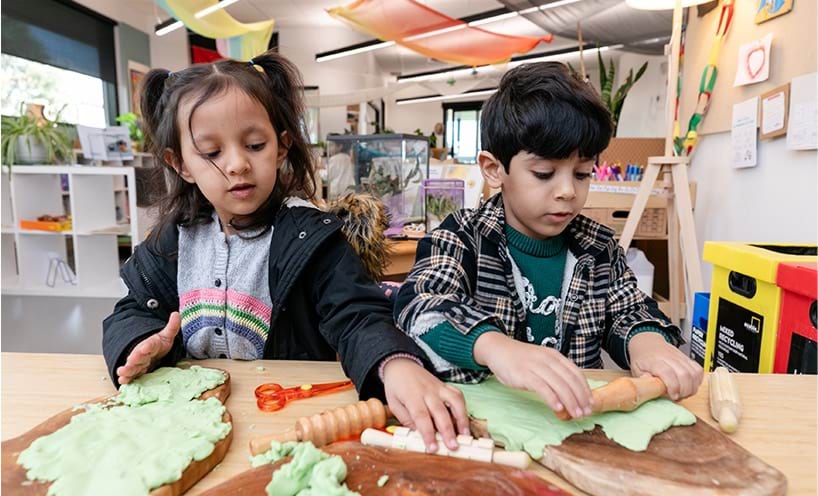
The University of Melbourne’s Educational and Developmental Gains in Early Childhood (EDGE) Study provides some of the first Australian evidence on the benefits of 3-Year-Old Kinder.
It found that 2 years are better than one. Children who attend 2 years of kindergarten have stronger language and problem-solving skills when they start school than children who attend only one year. Children benefitted more when they attended more hours per week of a quality 3-Year-Old Kinder program.
The department would like to thank the 149 early childhood services, over 2,200 children, their teachers and families across Victoria who participated in the study for their contribution to these landmark findings.
More than 3,000 services are delivering 3-Year-Old Kinder programs to more than 70,000 children across Victoria. This new evidence confirms the fantastic work early childhood services are doing is helping to give kids the best start in life.
Study findings
2 years of kindergarten are better than one
Children who completed 2 years of kindergarten gained an additional 5 months of development in language comprehension, and 2 to 3 months in early numeracy and working memory, compared with children who completed only one year.
The benefits were greater for children from socioeconomically disadvantaged backgrounds. They had a relative gain of at least 5 months in early numeracy and working memory (compared to 2 to 3 months for other children). This highlights the potential of 3-Year-Old Kinder to reduce existing disparities and promote more equitable outcomes.
The largest developmental gains were in children who:
- were funded for the full 15 hours of 3-Year-Old Kinder per week
- attended more hours of kindergarten
- attended high-quality services.
High-quality programs are achievable anywhere, and workforce matters
Researchers saw high-quality kinder programs across Victoria in very different communities and settings. This shows that excellence is not limited to socioeconomically advantaged communities.
Teacher experience was the strongest factor linked to high-quality programs. This highlights the importance of our highly skilled kindergarten workforce.
It also demonstrates the importance of providing ongoing professional learning supports for teachers and educators. The department’s Kindergarten Teaching Excellence Approach includes the new Early Childhood Hub. This is a one-stop-shop for free, evidence-based professional learning.
About the study
The independent EDGE Study is one of the largest Australian evaluations of 3-Year-Old Kinder. It is led by the University of Melbourne, in partnership with The Front Project, and funded by the Paul Ramsay Foundation and Ian Potter Foundation. The Victorian Department of Education provided administrative data to support analysis.
The study is the first in Australia to combine child outcome data with detailed information about children’s kindergarten attendance and the quality of programs they experience.
The EDGE Study team will continue to analyse the data to strengthen the findings and examine longer-term outcomes.
Further findings will be released progressively from 2027.
Find out more
For more information about the findings, refer to Educational and Developmental Gains in Early Childhood on the Front Project website.
Updated