The Motorcycle Safety Action Plan (the Plan) sets the strategic direction for the Victorian Road Safety Partners to strengthen motorcyclist safety.
The Plan sets the strategic direction for Victoria’s Road Safety Partners to help make riders safer across Victoria and forms part of the ongoing commitment to saving lives under Victoria’s 10-year Road Safety Strategy 2021-2030.
Motorcyclists are over-represented in road trauma and comprise a growing proportion of all lives lost on Victorian roads. That’s why this Plan continues to deliver initiatives that make a real difference to motorcyclist safety.
Actions will be delivered by Victoria’s Road Safety Partners:
- Department of Transport and Planning
- Victoria Police
- Transport Accident Commission
- Department of Justice and Community Safety
- Department of Health.
The Plan was developed with input from more than 100 stakeholders from across government, local councils, rider groups, training providers, motorcycle manufacturers and retailers.
Acknowledgement of Country
Acknowledgement of Country
We proudly acknowledge the First Peoples of Victoria.
The Victorian Road Safety Partners acknowledge their ongoing strength in practising the world’s oldest living culture. We acknowledge the Traditional Owners’ lands, waters and skies on which we live and work. We also pay our respects to their Elders past and present.

Description of artwork
Aaron Duggan (Gunaikurnai) ‘Movements Between the Five Clans’ 2019, acrylic on canvas. 'The tracks are going between the five clans of the Gunaikurnai and the hands are the symbols of my spirit travelling around the campsites.'
This artwork was created through programs provided by the Torch. The Torch provides art, cultural and arts industry support to Indigenous offenders and ex-offenders in Victoria. The Torch aims to reduce the rate of re-offending by encouraging the exploration of identity and culture through art programs to define new pathways upon release.
Ministerial foreword
Foreword by the Minister for Roads and Road Safety

More Victorians are riding motorcycles than ever before – whether for recreation, commuting or work. With traffic congestion benefits, cost of living pressures, and a greater interest in more environmentally friendly forms of transport, more Victorians are looking to motorcycles.
There have been notable advances in motorcyclist safety over the past decade, but riders remain highly vulnerable on our roads and continue to be over-represented in crashes causing serious and fatal injuries.
To deliver on this Plan, we’re focused on addressing the concerning rate of motorcyclist trauma now and in the future. This includes rolling out life-saving infrastructure across the state through the $40 million Motorcycle Safety Infrastructure Program.
We are also working with industry and experts to deliver a grant program that will explore innovative approaches and make better use of technological advancements and partnerships. Learnings from the evaluation of the Motorcycle Graduated Licence Scheme will also help us support newly licensed novice riders who are our most at-risk riding cohort.
We will continue to actively engage with the motorcycling community to understand their needs and support them to stay safe on our roads.
We will also continue to invest in tried and tested road safety approaches to address both persistent and emerging issues, such as the rise in electric motorcycles.
I urge all Victorians to stay alert and share the road so that everyone can get home safely.
The Hon. Paul Hamer MP
Minister for Roads and Road Safety
About the Plan
The Motorcycle Safety Action Plan (the Plan) sets the strategic direction for the Victorian Road Safety Partners to strengthen motorcyclist safety.
The Plan aims to improve safety for all riders, minimise the risk of a crash occurring and manage the severity of outcomes when a crash occurs.
It forms part of our ongoing commitment to reducing road trauma under Victoria’s 10-year Road Safety Strategy 2021–2030(opens in a new window) (Road Safety Strategy), reflects Victoria’s contribution to the National Road Safety Strategy 2021-2030(opens in a new window) and supporting action plans.
It also builds on the foundational work of the Strategic Action Plan for Powered Two Wheelers and Victoria’s strong track record in road safety.
The Plan was developed through a collaborative, evidence-based process involving research, in-depth crash data analysis, stakeholder workshops and consultation with the motorcycling community including the Motorcycle Community Engagement Panel.
Underpinned by the Safe System approach to road safety, the Plan outlines our goals and priority actions by 2030.
Motorcycle road trauma
Motorcycles remain over-represented in our road trauma.
Despite being a small portion of total registered motor vehicles (less than 4%), motorcyclists represent 18% of all fatal and serious injuries.
Motorcyclists also account for a growing proportion of lives lost on Victorian roads each year.
Tragically, 61 riders died on Victorian roads in 2025 – 21% of the state’s total lives lost (291) that year. This was a 36% increase on the annual average of 45 deaths over the previous 10 years. An increasing trend in motorcyclist deaths has also been observed nationally.
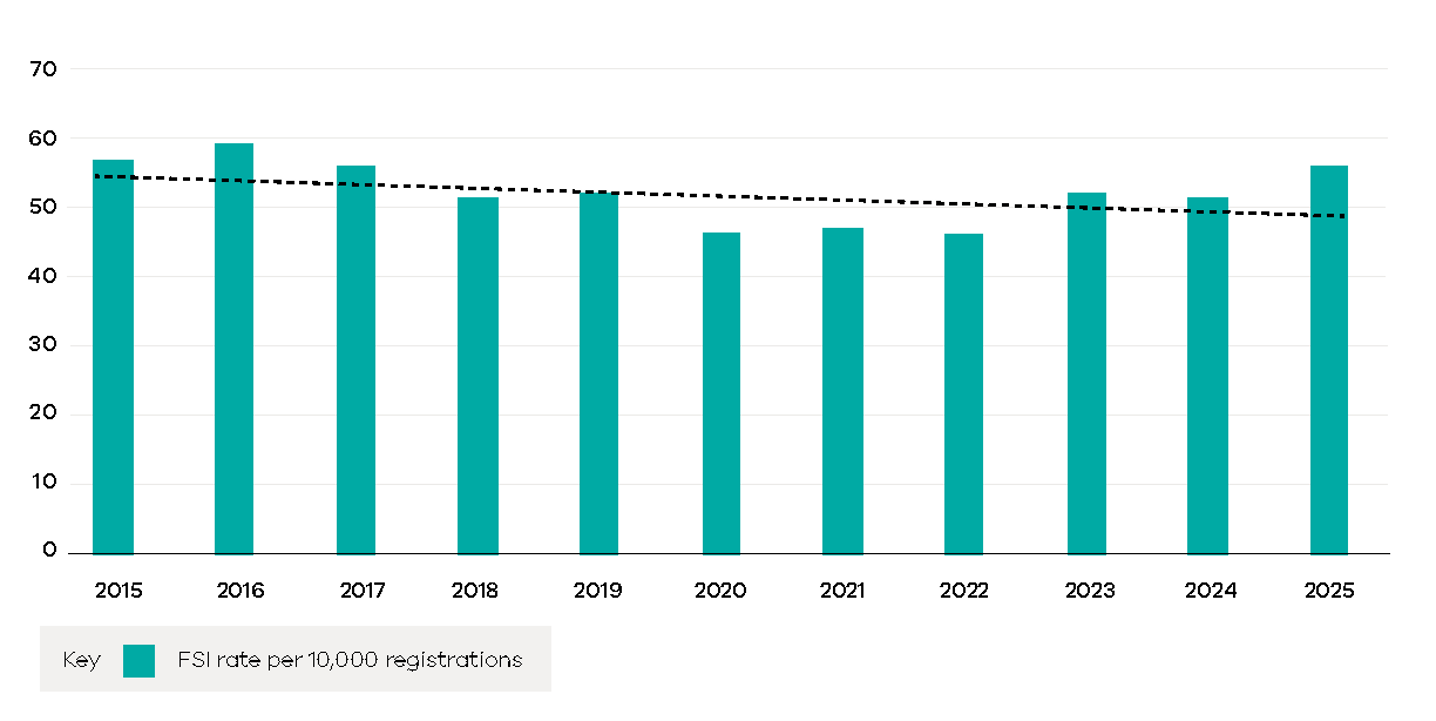
When accounting for the growth in motorcycle registrations however, the combined motorcyclist fatal and serious injury rate per 10,000 registrations appears stable, noting years 2020 and 2021 were significantly impacted by the COVID-19 pandemic (Figure 1).
Figure 1: Rate of motorcyclist fatal and serious injuries per 10,000 registrations (2015-2025)
Key challenges
Due to their unprotected nature, high travel speeds and reduced stability, motorcycle trauma is especially challenging to address.
Motorcyclists face more risks compared with other road users because:
- When involved in a crash, riders have limited protection compared with other motorists. The lack of crash protection also means fixed roadside features like curbing, trees and poles can be fatal hazards for motorcyclists.
- They are especially vulnerable to the actions and behaviour of other motorists – with their smaller size meaning they may not be seen or have their distance or speed misjudged by other road users. Drivers are also less likely to expect motorcyclists, simply because there are fewer of them on the road.
- Due to smaller tyre contact and reduced stability, surface imperfections, debris and low friction can lead to loss-of-control crashes.
- While most motorcyclists do the right thing, risk-taking behaviours persist. The likelihood and severity of a crash tend to be far greater for motorcyclists than for other motorists.
There is no ‘one size fits all’ approach. Motorcycle riders are a diverse group with different attitudes, motivations, experiences, and behaviours.
Riding on-road for recreational purposes continues to be the most common reason for riding, but motorcycling use also includes commuting, personal transportation and employment. Around 5% of active motorcyclists in Victoria ride for work purposes.
With increasing interest in motorcycling not only for recreation, but as an everyday transport and work option – we need to ensure our roads accommodate these vulnerable road users.
Progress to date
Over the last decade we have invested in a wide range of initiatives to advance motorcyclist safety.
| Year | Milestone |
|---|---|
| 2016 |
|
| 2017 |
|
| 2018 |
|
| 2019 |
|
| 2020 |
|
| 2021 |
|
| 2022 |
|
| 2023 |
|
| 2024 |
|
| 2025 |
|
| 2026 |
|
Vision, goals and priority actions
Vision
Our vision is to create a supportive road transport network for all Victorian motorcyclists, where every journey is a safe one.
2030 goals
The Plan is underpinned by eight motorcycle-specific goals.
- Increase wearing rates of personal protective gear.
- Improve the safety of priority urban and regional roads and roadsides for motorcyclists.
- Increase the uptake of safer motorcycles and other motor vehicles in the registered Victorian fleet.
- Reduce the incidence of unsafe driver and rider behaviours.
- Address priority gaps in our data and knowledge on problems and solutions.
- Support young and novice riders through a contemporary Motorcycle Graduated Licensing Scheme (MGLS).
- Embed a culture of safety and shared responsibility among riders and other road users.
- Improve the timeliness and effectiveness of post-crash response for motorcyclists.
Priority actions
Key actions include:
- Deliver a $40 million Motorcycle Safety Infrastructure Program to roll out motorcycle friendly safety treatments at high-risk sites across the state.
- Explore options for a new urban corridor safety trial to reduce road-related hazards for riders in urban environments.
- Evaluate the Motorcycle Graduated Licensing Scheme (MGLS) to identify what more we can do to protect our most at-risk cohort, novice motorcyclists.
- Respond to the growth in electric motorcycles by updating the Learner Approved Motorcycle Scheme (LAMS).
- Develop new ways to strengthen ownership and wearing rates of quality personal protective gear such as jackets, pants, boots and gloves.
Safe people
Almost half (47%) of all fatal and serious motorcyclist crashes involve another vehicle, while about half (49%) involve only the motorcycle.
There is a need to raise awareness among drivers of the presence and vulnerability of motorcyclists.
We also need to work with stakeholders to help build a stronger motorcycle safety culture across Victoria.
Excessive speeding, alcohol and drug use, distraction, fatigue and unauthorised vehicle use are significant contributors to road user trauma, including motorcyclists.
We want riders to be skilled and knowledgeable when they take to the road to help minimise personal risks throughout their riding career.
Young and novice riders are significantly over-represented in our road trauma. Learner permit holders make up 3% of total motorcycle licence holders but 11% of fatal and serious injuries. Motorcyclists aged 18-25 years make up less than 4% of total Victorian motorcycle licence holders yet 21% of motorcyclist fatal and serious.
Our evaluation of the Motorcycle Graduated Licensing Scheme will tell us more about how to best support novice riders and the core skills needed to be a safe and competent rider.
Safe people actions
Safe roads and speeds
Motorcyclist crashes happen in a diverse range of locations across the network. These include complex urban intersections, isolated winding rural roads, scenic coastal and mountain roads, and unsealed roads and tracks – each posing different hazards and risks.
Motorcycles are particularly susceptible to road hazards and adverse conditions, while roads are not always maintained with optimal safety for motorcyclists in mind.
We will prioritise investment in evidence-based road safety treatments at locations of greatest need, guided by risk and road trauma data.
The unique nature and needs of motorcycles also need to be considered in all aspects of transport policy and future transport planning.
Safe roads and speeds actions
Safe vehicles and protective gear
Motorcycle protective gear (helmet, gloves, boots, and abrasion-resistant clothing) with a high safety rating can greatly reduce injury severity in the event of a crash.
But we know riders don’t always wear all of the protective gear they own, all of the time.
Evidence shows that riders with anti-lock braking systems (ABS) are less likely to have a serious crash.
Safer vehicle purchases by other motorists are equally important. Overpowered motorcycles can make it harder for riders to control speed, traction and braking, especially on corners or in complex environments.
Beyond vehicle control and stability technologies, newer motorcycle technologies focus on the interaction between the rider and other vehicles.
Safe vehicles and protective gear actions
Post-crash care
Motorcycle crashes can be high impact and cause serious and life-altering injuries, making fast and effective post-crash care critical to saving lives.
Fellow motorcyclists are often the first on scene after a motorcycle crash.
Reducing response and transfer times decreases the odds of mortality. As such, prompt crash notification and locating motorcyclists is key.
Post-crash technologies such as Automatic Crash Notification (ACN) technologies, smart phone applications and Personal Locator Beacons (PLBs) can help emergency services be notified of a crash and locate an injured rider.
Post-crash care actions
Measuring our progress
We will monitor our progress on achieving the 2030 goals under this Action Plan alongside the broader safety performance indicators under Victoria’s Road Safety Strategy 2021-2030.
Key outcome measures will include:
- annual number of total motorcyclist and pillion passenger fatalities and serious injuries
- annual number of young and novice motorcyclist and pillion passenger fatalities and serious injuries
- annual rate of motorcyclist and pillion passenger fatalities and serious injuries per 10,000 registrations.