Victorian Government Values Statement
The Victorian Government is committed to building community harmony and ensuring every Victorian feels safe and can participate in all aspects of Victorian life. This commitment is reflected in the contractual relationship with funded organisations, which sets out the expectation that organisations will uphold the Victorian Government values and the Commitment to Social Cohesion, when delivering their funded projects.
Message from the Minister for Multicultural and Multifaith Victoria
I am pleased to announce the 2026-27 Multicultural Festivals and Events Program.
Victoria’s diversity is one of our greatest strengths and a defining part of who we are. Generations of multicultural and multifaith communities have helped shape our vibrant state, and their contributions continue to enrich our shared identity.
The Victorian Government is committed to supporting multicultural communities as they celebrate their heritage. Festivals and events play a vital role in keeping traditions alive and sharing them with all Victorians. They foster connection, understanding and respect across the many cultures that call Victoria home.
In 2026-27, the Multicultural Festivals and Events Program will provide more than $5 million for events delivered between 1 July 2026 and 30 June 2027.
An extra $1 million will be available through the Regional Multicultural Festivals and Events Fund to support events held outside metropolitan Melbourne.
As we launch this year’s program, we acknowledge the enormous contributions multicultural communities make in Victoria. Their traditions, resilience and generosity strengthen our state, and through this program, we look forward to supporting the festivals and events that bring Victorians together.

Ingrid Stitt MP
Minister for Multicultural and Multifaith Victoria
What is the 2026–27 Multicultural Festivals and Events Program?
Introduction
The Multicultural Festivals and Events (MFE) Program offers grants to help multicultural communities run events that bring people together and celebrate our shared diversity.
The program has two objectives:
- Program objective 1: To help Victorians celebrate and preserve cultures, and share traditions
- Program objective 2: To encourage all Victorians to take part in cultural events and develop understanding and respect for different cultures.
This program is:
- open – any community organisation that meets the criteria can apply
- discretionary – funding depends on how much money is available
- merit-based – applications are assessed on their strength and how well they meet the program objectives
- competitive – there is no guarantee you will receive funding or the full amount you request.
Key dates
Round 1 applications
19 March to 17 April 2026
- Applications opened Friday 19 March 2026.
- Applications closed Friday 17 April 2026 at 3 pm.
- Recipients must hold events between 1 July 2026 and 31 December 2026.
- The department will publish successful outcomes and notify applicants in:
- End of June 2026 - for July to September 2026 events
- End of September 2026 - for October to December 2026 events.
Round 2 applications
31 July to 31 August 2026
- Applications open 31 July 2026.
- Applications will close 31 August 2026
- Recipients must hold events between 1 January 2027 and 30 June 2027.
- The department will publish successful outcomes and notify applicants in:
- End of December 2026 – for January to March 2027 events.
- End of February 2027 – for April to June 2027 events.
Important: Organisations can receive funding for one event in the 2026-27 financial year, either for an event between July – December 2026 or an event between January – June 2027.
For example, if your organisation is approved for an event between July – December 2026, you will not be eligible to apply for an event between January – June 2027. This helps to ensure fair distribution and wider access of MFE funding to support more groups.
What types of grants are available?
Grants of up to $50,000 are available. The program has three funding streams to support activities that meet the program’s objectives:
You can visit the MFE program acronyms and definitions page to help you understand key terms.
Priority groups and events
The Victorian Government wants everyone to feel welcome and included no matter their background or where they live. This is why the MFE program shares the funding fairly and supports communities that have fewer resources or smaller networks.
The program is open to all eligible community organisations. To make access fairer, the program gives priority to communities that face more challenges when hosting events or reaching audiences.
These communities are:
- rural and regional communities
- new and emerging priority communities
- events that clearly include or engage:
- Women
- Young people
- LGBTIQA+
These communities may sit across multiple priority groups and often have fewer resources and networks. Giving them priority helps make cultural celebrations possible across the whole state and builds stronger community connections.
If your application meets a priority group eligibility, you may receive:
- lower attendance requirements
- reduced or no matched funding requirements
- no maximum funding limit
- a higher score in the “Engagement with priority groups” criteria.
More information is available on the funding eligibility pages:
Priority groups
Expectations of funded festivals and events
Events funded by this program must be respectful and open to all Victorians.
Acknowledgement of Country or a Welcome to Country
We encourage events to include an Acknowledgement of Country or a Welcome to Country. An Acknowledgement of Country recognises that Victoria has a strong and proud Aboriginal history and pays respect to the Traditional Owners.
More information is available on the First Peoples State Relations website: Welcome to Country and Acknowledgement of Traditional Owners.
Accessibility
Your organisation must make sure the event can be enjoyed by everyone, including people with disability. This includes but is not limited to:
- Easy physical access – Choose a venue that people can move around safely and easily. For example, entrances, paths, and toilets should be accessible for wheelchair users and people with mobility needs.
- Cultural and language inclusion – Think about language needs and cultural sensitivities so all Victorians feel welcome. This could include using clear, simple promotional materials, offering interpreters, or providing bilingual signs.
- Financial accessibility – Events must be free so everyone has an equal opportunity to attend.
Environmental impact
Your organisation must take steps to reduce harm to the environment. This includes:
- making the event more environmentally friendly
- managing waste responsibly. For example:
- advertising online instead of printing lots of paper
- avoiding single-use plastics.
Eligibility Overview
General eligibility
These are the basic rules that all applicants must meet before applying.
Organisation eligibility
Find out who can and cannot apply. As well as information on auspice eligibility.
Grant activity eligibility
Find out what events and activities can or cannot be funded.
Costs and budget eligibility
Find out what costs are and are not supported.
Funding stream eligibility
You can apply for one of the following funding streams.
Small stream (up to $5000)
A funding stream for smaller events within the MFE program.
Medium stream ($5,001 to $15,000)
Funding in the medium stream is competitive and for larger events within the MFE program.
Large stream ($15,001 to $50,000)
Funding in this stream is competitive and for events that have broad reach across Victoria.
Matched Funding, Quotes and Partnerships explained
For medium and large stream applications to be eligible, you must attach evidence of expenditure for all budget items of $10,000 and over.
More information on general eligibility and funding stream eligibility is provided on the following pages.
Organisation eligibility
Find out who can and cannot apply. As well as information on auspice eligibility.
Who can apply
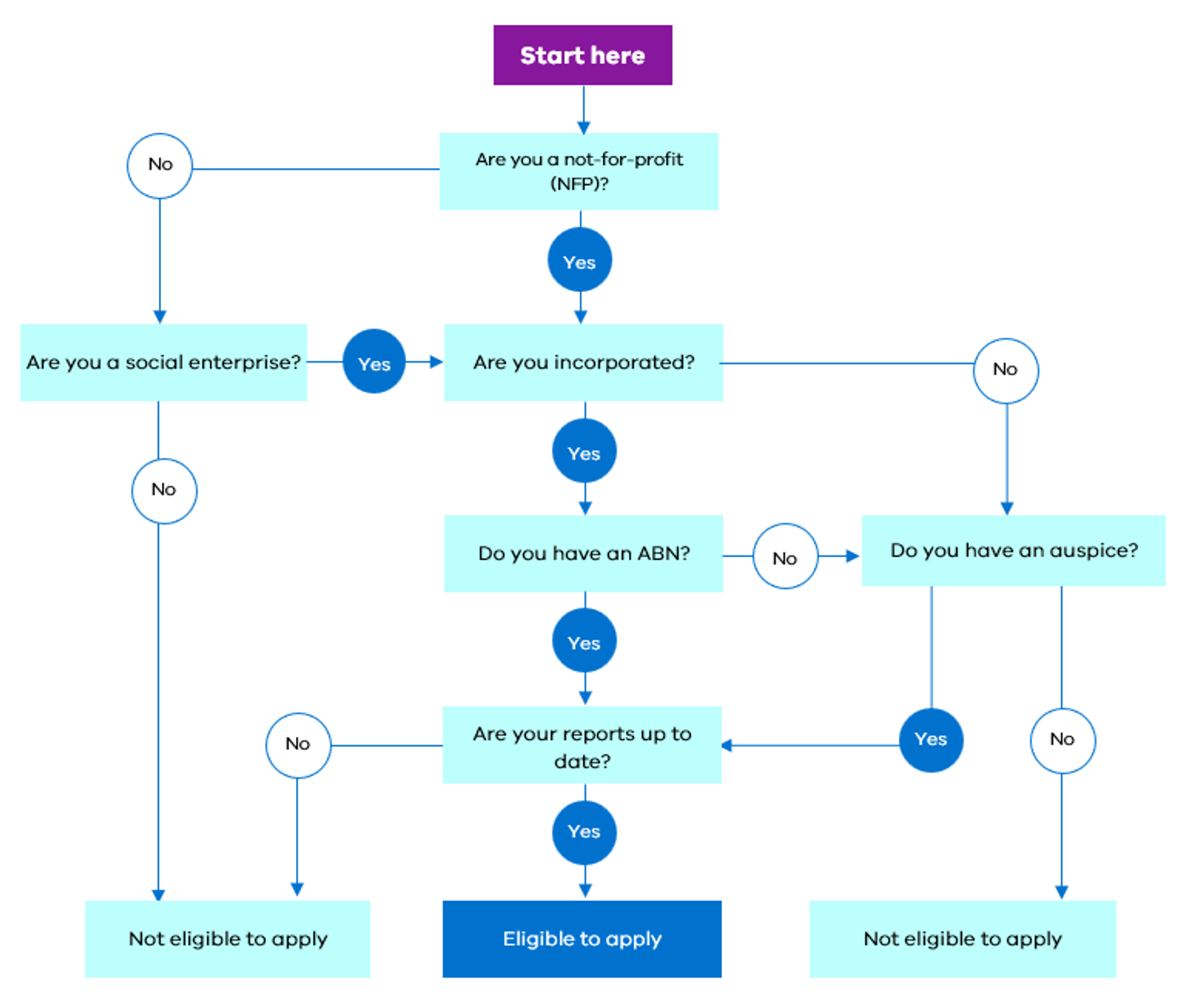
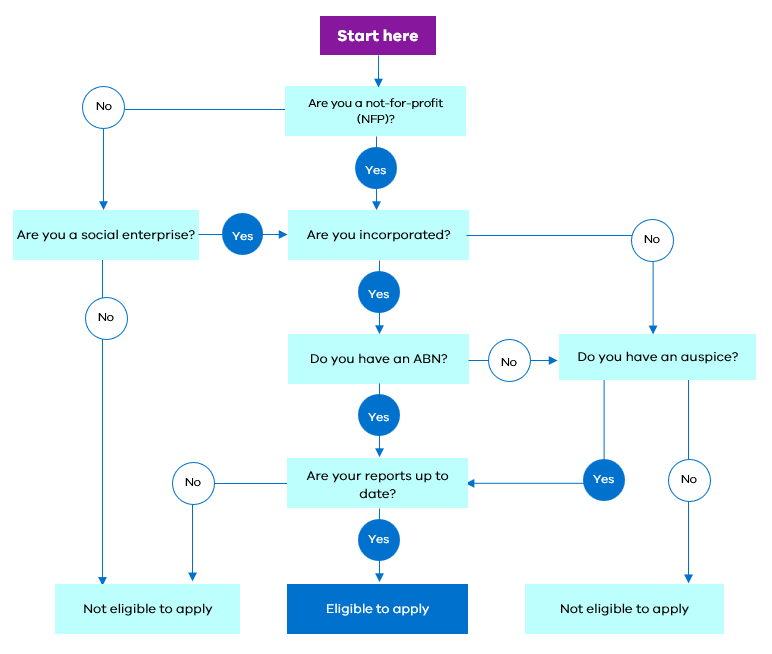
Your organisation must meet all four conditions below:
1. You must be an incorporated legal entity under one of the following:
- the Associations Incorporation Reform Act 2012 (Vic) registered with Consumer Affairs Victoria
- the Corporations Act 2001 (Cth) registered with the Australian Securities and Investments Commission (ASIC)
- an Act of Parliament. You must provide a copy of the Act with your application.
2. You must have a current Australian Business Number (ABN) matching the organisation’s name in your application
3. You must be a not-for-profit demonstrated under one of the following:
- registered with the Australian Charities and Not-for-profits Commission (ACNC)
- registered as an incorporated association with Consumer Affairs Victoria (CAV). This entity type is considered not-for-profit.
- registered as a company limited by guarantee with the Australian Securities and Investments Commission (ASIC)
- a social enterprise with a clearly stated purpose or mission related to supporting multicultural communities in Victoria.
Note: If you are not registered with the ACNC or if you are not registered with CAV as an incorporated association, you must attach a copy of your organisation’s constitution, rules or governance documents to your application to show your organisation’s not-for-profit eligibility.
4. You should have no overdue final reports from previous Victorian state government funded grants (including Multicultural Affairs grants) by 31 August 2026 for applications in Round 2.
If you are an unincorporated association or community organisation without an ABN, you can apply using an auspice. See Auspiced applications for more information.
Note: incorporated organisations are considered not-for-profit entities.
Who cannot apply
The following organisation types are not eligible to apply:
- unincorporated associations (unless applying with an eligible auspice)
- state and federal government departments, agencies and sports regulatory bodies
- individuals and sole traders
- public companies limited by shares (unless they can prove they are not-for-profit)
- commercial (for-profit) businesses
- Local Government Authorities (LGAs), including LGA-managed, operated, administered and regulated trusts. LGAs can act as an auspice for an unincorporated organisation
- registered public or private primary and secondary schools, preschools, TAFE institutes and universities. Community language schools are eligible and can act as an auspice for an unincorporated organisation
- organisations that have not followed the rules of previous Multicultural Affairs grants
- groups delivering projects that are the responsibility of another Victorian Government department
- hospitals and health service organisations
- organisations that already receive government funding for a multicultural event between 1 July 2026 to 30 June 2027.
Auspiced applications
You can apply using an auspice arrangement for the:
- small and medium stream
- large stream if you are
- a new and emerging priority community organisation or
- a rural or regional organisation.
An auspice organisation can support more than one application.
Use this chart to check whether your organisation can apply
Grant activity eligibility
What events and activities can be funded
- one day events
- multiple events held within 30 days that share the same theme or focus. Your application must explain why the events are culturally important and how they are linked together
- events that celebrate cultural and religious dates or festivals
- activities that help different communities connect, share and understand each other
- hybrid events that are in-person and online (for example, live-streaming, to reach people across the state).
Important: All promotional materials must clearly say “free entry”.
What events and activities cannot be funded
- sporting competitions (modern or contemporary sports tournaments)
- digital only activities (for example, online campaigns or events with no in-person element)
- invite-only, members-only events or VIP-only events or areas
- exhibition-only events (events that only display items without other activities)
- events that promote political parties, candidates or political causes
- conferences
- events that charge an entry fee
- fundraising events
- events focused mainly on commercial activities (for example, trade events, business activation or markets where selling goods is the main purpose)
- events already funded by the department
- events used to cover an organisation’s ongoing operating costs
- events that are dependent on recurrent annual funding
- events or related deliverables funded under an election commitment
- events advertised only in a language other than English (you can advertise in other languages, but English must also be used)
- events that run longer than 30 days
- a series of events within 30 days that do not share a clear cultural theme (or where the connection is not explained in the application)
- performance-only or talent showcase only events (if they do not include other activities for attendees)
- gala dinners
- events held in restaurants
- events held at residential settings or in private offices
- events or activities primarily funded by another state, federal or local government program
- events or activities that are the responsibility of another government body
- events or activities that have already started or finished (including anything done before the grant is approved)
- private-sector projects delivered as part
of a Victorian Government contract.
Costs and budget eligibility
Find out what costs are and are not supported.
What costs are supported
Face-to-face event costs the program can fund:
- fees for artists and performers
- food and drinks for all attendees at the event
- venue hire
- security services
- short-term staff to help run the event (for example, event or project managers)
- you must provide evidence of this arrangement as part of the acquittal process.
- advertising and promotion (such as marketing, printing and publicity)
- event equipment hire and cleaning
- auspice fees
- transport within Victoria for attendees and performers (for example, bus hire, public transport, petrol costs directly linked to the event).
Hybrid event costs the program can fund:
- digital equipment hire
- one-off venue or studio hire for live streaming or filming
- administration costs (for example, streaming membership)
- short-term digital specialist to support the event
- podcast or videocast production.
Note: All costs must show good value for money. If you are not sure whether a cost is allowed, contact the MFE team before you apply.
What costs are not supported
The program does not support:
- event materials and supplies (for example, disposable cutlery, event décor, flowers). Only up to 15% of MFE funds can be used on this cost
- ongoing salaries
- ongoing operating costs of the organisation
- public liability insurance
- costs for digital capability or website development
- business or organisation set-up or running costs, subscriptions, or licences
- costs for permits, registrations or other required approvals
- pre-event rehearsal costs (for example, venue/artist hire for dance practice)
- contingency/unforeseen costs (all costs must be itemised)
- buying:
- vouchers
- event equipment (for example tents, chairs, stages, lighting, microphones)
- cultural or religious items
- costumes
- alcohol
- digital equipment (like laptops)
- rapid antigen tests
- gifts, honorariums, prizes or awards
- private dining (for example, meals for members or volunteers only)
- travel outside Victoria
- interstate or overseas travel costs
- accommodation costs
- transport costs relating to event logistics
- expenditure items that are already receiving funding though other Multicultural Affairs grant programs.
Small stream (up to $5000)
| Eligibility criteria | Metropolitan organisation or event | New and emerging organisation | Rural and regional organisation or event |
|---|---|---|---|
| MFE Objectives | The event must meet and clearly demonstrate alignment with both program objectives | ||
| Minimum attendance | 100 people | 50 people | |
| Funding amount available | Up to $5,000 | ||
| Match funding required? | Not required | ||
| In-kind contributions required? | Not required | ||
| Mandatory documents |
| ||
Medium stream ($5,001 to $15,000)
| Eligibility criteria | Metropolitan organisation or event | New and emerging organisations | Rural and regional organisation or event |
|---|---|---|---|
| MFE Objective | The event must meet and clearly demonstrate alignment with both program objectives. | ||
| Minimum attendance | 250 people | 100 people | |
| How funding amounts apply | Maximum of $5,001 for 250 people | Maximum of $5,001 for 100 people | |
| Maximum of $10,000 for 1,000 people | Maximum of $10,000 for 400 people | ||
| Maximum of $15,000 for 1,500 people | Maximum of $15,000 for 600 people | ||
| Matched funding required? | Not required | ||
| In-kind contributions required? | Not required | ||
| Mandatory documents |
| ||
Large stream ($15,001 to $50,000)
| Eligibility criteria | Metropolitan organisation or event | New and emerging organisation | Rural and regional organisation or event |
|---|---|---|---|
| MFE Objective | The event must meet and clearly demonstrate alignment with both program objectives. | ||
| Minimum attendance | 1,500 | 600 | |
| How funding amounts apply | Maximum of $15,001 for 1,500 people | Maximum of $15,001 for 600 people | |
| Maximum of $20,000 for 2,000 people | Maximum of $20,000 for 800 people | ||
| Maximum of $30,000 for 3,000 people | Maximum of $30,000 for 1,200 people | ||
| Maximum of $40,000 for 4,000 people | Maximum of $40,000 for 1,600 people | ||
| Maximum of $50,000 for 5,000+ people | Maximum of $50,000 for 2,000+ people | $50,001 and above for 2,000+ people | |
| Matched funding required? | Yes – you must contribute $1 for every $1 granted | Yes – you must contribute $1 for every $3 granted | Not required, but allowed
|
| In-kind contributions allowed? | Yes – up to 50% of your matched amount | Yes – up to 100% of your matched amount | Not required, but allowed |
| Partnership required? | Yes – mandatory. You must partner with another community organisation in the planning and delivery of the event. A partnership letter that shows how your partner organisation will help deliver the event must be submitted with your application. If you are a metropolitan organisation delivering an event in rural/regional Victoria, to be eligible for the RMFEF you must partner with a rural/regional multicultural organisation and provide a partnership letter from your regional partner organisation. | ||
| Documents you must provide |
| ||
Matched Funding, Quotes and Partnerships explained
Matched funding (Large stream only)
The MFE program provides an opportunity for the Victorian Government to co-invest in multicultural festivals and events. Funding provided under the MFE program is considered a contribution to total event costs, and events should not rely on the contributions of this program.
Matched funding forms part of the eligibility criteria for the MFE large stream. It is not required under the small or medium stream, or for large stream applications under the RMFEF.
Your matched funding can come from your organisation and other sources, such as partners and other grants.
A portion of matched funding can be contributed in-kind (for more information see ‘In-kind contribution’ definition). It is important to consider that different ratios apply. Organisations applying under the large stream will only be eligible to receive the amount of funding they have matched, according to the requirements in the large stream eligibility table (see ‘Large stream eligibility’).
For example, if you are a metropolitan organisation applying for $50,000 and can only demonstrate (through the budget section) that you can contribute $25,000 as matched funding, you will only be considered eligible to receive up to $25,000.
The following are examples of matched funding calculations.
Metropolitan applications
If you request $20,000 from the program, your organisation must contribute $20,000 towards the event. Up to $10,000 of your matched funding contribution can be from in-kind support.
New and emerging priority community applications
If you receive $18,000, your organisation must contribute $6,000 in matched funding.
In this example, the entire $6,000 can be in-kind.
Quotes for expenditure items of $10,000 and over
For medium and large stream applications to be eligible, you must attach evidence of expenditure for all budget items of $10,000 and over, where MFE program funds will be used to support the cost. Evidence of expenditure includes quotes and must be for the event that you are seeking funding for.
You do not need to supply a quote if you can break down the total amount into smaller line items in the budget template.
For example, if the total performer fees are $10,500, you can explain this in the budget as:
- performer 1 - $3,500
- performer 2 - $3,500
- performer 3 - $3,500
A quote will be ineligible if:
- it does not include the letter head and ABN of the company providing the service or item
- the quote does not match the activity, service or cost listed in the budget
- the quote is older than 24 months before the application deadline
- the MFE template budget does not match the costs in the online application budget section.
Partnerships
Working in partnership means your group works together with at least one other community organisation to plan and run your event.
Partnering with another organisation can help you by:
- building understanding and stronger relationships between different communities
- sharing knowledge, which can make your organisation stronger when delivering events
- reaching more people, including communities from different cultures, faiths and locations
- sharing resources, such as venues, volunteers, equipment or marketing, and gaining access to useful networks.
Your partnership letter must explain how the other organisation will help deliver the event.
What your partnership letter must include:
- the partner organisation’s name and ABN, and be signed by someone who is authorised to sign for that organisation
- a clear description of what the partner organisation will do, including their roles and responsibilities in planning and delivering the event.
Letters that are not eligible:
- general letters of support that only show endorsement and do not explain a clear role
in the event - letters from non-community organisations, such as Members of Parliament, local council representative, businesses, individuals or sole traders. Applicants are strongly encouraged to work with the following to show cross-cultural partnerships:
- a new and emerging priority community organisation, or
- an organisation from outside your own community.
- Intercultural and interfaith partnerships are also strongly encouraged.
How will your application be assessed?
All applications will be checked to make sure they meet the eligibility requirements. This is called an eligibility assessment.
For more details on funding stream eligibility see information on:
Small stream applications only go through an eligibility assessment.
Only medium and large stream applications that pass the eligibility check will move to the next stage, called a merit assessment. A merit assessment looks at the quality, impact and community benefit of your event.
If a medium or large stream application does not meet a specific merit criterion (such as priority group engagement or demonstrated capacity) it will receive no score for that criterion.
Merit assessment criteria (medium and large stream only)
| Assessment criteria | Criteria guidance | Weighting |
|---|---|---|
| How your event supports the program objectives | To have the best chance of being funded, your application must show how your event supports the two objectives of the program. Program objective 1: to help Victorians celebrate and preserve cultures, and share traditions We look at how well your event:
Program objective 2: to encourage all Victorians to take part in cultural events and develop understanding and respect for different cultures We look at how well your event:
| 40% |
| Budget | Your budget needs to show that the event offers good value for money. The costs you list must be accurate, reasonable, and clearly linked to running your event. You must:
Additional requirements for the large stream only: If you are applying for the large stream, you must also:
| 25% |
| Your experience and skills to run the event | Your application must show that your organisation can successfully plan and deliver the festival or event. You must attach your project plan using the MFE template with your application. We look at the following: Your project plan: You must include a clear project plan (using the MFE template). The plan should show:
You need to show that your organisation has the skills, experience or resources to run the event well. You can do this by including:
Organisations are encouraged to include a list of past events and the resources they already have. Providing this will help increase the criteria score. | 20% |
| Engagement with priority groups | Your applications must show whether your event will mainly involve or support one of the priority groups listed below:
To receive a score for this criterion, explain:
For example:
| 15% |
Assessment process overview
Step 1. Eligibility assessment
We look at every application to make sure they meet eligibility criteria.
Step 2. Merit assessment (medium and large streams only)
We assess all eligible medium and large applications against the merit assessment criteria.
Step 3. Assessment panel
An assessment panel comprising relevant experts will review applications in all streams.
Step 4. Ministerial approval
The Minister for Multicultural and Multifaith Victoria makes the final decision based on the recommendations.
Step 5. Outcome notification
All applicants are notified of the outcome via email.
Submitting your application
What you can expect from the application process.
To make sure your application is accepted, remember to:
- read the 2026-27 MFE program guidelines carefully before starting your application online
- check the application closing time and date and set a reminder
- fill out the application form as early as possible
- make sure the event meets all eligibility criteria for the stream you are applying under. Use the checklist in the appendix section to prepare all items
- answer all questions and upload the correct documents
- attend an information session. For available sessions, please visit the Multicultural Festivals and Events Program webpage
- submit your application through the online portal by 3pm on Monday 31 August 2026 for Round 2 applications
- only submit one application per organisation. Please note that organisations and any affiliated organisations with the same ABN can only submit one application per round. If you submit more than one application, the department will only assess the first application
- Applications should not assume they will receive funding, nor the level of funding requested. If your application is successful, the funded amount may be less than what you requested. Consider other funding sources in case your application is unsuccessful or only partly funded
- events previously funded are not guaranteed to receive funding, and the amount of funding may vary
- do not make commitments until you are formally notified of the outcome of your application.
Please note: we will not accept late or incomplete applications or documentation.
Successful grant recipients
Funding agreements
- if your organisation is successful, you must sign the Victorian Common Funding Agreement (VCFA) within 30 days of receiving the funding offer
- if you do not sign the agreement in time, the department may withdraw the grant
- the VCFA will explain:
- the terms and conditions
- how you can use the funds
- what you must deliver and by when
- your reporting requirements
- you will receive the VCFA electronically, and it must be signed online by the deadline
- printed copies are not accepted
- if you do not sign the VCFA, you will not receive the funding.
Use of funds
Your organisation must:
- use the grant during the activity period set out in the VCFA
- meet all conditions listed in your letter of offer or funding agreement, such as
- minimum attendance
- matched funding (if required)
If these conditions are not met, you will need to return the funds.
Insurance
- all funded events must have public liability insurance
- it is the responsibility of the organisation to source an appropriate insurance provider.
- you do not need to submit proof when signing the VCFA, but insurance must be in place for your event. This a condition of funding.
Good and Services Tax (GST)
If your organisation is:
- registered for GST: GST will be added on top of your grant amount
- not registered for GST: you will receive only the grant amount (no GST added).
The Australian Taxation Office (ATO) treats grants and sponsorships as taxable income.
For tax or GST questions, call 13 28 66 or visit the ATO website.
Final reports
- if you receive funding, you must complete an online final report through the Grants Gateway portal
- the report must meet all requirements listed in your funding agreement.
Do you need more information or help?
Information sessions
- there will be online information sessions to help you with the application process
- we will deliver these sessions online
- dates, times and details will be available on the Multicultural Festivals and Events Program webpage.
Contacting the Multicultural Affairs Programs and Grants team
We encourage you to ask for advice with your application. Asking questions can help strengthen your application and make the process easier. Contact the Multicultural Affairs Programs and Grants team by:
- phone on 1300 112 755
- or email multicultural-festivals.events@dpc.vic.gov.au
More information
- to access the program’s frequently asked questions and application form guidance, please visit the Multicultural Festivals and Events Program webpage
- for information and guidance on the below topics and other resources, please visit applying and reporting multicultural grants
- how to write a grant application
- grant terminology explained
- understanding in-kind contributions
- auspice and partnership applications
- case studies.
MFE program acronyms and definitions
| ABN | Australian Business Number |
|---|---|
| ABR | Australian Business Register |
| Acknowledgement of country | It's a way of showing awareness of, and respect for, the Aboriginal Traditional Owners of the land where a meeting or event is held. An Acknowledgement of Traditional Owners can be done by anyone. |
| ACNC | Australian Charities and Not-for-profits Commission |
| Auspice arrangement | An auspice arrangement is when a larger organisation partners with a smaller organisation to fund a grant activity or event. The larger organisation is known as the auspice organisation. Your organisation or community group is known as the grant recipient. |
| Auspice organisation | An auspice organisation is an organisation who manages grant funding on another organisation's behalf. This will include taking responsibility to:
|
| Community organisation | These are not-for-profit organisations that exist to support and improve the well-being of people and communities. They run programs, services or projects that help the community in general, or support groups of people who need extra help because of age, disability, financial situation or social circumstance. |
| DFFH | Department of Families, Fairness and Housing |
| DPC | Department of Premier and Cabinet |
| Eligibility assessment | Checking whether an organisation meets the basic rules or requirements to take part in a program or grant. |
| Eligible | Your organisation or project meets the rules and requirements to apply for or receive funding. |
| Funding stream | Funding streams indicate the various funding amounts available for a grant program. Each funding stream may have different eligibility, application and project requirements depending on the funding stream. |
| GST | Goods and Services Tax |
| Ineligible | Your organisation does not meet the rules and requirements, so it cannot apply for or receive funding. |
| In-kind contribution | An in-kind contribution is a contribution of goods or services to your event, other than money, which would normally have a financial value. Examples:
|
| LGA | Local Government Authority |
| LGBTIQA+ | Lesbian, Gay, Bisexual, Trans and gender diverse, Intersex, Queer, or Asexual |
| Matched funding | Under the large stream, the organisation must financially contribute to the project as well, whether through a dollar or in-kind amount. This is called matched funding. |
| Merit assessment | Looking at the quality or strengths of an application or idea to decide which ones are the best or most suitable. |
| MFE | Multicultural Festival and Events |
| Multicultural | Racially and ethnically diverse people who live in Victoria. |
| New and emerging priority communities | Communities of migrants and refugees that have recently arrived in Australia. These groups may need extra support in the settlement process. The main identifiers are:
|
| Not-for-profit organisation | An organisation that does not work to make money for its owners or members, whether directly or indirectly. A not-for-profit organisation can still make a profit, but this profit must be used to achieve the purposes of the organisation - not given to owners, members or private individuals. |
| Public companies limited by shares | A type of company that is listed on the stock market and owned by shareholders. |
| Public liability insurance | Public liability insurance protects your organisation or community group if someone from the public is injured or their property is damaged because of your activities. It helps cover the costs of claims or legal action. |
| RMFEF | Regional Multicultural Festivals and Events Fund |
| Rural and regional Victoria | These are the five regions listed in the Regional Development Victoria Act 2002:
|
| Social enterprise | Social enterprises are organisations that:
|
| TAFE | Technical and Further Education |
| Unincorporated associations | A group of people who come together for a common purpose, like a community group, without becoming a formal legal organisation. |
| Value for money | All supported costs must show good use of funding. This means the cost should be accurate, reasonable, necessary for the event, and provide clear benefit to the community. |
| VCFA | Victorian Common Funding Agreement |
| Welcome to Country | A Welcome to Country ceremony is performed by Aboriginal Traditional Owners for people visiting their Country. These ceremonies vary from speeches of welcome to traditional dance and smoking ceremonies. |
Appendix 1: MFE Checklist
| Criteria | Guideline section | You must check yes to all to be eligible |
|---|---|---|
| All streams | ||
| Does your event meet program objective 1? | What is the multicultural festivals and events program? | Yes or No |
| Does your event meet program objective 2? | What is the multicultural festivals and events program? | Yes or No |
| Is your organisation type eligible? | Organisation eligibility | Yes or No |
| Do your activities meet the program activity requirements? | Grant activity eligibility | Yes or No |
| Are all event costs supported? | Cost and budget eligibility | Yes or No |
| Does your event meet the attendance threshold for the stream selected and the amount requested? | Yes or No | |
| Does your organisation have any overdue final reports? | Organisation eligibility | Yes or No |
| Have you attached an auspice letter (if using an auspice)? | Organisation eligibility | Yes or No |
Have you attached a copy of your organisation’s constitution, rules or governance documents – only if you are:
| Organisation eligibility | Yes or No |
| Has the online application form been completed and submitted before 3pm on 31 August 2026 (for Round 2 applications)? | Yes or No | |
| Medium stream only | ||
| Have you attached the project plan (you must use the MFE template available online)? | Yes or No | |
| Have you attached quotes for items $10,000 and over? | ||
| Large stream only | ||
| Have you attached the project plan (you must use the MFE template available online)? | Yes or No | |
| Have you attached the Total Event Budget (you must use the MFE template available online)? | Yes or No | |
| Have you attached quotes for items $10,000 and over? | Yes or No | |
Have you attached a partnership letter that has:
| Yes or No |