

Victoria’s diverse economy employs around 3.8 million Victorians4 and is home to 754,000 businesses.5 Almost two-thirds of Victorians are currently employed, which is near record highs.6
Around 373,000 new workers are expected to enter the Victorian labour market over the next 3 years, including 143,000 workers in new jobs and 230,000 workers replacing retiring workers. Over the coming decade, around 1.5 million new workers are expected in the Victorian labour market.
Detailed analysis of employment trends in Victoria is provided in the accompanying Snapshot of the Victorian Labour Market report and the VSA’s Employment Projections Dashboard.
Participation in training and employment can be higher for some Victorians
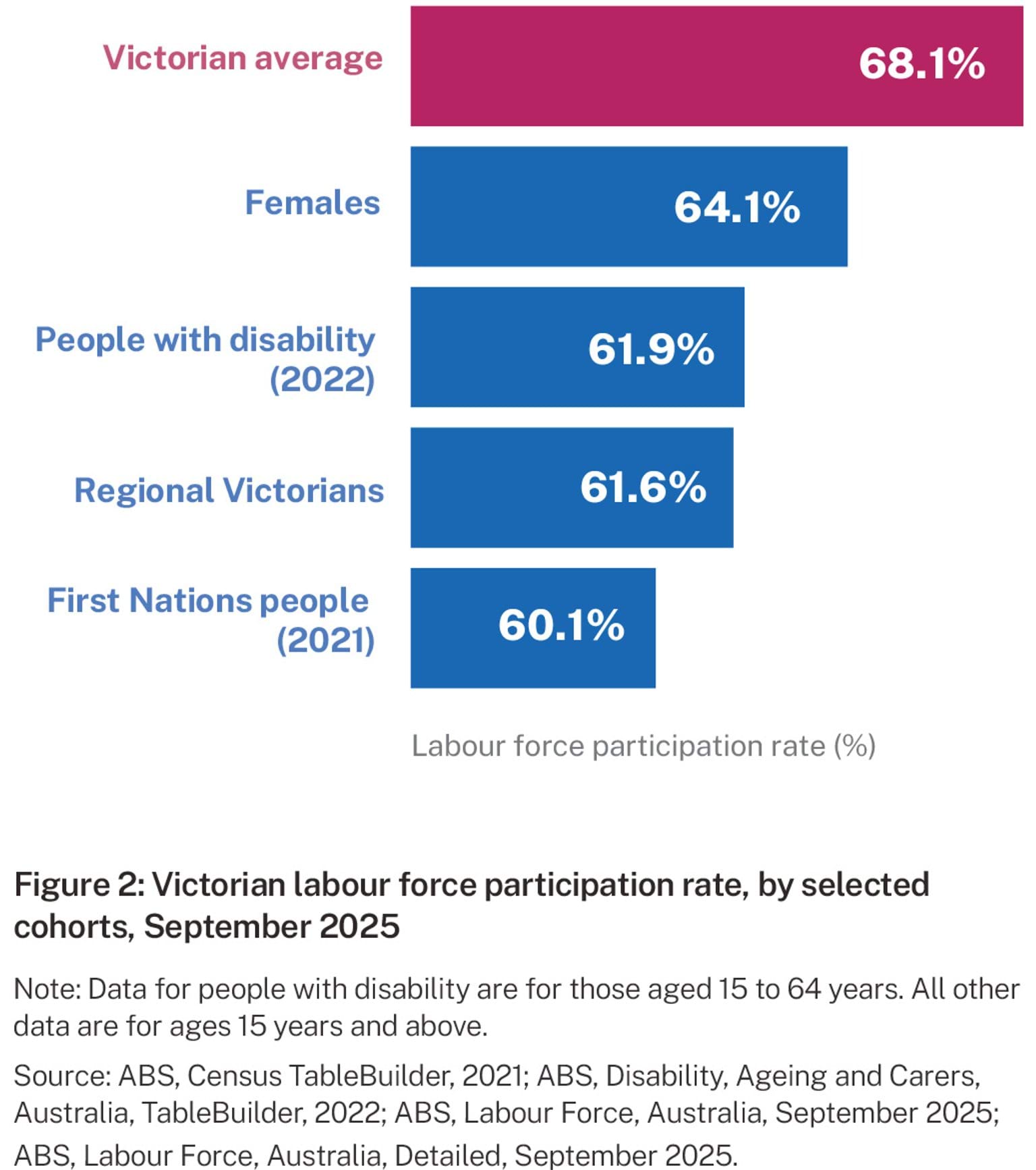
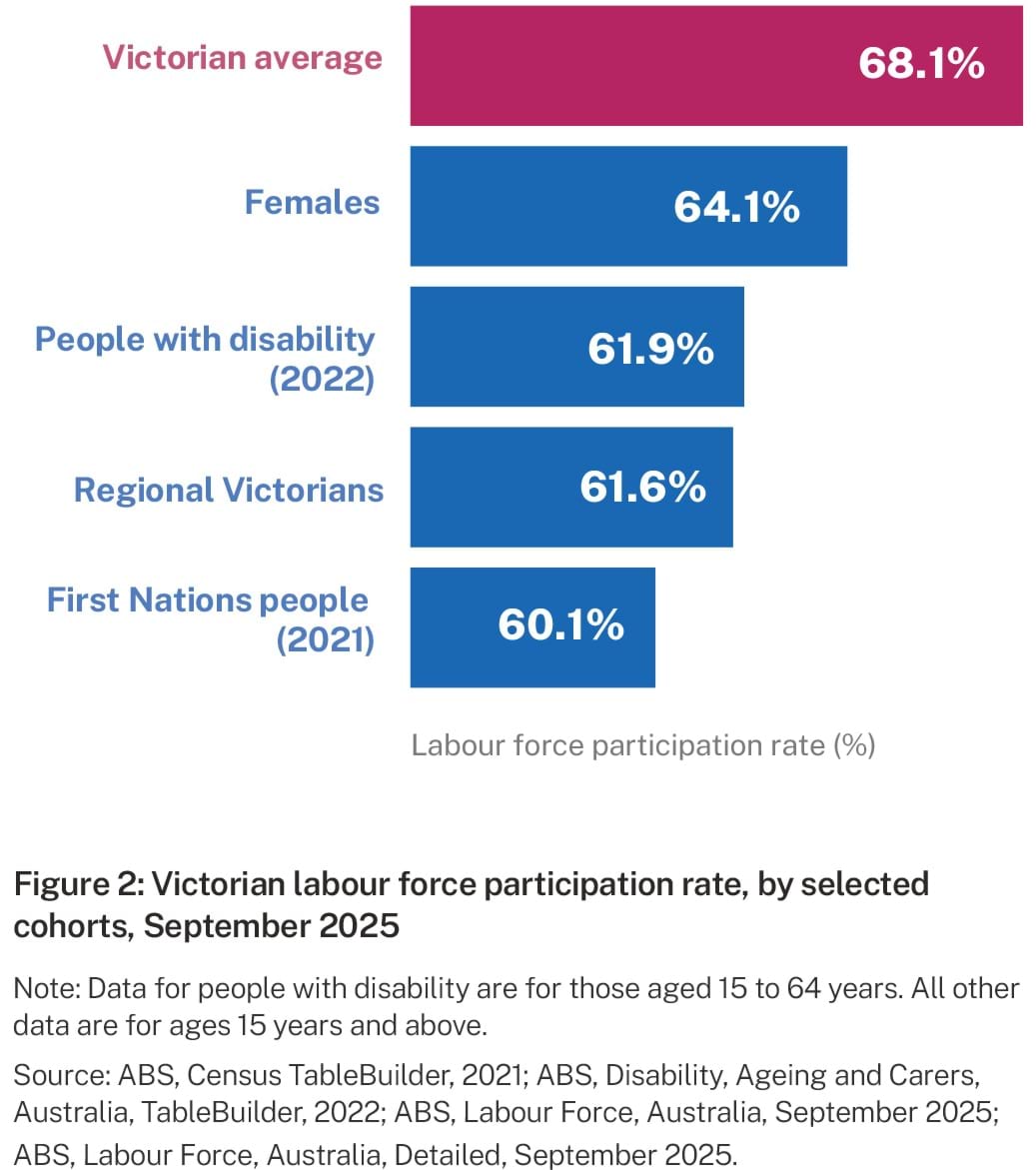
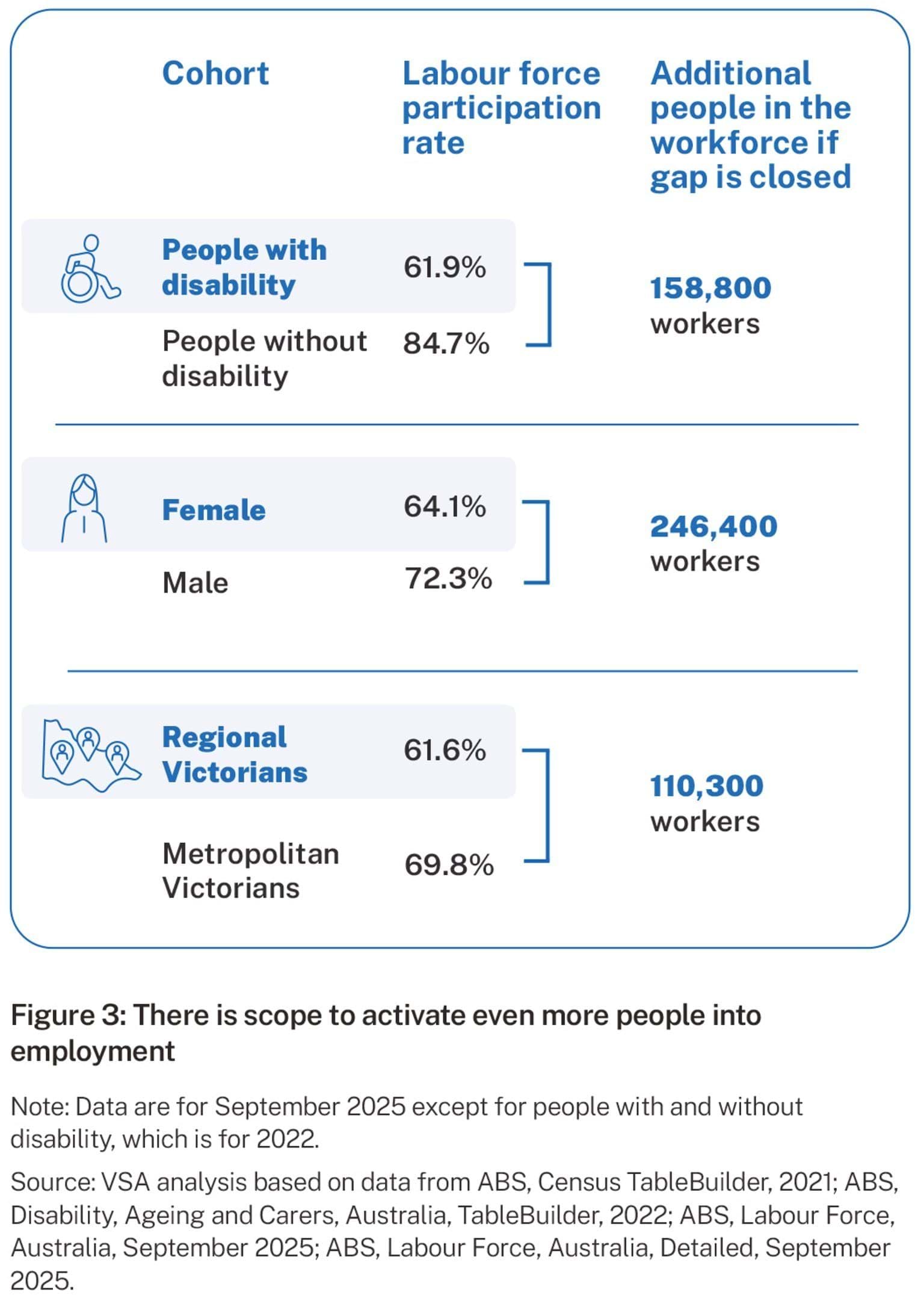
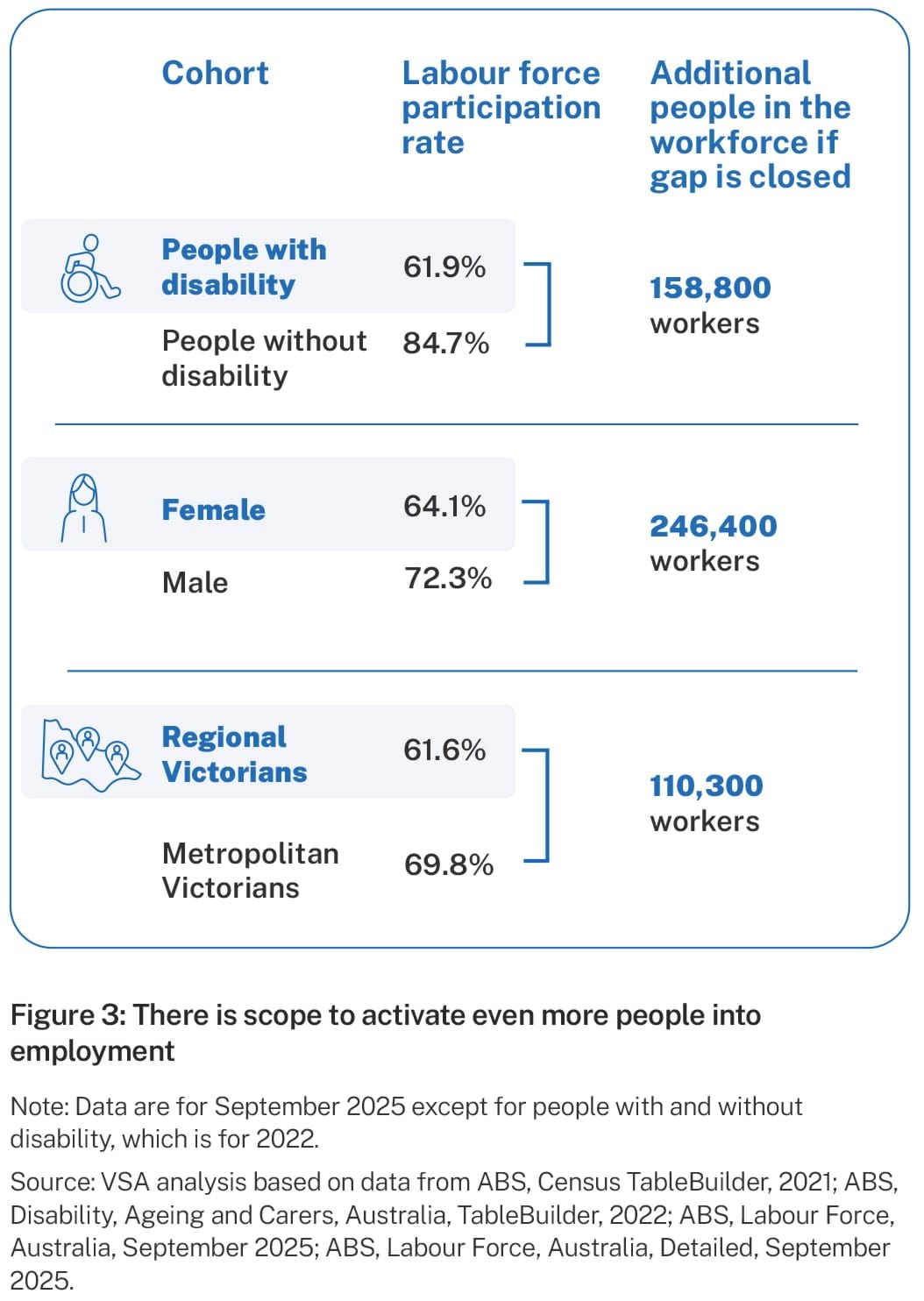
Not all Victorians are working to the extent they would like and there is scope to address participation barriers and assist even more people into employment. For example, there could be up to 246,400 additional workers if the female labour force participation rate (64.1%) increased to match the male participation rate (72.3%) (Figures 2 and 3).
Figure 2: Victorian labour force participation rate, by selected cohorts
The gender imbalance in employment is evident across industries. In 2025, females accounted for 76% of workers in health care and social assistance and 69% in education and training, but only 28% in manufacturing and 13% in construction.7
The Victorian Government is breaking down barriers for Victorians to undertake vocational education and get a job. For example:
- the VSA's Skills and Jobs Centres offer free career, employment and training support services to help Victorians achieve their training and career goals.
- people with disability are supported in their training with a range of reasonable adjustments at TAFEs and access to support officers and careers advisers. Victoria's Inclusive Victoria: State Disability Plan 2022–26 (extended to 2027) aims for everyone to have access to mainstream education that is inclusive and linked to good employment outcomes.8
- women are supported into traditionally male-dominated sectors through initiatives like the Women Onsite and Women in Trades projects, Trade & Tech Fit Expo, Women in Security Program, as well as the Women in Manufacturing Strategy and the upcoming Women in Energy Strategy. In addition, the Safe Workplaces for Women initiative supports women experiencing workplace gendered violence and sexual harassment.
- the Local Skills Partnership Program supports inclusive training in regional Victoria and addresses skills shortages for local businesses and industries.
Figure 3: There is scope to activate even more people into employment
Through vocational education and training, Victorians can get into in-demand jobs across the state
Workers with post-secondary qualifications will continue to be the foundation of Victoria’s workforce. Nearly half of the new workers projected in the next 10 years, or 716,000 people, are expected to be in jobs that usually need a VET qualification (Figure 4), including:
- 155,000 new workers who will generally acquire an associate degree, advanced diploma or diploma to work in jobs such as medical technicians and welfare support workers.
- 177,000 new workers who will generally require a Certificate III (including at least 2 years of on-the-job training, such as an apprenticeship) or Certificate IV to work in the trades and other roles like child carers/early childhood educators.
- 384,000 new workers who will generally acquire a Certificate III (non-apprenticeship) or Certificate II for jobs like ageing and disability carers and nursing support and personal care workers. Many traineeships fall into this category.
After completing VET qualifications, graduates can work in a range of in-demand jobs that offer them good earnings and good career prospects (Table 2).
Apprentices and trainees can earn a wage while completing formal study. Pre-apprenticeship courses are also available that allow learners to gain exposure and experience in an industry to prepare them for an apprenticeship.
Find out more about the training and skills needed for in-demand and emerging jobs on the Victorian Skills Gateway.
Figure 4: New workers expected over 2025–35, by qualification level and type
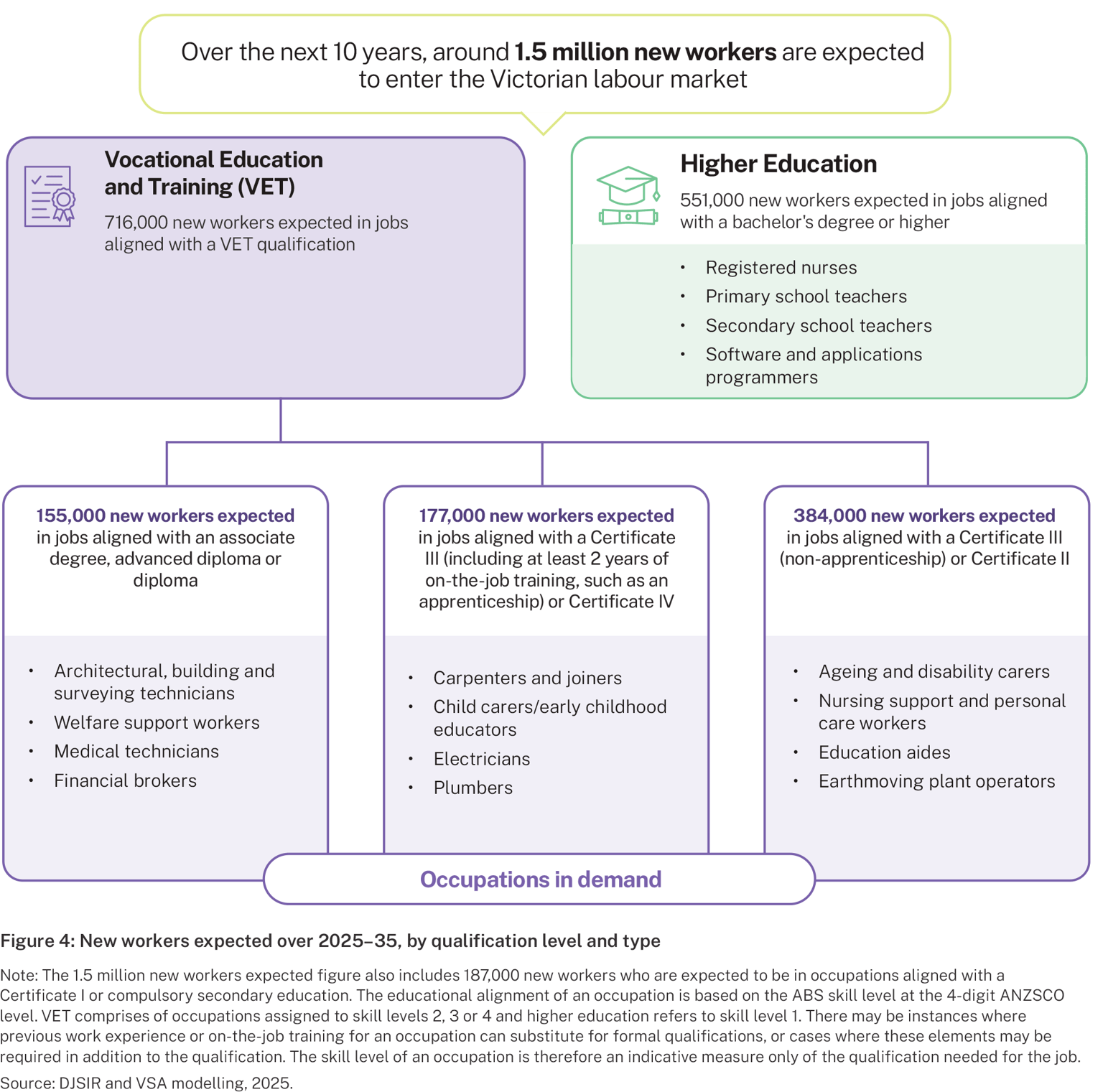
Table 2: TAFE pathways into occupations in demand have strong outcomes in Victoria
Note: The table has been split into 4 smaller tables to improve accessibility.
Health care and social assistance industry
| Occupations in demand | Average adult full-time weekly total cash earnings (2023) | TAFE pathway into occupation | Proportion of students in a job after training (2025) | Free TAFE |
|---|---|---|---|---|
| Ageing and disability nurses | $1,271 | Certificate III in Individual Support | 78% | Yes |
| Ageing and disability nurses | $1,271 | Certificate IV in Ageing Support | 83% | Yes |
| Ageing and disability nurses | $1,271 | Certificate IV in Disability Support | 85% | Yes |
| Ageing and disability nurses | $1,271 | Diploma of Community Services | 77% | Yes |
| Registered nurses | $2,166 | Diploma of Nursing Note: Qualifies graduate as an enrolled nurse and can support transition into the Bachelor of Nursing (required to become a registered nurse) | 77% | Yes |
| Nursing support and personal care workers | $1,398 | Certificate III in Health Services Assistance | 76% | Yes |
| Nursing support and personal care workers | $1,398 | Certificate IV in Allied Health Assistance | 72% | Yes |
Construction industry
| Occupations in demand | Average adult full-time weekly total cash earnings (2023) | TAFE pathway into occupation | Proportion of students in a job after training (2025) | Free TAFE |
|---|---|---|---|---|
| Carpenters and joiners | $2,150 | Certificate III in Carpentry APPRENTICESHIP | 96% | - |
| Carpenters and joiners | $2,150 | Certificate IV in Building and Construction UP-SKILL | 87% | Yes
|
| Construction managers | $3,217 | Diploma of Building and Construction (Management) | 100% | -
|
| Construction managers | $3,217 | Diploma of Building and Construction (Building) | 86% | Yes |
| Plumbers | $1,757 | Certificate III in Plumbing APPRENTICESHIP | 96% | -
|
| Plumbers | $1,757 | Certificate IV in Plumbing and Services UP-SKILL | 98% | * |
Education and training industry
| Occupations in demand | Average adult full-time weekly total cash earnings (2023) | TAFE pathway into occupation | Proportion of students in a job after training (2025) | Free TAFE |
|---|---|---|---|---|
| Primary school teachers | $1,904 | Diploma of Teacher Education Preparation Note: Supports transition into higher education qualifications | 75% | - |
Note: * Free TAFE for this qualification has been replaced with a number of Free TAFE short courses in licensed plumbing.
Courses denoted with ‘Up-skill’ provide qualified workers with additional skills and other benefits, such as a licence to perform certain works.
All data are for Victoria. Apprentices are paid for time spent on the job and in trade school and typically receive payment or reimbursement under the award for a range of expenses incurred during their training, including course fees and textbooks. An apprentice undertaking the apprenticeships above may also be eligible to receive a Key Apprenticeship Program payment of up to $10,000 if they are working in the residential construction or clean energy sectors.9
Traineeship options are available for all courses above except for those that have an apprenticeship pathway, the Diploma of Teacher Education Preparation and the Certificate IV in Plumbing and Services. A learner undertaking the health care and social assistance or school-based education support qualifications through a traineeship may also be eligible to receive an Australian Apprenticeship Training Support Payment of up to $2,500.10
Source: ABS, Employee, Earnings and Hours, 2023, TableBuilder; DJSIR and VSA modelling, 2025; Victorian Skills Authority Student Satisfaction Survey, 2025.
Updated