

New technologies, such as AI, the Internet of Things (IoT) and robotics, are being adopted by employers across the economy. AI is creating new jobs and transforming workplace processes and tasks and influencing the skills that workers need. To succeed in an increasingly technology-driven workplace, workers need digital skills as well as non-technical skills.
AI refers to a machine-based system that is able to generate outputs such as predictions, content, recommendations or decisions that influence physical or virtual environments based on input it receives. AI can take various forms, including:32
- Generative AI (Gen AI), which uses models to produce content including text, images and videos33
- Agentic AI, which is the latest wave of AI that can accomplish multi-step tasks with little or no human oversight (such as customer service).34
The Victorian Government is harnessing AI to boost productivity, foster innovation and create new opportunities
The economic potential and benefits of AI are significant. Over the next decade, AI has the potential to boost Australia’s labour productivity by about 4.3%35 and deliver up to $30 billion additional gross state product for Victoria.
Realising the opportunities from AI is a central tenet of Victoria’s Economic Growth Statement, with digital technologies identified as a priority growth sector for the state. Innovations such as data integration analytics, advanced weather and climate forecasting and generative AI chatbots are examples of transformative AI breakthroughs.36
The Victorian Government is taking active steps to grow the state’s digital and AI ecosystem by:
- streamlining investment facilitation through the Investment Front Door – a single-entry point for businesses, including data centres
- providing $150 million for the Victorian Investment Fund to further support investment attraction, including in AI37
- investing $10 million in the Australian Centre for Artificial Intelligence in Medical Innovation at La Trobe University38
- expanding the Digital Jobs Program to offer specialist digital skills training for construction and advanced manufacturing businesses, including AI and machine learning.39
AI is creating new jobs and changing existing jobs
Through augmentation, AI tools can improve the quality and scope of work and enable workers to perform a broader set of tasks. For example, by using screening tools to analyse images and identify issues, medical professionals can use AI to enhance their diagnosis and treatment of patients.40
AI tools can automate tasks like generating and translating text, handling routine queries through chatbots, entering data, and parsing legal documents. For example, AI can automate supply network controls in manufacturing to better manage disruptions to the supply chain.41 AI allows people to spend more time on high value work and human connection.
The use of AI is creating new jobs across the economy. For example, prompt engineers design and refine instructions for AI models and tools.42 In sectors such as prefabricated construction, robotics engineers use AI to optimise manufacturing processes and allow robotic systems to handle more complex tasks.43
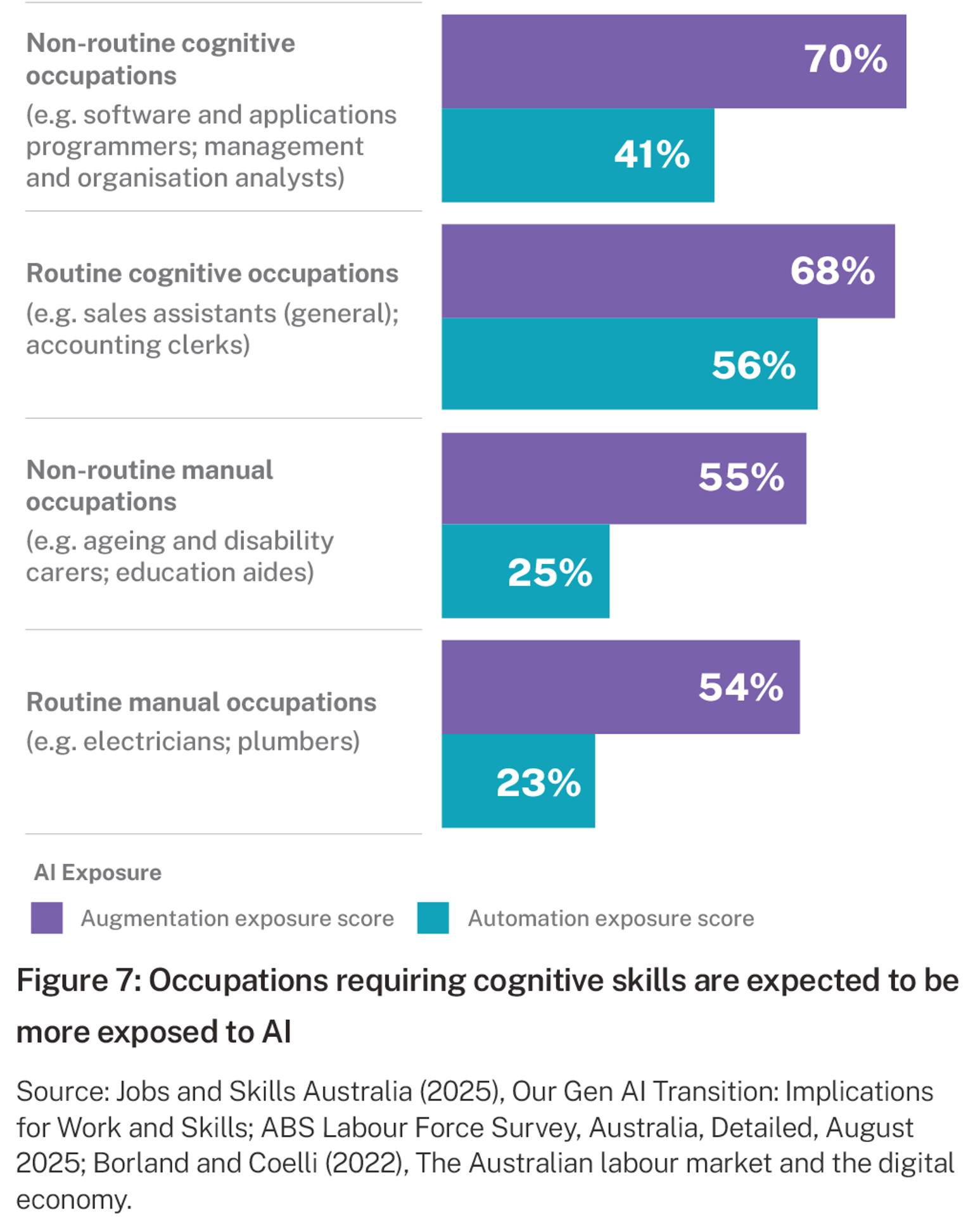
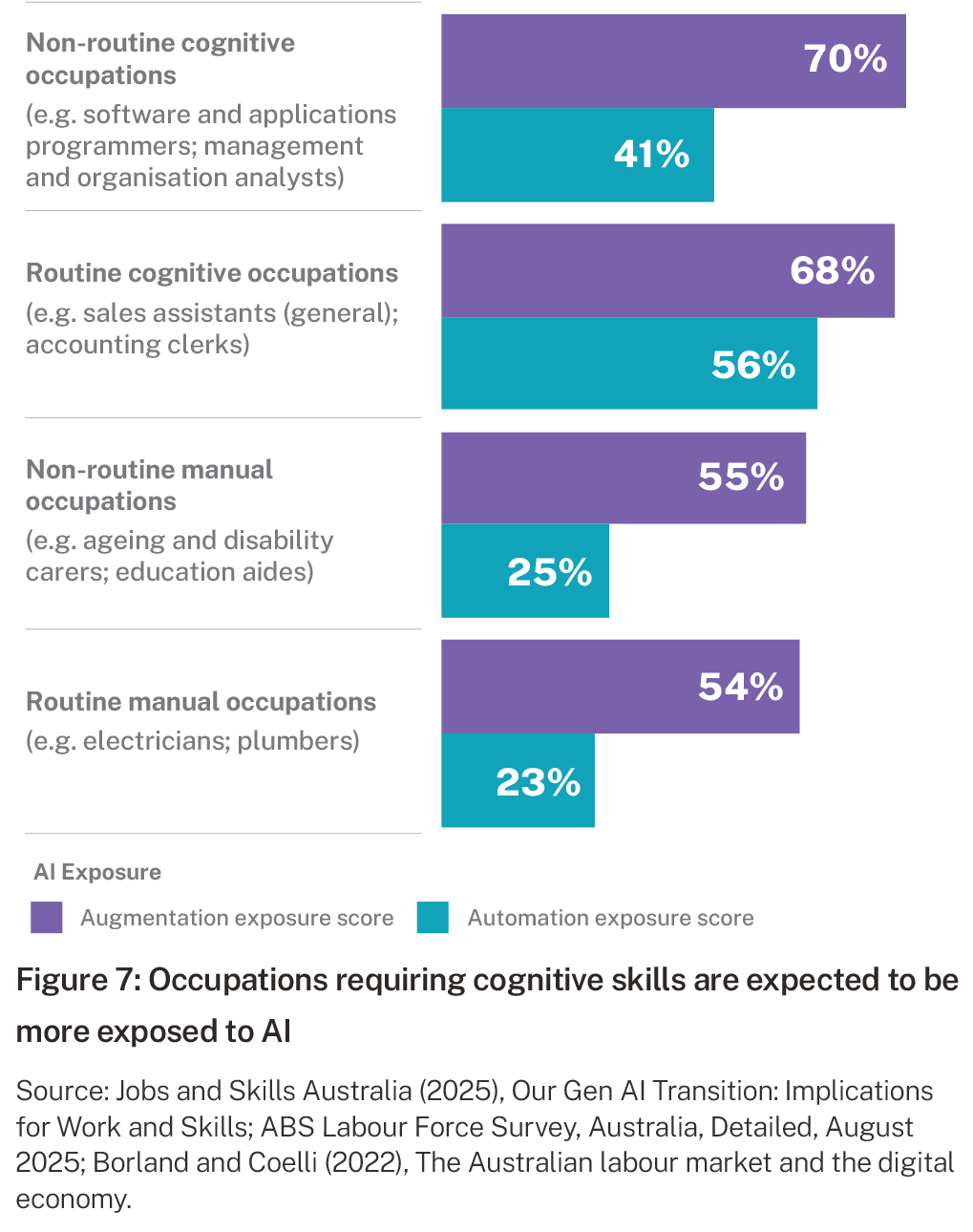
Existing occupations have different levels of exposure to AI (Figure 7). Workers who mainly perform non-routine, cognitive tasks are greatly exposed to AI, including many professionals such as software and applications programmers and management and organisation analysts. While these roles are exposed to both automation and augmentation by AI, they are more likely to be augmented rather than automated.
Manual occupations are less exposed to AI due to their physical and service-oriented nature. These include non-routine manual occupations such as ageing and disability carers and education aides, and skilled trades such as electricians and plumbers.44 Workers in these jobs still need to develop the skills and knowledge to keep up with the latest technology to do their jobs well and meet the evolving needs of their customers.
The Victorian Government’s Digital Jobs Program provides beginner-friendly training for tradespeople and small business owners in trades-related industries. The training can support them to use AI tools to streamline operations, enhance customer engagement, improve job quoting and optimise business management.45
Figure 7: Occupations requiring cognitive skills are expected to be more exposed to AI
As with most types of technological and structural changes in the economy, the adoption of AI may displace some workers.
The skills system plays an important role in supporting displaced workers, including through targeted re-skilling and up-skilling, efficient recognition of prior learning (RPL) and credit transfer processes, and clear information about in-demand jobs and associated skilling pathways.
Through Victoria’s Economic Growth Statement, $3 million was provided for Bendigo Kangan Institute to develop an AI‑enabled RPL tool that improves the speed and accuracy of RPL. This will help employers and training providers better understand a worker’s existing skills and fast-track learning for students.
To support the development and adoption of AI and advanced technologies, Victoria is becoming a data centre hub
Victoria’s world-class research and innovation ecosystem, highly skilled workforce and strong track record of investment in industry, innovation and technology make the state an ideal place for AI investment. Melbourne’s Central Business District is currently Australia’s largest AI cluster with 188 AI firms across a diverse range of industries and around 22% of Australia's AI startups and scaleups.46
The rapidly increasing demand for cloud computing and AI services is creating the need for more data centres – specialised facilities that process, store and distribute vast amounts of data, enabling seamless access to online services and digital activities.47
This digital infrastructure is critical to maximise the benefits from AI and boost Victoria’s digital economy.
Victoria is an emerging data centre hub in the Asia-Pacific region. More than 40 data centres are already located in Victoria, supported by a strong pipeline of investments and commitments from leading global companies and facilitation provided by the Victorian Government.
The growth in data centres comes with a variety of job opportunities, including:
- Construction jobs (such as plumbers and carpenters) to build new data centres.
- Trades and technical jobs (such as electricians and heating, ventilation and air conditioning technicians) to maintain data centre infrastructure.
- Business operations and support (such as IT workers, human resources personnel, managers and administrative staff) to set up and maintain the electronic equipment and support the operation of data centres.48
The data centre sector broadly shares the same pool of workers with other sectors such as construction, IT and professional services. Therefore, new qualifications that are specific to data centres are not necessarily required. Instead, embedding transferable knowledge and skills in existing VET qualifications is critical so workers are mobile in the labour market and can move to where the jobs are (for example, from building data centres to building houses). Employers in the data centre sector have a responsibility to provide sector- specific or organisation-specific training and skills to new and existing workers.
Updated