

- Date:
- 12 Jan 2026
Read the fourth Victorian Skills Plan
A message from the Minister
A knowledgeable, skilled and adaptable workforce is key to higher productivity, innovation and economic prosperity in Victoria.
Skilled workers are in high demand across the state. We are creating thousands of jobs for Victorians through our expanding housing and transport projects, growing data centre sector, fast-growing care economy, and transition to renewable energy.
Our continued investment in skills and training means that we can make the most of emerging opportunities across the economy — in digital technologies and advanced manufacturing for example — and deliver on the economic aspirations presented in our Victorian Economic Growth Statement and the Victorian Industry Policy.
Through Skills First and Free TAFE, we fund hundreds of qualifications and short courses at TAFEs and other training providers. Since 2019, we have helped over 212,000 Victorians save more than $674 million in tuition fees through Free TAFE – helping them get back into the workforce, gain the skills they need for current and emerging jobs and support them with the cost of living. This includes over 50,000 students in regional Victoria.
Our strong TAFE Network remains critical to skilling up Victorians for in-demand jobs across the state and we continue to invest in state-of-the-art TAFE facilities across metropolitan and regional Victoria.
An additional $459.3 million for TAFE and training in the 2025/26 Budget is helping more Victorians up-skill and re-skill into priority careers including $15.2 million for more pre- accredited literacy, numeracy, digital and non-technical skills training at Learn Local providers.
Victoria’s priority sectors, like construction, health, advanced manufacturing and defence, digital technologies, agribusiness and the clean economy offer good job prospects. This Victorian Skills Plan discusses the diverse job opportunities in these sectors and the skilling pathways to get into these jobs.
Rapid technological change and the rise of Artificial Intelligence is changing how Victorians live and work.
We are growing our data centre sector to support the rollout of advanced technologies and at the same time creating jobs. We are providing Victorians with the digital skills and non-technical skills they need to thrive in an increasingly technology-driven workplace. And our skills system remains flexible and responsive to meet current and emerging workforce needs.
Maintaining a high-performing, future-focused and fiscally sustainable skills system is a shared endeavor that requires engagement and investment from both government and industry. The government’s continued extensive investment in skills supports economic, social and community needs and provides Victorians with the core skills and knowledge they need to thrive in work and life. Industry must complement this and do more to train new and existing workers so it can adopt new technologies and make the most of new business opportunities.
The series of existing Victorian Skills Plans form a comprehensive roadmap to building a highly skilled and adaptable Victorian workforce to power our economy into the future. The Victorian Skills Plan for 2025 into 2026 identifies further opportunities for improvement and provides data, insights and advice to help learners, careers advisers, employers and other Victorians make good education, training and employment decisions.
I would like to thank the Victorian Skills Authority and its Advisory Board and Industry Advisory Groups, Victorian TAFEs and other training providers, and other stakeholders and partners who provided valuable insights to shape this Victorian Skills Plan.

The Hon. Gayle Tierney MP
Minister for Skills and TAFE
Minister for Water
1. Victorians are getting the skills they need to succeed
Through its investment in skills, the Victorian Government is giving Victorians access to training for the jobs the economy needs.
Over 80 qualifications and short courses available through Free TAFE are giving many Victorians training for in-demand jobs whilst providing cost of living relief.1
Since 2019, there have been over 212,000 Free TAFE commencements and the Victorian Government has saved students $674 million in tuition fees.2
In 2024, the Victorian Government funded the training of more than 250,000 Victorian vocational education and training (VET) students, including 73,000 apprentices and trainees.
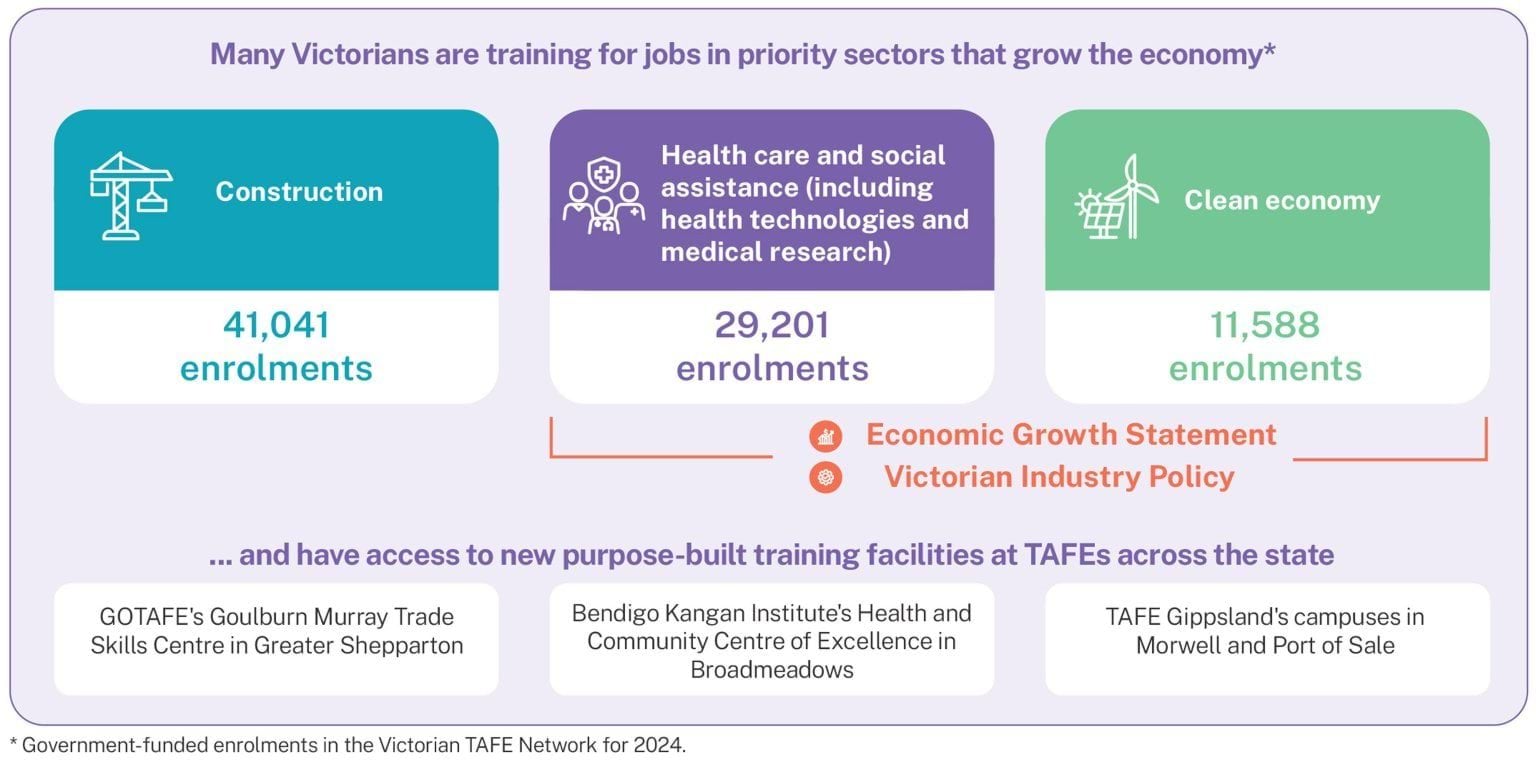
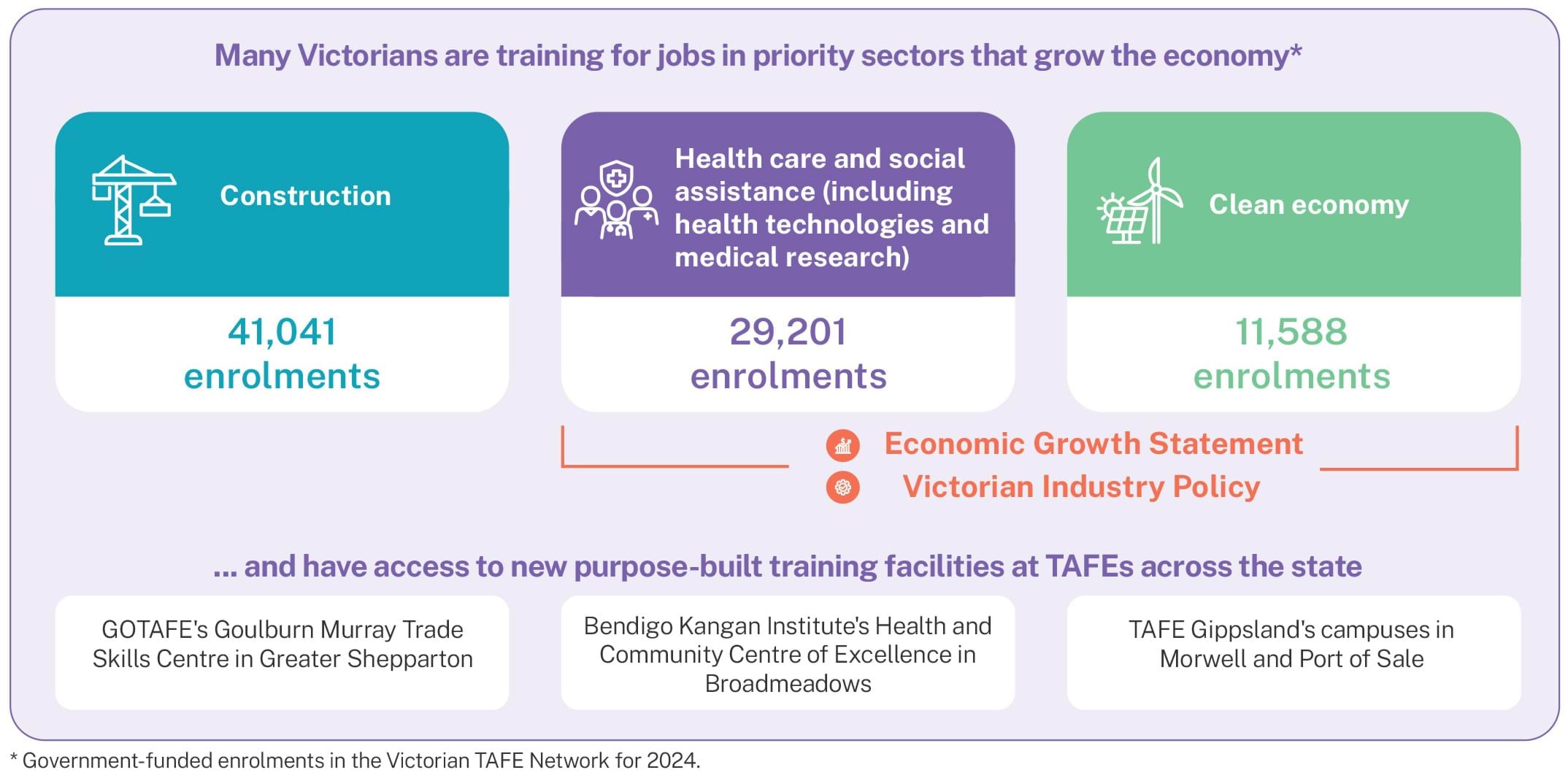
Many Victorians are training for jobs in priority sectors that grow economy*
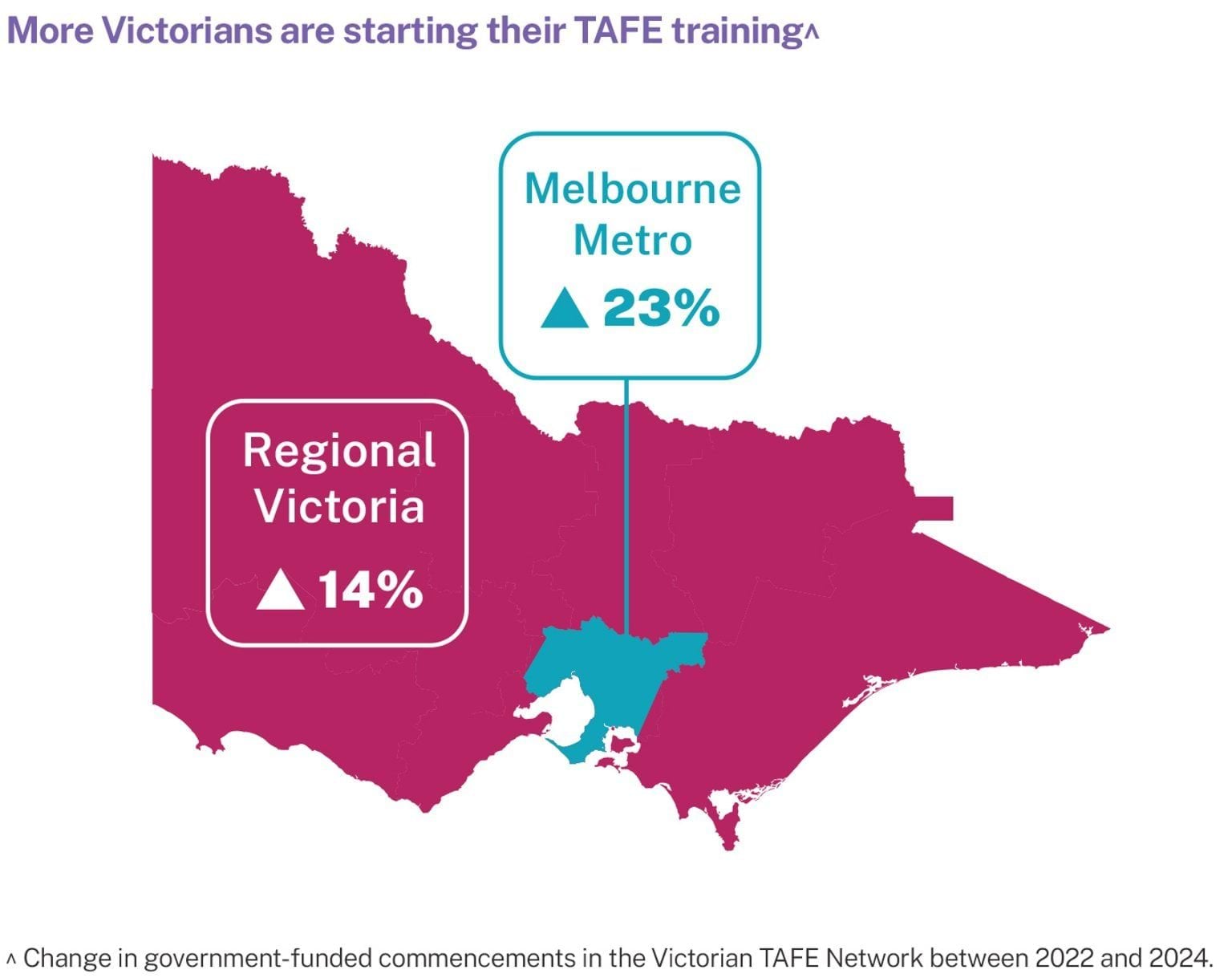
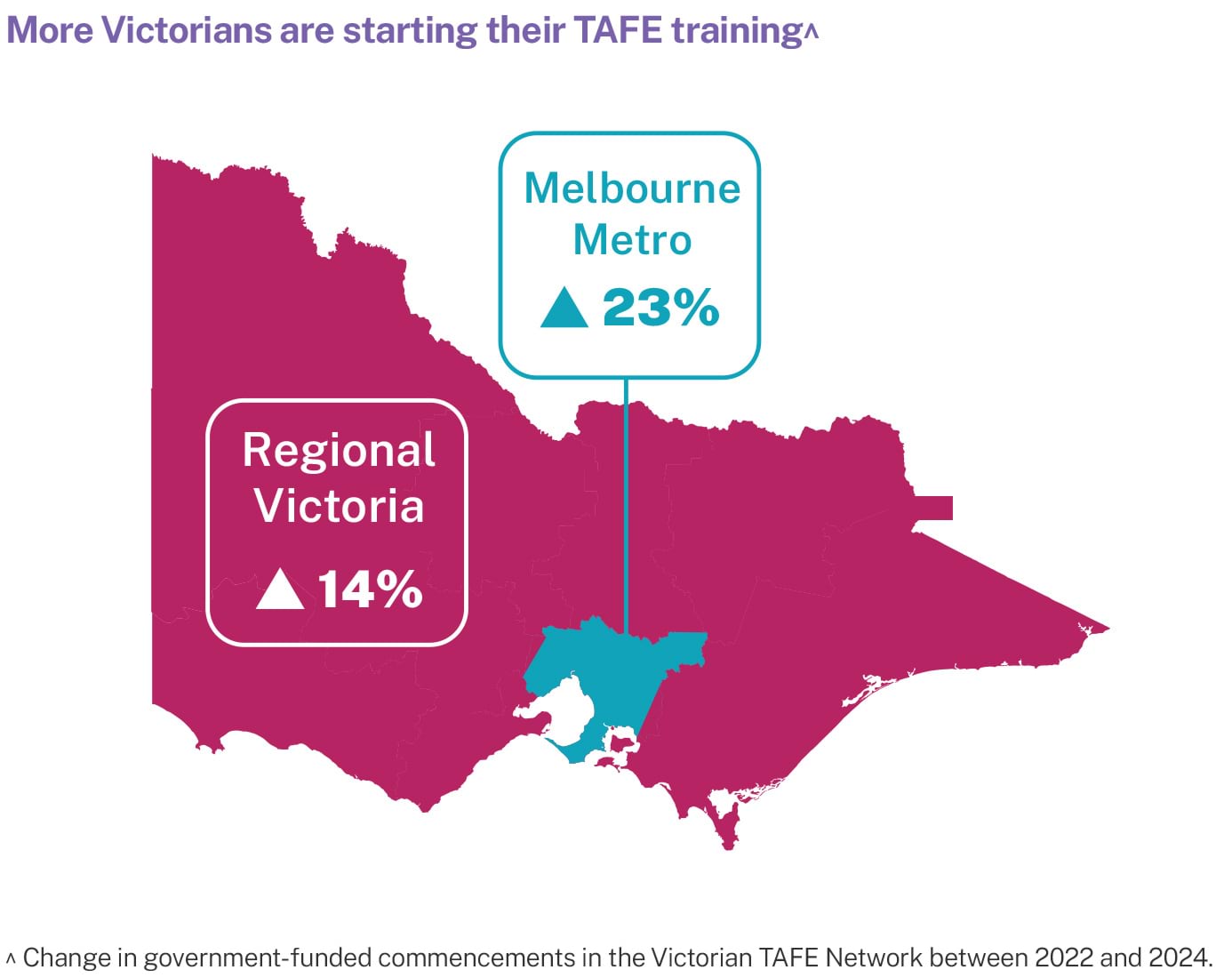
More Victorians are starting their TAFE training^
More Victorians from priority cohorts are engaging in VET^
- 33% more First Nations Victorians
- 34% more people with disability
- 15% more women returning to work
- 45% more unemployed Victorians
* Government-funded enrolments in the Victorian TAFE Network for 2024.
^ Change in government-funded commencements in the Victorian TAFE Network between 2022 and 2024.
Source: DJSIR internal data analysis, 2025.
2. Adult community education and accredited vocational education are both critical to Victoria’s strong skills system
The Victorian TAFE Network leads the provision of accredited vocational education and training to Victorians. Adult community education (or pre-accredited training) complements this provision.
Alongside Victorian TAFEs, quality private and community training providers funded through Skills First develop and deliver industry-specific training programs, including niche skills and programs for communities that connect people to learning.
The Victorian Government provides funding to Learn Local providers across the state.3 The Adult Community Education (ACE) sector has wide reach across the state, providing Victorians with access to training at more than 200 locations.
Learn Local providers meet the place-based needs of learners, employers and their communities and focus on building the foundation skills of Victorians through quality pre-accredited learning including literacy, numeracy, non-technical and digital skills.
The Ministerial Statement on the Future of Adult Community Education in Victoria 2020–25 sets out several priorities for the ACE sector (Table 1). The Victorian Government and the ACE sector have made significant progress on these priorities.
In 2024, the Victorian Government funded the training of over 28,000 Victorian learners
- 19,278 females
- 14,124 people from culturally and linguistically diverse backgrounds
- 5,096 people with disability
- 8,037 unemployed people
Table 1: The Victorian Government invests in the ACE sector to deliver high-quality pre-accredited training to Victorians
| Ministerial Statement on the Future of Adult Community Education in Victoria 2020–25 – priority focus areas | Achievements |
|---|---|
| Build the capability of the sector to provide literacy, numeracy, employability and digital skills training |
|
| Develop partnerships with industry, government agencies and across the post-secondary education system to support learners to work, study and fully participate in society |
|
| Enhance learner access, inclusion and engagement across all local government areas (LGAs) and promote the role and value of the sector |
|
Source: ACFE Board, 2025.
3. The Victorian Skills Plan underpins Victoria’s economic growth agenda
The annual Victorian Skills Plan is central to developing a knowledgeable, skilled and adaptable workforce to support Victoria's growing economy.
The Victorian Skills Plan promotes education and training pathways to deliver Victoria’s economic agenda
Through robust data and insights, close industry collaboration and stakeholder engagement, each Victorian Skills Plan (Skills Plan) weaves the aspirations of learners with the skills needs of industry, government and local communities. The Skills Plan identifies and promotes forward-looking education and training pathways that support Victoria’s economic priorities.
Prospective learners can find information on education and training pathways to in-demand jobs through the VSA’s Employment Projections Dashboard, Victorian Skills Gateway, Skills and Jobs Centres, and the TAFE and Training Line. These resources help future students and their parents, teachers and career advisors.
Victorian employers and unions use the Skills Plan to guide workforce planning and identify the skilling pathways needed to meet workforce needs. Registered training organisations, including TAFEs, Learn Locals and private training providers use the Skills Plan to inform the training they provide.
The Skills Plan draws on engagement with diverse stakeholders including the Victorian TAFE Network, training providers, unions, employers, learners, the Victorian Skills Authority's (VSA) Advisory Board and Industry Advisory Groups, and government.
Through the Skills Plan, Victoria aligns its skills agenda with national priorities identified in the National Skills Agreement and the Australian Universities Accord.
This Skills Plan continues the work program to build the skills Victoria needs now and in the future
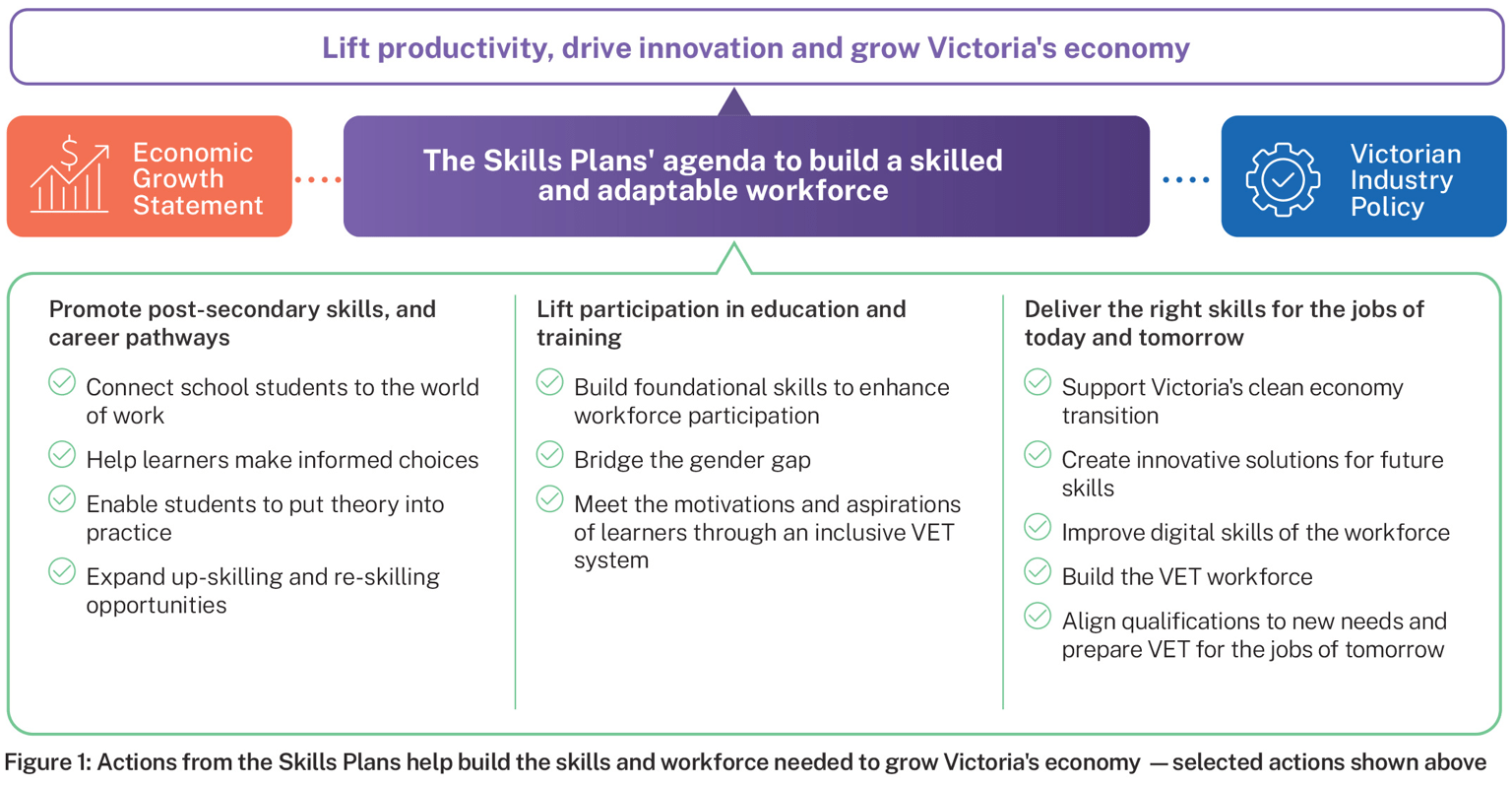
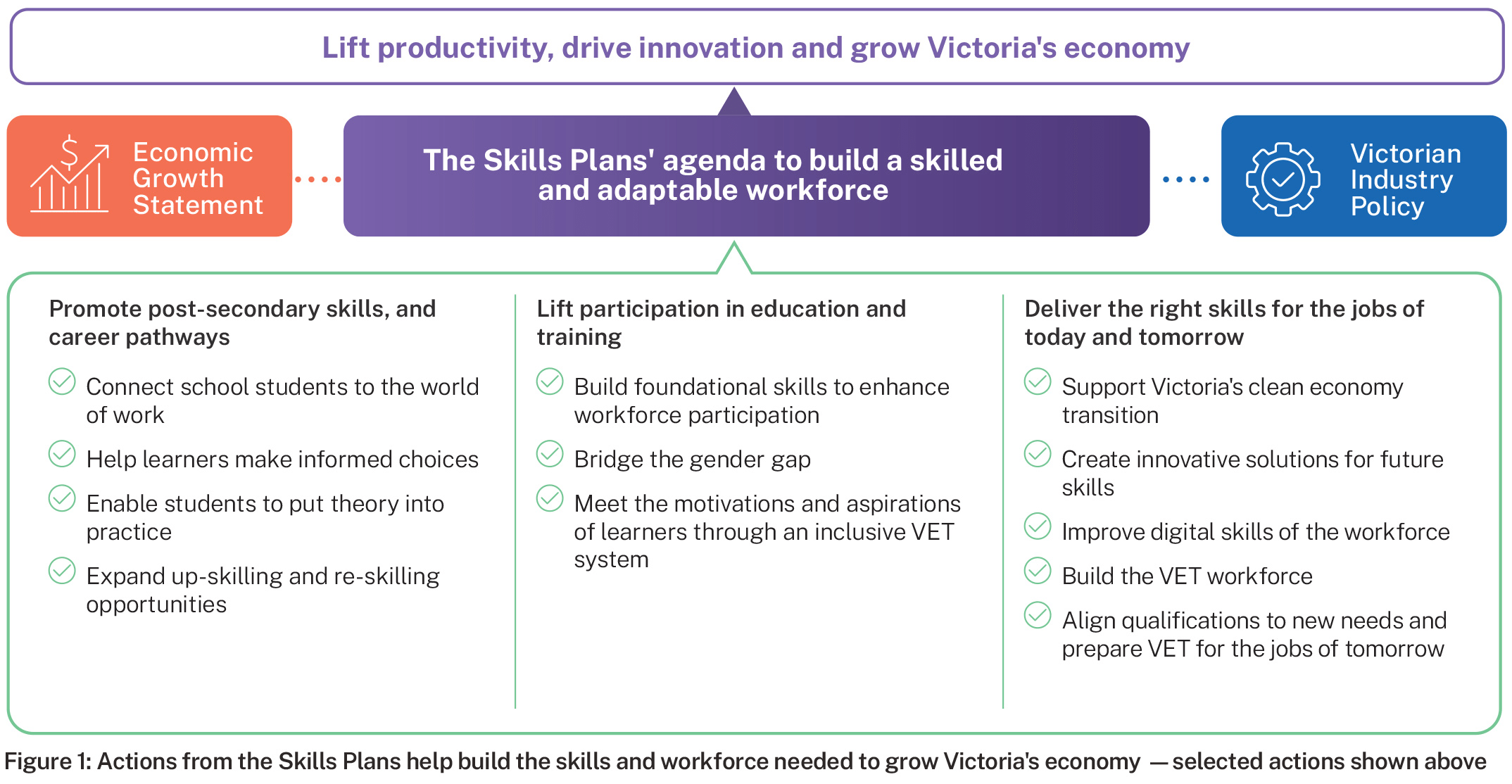
The Victorian Government’s Economic Growth Statement and Victorian Industry Policy make it clear that Victoria must continue building a skilled workforce to have the right workers with the right skills to drive productivity, innovation and economic growth.
The series of Skills Plans has established a strong work program to achieve this goal. The Victorian Government, together with the Victorian TAFE Network, other training providers, employers, unions and the Victorian community, have made significant progress in implementing the actions in the 2022, 2023 and 2024 Skills Plans. Selected actions are presented in Figure 1.
Further details can be found in the accompanying Victorian Skills Plan Implementation Update for 2025.
Building on the existing work program, the Skills Plan for 2025 into 2026:
- focuses on opportunities to further improve the skills system and develop Victoria's workforce to drive productivity and innovation and grow the economy. This includes capitalising on the opportunities arising from rapid changes in technology, especially artificial intelligence (AI).
- presents vocational and higher education pathways for learners into in-demand and emerging jobs in priority sectors such as construction, digital technologies, health technologies, advanced manufacturing, and clean economy.
Figure 1: Actions from the Skills Plans help build the skills and workforce needed to grow Victoria’s economy
4. Skilled workers are central to Victoria’s growing economy
This section looks at Victoria’s labour market, focusing on workforce growth, skills needs and the key role of vocational education and training (VET) in filling jobs and addressing skills shortages. It highlights gender gaps in employment, the growing demand for skilled workers in areas like health care and construction, and efforts to make training and jobs more accessible. Initiatives supporting women in male-dominated industries, people with disabilities and regional communities are also highlighted.
4.1 Victoria’s labour market will continue growing over the next decade
Victoria’s diverse economy employs around 3.8 million Victorians4 and is home to 754,000 businesses.5 Almost two-thirds of Victorians are currently employed, which is near record highs.6
Around 373,000 new workers are expected to enter the Victorian labour market over the next 3 years, including 143,000 workers in new jobs and 230,000 workers replacing retiring workers. Over the coming decade, around 1.5 million new workers are expected in the Victorian labour market.
Detailed analysis of employment trends in Victoria is provided in the accompanying Snapshot of the Victorian Labour Market report and the VSA’s Employment Projections Dashboard.
Participation in training and employment can be higher for some Victorians
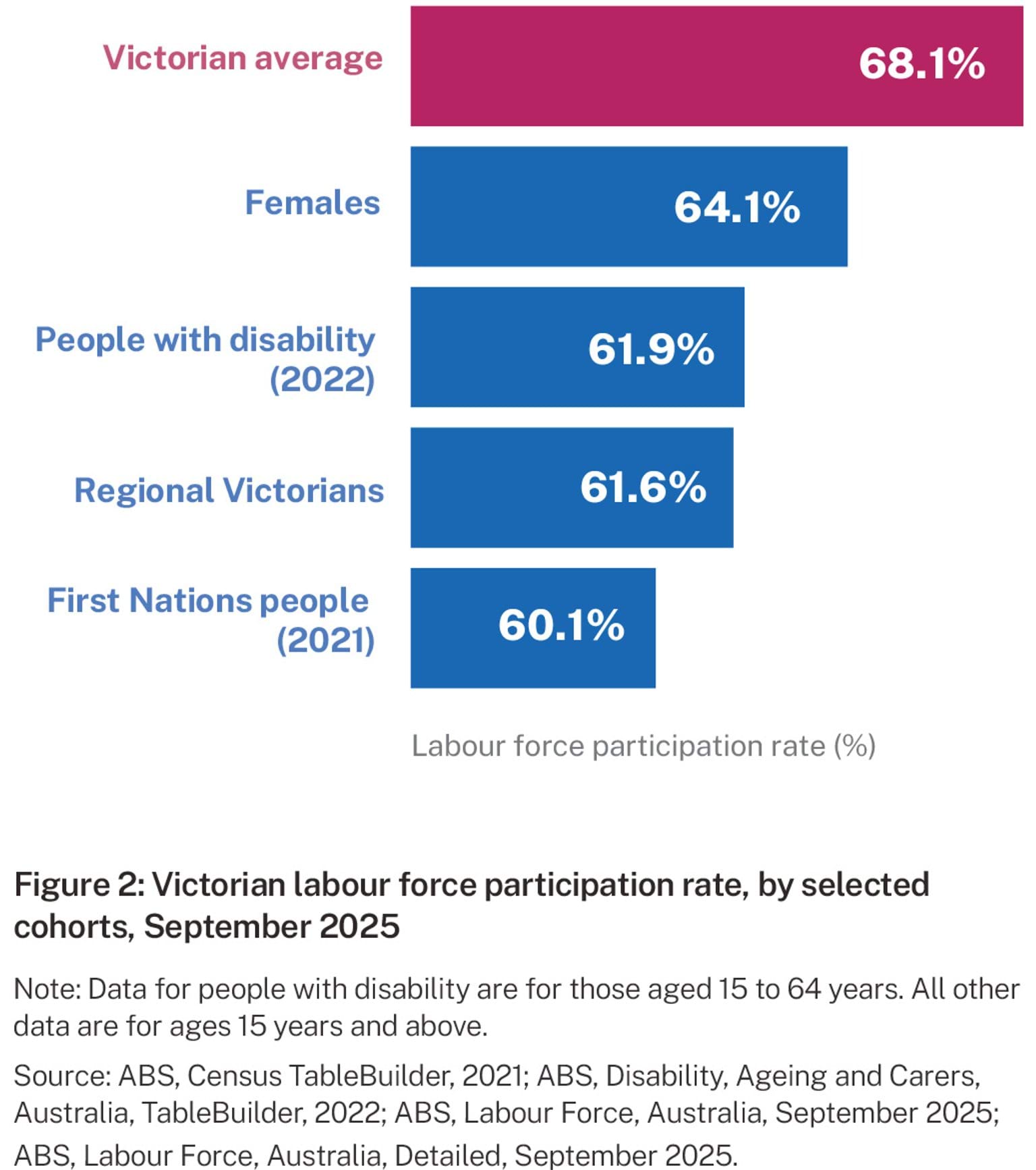
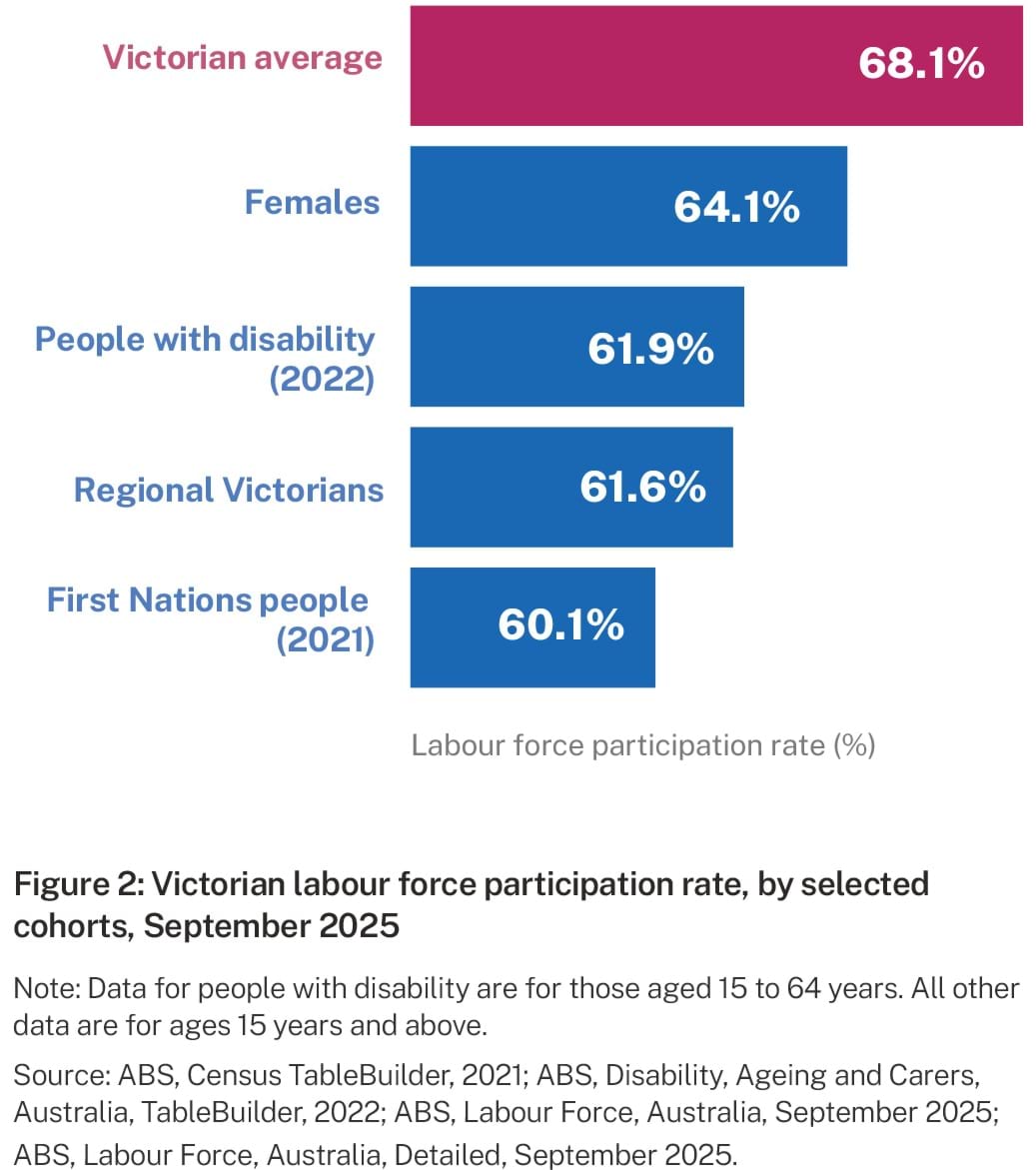
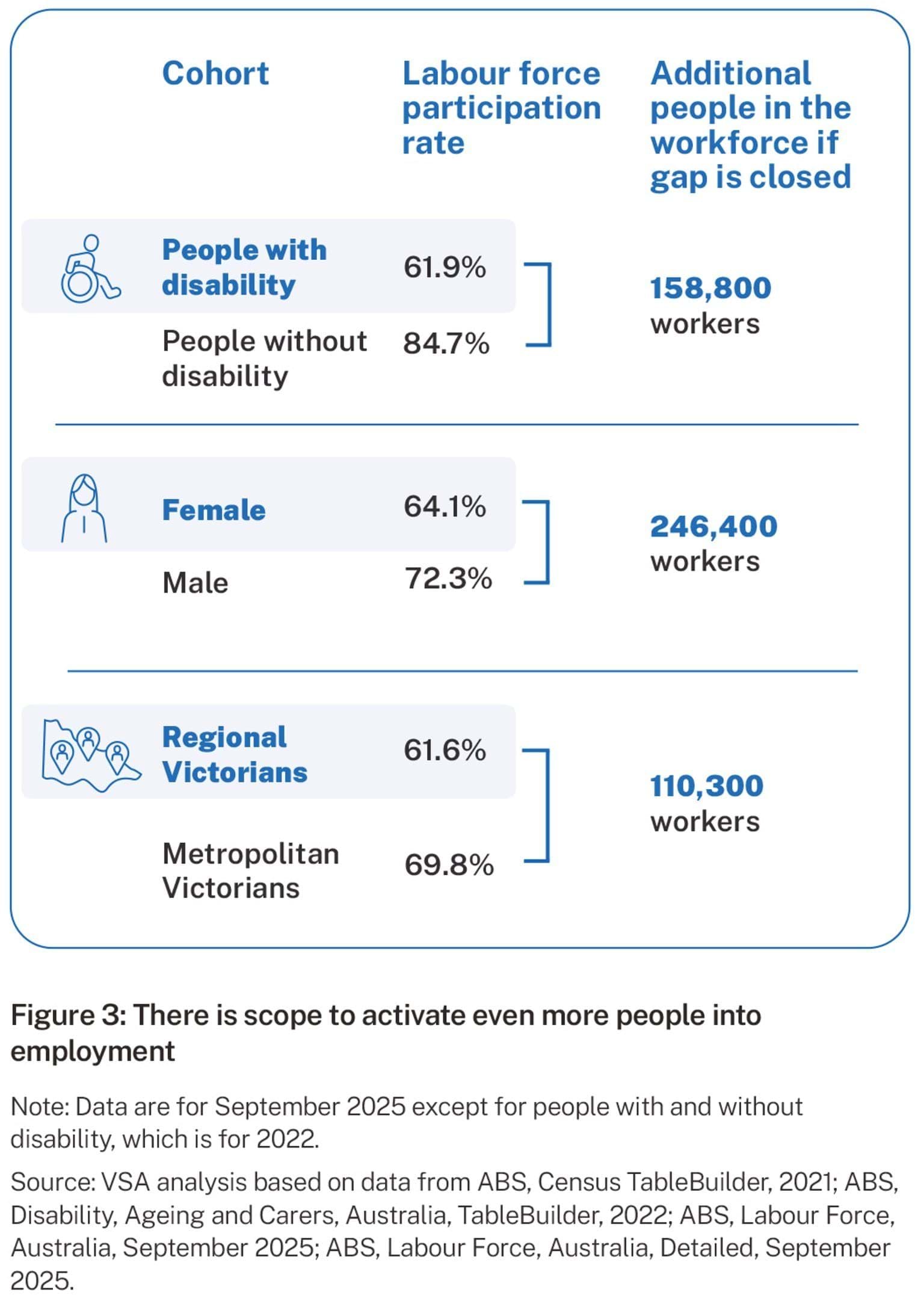
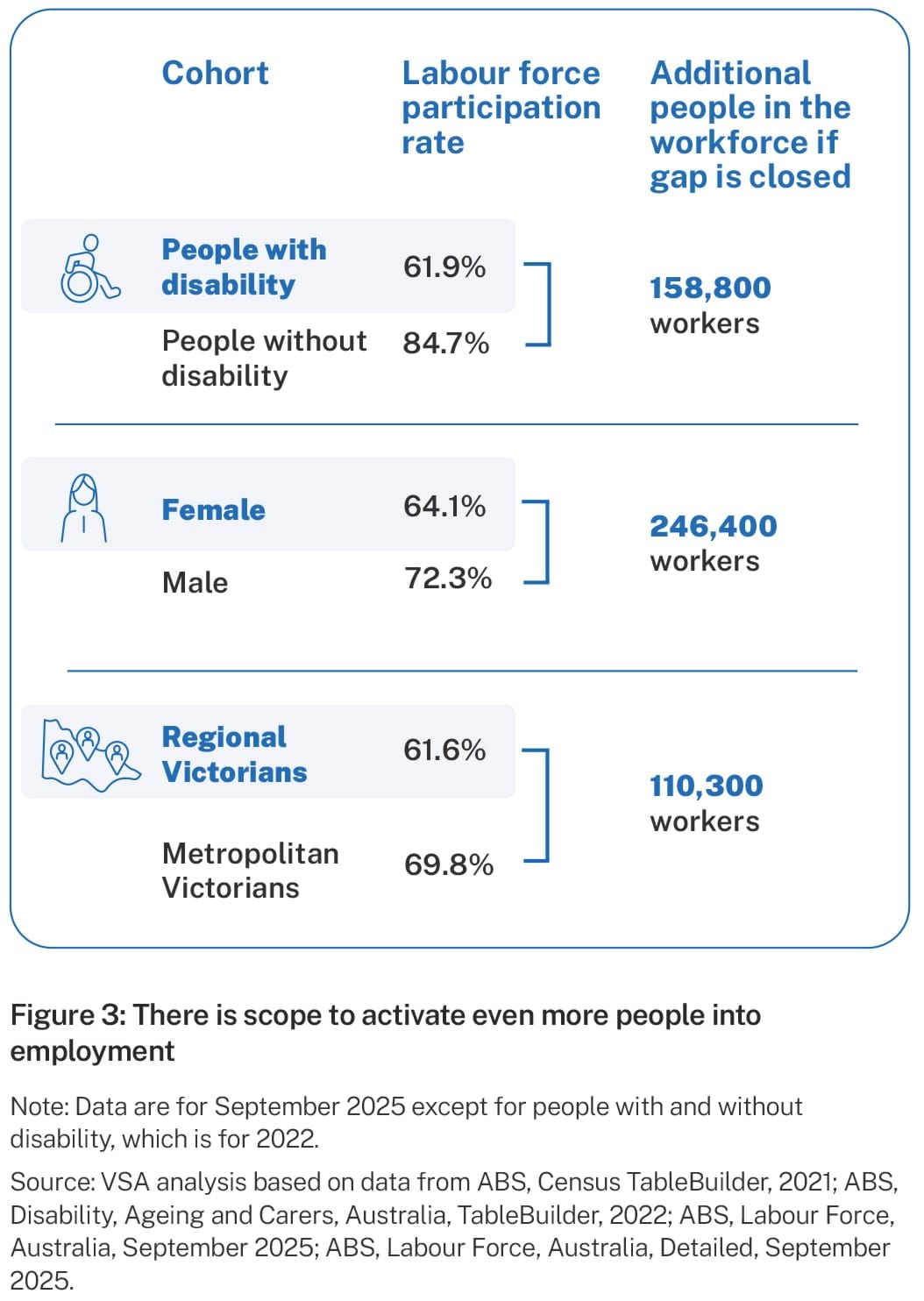
Not all Victorians are working to the extent they would like and there is scope to address participation barriers and assist even more people into employment. For example, there could be up to 246,400 additional workers if the female labour force participation rate (64.1%) increased to match the male participation rate (72.3%) (Figures 2 and 3).
Figure 2: Victorian labour force participation rate, by selected cohorts
The gender imbalance in employment is evident across industries. In 2025, females accounted for 76% of workers in health care and social assistance and 69% in education and training, but only 28% in manufacturing and 13% in construction.7
The Victorian Government is breaking down barriers for Victorians to undertake vocational education and get a job. For example:
- the VSA's Skills and Jobs Centres offer free career, employment and training support services to help Victorians achieve their training and career goals.
- people with disability are supported in their training with a range of reasonable adjustments at TAFEs and access to support officers and careers advisers. Victoria's Inclusive Victoria: State Disability Plan 2022–26 (extended to 2027) aims for everyone to have access to mainstream education that is inclusive and linked to good employment outcomes.8
- women are supported into traditionally male-dominated sectors through initiatives like the Women Onsite and Women in Trades projects, Trade & Tech Fit Expo, Women in Security Program, as well as the Women in Manufacturing Strategy and the upcoming Women in Energy Strategy. In addition, the Safe Workplaces for Women initiative supports women experiencing workplace gendered violence and sexual harassment.
- the Local Skills Partnership Program supports inclusive training in regional Victoria and addresses skills shortages for local businesses and industries.
Figure 3: There is scope to activate even more people into employment
Through vocational education and training, Victorians can get into in-demand jobs across the state
Workers with post-secondary qualifications will continue to be the foundation of Victoria’s workforce. Nearly half of the new workers projected in the next 10 years, or 716,000 people, are expected to be in jobs that usually need a VET qualification (Figure 4), including:
- 155,000 new workers who will generally acquire an associate degree, advanced diploma or diploma to work in jobs such as medical technicians and welfare support workers.
- 177,000 new workers who will generally require a Certificate III (including at least 2 years of on-the-job training, such as an apprenticeship) or Certificate IV to work in the trades and other roles like child carers/early childhood educators.
- 384,000 new workers who will generally acquire a Certificate III (non-apprenticeship) or Certificate II for jobs like ageing and disability carers and nursing support and personal care workers. Many traineeships fall into this category.
After completing VET qualifications, graduates can work in a range of in-demand jobs that offer them good earnings and good career prospects (Table 2).
Apprentices and trainees can earn a wage while completing formal study. Pre-apprenticeship courses are also available that allow learners to gain exposure and experience in an industry to prepare them for an apprenticeship.
Find out more about the training and skills needed for in-demand and emerging jobs on the Victorian Skills Gateway.
Figure 4: New workers expected over 2025–35, by qualification level and type
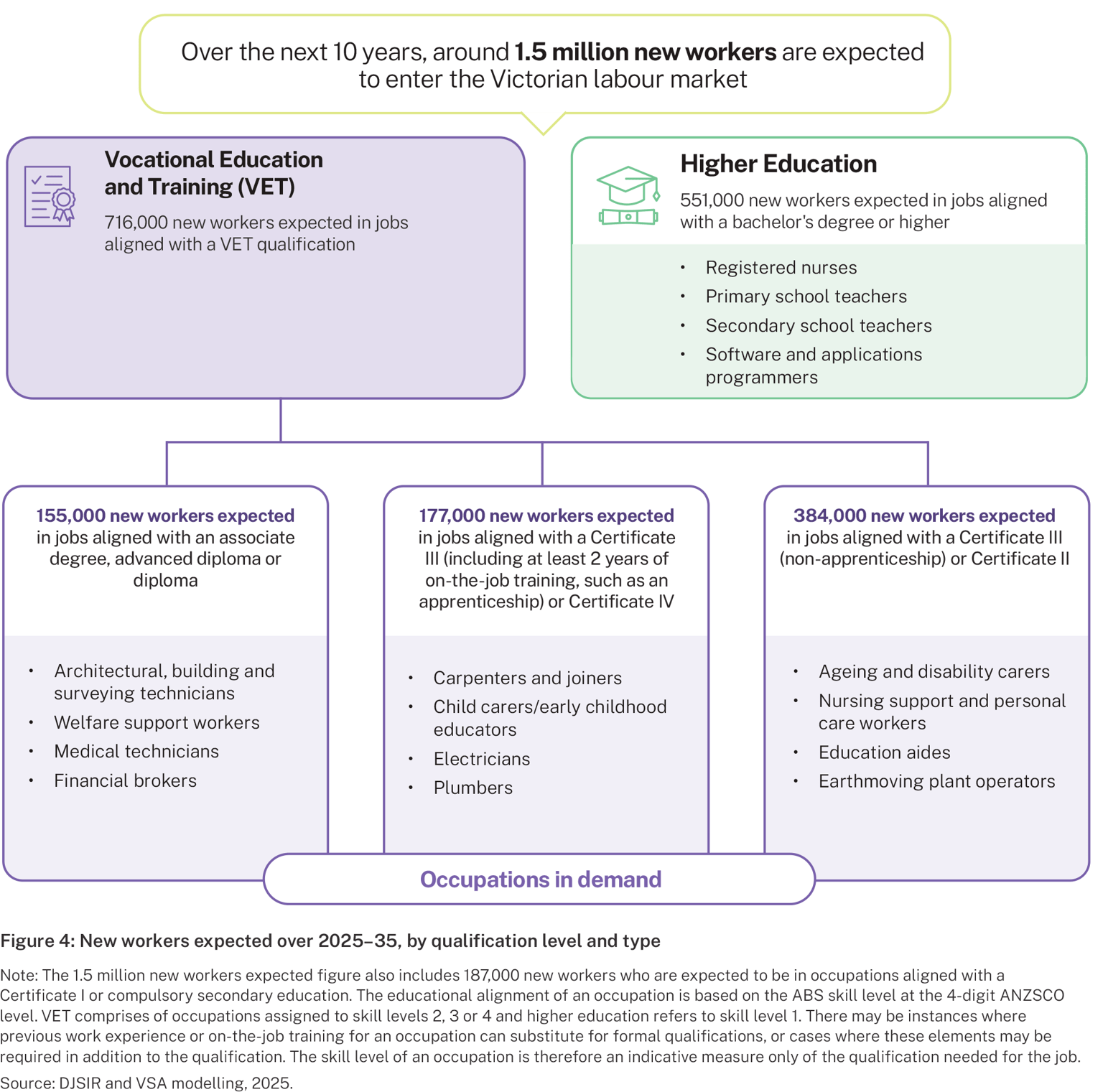
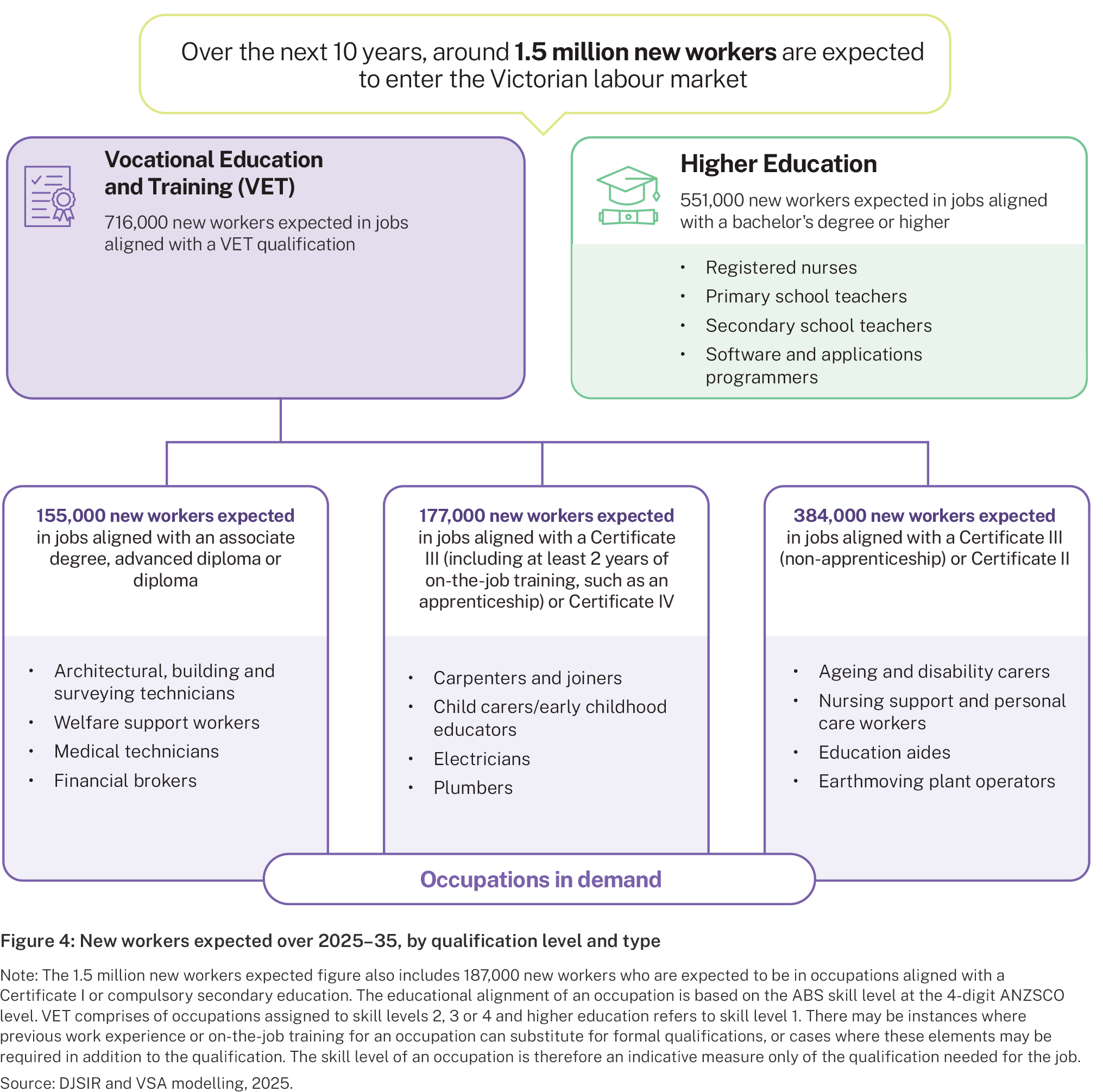
Table 2: TAFE pathways into occupations in demand have strong outcomes in Victoria
Note: The table has been split into 4 smaller tables to improve accessibility.
Health care and social assistance industry
| Occupations in demand | Average adult full-time weekly total cash earnings (2023) | TAFE pathway into occupation | Proportion of students in a job after training (2025) | Free TAFE |
|---|---|---|---|---|
| Ageing and disability nurses | $1,271 | Certificate III in Individual Support | 78% | Yes |
| Ageing and disability nurses | $1,271 | Certificate IV in Ageing Support | 83% | Yes |
| Ageing and disability nurses | $1,271 | Certificate IV in Disability Support | 85% | Yes |
| Ageing and disability nurses | $1,271 | Diploma of Community Services | 77% | Yes |
| Registered nurses | $2,166 | Diploma of Nursing Note: Qualifies graduate as an enrolled nurse and can support transition into the Bachelor of Nursing (required to become a registered nurse) | 77% | Yes |
| Nursing support and personal care workers | $1,398 | Certificate III in Health Services Assistance | 76% | Yes |
| Nursing support and personal care workers | $1,398 | Certificate IV in Allied Health Assistance | 72% | Yes |
Construction industry
| Occupations in demand | Average adult full-time weekly total cash earnings (2023) | TAFE pathway into occupation | Proportion of students in a job after training (2025) | Free TAFE |
|---|---|---|---|---|
| Carpenters and joiners | $2,150 | Certificate III in Carpentry APPRENTICESHIP | 96% | - |
| Carpenters and joiners | $2,150 | Certificate IV in Building and Construction UP-SKILL | 87% | Yes
|
| Construction managers | $3,217 | Diploma of Building and Construction (Management) | 100% | -
|
| Construction managers | $3,217 | Diploma of Building and Construction (Building) | 86% | Yes |
| Plumbers | $1,757 | Certificate III in Plumbing APPRENTICESHIP | 96% | -
|
| Plumbers | $1,757 | Certificate IV in Plumbing and Services UP-SKILL | 98% | * |
Education and training industry
| Occupations in demand | Average adult full-time weekly total cash earnings (2023) | TAFE pathway into occupation | Proportion of students in a job after training (2025) | Free TAFE |
|---|---|---|---|---|
| Primary school teachers | $1,904 | Diploma of Teacher Education Preparation Note: Supports transition into higher education qualifications | 75% | - |
Note: * Free TAFE for this qualification has been replaced with a number of Free TAFE short courses in licensed plumbing.
Courses denoted with ‘Up-skill’ provide qualified workers with additional skills and other benefits, such as a licence to perform certain works.
All data are for Victoria. Apprentices are paid for time spent on the job and in trade school and typically receive payment or reimbursement under the award for a range of expenses incurred during their training, including course fees and textbooks. An apprentice undertaking the apprenticeships above may also be eligible to receive a Key Apprenticeship Program payment of up to $10,000 if they are working in the residential construction or clean energy sectors.9
Traineeship options are available for all courses above except for those that have an apprenticeship pathway, the Diploma of Teacher Education Preparation and the Certificate IV in Plumbing and Services. A learner undertaking the health care and social assistance or school-based education support qualifications through a traineeship may also be eligible to receive an Australian Apprenticeship Training Support Payment of up to $2,500.10
Source: ABS, Employee, Earnings and Hours, 2023, TableBuilder; DJSIR and VSA modelling, 2025; Victorian Skills Authority Student Satisfaction Survey, 2025.
4.2 Vocational education sets people up for career progression
Through its practical and applied approach, vocational education provides a direct and accessible pathway to many good jobs and gives people transferable skills and knowledge to help them progress in their career.
Jobs like ageing and disability carers, child carers/early childhood educators and electricians are in-demand in Victoria. These jobs also offer the possibility to move up into related roles that are higher skilled and often better paid.
Analysis of Australian Taxation Office (ATO) data shows that many people who worked in the occupations listed below in 2016 and then changed jobs, had transitioned into higher-skilled roles by 2021 (Table 3).
Table 3: Occupation transitions from selected jobs in demand
| Original occupation in 2016 | Proportion of people who changed jobs between 2016-21 and moved into higher skilled roles | Examples of higher skilled roles they had moved into by 2021 |
|---|---|---|
| Ageing and disability carers | 67% | Registered nurses Welfare support worker Nursing support and personal care workers |
| Child carers/early childhood educators | 60% | Primary school teachers Child care centre managers Early childhood (pre-primary school) teachers |
| Electricians | 53% | Chief executive and managing directors Electrical engineers Electrical engineering draftsperson and technicians |
Source: ATO (2024), Occupation transition 2020–11 to 2021–22 income years.
Through VET, Victorians can up-skill or re-skill to work in growing industries
Ongoing technological change, innovation, and the changing nature of the economy means that people need to keep their skills up to date throughout their working lives, whether it is through up-skilling in their current job or re-skilling for a new job. VET is a critical way to do so.
This also applies to people with a university qualification who need to up-skill in their current job or re-skill for a new job. More university-qualified people are seeing VET as a valuable skilling pathway (Figure 5).
Figure 5: More university-qualified people are seeing the value of VET
VET provides flexible learning options for skilled workers to transition into new jobs
In 2024: 14.9% of VET learners had a university qualification (up from 11.6% in 2019)
Source: NCVER, Total VET students and courses 2024, DataBuilder.
Popular areas for up-skilling and re-skilling include management and commerce, community services, and education. The Certificate IV in Training and Assessment was the most common VET qualification undertaken in 2024 by people with a bachelor's degree or higher.11
People use VET for different purposes. For example, enrolled nurses and nursing support and personal care workers are more likely to use their additional training to change jobs, while ageing and disability carers and child carers/early childhood educators are more likely to be VET graduates who are new labour market entrants (Table 4).12
Table 4: Examples of current occupations for different types of VET learners
| People entering the labour market | People broadening their skills | People changing jobs | People getting additional job-specific skills |
|---|---|---|---|
Ageing and disability carers Child carers/early childhood educators Electricians | Sales assistants (general) Building and plumbing labourers Fast food cooks | Enrolled nurses Nursing support and personal care workers Medical technicians | Plumbers Child carers/early childhood educators Fire and emergency workers |
Source: VSA analysis of ABS PLIDA, 2025.
Emma Jepsen – Victorian Training Awards 2025 Apprentice of the Year finalist
After finishing school, Emma Jepsen enrolled in a Bachelor of Commerce. An aptitude for mathematics and physics, and a passion for renewable energy, led her to launch into a Certificate III in Electrotechnology Electrician at Holmesglen TAFE.
Emma completed her bachelor’s degree while doing the electrical apprenticeship, which added value to her work in the electrical field. In 2025, Emma received the George Kline Apprentice of the Year award. Emma advocates for TAFE training and women in trades, inspiring many through her online community.

5. Victoria’s growth sectors offer many skilling and employment opportunities
This section highlights Victoria’s growing economy, driven by industries like construction, health care, digital technologies and advanced manufacturing. There is strong demand for skilled workers in existing and emerging roles, with vocational education and training (VET) providing pathways into these jobs. Areas like renewable energy, artificial intelligence (AI) and advanced construction methods are driving new opportunities and increasing the need for technical and digital skills.
5.1 Victorians can find good jobs in various sectors of the economy
Victoria’s largest employing industries like construction and health care continue to grow, especially with the government’s housing and infrastructure agenda and investment in hospitals, aged care services and early childhood education.
The Victorian Government’s Economic Growth Statement and Victorian Industry Policy identify additional sectors that will keep the Victorian economy growing, namely: digital technologies; health technologies and medical research; advanced manufacturing and defence; agribusiness; and clean economy.13 Vocational education and training is the pathway into many jobs needed in these sectors.
Victoria’s growth sectors
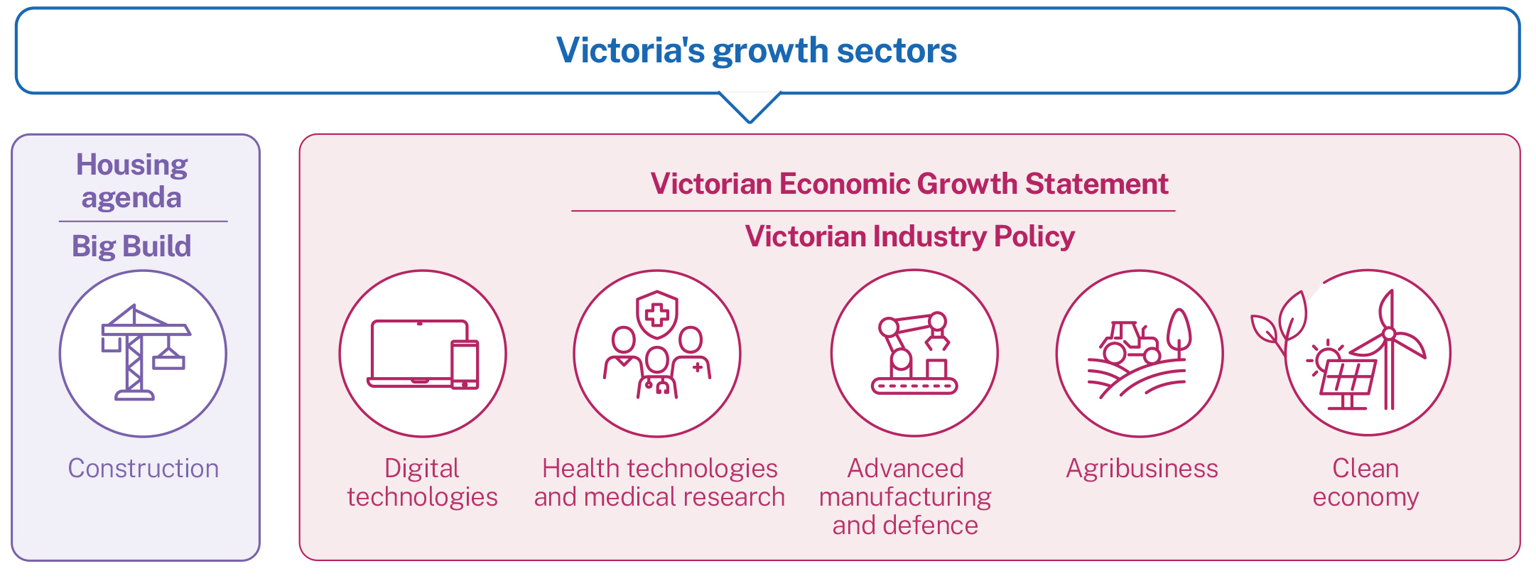
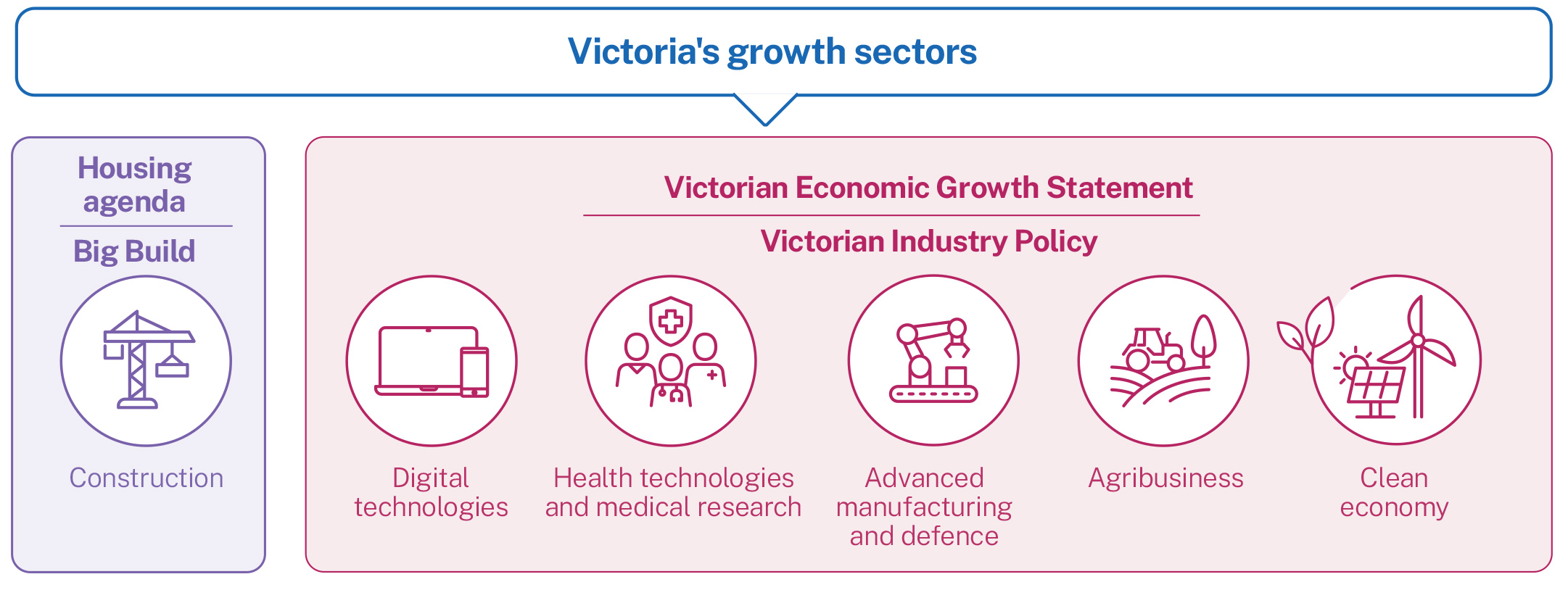
Investment and growth in these sectors will increase demand for existing as well as emerging occupations.
Construction
64,500 new workers expected over 2025–28
162,500 new workers expected over 2025–35
Employment in Victoria's construction industry, including in residential construction and public infrastructure continues to grow significantly – 64,500 new workers are expected to enter the construction workforce over 2025–28, with occupations such as carpenters and joiners and plumbers remaining in high demand.
Technological change and innovation in the construction sector are increasing the uptake of Modern Methods of Construction (MMC) such as prefabrication, robot assisted automation, artificial intelligence, 3D printing, Digital Twins and Building Information Modelling (BIM). This is boosting demand for multi-skilled workers with a blend of technical, design and digital skills and stimulating up-skilling in areas like process manufacturing and assembly of building components.
There is also a growing need for process automation skills, including robotics and predictive maintenance systems, design for manufacture and assembly (DfMA) and machine maintenance.
Occupations in demand in construction
| Occupations in demand | Pathways into the sector |
|---|---|
| Carpenters and joiners | Certificate III in Carpentry |
| Plumbers | Certificate III in Plumbing |
| Painting and trades workers | Certificate III in Painting and Decorating |
Source: DJSIR and VSA modelling, 2025.
Emerging occupations in modern methods of construction
| Emerging occupations | Pathways into the sector |
|---|---|
| Steel detailers | Diploma of Engineering Technology |
| Manufacturing engineers and technicians | Diploma of Engineering – Technical |
| Construction/Project managers | Diploma of Building and Construction (Building/Management) |
Source: Alviano (2015), Job Skills in Prefabricated Construction; Masood, Aliakbarlou and Hu (2022), Skills Matrix for Prefabricated Construction – A case of NZ Modular Company.
Digital technologies
19,300 new workers expected over 2025–28
87,700 new workers expected over 2025–35
Digital technology occupations are defined in the Tech Council of Australia's 2023 Tech Jobs Update
Victoria’s ICT industry continues to grow rapidly, with 19,300 new workers in digital technology occupations expected over 2025–28. Increased demand for digital services and technologies is driving investment across the sector, with growing demand for skills in data analytics, cyber security and cloud computing.
Growing investment in Victorian data centres presents opportunities for ICT professional roles and skilled trades. Victoria hosts one of Australia’s largest data centre hubs, providing cloud hosting, disaster recovery and co-location services. Data centre capacity in Victoria is projected to grow significantly over the next decade.14
Depending on the type of data centre, up to 30% of the workforce are in operational roles, such as electricians and heating, ventilation and air conditioning (HVAC) technicians. A further 30% of the workforce are ICT professionals, such as software engineers and process engineers.15
The rapid take-up of cloud computing and AI by businesses is driving the need for more data centres and creating new job opportunities such as cloud developers and solutions architects.
Demand for highly technical skills in AI, machine learning and quantum technologies are emerging and expected to gain momentum.
Occupations in demand in digital technology
| Occupations in demand | Higher education pathways into the sector |
|---|---|
| Software and applications programmers | Bachelor of Computer Science/Information Technology |
| ICT managers | Bachelor of Information Technology |
| Graphic and web designers, and illustrators | Bachelor of Graphic Design |
Source: DJSIR and VSA modelling, 2025.
Emerging occupations in digital technologies
| Emerging occupations | Higher education pathways into the sector |
|---|---|
| Cloud developers | Graduate Diploma in Computer Science |
| Solutions architects | Master of Information Technology |
| Automation engineers | Bachelor of Engineering (Software Engineering) |
Note: Data are for Australia.
Source: Jobs and Skills Australia (2024), Emerging Roles.
Health care and social assistance (including health technologies and medical research)
90,300 new workers expected over 2025–28
363,300 new workers expected over 2025–35
Health care and social assistance employs the largest number of people in Victoria and is expected to grow further, with 90,300 new workers expected over 2025–28. Occupations such as ageing and disability carers, nursing support and personal care workers, and child carers/early childhood educators continue to be in high demand.
Innovation and research are central to Victoria’s health sector. Victoria is home to 18 world-class medical research institutes and hosts 40% of ASX-listed medical technology and pharmaceutical companies.16
Growth in health technologies and medical research is creating new career opportunities, such as for clinical project managers and medical technicians. Engineers from various disciplines are also highly sought after. There is growing demand for MedTech project management skills, manufacturing expertise in specialised devices, strategic design of clinical trials and bioinformatics and management of health data.
Occupations in demand in health care and social assistance
| Occupations in demand | Pathways into the sector |
|---|---|
| Ageing and disability carers | Certificate III in Individual Support |
| Nursing support and personal care workers | Certificate III in Health Services Assistance |
| Child carers/early childhood educators | Certificate III in Early Childhood Education and Care |
Source: DJSIR and VSA modelling, 2025.
Emerging occupations in health technologies and medical research
| Emerging occupations | Pathways into the sector |
|---|---|
| Manufacturing and research technicians | Bachelor of Engineering |
| Clinical project managers | Bachelor of Science |
| Medical technicians | Diploma of Laboratory Technology |
Source: VicMedTechHub (2023), MedTech Skills–Education Gaps Roadmap.
Advanced manufacturing
2,200 new workers expected over 2025–28
13,500 new workers expected over 2025–35
A $37 billion industry, manufacturing is a major player in the Victorian economy. 17 Through the Victorian Industry Policy, the Victorian Government is looking to modernise several segments of manufacturing including food product; chemical; composites, polymers and rubbers; and machinery and equipment.
Metal fitters and machinists is expected to be one of the most sought-after occupations in advanced manufacturing. As automation and digital technologies become more integrated into production processes, collaboration and critical thinking skills remain essential.
As Victoria focuses on advanced manufacturing, technical production skills, which combine specialised knowledge with hands-on expertise, are increasing in demand.
Around 2,200 new workers are expected to enter the advanced manufacturing workforce over 2025–28. Skills that are growing in demand include robotics and automation, additive manufacturing/3D printing, Internet of Things (IoT) and sensor technology.
Engineering and technician roles are growing in the sector. Other roles that are emerging include chemists, and food and wine scientists and aircraft maintenance engineers.
Occupations in demand in advanced manufacturing
| Occupations in demand | Pathways into the sector |
|---|---|
| Metal fitters and machinists | Certificate III in Engineering – Mechanical Trade |
| Industrial, mechanical and production engineers | Bachelor of Engineering (Mechanical) |
| Structural steel and welding trades workers | Certificate III in Engineering – Fabrication Trade |
Source: DJSIR and VSA modelling, 2025.
Emerging occupations in advanced manufacturing
| Emerging occupations | Pathways into the sector |
|---|---|
| Chemists, and food and wine scientists | Diploma of Food Science and Technology |
| Aircraft maintenance engineers | Certificate IV in Aeroskills (Avionics/Mechanical/Structures) |
| Mechanical engineering draftspersons and technicians | Diploma of Engineering Technology |
Source: Manufacturing Industry Skills Alliance (2024), Manufacturing Workforce Plan 2024.
Defence
Victoria's defence industry employs around 29,000 workers across 2,500 businesses.18
Jobs in demand include welders, boilermakers and fitters and turners who have relevant skills for maritime shipbuilding and advanced manufacturing projects.
Skills important to the industry include electronics, carpentry, plumbing, engineering, boilermaking and fabrication.
Increased government investment in defence-related projects presents many employment opportunities for Victorians, including in emerging roles like naval architects and engineering managers.
Occupations in demand in defence
| Occupations in demand | Pathways into the sector |
|---|---|
| Welders | Certificate III in Engineering – Fabrication Trade |
| Boilermakers | Certificate III in Engineering – Fabrication Trade |
| Fitters and turners | Certificate III in Engineering – Mechanical Trade |
Source: DJSIR analysis.
Emerging occupations in defence
| Emerging occupations | Higher education pathways into the sector |
|---|---|
| Naval architects | Bachelor of Engineering |
| Penetration testers | Bachelor of Computer Science |
| Engineering managers | Bachelor/Master of Engineering |
Source: Kinexus (2025), Defence Industry Insights – 11th edition; Department of Jobs, Skills, Industry and Regions (2025), Victorian Defence Vision Statement.
Agriculture, forestry and fishing (including agribusiness)
5,400 new workers expected over 2025–28
20,200 new workers expected over 2025–35
Victoria is Australia’s second largest agricultural producer, and the largest producer of dairy, grapes, sheep meat, fruit, nuts and vegetables. Victoria’s rapidly expanding food and fibre exports reached a record high of $20.1 billion in 2023–24.19
The industry will continue to grow, with 5,400 new workers anticipated over 2025–28, including in jobs like livestock farming and crop farming.
Agribusiness needs more skilled workers with digital, business, risk management and marketing skills.
Emerging roles in agribusiness include agricultural and agritech technicians, agricultural consultants, and agricultural research scientists. Food and fibre entrepreneurs are also needed to take products to international markets.
Occupations in demand in agriculture, forestry and fishing
| Occupations in demand | Pathways into the sector |
|---|---|
| Livestock farmers | Certificate III in Agriculture |
| Crop farmers | Certificate III in Agriculture |
| Agriculture, forestry and horticulture plant operators | Certificate III in Forest Operations |
Source: DJSIR and VSA modelling, 2025.
Emerging occupations in agribusiness
| Emerging occupations | Pathways into the sector |
|---|---|
| Agriculture and agritech technicians | Bachelor of Agriculture and Technology (Agronomy) |
| Agricultural consultants | Advanced Diploma of Agribusiness Management |
| Agricultural research scientists | Diploma of Applied Agronomy |
Source: Agriculture Victoria (2025), Skills in agriculture; Victorian Skills Gateway (2025), Featured agriculture, horticulture and agribusiness jobs.
Clean economy (including circular economy)
Victoria’s transition to a clean economy with net zero emissions is creating new employment and skilling opportunities in areas like onshore and offshore wind, utility-scale energy storage, electric vehicle recharging infrastructure, circular production, reuse and recycling, and critical minerals production.
Distributed energy resources and zero emissions vehicles charging infrastructure and energy upgrades will require a diverse workforce including electricians, plumbers, and airconditioning and refrigeration mechanics.
Emerging jobs in the clean economy include electric vehicle technicians, sustainability consultants, battery design specialists and energy engineers.
To support the clean economy workforce, the Victorian Government will offer (from 2027) new renewable energy qualifications to students undertaking vocational education in schools, including the Certificate III in Renewable Energy Pathways and Certificate II in Renewable Energy Technologies and Applications.
The Victorian Government is also establishing a Wind Worker Training Centre that will deliver training for the onshore and offshore wind sectors.
Occupations in demand in the clean economy
| Occupations in demand | Pathways into the sector |
|---|---|
| Electricians | Certificate III in Electrotechnology Electrician |
| Plumbers | Certificate III in Plumbing |
| Airconditioning and refrigeration mechanics | Certificate III in Air Conditioning and Refrigeration |
Source: Department of Jobs, Skills, Industry and Regions (2023), Clean Economy Workforce Development Strategy, 2023–2033; Jobs and Skills Australia (2023), The Clean Energy Generation – Workforce needs for a net zero economy.
Emerging occupations in the clean economy
| Emerging occupations | Pathways into the sector |
|---|---|
| Electric vehicle technicians | Certificate III in Automotive Electrical Technology |
| Sustainability consultants | Certificate IV in Home Energy Efficiency and Sustainability |
| Battery design specialists | Bachelor of Engineering |
Note: Data are for Australia
Source: Jobs and Skills Australia (2024), Emerging roles.
To meet the skills needs of the renewable energy transition, many existing occupations are evolving
| Occupations | New skills requirements |
|---|---|
| Electricians | Installation of solar photovoltaic (PV), storage batteries, EV charging stations and other energy-efficient appliances |
| Automotive electricians and mechanics | Electrical and mechanical diagnostics Analytical and trouble-shooting skills EV/Hybrid vehicle repair |
| Airconditioning and refrigeration mechanics | Installation of energy-efficient appliances Natural refrigerant expertise |
Source: Jobs and Skills Australia (2023), The Clean Energy Generation; Department of Jobs, Skills, Industry and Regions (2023), Clean Economy Workforce Development Strategy 2023–2033.
5.2 Victorians can find good jobs in regional Victoria
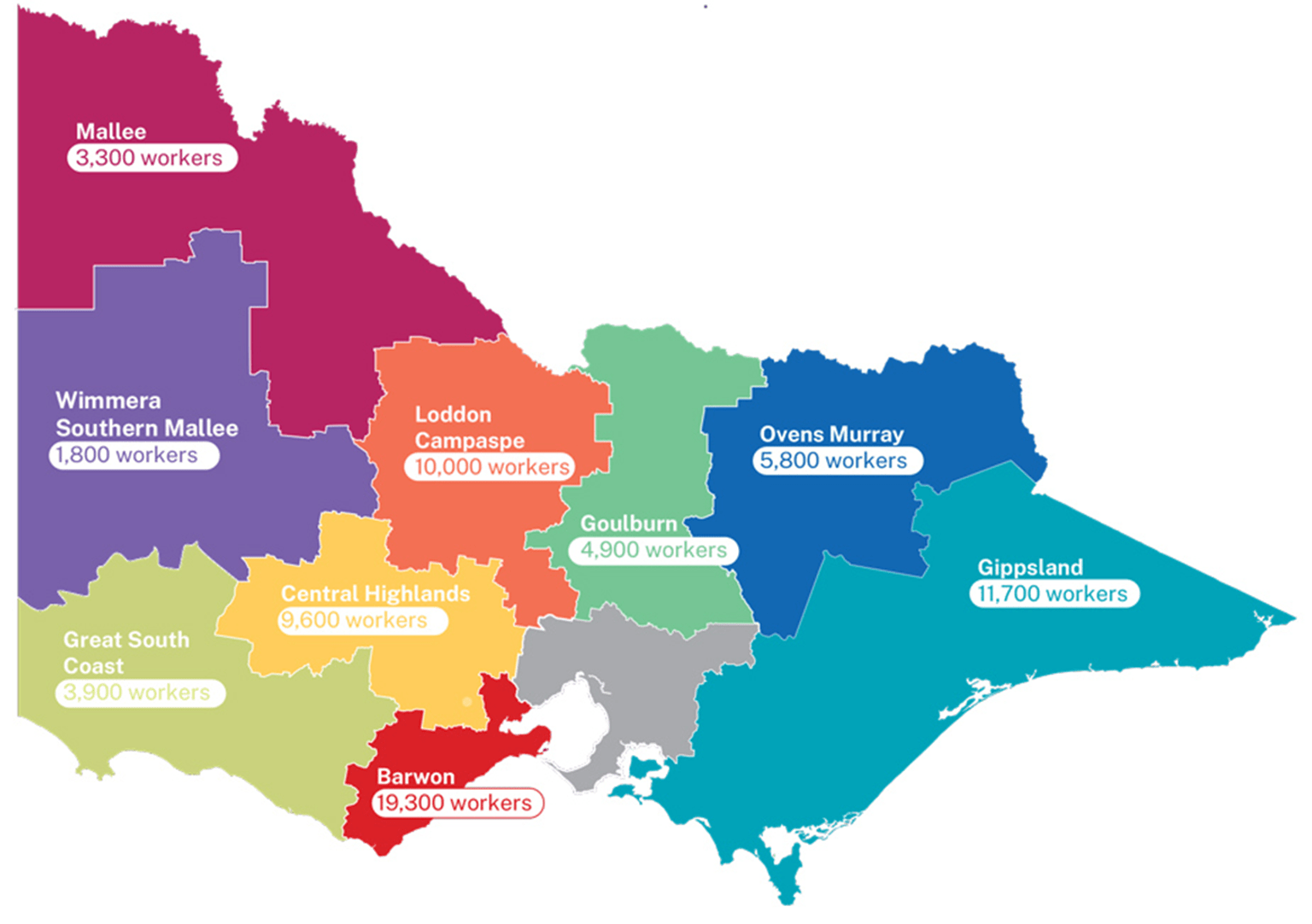
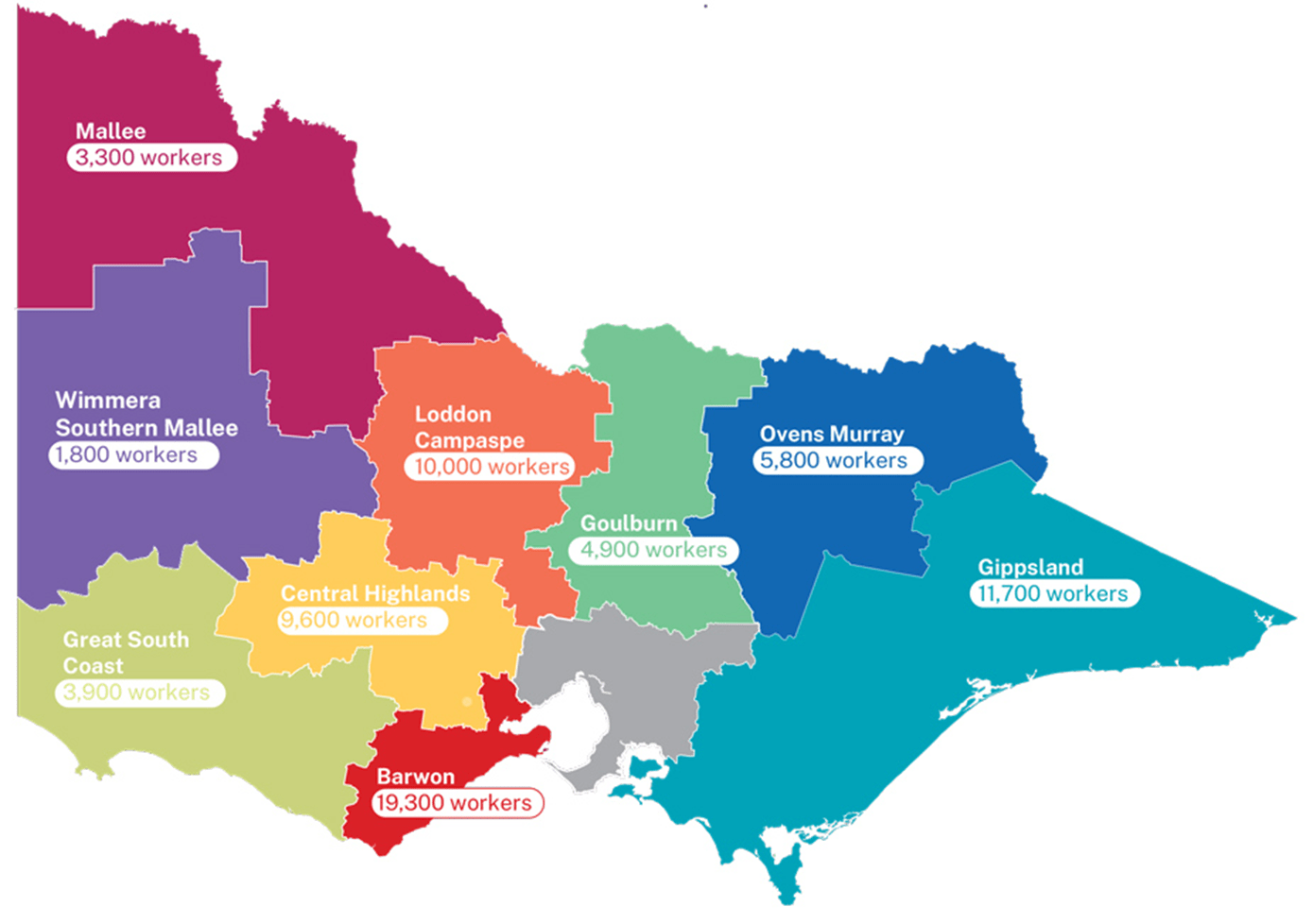
Victoria’s growing economy is driving jobs growth across the state, particularly in health care and social assistance, construction, and education and training. In the next 3 years, 70,000 new workers are expected to enter the workforce across regional Victoria (Figure 6).
Learners in regional Victoria can access training at TAFEs and other training providers. In addition, 12 Regional University Study Hubs provide VET and higher education learners living in regional, rural or remote areas with access to online learning, study facilities and student support services.20
Victoria’s regions are home to several growing sectors of the economy
Renewable energy
Gippsland is a hub for Victoria’s renewable energy initiatives. The Gippsland Offshore Wind Zone will create demand for a range of jobs, including engineers, technicians, project managers and environmental scientists.
The Great South Coast is also emerging as a key player in the renewable energy transition.21 In 2024, the Commonwealth Government declared an area in the Southern Ocean from Warrnambool and Port Fairy for offshore renewable energy.22
Critical minerals
The inaugural Victorian Critical Minerals Roadmap identifies opportunities for critical minerals development in areas like Mallee and Wimmera Southern Mallee. This emerging sector will require skilled workers in regional Victoria including engineers, scientists, heavy machinery operators, mechanics and construction workers. Jobs will span the mining life cycle, from new mineral discoveries and production to innovative uses for land following rehabilitation.
Agribusiness
Jobs in agribusiness can be found across the state.
- The Gippsland region has a thriving agribusiness industry with over 9,000 food and fibre businesses.23
- The Loddon Campaspe region and Ballarat are large employers in the food manufacturing sector.24
- Greater Shepparton is a major centre for fruit, vegetable and dairy production and processing, with many international food processing companies based there.25
Medical technology
Opportunities are present across regional Victoria with medical research facilities and specialised MedTech manufacturing firms in areas like Bendigo and Geelong. The $20 million Australian MedTech Manufacturing Centre is a Victorian Government initiative that is supporting the growth of innovative medical technology manufacturing in Victoria, creating new jobs, enhancing skills and increasing investment and exports.26 For example, this initiative has backed a partnership between the University of Melbourne and Bendigo Health to boost MedTech innovations.27
Advanced manufacturing and defence
The Greater Geelong area is a hub for advanced manufacturing (for example, Deakin University's ManuFutures) and a growing base for engineering design expertise in composite materials, precision engineering, customised steel, fiberglass fabrication and heat transfer technology.
Advanced manufacturing is one of the largest industries in Bendigo and Ballarat, both in terms of economic output and employment. This includes the supply of defence equipment.
Other advanced manufacturing locations in regional Victoria include the Latrobe Valley in the Gippsland region which has a commercial aviation manufacturing industry.28
Digital technologies
Ballarat has one of the largest ICT hubs across regional Australia.29 For example, Federation University Technology Parks host around 60 private enterprises and a growing cyber security hub.30 Regional cities such as Geelong are also being considered as locations for data centres.31
Figure 6: Number of new workers expected across Victoria's regions, 2025–28
6. Rapid technological change and the adoption of AI are changing how Victorians live and work
New technologies, such as AI, the Internet of Things (IoT) and robotics, are being adopted by employers across the economy. AI is creating new jobs and transforming workplace processes and tasks and influencing the skills that workers need. To succeed in an increasingly technology-driven workplace, workers need digital skills as well as non-technical skills.
AI refers to a machine-based system that is able to generate outputs such as predictions, content, recommendations or decisions that influence physical or virtual environments based on input it receives. AI can take various forms, including:32
- Generative AI (Gen AI), which uses models to produce content including text, images and videos33
- Agentic AI, which is the latest wave of AI that can accomplish multi-step tasks with little or no human oversight (such as customer service).34
The Victorian Government is harnessing AI to boost productivity, foster innovation and create new opportunities
The economic potential and benefits of AI are significant. Over the next decade, AI has the potential to boost Australia’s labour productivity by about 4.3%35 and deliver up to $30 billion additional gross state product for Victoria.
Realising the opportunities from AI is a central tenet of Victoria’s Economic Growth Statement, with digital technologies identified as a priority growth sector for the state. Innovations such as data integration analytics, advanced weather and climate forecasting and generative AI chatbots are examples of transformative AI breakthroughs.36
The Victorian Government is taking active steps to grow the state’s digital and AI ecosystem by:
- streamlining investment facilitation through the Investment Front Door – a single-entry point for businesses, including data centres
- providing $150 million for the Victorian Investment Fund to further support investment attraction, including in AI37
- investing $10 million in the Australian Centre for Artificial Intelligence in Medical Innovation at La Trobe University38
- expanding the Digital Jobs Program to offer specialist digital skills training for construction and advanced manufacturing businesses, including AI and machine learning.39
AI is creating new jobs and changing existing jobs
Through augmentation, AI tools can improve the quality and scope of work and enable workers to perform a broader set of tasks. For example, by using screening tools to analyse images and identify issues, medical professionals can use AI to enhance their diagnosis and treatment of patients.40
AI tools can automate tasks like generating and translating text, handling routine queries through chatbots, entering data, and parsing legal documents. For example, AI can automate supply network controls in manufacturing to better manage disruptions to the supply chain.41 AI allows people to spend more time on high value work and human connection.
The use of AI is creating new jobs across the economy. For example, prompt engineers design and refine instructions for AI models and tools.42 In sectors such as prefabricated construction, robotics engineers use AI to optimise manufacturing processes and allow robotic systems to handle more complex tasks.43
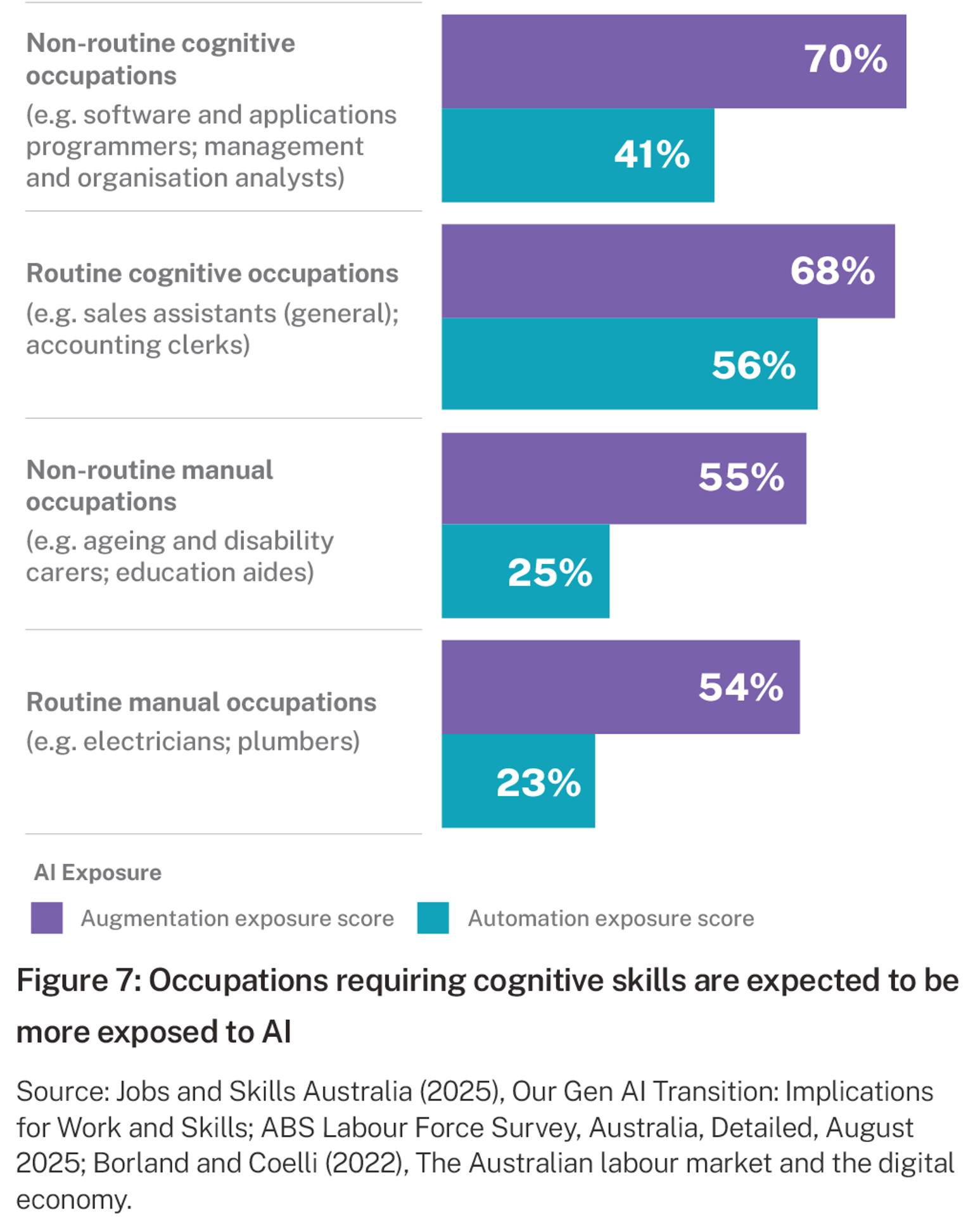
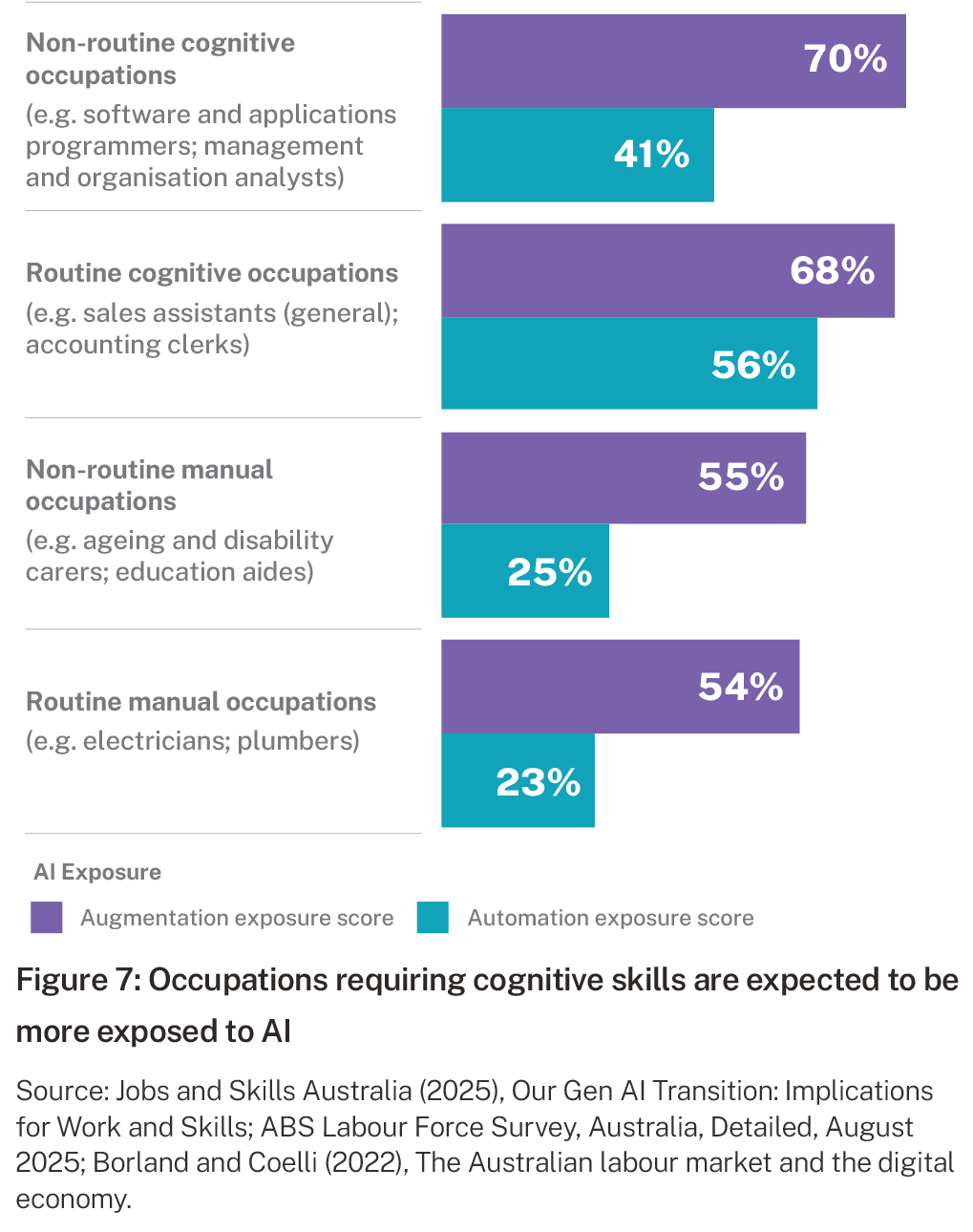
Existing occupations have different levels of exposure to AI (Figure 7). Workers who mainly perform non-routine, cognitive tasks are greatly exposed to AI, including many professionals such as software and applications programmers and management and organisation analysts. While these roles are exposed to both automation and augmentation by AI, they are more likely to be augmented rather than automated.
Manual occupations are less exposed to AI due to their physical and service-oriented nature. These include non-routine manual occupations such as ageing and disability carers and education aides, and skilled trades such as electricians and plumbers.44 Workers in these jobs still need to develop the skills and knowledge to keep up with the latest technology to do their jobs well and meet the evolving needs of their customers.
The Victorian Government’s Digital Jobs Program provides beginner-friendly training for tradespeople and small business owners in trades-related industries. The training can support them to use AI tools to streamline operations, enhance customer engagement, improve job quoting and optimise business management.45
Figure 7: Occupations requiring cognitive skills are expected to be more exposed to AI
As with most types of technological and structural changes in the economy, the adoption of AI may displace some workers.
The skills system plays an important role in supporting displaced workers, including through targeted re-skilling and up-skilling, efficient recognition of prior learning (RPL) and credit transfer processes, and clear information about in-demand jobs and associated skilling pathways.
Through Victoria’s Economic Growth Statement, $3 million was provided for Bendigo Kangan Institute to develop an AI‑enabled RPL tool that improves the speed and accuracy of RPL. This will help employers and training providers better understand a worker’s existing skills and fast-track learning for students.
To support the development and adoption of AI and advanced technologies, Victoria is becoming a data centre hub
Victoria’s world-class research and innovation ecosystem, highly skilled workforce and strong track record of investment in industry, innovation and technology make the state an ideal place for AI investment. Melbourne’s Central Business District is currently Australia’s largest AI cluster with 188 AI firms across a diverse range of industries and around 22% of Australia's AI startups and scaleups.46
The rapidly increasing demand for cloud computing and AI services is creating the need for more data centres – specialised facilities that process, store and distribute vast amounts of data, enabling seamless access to online services and digital activities.47
This digital infrastructure is critical to maximise the benefits from AI and boost Victoria’s digital economy.
Victoria is an emerging data centre hub in the Asia-Pacific region. More than 40 data centres are already located in Victoria, supported by a strong pipeline of investments and commitments from leading global companies and facilitation provided by the Victorian Government.
The growth in data centres comes with a variety of job opportunities, including:
- Construction jobs (such as plumbers and carpenters) to build new data centres.
- Trades and technical jobs (such as electricians and heating, ventilation and air conditioning technicians) to maintain data centre infrastructure.
- Business operations and support (such as IT workers, human resources personnel, managers and administrative staff) to set up and maintain the electronic equipment and support the operation of data centres.48
The data centre sector broadly shares the same pool of workers with other sectors such as construction, IT and professional services. Therefore, new qualifications that are specific to data centres are not necessarily required. Instead, embedding transferable knowledge and skills in existing VET qualifications is critical so workers are mobile in the labour market and can move to where the jobs are (for example, from building data centres to building houses). Employers in the data centre sector have a responsibility to provide sector- specific or organisation-specific training and skills to new and existing workers.
7. The Victorian skills system is central to realising the benefits of AI and technological change
To succeed in the modern workplace, workers need varying levels of digital skills. Almost all workers need foundation digital skills; many workers need industry-specific digital skills; and tech workers need advanced digital skills. The skills system plays a key role in delivering these skills.
To engage with AI and other technologies, workers need foundation digital skills
Foundation digital skills, such as the ability to use the internet and word processing software, and messaging, collaboration, and project management tools are required for many jobs. AI and other digital technologies are used across many sectors, from retail services and health care to manufacturing and construction.
The Victorian Government is building digital literacy across the workforce to support a tech-driven economy. The Literacy and Numeracy Support program is available across all Victorian TAFEs and through specific community providers, giving learners the literacy, numeracy and digital skills they need to complete their VET qualification. The Victorian Government also funds short courses on foundation digital skills delivered by the ACE sector.
Tech workers need advanced digital skills
In addition to foundation digital skills, many workers need digital skills that are specific to their industry or employer. Industry-specific skills include electronic patient management systems in health care and project management software in construction. Demand for industry-specific digital skills is growing across many industries, including advanced manufacturing and renewable energy.
In-demand tech jobs include software and applications programmers, ICT managers, and graphic and web designers. Workers in these jobs need advanced digital skills, such as cloud computing, programming and cybersecurity, and demand for these skills continues to grow.
In a sector that is constantly evolving, it is critical for tech workers to have a combination of detailed technical expertise and advanced digital skills that are transferable across the industry, allowing them to adapt to new technologies and roles. VET qualifications at the Diploma and Advanced Diploma level provide this combination of knowledge and skills.
AI and machine learning are some of the most used technologies in the tech sector, with 58% of Victorian digital technology businesses surveyed in 2024 now using or trialling them in their business.49
In AI-related roles, employers are looking for workers with both advanced digital skills and non-technical skills such as creativity, critical thinking, communication, and collaboration because workers must be able to critically evaluate AI outputs and collaborate with others to get the best out of AI.50
The Victorian skills system is well positioned to respond to the opportunities arising from AI
Victoria’s TAFEs and universities are pioneering new AI and digital training in priority sectors of the economy, including in manufacturing and construction, to strengthen ethical AI adoption and boost safety, productivity and efficiency.
- The Victorian TAFE Network is exploring AI to make it easier to recognise workers’ existing skills and experience so that employers can quickly access the skilled workers they need.51 Holmesglen TAFE delivers a Digital and AI Skills Workshop for Educators to help them develop effective prompting techniques and use AI tools to enhance their lessons.52
- Six Victorian universities have AI centres, including the University of Melbourne’s AI and Autonomy Lab,53 RMIT’s Enterprise AI and Data Analytics Hub,54 Deakin University’s Applied AI Initiative,55 and La Trobe University’s Australian Centre for AI in Medical Innovation.56
The rapid pace of technological advancements means the skills system must remain responsive and adaptable to meet the needs of industry, encourage lifelong learning and support workers to up-skill and re-skill throughout their careers.
For people who already have full qualifications, micro-credentials and skillsets (that can be developed quickly) offer options to up-skill and re-skill to keep up with the latest technologies. These short qualifications can be delivered under fee-for-service arrangements through partnerships between industry and the Victorian TAFE Network.
Through self-accreditation for authorised providers, TAFEs can quickly develop courses to meet industry and workforce needs. TAFE Centres of Excellence have also been established to deliver more responsive training that meets industry needs. For example, Bendigo Kangan Institute self-accredited an Advanced Diploma of Digital Innovation in 4 months to deliver in-demand digital skills.57 Similarly, Melbourne Polytechnic’s Future of Housing Construction Centre of Excellence specialises in uplifting the digital skills of traditional construction and engineering trades in modern methods of construction.58
Embedding new technologies in teaching practices can benefit VET learners and teachers
New technologies such as virtual reality provide simulated learning environments that can benefit many VET disciplines. Simulated VET training facilities already exist in Victoria, including at Holmesglen TAFE’s Simulation Centre for health care and the Metro Trains Academy.59
VET teachers can use digital tools to give learners hands-on, work-based experience to better prepare them for the world of work before they commence their apprenticeships or traineeships. VET teachers can also use AI to reduce the time spent on administrative tasks, allowing them to focus more on teaching.
8. Shared investment in skills by government and industry underpins Victoria’s objectives in digital technologies and other priority sectors
A skilled workforce is a pillar of long-term productivity, innovation and economic prosperity and is a central element of Victoria’s Economic Growth Statement and the Victorian Industry Policy. A skilled workforce enables industry to adopt new technologies (such as AI), leading to better production processes, and the ability to capture new business opportunities.
Building and maintaining a skilled workforce requires significant ongoing financial investment, which is a shared responsibility between government, industry and individuals.
The Victorian Government’s investment in skills is aligned to economic, social and community needs
With the Victorian TAFE Network leading the way, the Victorian Government is playing its part by investing extensively in education and training. It targets areas of greatest economic, social and community need and invests based on strong policy principles to make training accessible, equitable, impactful and responsive to new priorities (Figure 8).
Figure 8: Policy principles that underpin Victorian Government’s investment in skills and training
| Drive productivity, innovation and economic growth |
| Maintain a high-performing and fiscally sustainable skills system through targeted investment |
| Increase participation in skilling and employment for all Victorians |
| Provide Victorians with strong foundational skills in literacy, numeracy and digital literacy |
Under Skills First, the government funds over 500 accredited qualifications and short courses at TAFE and non-TAFE providers through the Training Needs List.60 Free TAFE offers no-fee training for more than 80 courses,61 and the Victorian Government offers financial and other supports for many priority cohorts to access and complete training, including disengaged young people and First Nations peoples.
Through the ACE sector, the Victorian Government funds pre-accredited training so that Victorians can get the literacy, numeracy, non-technical and digital skills that allow them to participate in higher-level learning, gain employment and succeed in work and life.
The government also supports industry to partner with the Victorian TAFE Network to address skills gaps in priority sectors and provides funding for targeted up-skilling through programs such as the Digital Jobs Program and Skills Solution Partnerships.
While industry invests in the skilling of its workforce, more can be done
Victorian industry invests in the skilling of its workers in various ways, including by:
- supporting career awareness and work-based learning through informal and formal on-the-job opportunities, including apprenticeships and traineeships
- paying for accredited and unaccredited training of workers
- engaging with government on skills and training needs in the economy – for example, through the VSA’s Industry Advisory Groups.
Industry investment generally focuses on the specific skills needed within an industry or organisation and often builds on the existing qualifications that people have received through government-funded training.
Employers are the primary beneficiaries of industry-specific training through growth in productivity, revenue and profit, increased innovation, and improved staff motivation and retention. They also have significant influence on the uptake of training by their workers.
To remain responsive to changes in their operating environment, employers need to invest more in training their workers, especially to provide industry-specific skills. For example, with the rapid pace of technological change, especially AI, investment in industry-specific digital skills enables businesses to reap the benefits of the digital transformation by improving processes and helping them save time and achieve more work at a lower cost. Similarly, by up-skilling their employees, employers in the construction sector can capitalise on new business opportunities in renewable energy, including battery storage integration and EV charger installation.
The form of industry investment in skilling may depend on factors such as business size and financial capacity and may include fee-for-service accredited training, in-house and on-the-job training, and unaccredited training to gain skills that are transferable across the industry.
The Victorian TAFE Network is well placed to support industry investment in skills
Industry can partner with the Victorian TAFE Network to address critical skills shortages and up-skill its workforce. TAFEs and dual sector providers have the capacity and capability to design, develop and deliver responsive industry-specific training. They also offer high-end training facilities and opportunities for applied research and innovation across many emerging and priority industry sectors.
Through Skills Solution Partnerships, Victoria’s industry, TAFEs and dual sector providers partner and co-invest with the Victorian Government to design and pilot new short courses to quickly address skills gaps in priority sectors including the clean economy, advanced manufacturing and defence.
The self-accreditation pilot, led by the Australian Skills and Quality Authority, demonstrated the benefits of self-accreditation for TAFEs. Empowering more Victorian TAFEs with the ability to self-accredit, while fostering strong industry partnerships, supports more responsive industry-specific training and increased industry investment in the up-skilling of its workforce.
Conclusion
Securing good jobs requires good preparation through vocational and higher education. By providing data and insights on where good jobs are across the state, this Skills Plan is a practical guide to help Victorians make informed skilling and career decisions.
Over the coming years, large industries like health care and social assistance and construction will continue to grow. Emerging sectors like advanced manufacturing and the clean economy will also offer many good jobs. Vocational education and training, led by the Victorian TAFE Network, is the pathway into many of these jobs.
Digitisation is transforming workplaces and this has been turbocharged by the rapid deployment of AI. Digital literacy is now an essential skill for all workers to succeed in the labour market. Most workers also need digital skills (such as data analysis) and tech workers need advanced digital skills (such as integration and configuration of digital systems). Communication, critical thinking, collaboration and creativity are essential to adapt digital solutions in work settings.
To support the rollout of AI and advanced technologies, Victoria is growing its data centre sector and the skills system is training the skilled workforce needed, including construction workers, trade and technical specialists, and business operations staff.
The skills system must adapt quickly to provide learners with the foundation, industry-specific and advanced digital skills that are needed. A refreshed approach to VET needs to build capabilities alongside technical skills to help learners succeed in a rapidly changing economy.
Close partnership with industry and shared investment in skills underpin our successful skills system and industry must do more to train new and existing workers.
Skills are the powerhouse of productivity, driving 20% of labour productivity growth in Australia over the past few decades and supporting better living standards for Victorians.62 Through the Economic Growth Statement and the Victorian Industry Policy, the Victorian Government reinforces the role of skills as a pillar of economic prosperity.
Victoria is a place of opportunity, including in education and work. As the Victorian economy and society change, its skills system is also evolving to give Victorians the education and training they need to succeed in work and life. This Skills Plan lays out the latest insights and advice to achieve this goal.

The Hon. Jenny Macklin AC
Chair
Victorian Skills Authority Advisory Board

Craig Robertson
Chief Executive Officer
Victorian Skills Authority
Endnotes
- Victorian Government (2025), Free TAFE program(opens in a new window).
- The Hon Gayle Tierney MP (2025), Free TAFE Makes It Real For Hundreds Of Thousands Of Victorians(opens in a new window), 9 September.
- Learn Local (2025), About Learn Local(opens in a new window).
- ABS, Labour Force, Australia(opens in a new window), September 2025.
- ABS, Counts of Australian Businesses, including Entries and Exits(opens in a new window), July 2021 – June 2025.
- ABS, Labour Force, Australia(opens in a new window), September 2025.
- ABS, Labour Force, Australia, Detailed(opens in a new window), August 2025.
- Victorian Government (2022), Inclusive Victoria: State disability plan 2022-2026(opens in a new window).
- Commonwealth Government (2025), Key Apprenticeship Program(opens in a new window).
- The Hon Amanda Rishworth MP and the Hon Andrew Giles MP (2025), Apprentice support in key sectors extended(opens in a new window), 1 December.
- NCVER, Total VET students and courses 2024, DataBuilder.
- The results are based, in part, on data supplied to the ABS under the Taxation Administration Act 1953, A New Tax System (Australian Business Number) Act 1999, Australian Border Force Act 2015, Social Security (Administration) Act 1999, A New Tax System (Family Assistance) (Administration) Act 1999, Paid Parental Leave Act 2010 and/or the Student Assistance Act 1973. Such data may only used for the purpose of administering the Census and Statistics Act 1905 or performance of functions of the ABS as set out in section 6 of the Australian Bureau of Statistics Act 1975. No individual information collected under the Census and Statistics Act 1905 is provided back to custodians for administrative or regulatory purposes. Any discussion of data limitations or weaknesses is in the context of using the data for statistical purposes and is not related to the ability of the data to support the Australian Taxation Office, Australian Business Register, Department of Social Services and/or Department of Home Affairs’ core operational requirements.
Legislative requirements to ensure privacy and secrecy of these data have been followed. For access to PLIDA and/or BLADE data under Section 16A of the ABS Act 1975 or enabled by section 15 of the Census and Statistics (Information Release and Access) Determination 2018, source data are de-identified and so data about specific individuals has not been viewed in conducting this analysis. In accordance with the Census and Statistics Act 1905, results have been treated where necessary to ensure that they are not likely to enable identification of a particular person or organisation. - Department of Jobs, Skills, Industry and Regions (2025), Victorian Industry Policy(opens in a new window); Department of Treasury and Finance (2024), Economic Growth Statement(opens in a new window).
- Invest Victoria(opens in a new window) (2025), Digital infrastructure.
- Mandala Partners (2024), Empowering Australia's Digital Future(opens in a new window), p. 15.
- Department of Jobs, Skills, Industry and Regions (2025), Victorian Industry Policy(opens in a new window).
- ABS, Australian National Accounts: State Accounts, 2023–24 financial year(opens in a new window).
- Department of Jobs, Skills, Industry and Regions (2025), Victorian Defence Vision Statement(opens in a new window).
- Global Victoria (2025), Victorian Food and Fibre Export Performance Summary 2023–24(opens in a new window), p. 4.
- Department of Education (2025), Regional University Study Hubs(opens in a new window).
- Department of Jobs, Precincts and Regions (2022), Great South Coast: Regional Economic Development Strategy(opens in a new window).
- Department of Climate Change, Energy, the Environment and Water (2025), Southern Ocean region off Victoria, declared offshore wind area(opens in a new window).
- Invest Gippsland (2025), Invest in a Growing Food Bowl(opens in a new window).
- Business Events Victoria (2025), Agribusiness(opens in a new window).
- Business Events Victoria (2025), Agribusiness(opens in a new window) (2025), Agri and Horticulture Business(opens in a new window).
- Department of Jobs, Precincts and Regions (2022), Medtech Manufacturing Capability Program Guidelines(opens in a new window), p. 1.
- Premier of Victoria (2022), Backing Medtech Innovations In Bendigo(opens in a new window), 15 September.
- Business Events Victoria (2025), Advanced manufacturing(opens in a new window).
- Business Events Victoria (2025), Advanced manufacturing(opens in a new window).
- Federation University (2024), Federation University Technology Parks: About us(opens in a new window).
- Data Centre Dynamics (2025), NextDC announces plans for data centre in Melbourne, promises 1MW rack densities(opens in a new window).
- Jobs and Skills Australia (2025), Our Gen AI Transition: Implications for Work and Skills(opens in a new window), p. 119.
- Jobs and Skills Australia (2025), Our Gen AI Transition: Implications for Work and Skills(opens in a new window), p. 119.
- Jobs and Skills Australia (2025), Our Gen AI Transition: Implications for Work and Skills(opens in a new window), p. 119.
- Productivity Commission (2025), Harnessing data and digital technology - Interim report(opens in a new window).
- CSIRO (2025), Byte by byte: How AI is reshaping agriculture.
- Premier of Victoria (2025), A Responsible Budget Focused On What Matters Most(opens in a new window), 20 May.
- La Trobe University (2024), New centre to be key in global AI medical research(opens in a new window).
- Business Victoria (2025), Digital Jobs Program.
- UNSW (2025), How AI in healthcare is reshaping the future of medicine(opens in a new window).
- Tech Council of Australia (2023), Australia’s Generative AI Opportunity(opens in a new window), p. 19.
- Tech Council of Australia (2024), Meeting the AI Skills Boom(opens in a new window), p. 53.
- ParametricArchitecture (2024), The use of robotics in prefabricated construction: advantages and challenges(opens in a new window).
- These are technically classified as manual, routine occupations as per Borland and Coelli (2022) methodology.
- Business Victoria (2025), Digital Jobs Program Handbook, p.41
- Department of Industry, Science and Resources (2025), Australia’s artificial intelligence ecosystem: growth and opportunities, p. 21; Global Victoria (2025), Victoria’s Digital Technology Ecosystem.
- Mandala Partners (2024), Empowering Australia’s Digital Future(opens in a new window), p. 4.
- Mandala Partners (2024), Empowering Australia’s Digital Future(opens in a new window), p. 16.
- Department of Jobs, Skills, Industry and Regions (2025), Victorian Digital Technology Sector Factsheet(opens in a new window), p. 1.
- Department of Industry, Science and Resources (2025), Australia’s artificial intelligence ecosystem: growth and opportunities, p. 43.
- Victorian Government (2025), 2025–26 State Budget – Service and Delivery, Budget Paper 3, p. 11.
- Holmesglen Institute of TAFE (2025), Digital and AI Skills Workshop for Educators.
- University of Melbourne (2025), AI and Autonomy Lab.
- RMIT (2025), Enterprise AI and Data Analytics Lab.
- Deakin University (2025), Applied Artificial Intelligence Initiative.
- La Trobe University (2025), Australian Centre for Artificial Intelligence in Medical Innovation.
- Kangan Institute (2024), Kangan Institute leading digital course innovation with ASQA pilot initiative(opens in a new window).
- Melbourne Polytechnic (2024), $50 million national housing construction training centre for Melbourne Polytechnic(opens in a new window).
- Holmesglen (2025), Holmesglen Simulation Centre; Metro Trains (2023), Metro opens its doors to train enthusiasts young and old.
- The Hon Gayle Tierney MP (2024), Free TAFE Training Victorians For The Jobs Of The Future(opens in a new window), 29 November.
- Victorian Government (2025), Free TAFE program(opens in a new window).
- Productivity Commission (2023), 5-year Productivity Inquiry: from learning to growth, Vol. 8, p. 3.