Occupational health and safety
DPC is committed to maintaining a safe, healthy and supportive workplace that protects and promotes the health, safety and wellbeing of all employees. This commitment is underpinned by compliance with relevant legislation, regulations, standards and codes, and is supported by a culture of shared responsibility in which employees and leaders actively contribute to the continuous improvement of health, safety and wellbeing outcomes.
Aligned with the Victorian Public Service Leading the Way strategy, DPC fosters a culture of high safety standards that supports a holistic and inclusive approach to staff physical and mental wellbeing.
Vision: A workforce that demonstrates both physical and psychosocial safe practices in all aspects of our work. Mission: To develop a holistic, values-aligned, integrated approach to health, safety and wellbeing. |
DPC continues to strengthen a supportive and robust safety culture that promotes both physical and psychosocial safety within the workplace for all employees.
As part of this culture, DPC places particular focus on psychological safety by identifying and reducing psychosocial hazards and risks in the workplace.
During 2025–26, DPC enhanced a range of health, safety and wellbeing initiatives to support staff.
New policies, procedures and supporting documentation were also introduced to strengthen the management of psychosocial hazards in the workplace. Risk assessments continue to be enhanced with the introduction of the Psychological Health Regulations 2025. In addition, DPC promoted mental wellbeing through targeted initiatives and training, supported by its employee assistance program provider, Converge International.
Incident management
There were no notifiable incidents reported across DPC in 2025–26. Notifiable incidents are those required to be reported to WorkSafe Victoria under occupational health and safety legislation.
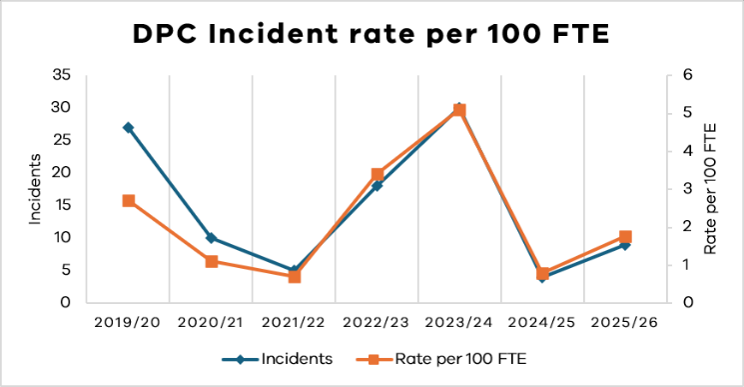
The overall incident rate increased from 0.8 per 100 FTE in 2024–25 to 1.7 per 100 FTE in 2025–26, with 9 incidents reported during the year. This increase may reflect improved awareness of psychosocial hazards and reporting processes, which may have led to increased reporting of issues that might previously not have been raised. Figure 1 shows this trend.
DPC’s performance against OHS management measures is outlined in Section 6, Appendix 3: Occupational health and safety data.
Commitment to public sector values and workforce integrity
The Public Administration Act established the VPSC to enhance public sector efficiency, effectiveness and capability while advocating for professionalism and integrity. In alignment with the VPSC’s employment standards, DPC has implemented policies and practices that ensure fair treatment, provide career opportunities and facilitate the early resolution of workplace issues.
DPC actively educates employees on avoiding conflicts of interest, handling offers of gifts and addressing misconduct. The department is committed to upholding principles of merit and equity in staff appointments. Recruitment processes are designed to ensure that all applicants are assessed fairly and consistently against key selection criteria and other relevant accountabilities, without discrimination.
Employees are also accurately classified in workforce data collections. For a detailed breakdown of DPC’s workforce data, refer to Section 6, Appendix 2: Workforce data.
Workforce inclusion policy
DPC are committed to providing a workplace which is safe, inclusive, and respectful.
This year we introduced our Diversity, Equity and Inclusion (DEI) Strategy 2025–29 which outlines our strategic vision to create a diverse, equitable and inclusive workplaces where all people feel like they belong and are treated with dignity and respect.
The strategy builds on our previous work and aligns where possible with the department’s obligations under the Gender Equality Act 2020.
The Strategy was developed following extensive research and consultation including Executive Leadership group briefings, a desktop review of whole of Victorian Government DEI strategies and research, analysis of 2024 People Matter Survey data by diversity, a series of staff workshops and playback sessions, focus groups with staff networks (including the Combined Enablers Network) and interviews with DEI Executive Champions.
The priority diverse cohorts under the Strategy include:
- Disability Access and Inclusion
- LGBTIQA+ Inclusion
- Cultural Diversity
- Gender Equality.
The strategic vision is underpinned by five key focus areas which are:
- Visible leadership and accountability for DEI
- Attracting, developing, and retaining a diverse and talented workforce
- Ensure equity in the workplace
- Creating culturally safe and respectful workplaces
- Measuring, monitoring and reporting on DEI strategy.
Each focus area has dedicated actions and outcomes. In line with the Corporate Shared Services function, the strategy outlines a clear governance and accountability framework for implementing the strategy.
Gender equality
DPC recognises the importance of gender diversity within its workforce and is committed to strategies that promote opportunities for all employees, including those who identify as gender diverse. As at the end of June 2026, women held 55.1% of these positions.
During 2025–26, DPC developed its new Gender Equity Action Plan which includes strategies aligned to the Commission’s gender equality indicators. The plan followed extensive consultation with various stakeholders including the Board of Management, staff, the DPC People Committee, and the Community and Public Sector Union (CPSU). It recognises that gender equality is strengthened when it reflects the diversity of our people, including Aboriginality, age, disability gender identity, race, religion, and sexual orientation and when all employees feel safe, valued, and supported.
DPC’s new Gender Equity Action Plan builds on the progress and achievements of the previous plan and has been developed in partnership with our staff and leaders. DPC is strongly committed to building an organisation where gender does not determine access to opportunity, recognition, and career progression.
Disability inclusion and employment
In early 2026, DPC launched the Diversity, Equity and Inclusion Strategy 2025–29 which sets out how we will continue to strengthen inclusion and support a culture where people feel valued and supported. In addition, in collaboration with DGS, DPC has:
- Reduced barriers to persons with a disability obtaining and maintaining employment by promoting and educating employees and managers on the Common Workplace Adjustment Policy
- Promoted other internal and external training and awareness opportunities to build confidence in recruiting, managing, and working with employees with disability
- Maintained an Executive Champion for Disability who regularly meets with members of the Enablers Network (a staff network for persons with a disability, their carers and allies) as a forum that represents the needs, interests, and concerns of employees with lived experience of a disability
- Continued to support DPC’s LGBTIQA+ staff and their allies through the DPC / DGS LGBTIQA+ Network and the work of the DPC Executive Champion for LGBTIQA+ Inclusion
- Established an Executive Champion for Cultural Diversity who sponsors the DPC Multicultural Staff Network, which brings together culturally diverse staff and allies to connect, share experiences and ideas, and help build a more inclusive workplace.
During 2025–26, DGS Corporate Shared
Services supported DPC’s commitments by:
- reviewing various policies with an
inclusive lens - embedding disability and other diversity considerations in manager tools, learning resources and supports.
Workforce data showed that 2.0% of DPC employees had disclosed a disability in 2025–26, compared to 2.6% in 2024–25. Separately however, the 2026 People Matter Survey reported that 10.0% of staff identified as having a disability. This discrepancy is likely due to the anonymity of survey responses. DPC remains committed to fostering a culture where staff feel comfortable sharing diversity information to better inform future workplace inclusion strategies.
Aboriginal and Torres Strait Islander staff inclusion and employment
DPC is committed to improving the recruitment and retention of Aboriginal and Torres Strait Islander staff by fostering a culturally safe workplace, strengthening cultural capability and providing flexible and progressive career opportunities. Barring Djinang is the Victorian public sector’s five-year Aboriginal employment strategy, which sets a target of 2.0% Aboriginal employment across the sector.
In 2025–26, DPC exceeded this target, with 3.5% of staff identifying as Aboriginal and/or Torres Strait Islander. In the 2026 People Matter Survey, 4.0% of respondents disclosed they were Aboriginal and/or Torres Strait Islander.
Workforce inclusion policy progress
The table below1 outlines DPC’s progress against key workforce inclusion targets, relating to gender profiles at the executive level, employment of people with disability, and employees who identify as Aboriginal and/or Torres Strait Islander. Figures are drawn from payroll data as at the end of the last full pay period in June each year.
| Workforce Inclusion Policy initiative | Target | 2025–26 | 2024–25 |
| Gender profile at executive levels | Representation of at least 50% women in executive officer roles | 55.122 | 57.9 |
| People with disability | People with disability at DPC increases to 12% by 2025 | 1.73 | 2.0 |
| Aboriginal and/or Torres Strait Islander staff | Barring Djinang has adopted an Aboriginal employment target of 2% for the Victorian public sector | 3.04 | 3.5 |
Notes:
1. This table excludes Yoorrook Justice Commission staff.
2. DPC's representation of women at the executive level decreased primarily due to relatively higher rate of executive women choosing to leave the department for employment with another VPS employer.
3. DPC's percentage of staff with disability decreased due to unrelated individual employee departures which DPC was unable to offset through recruitment during the reporting period.
4. DPC's Aboriginal and/or Torres Strait Islander staffing levels decreased proportionally between June 2025 to June 2026, reflecting staff departures associated with organisational change processes undertaken in 2026 in DPC's First Peoples - State Relations group under clause 11 of the VPS Enterprise Agreement 2024.
Compliance with the Carers Recognition Act
DGS Corporate Shared Services supports DPC in taking practical measures to meet obligations under the Carers Recognition Act 2012 (the Act). These include:
- Considering the care relationships principles set out in the Act when setting policies and providing services, for example:
- A DGS Common Policy on flexible work, which ensures flexible work arrangements are embedded within DGS’ working culture (in line with requirements under the Gender Equality Act) and are available to all staff for any reason including supporting employees with family and caring responsibilities
- Embedding a hybrid working model to support diversity, inclusion and a more equitable workplace
- Ongoing provision of the Parental Leave Transition Support Coaching Program.
- Ensuring our staff have an awareness and understanding of the care relationship principles set out in the Act, for example:
- Championing the Enablers Network, a network run by persons with a disability for persons with a disability, with an executive sponsor, which is open to all staff including carers and allies
- Providing support to all employees through the Peer Support Program and the Employee Assistance Program.
Updated