
Physical violence
The Child Wellbeing and Safety Act 2005 (Vic) states that physical violence committed against, with, or in the presence of a child is a type of reportable conduct.
This information sheet provides guidance to assist organisations in deciding whether conduct or behaviour is physical violence under the Reportable Conduct Scheme (the scheme). As this guidance is of a general nature, it may not cover all possible situations.
If further guidance is required, please contact the Social Services Regulator to discuss your individual situation.
What is physical violence?
Physical violence has two elements that need to be satisfied in order to make a substantiated finding of reportable conduct. These elements are:
- the conduct or behaviour that the worker or volunteer engaged in meets the definition of physical violence, and
- the worker or volunteer either intentionally carried out the conduct or behaviour, or else was reckless in not having thought about the likely consequences of their behaviour for a child.
If a decision maker does not find that both of these elements are met, then the conduct or behaviour will not be physical violence under the scheme.
The definition of physical violence
There are two types of physical violence under the scheme:
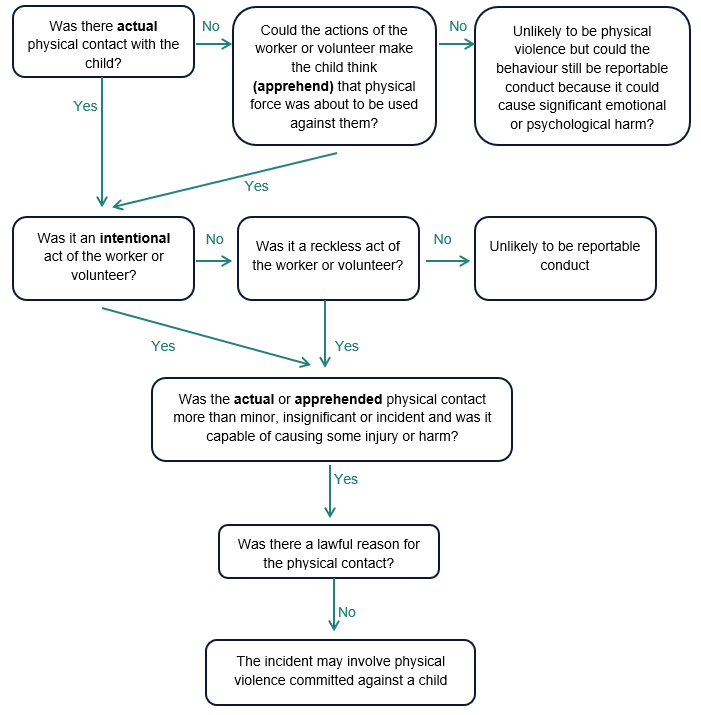
- actual physical violence a worker or volunteer intentionally or recklessly uses physical force against, with, or in the presence of a child without a lawful reason, which has the ability to cause injury or harm to the child. Actual physical violence can include hitting, punching, kicking, pushing or throwing something that strikes a child or another person.
- apprehended physical violence a worker or volunteer intentionally or recklessly engages in conduct or behaviour against, with, or in the presence of a child that is capable of causing a child to think that physical force is about to be used against them or another person. This could include words, gestures or actions that cause a child to believe physical force is about to be used against them, regardless of whether or not the worker or volunteer actually intended that any physical force would be applied. For example, a worker angrily punches the wall next to a child’s head causing the child to fear they were about to be punched might constitute physical violence.
What is a ‘lawful reason’ for physical contact?
There are a number of situations where a worker or volunteer may make physical contact with a child for lawful reasons. This would mean the conduct or behaviour does not satisfy the definition of physical violence under the scheme. An example of lawful physical contact includes physically restraining a child to stop them from hurting another person or themselves, or from destroying property.
Any force used by the worker or volunteer must be reasonable in all of the circumstances and no more force should be used than is absolutely necessary. If the force used is not reasonable, or is more than is needed, the act could be physical violence under the scheme.
In very limited circumstances, physical force against a child might be lawful because the child has consented to the conduct or behaviour by the worker or employee. An example might be when a child helps a teacher demonstrate a block in a martial arts class. The child would be consenting to some degree of physical force in demonstrating the block but would not be consenting to, for example, being punched in the face.
For consent to be valid, the child must be capable of understanding what they are consenting to and the possible consequences. In assessing the ability of the child to consent, consideration is needed of the age of the child, their stage of development, and whether there is any other characteristic of the child that affects their ability to understand, for example, an intellectual disability.
What is ‘intentional’ and ‘reckless’?
For conduct or behaviour to be physical violence under the scheme, the actions of the worker or volunteer must be either intentional or reckless.
Intentional means that the worker or volunteer engaged in the behaviour or conduct deliberately.
In the case of actual physical violence, this applies where the worker or volunteer intentionally carries out the conduct or behaviour when physical contact was made with the child. An example of actual physical violence is a situation where a volunteer intentionally kicks a child in an attempt to have the child stop talking in bible class.
In the case of apprehended physical violence, this applies where the worker or volunteer intentionally carries out the conduct or behaviour, with an intention of making a child believe there would be actual physical force that could injure or harm the child. An example might be where a child care worker raises an open hand above their head as if about to hit a child, while yelling a threat at the child that they need to be quiet or they will get a smack and the child cringes believing they are about to be smacked.
Reckless means the worker or volunteer might not have intended to use actual physical force, or to make a child believe actual physical force would be used, but was reckless about the impact their conduct or behaviour could have on a child. Investigations will often need to be undertaken before it is possible to determine whether or not the conduct or behaviour was reckless as it will frequently require an examination of all of the circumstances surrounding the incident.
In cases of recklessness, the worker or volunteer will often know it was likely their conduct or behaviour could lead to physical force being applied to a child, or make the child afraid that physical force was about to be used, but engages in the conduct or behaviour anyway.
Recklessness can occur when the worker or volunteer:
- does not stop to think about the potential consequences of their conduct or behaviour, but if they had, they would have realised the impact their actions were likely to have, or
- has some understanding of the possible impact their actions were likely to have, but goes ahead with the conduct or behaviour anyway.
An example of recklessness resulting in actual physical violence is a situation where a physical education teacher is demonstrating archery by having a student hold an aluminium can up as a target and the student gets hit in the hand by the arrow.
An example of recklessness causing a child to apprehend they would suffer physical violence could include a teacher playing a joke on a student by threatening a student with a fake gun but the student believed it to be a real gun and thought he was about to be shot. The teacher was reckless as to the consequences of her conduct, and therefore this could be physical violence under the reportable conduct scheme.
An example of conduct that might not meet the definition of recklessness is a situation where a teacher is walking with a student over a muddy football oval when the teacher slips in the mud and knocks the child to the ground.
Does the child have to be injured or harmed?
Where physical contact is made with a child, the contact must be capable of causing some type of injury or harm to the child.
It is not necessary that this injury or harm actually happened, and the injury or harm does not have to be serious or permanent.
The evidence of the actual impact, or lack of impact, of the conduct or behaviour on the alleged victim will be highly relevant, but may not be conclusive.
An example is where a child is slapped on the face by a carer, but the slap does not leave a visible mark and the child is too upset to provide evidence about whether the slap hurt. If the slap was capable of injuring or harming the child, it may be physical violence under the reportable conduct scheme.
Another example is where a volunteer at a park pokes a child’s shoulder to get their attention. If the poke was not capable of causing injury or harm to the child and the child gives evidence that the poke was uncomfortable but didn’t hurt, it may not be physical violence under the reportable conduct scheme.
Where there has been no physical contact with a child, and the conduct or behaviour has caused a child to fear that physical contact will be made with them, the apprehended physical contact must be capable of causing some type of injury or harm.
Conduct or behaviour that is not physical violence under the reportable conduct scheme includes:
- where the contact is minor, trivial or negligible
- where the physical contact is a part of normal social interactions such as touching a child to gain their attention, to guide or to comfort a child
- actions involved in caring for a child having regard to their age, maturity, health or any other relevant characteristics.
For conduct or behaviour to be physical violence under the reportable conduct scheme, it is not necessary for the worker or volunteer to act with hostility or aggression. However, the worker or volunteer’s demeanour, including whether or not they were hostile or aggressive, might help in deciding if the conduct or behaviour was intentional or reckless. It could also be relevant, together with other factors, to whether the conduct or behaviour had the potential to cause injury or harm.
If the conduct or behaviour of the worker or volunteer does not meet the definition of physical violence, it may be another type of reportable conduct, for example conduct that causes significant psychological or emotional harm.
For more information, please refer to Information Sheet 2 - What is reportable conduct?
Flow chart of physical violence committed against a child
Physical violence committed ‘with’ a child
The reportable conduct scheme only applies to the conduct or behaviour of workers or volunteers aged 18 years and over. However, there is a type of reportable conduct where an adult worker or volunteer is involved in an act of physical violence with a child.
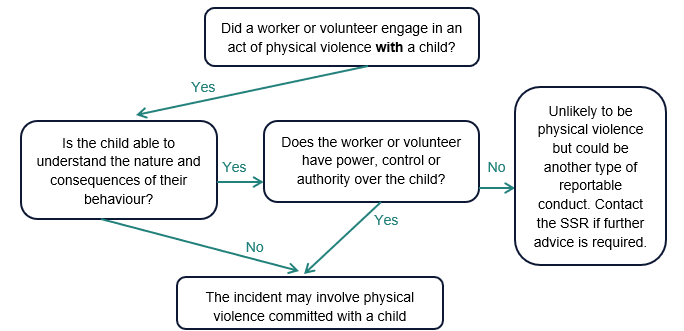
Physical violence committed with a child applies where a child is involved in the act of physical violence together with the worker or volunteer. It uses the same definition of physical violence as outlined above, but with the added need to identify whether a child voluntarily took part in the conduct or behaviour with the adult worker or volunteer, and whether the child could understand that their behaviour was wrong. The victim of the physical violence can be an adult or a child in this situation.
Generally, a child aged 14 years or older will have the maturity and understanding to know when their behaviour is wrong and to choose to voluntarily participate. This might not be the case, however, for some children aged 14 years and older with an intellectual disability or some other characteristic meaning they are less mature or less able to understand the consequences of their actions.
It can also be generally assumed that a child who is younger than 14 years will not have the maturity and understanding to voluntarily participate, or to know when their behaviour is very wrong. This will not always be the case though and some children younger than 14 years of age will have the understanding and maturity.
Another important factor to consider is the relationship between the worker or volunteer and the child that they are alleged to have engaged in physical violence ‘with’. If the worker is able to exercise any power or authority over the child, the child may feel they have no choice or are too afraid to disobey the worker even if they understand that their behaviour is wrong. This may mean the child did not voluntarily participate.
Physical violence committed with a child may include situations where:
- a worker or volunteer encourages a child aged less than 14 years to participate in an act of physical violence, but the worker or volunteer does not use any physical force
- a child who is 14 years of age (or older) participates in an act of physical violence with a worker or volunteer but the child does not have the ability to understand that their behaviour is wrong
- a worker or volunteer encourages a child aged 14 years or more to participate in physical violence but because the worker or volunteer has authority or power over the child, the child feels they must do what the worker or volunteer wants. The child might also feel too afraid to disobey the worker or volunteer even if they know the behaviour is wrong.
If a child is able to understand the nature and consequences of their behaviour, and the worker or volunteer has no power, control and authority over the child, it is unlikely that physical violence with a child will be substantiated. However, there could be other types of reportable conduct involved.
Flow chart of physical violence committed with a child
Physical violence ‘in the presence’ of a child
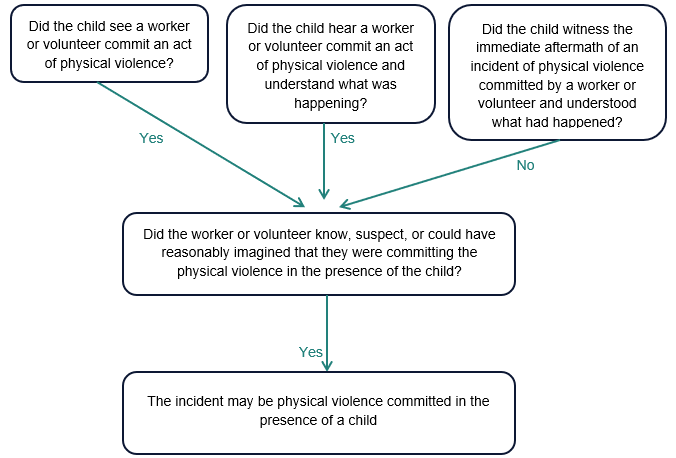
Physical violence committed in the presence of a child will include situations where the child sees a worker or volunteer commit an act of physical violence. The victim could be another child or an adult.
Physical violence in the presence of a child will also include situations where a child can’t see, but can hear, an act of physical violence. The child might be in the next room. In this situation, it will be necessary to establish that the child was likely to know that the noises they heard were physical violence.
It will also include situations where a child witnesses the immediate aftermath of an act of physical violence. The child might see a room in disarray where items may have been knocked over or broken, or see a victim injured or very upset as a result of the physical violence. In this situation, it will be necessary to establish that the child was likely to know that the disarray they saw, or the injuries or distress of the victim they observed, were caused by physical violence.
Flow chart of physical violence committed in the presence of a child
Contact us
For further information about the Reportable Conduct Scheme, to talk through issues of concern, or to make a notification, contact SSR by phone on 1300 310 778 or via email at contact@ssr.vic.gov.au.
For all WWC Check queries contact 1300 652 879.
If you need an interpreter, please call the Translating and Interpreting Service on 13 14 50 and ask them to contact the Social Services Regulator on 1300 310 778.
If you are deaf, or have a hearing or speech impairment, contact us through the National Relay Service. For more information, visit: https://www.accesshub.gov.au/about-the-nrs.
Download this information sheet
Updated