


On this page
Information for children
You have the right to feel safe and to be safe.
This may be at school, participating in activities, camps, playing sport, part of a religious organisation or anywhere else.
Being safe means you are free from abuse. Feeling safe means you are comfortable in the places where you spend time and trust the adults around you.
Adults are not allowed to:
- say or do anything that makes you feel unsafe or uncomfortable
- touch you in a way that you don’t like or that makes you feel uncomfortable
- hit you or hurt your body.
There are also special rules called the Reportable Conduct Scheme.
The Reportable Conduct Scheme says that adults in charge have to:
- listen to you and find out what happened
- keep you safe and protected
- tell the Social Services Regulator if an adult breaks the rules
- take action to keep you safe.
If there is an emergency, or you or someone else is in danger, then call police on Triple Zero (000) immediately.
Or, tell an adult you trust. This might be a parent, carer, another adult in your family, a teacher, coach or any other adult that you trust. They can get help so you can stay safe.
If they don’t help you, tell another adult you trust or contact us at the SSR.
You can also call Kids Helpline on 1800 55 1800 at any time for any reason.
What happens next?
After you tell an adult you trust, there are people whose job it is to find out what happened. They will ask questions so they can understand what happened.
- Tell them everything you remember
- If you don’t know the answer to a question or you have forgotten, just say ‘I don’t know’ or ‘I don’t remember'. You won’t get in trouble if you don’t know an answer.
- You can ask questions too, to help you understand what is happening.
- The adult who broke the rules won’t be there when you answer questions.
After talking to you, the person asking questions might need to talk to other people. Adults in charge will then decide how to keep you and other children safe.
The Social Services Regulator is a group of people whose job is to help make sure that children are kept safe. We do our best to make sure that adults follow the rules.
Information about the Reportable Conduct Scheme for parents and carers
Organisations have a responsibility to keep children safe from harm.
The Victorian Reportable Conduct Scheme is one of the laws that helps keep children and young people safe from abuse. It does this by making sure certain organisations deal with safety concerns properly and fairly. This includes schools, childcare centres, overnight camps for children, religious organisations and many others.
The Reportable Conduct Scheme supports organisations to improve how they manage allegations of child abuse by their workers and volunteers.
An allegation is when someone accuses another person of having done something.
The Reportable Conduct Scheme supports organisations to improve how they manage allegations by making sure they:
- have ways for anyone to report safety concerns about adults who work or volunteer with the organisation
- tell the SSR about certain allegations
- investigate allegations
- tell the SSR what it will do at the end of an investigation.
Not all organisations fall under the Reportable Conduct Scheme. Find out who is covered on our Who the Reportable Conduct Scheme applies to webpage.
Reportable conduct covers a range of inappropriate behaviours by adult workers and volunteers towards children and young people aged under 18 years. There are five types of reportable conduct:
- sexual offences (against, with or in the presence of, a child)
- sexual misconduct (against, with or in the presence of, a child)
- physical violence (against, with or in the presence of, a child)
- behaviour that causes significant emotional or psychological harm
- significant neglect.
The organisation must notify the SSR about all allegations of reportable conduct and investigate. This should be done by someone who was not involved in the incident. The investigator should talk with relevant people, including children or young people, if they want to be involved. Where an allegation involves possible criminal conduct, the organisation and the SSR must report it to Victoria Police.
If your complaint doesn’t relate to reportable conduct, organisations must still take your complaint seriously under the Child Safe Standards. Any risks to children must be identified and responded to.
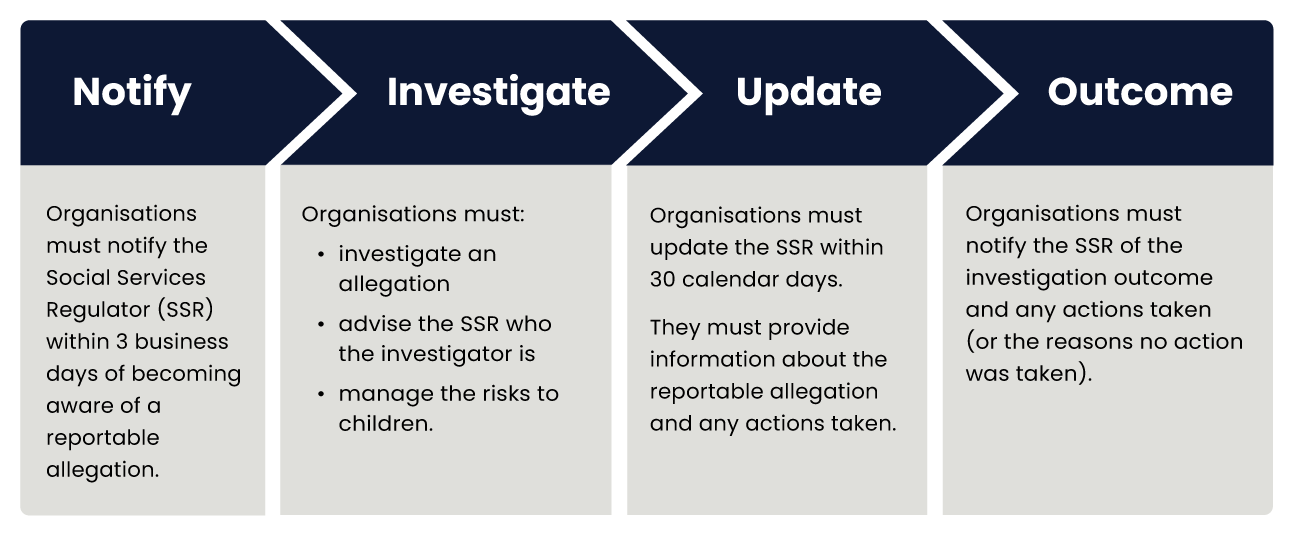
We oversee and monitor organisations’ reportable conduct investigations. This means that we have the power to:
- ask for information on an investigation
- help organisations recognise reportable conduct
- give organisations advice on their investigations
- share information with agencies in certain circumstances, like Victoria Police and the Victorian Institute of Teaching
- share some information with parents and carers about an investigation and the outcomes.
The SSR cannot:
- direct an organisation to take a particular action during an investigation
- approve or reject investigation findings made by organisations
- make an organisation change a finding
- share a copy of the investigation report with parents and carers or alleged victims.
To report concerns about the immediate safety of any person, ring Victoria Police on Triple Zero (000).
You can call 131 444 to report some non-urgent crime and events to Victoria Police. More information can be found on the Police Assistance Line and online reporting page.
Parents and carers should also raise concerns directly with an organisation. The organisation must tell the SSR about reportable allegations.
If you are worried that the organisation has not done this, or you are worried about their response, you can report the allegation to the SSR. We call this a ‘public notification’. You can make a report via our contact form or by calling us on 1300 310 778.
Read more about the Reportable Conduct Scheme in our information sheet for parents and carers.
Information about investigations for parents and carers
This section provides information on reportable conduct investigations for parents and carers.
Organisations must investigate all allegations of reportable conduct. Your child might be involved in a reportable conduct investigation if they are an alleged victim or witness to an alleged incident. It is important that the organisation tells you about the investigation and gives you updates on the investigation process.
Organisations should plan for the safety of all children participating in an investigation. They should consider any support needs and check in regularly. Children and young people have the right to choose if they want to take part in an investigation. They should never be forced to. They can also choose to stop participating at any time.
If your child is asked to be interviewed, then the interview should be tailored to their individual needs. The interview does not need to happen in person. For example, they can be interviewed via a video call from somewhere that they are comfortable. As a parent or carer, you can let the organisation, and the investigator, know how they can best support your child’s needs.
The organisation is responsible for the investigation. They will have the most up-to-date information, so check with them. If there is police involvement, the organisation cannot start their investigation until they have permission from the police.
If your child is an alleged victim or witness, the organisation should update you at key stages of the investigation. This update could include:
- the stage of the investigation and how long it could take
- when and how your child will be interviewed
- the findings of the investigation
- reasons for the findings
- any recommendations made at the end of the investigation.
Sometimes an organisation can’t tell you all the details of an investigation. This might happen if, for example, the police have requested that certain information is not shared.
After an investigation, the organisation will review the evidence and decide if the allegations are substantiated or unsubstantiated.
An allegation that is substantiated means that there is enough evidence that the incident happened and it is reportable conduct.
An unsubstantiated finding does not mean your child has not been believed. It may mean there isn’t enough evidence to make a finding that there has been reportable conduct.
Sometimes, the organisation may decide the behaviour was inappropriate, but it was not reportable conduct. This may mean that the worker or volunteer has not followed the organisation’s rules or policies.
After the investigation the organisation must respond by:
- making sure that children are safe, both now and in the future
- updating the SSR on the:
- findings
- reasons for the findings
- actions they will take to keep children safe.
The SSR may share allegations and findings with other agencies, such as Working with Children Check Victoria or the Victorian Institute of Teaching.
If you need some more information to better understand the findings, speak with the organisation.
To learn more about each type of finding see our Investigation findings information sheet.
If you disagree with a finding or the action taken by the organisation, you should contact the organisation to discuss your concerns.
No, the law does not let us change the outcome of an investigation.
If you are concerned about the immediate safety of a child or young person, call police on 000 (Triple Zero).
If you have safety concerns for your child when they are in the care of an organisation, it is important to tell the organisation about your concerns.
Even if the organisation is not covered by the Reportable Conduct Scheme, they should still listen to you and respond to your concerns. There are other laws that could be relevant including the Child Safe Standards.
For information on how to raise a child safety concern about an organisation, see Get help or raise a concern with the Social Services Regulator on our website, or contact the SSR directly. If you are concerned that a child is at risk of significant harm as a result of abuse or neglect, please contact DFFH Child Protection.
Learn more about investigations under the Reportable Conduct Scheme in our information sheet.
Information for adults who would like to report past harm or abuse
You may be an adult who wishes to make a notification about an allegation of abuse or neglect that you experienced as a child within an organisational context. As the Reportable Conduct Scheme does not cover every set of circumstances or all types of complaints, we have prepared an information sheet to help you determine whether the Scheme applies to your situation.
View the Reporting past harm or abuse as an adult information sheet, or please feel free to contact the SSR with any questions you have about the Scheme and whether it applies to your situation.
Supports
The following are links to organisations parents and carers may find useful when supporting their children in a reportable conduct investigation.
Blue Knot Helpline
The Blue Knot Helpline offers support to the families of those who have suffered childhood trauma or abuse. Contact Blue Knot on 1300 657 380.
Lifeline
Lifeline offers support to people experiencing emotional distress. Contact Lifeline on 131 114.
1800Respect
1800RESPECT provides confidential information, counselling and support services to people impacted by domestic, family or sexual violence. Contact 1800Respect on 1800 737 732.
The following are links to other organisations with resources and supports for children and young people.
eSafety Commissioner
The eSafety Commissioner is Australia’s national independent regulator for online safety. The eSafety website includes advice for children and young people to have safe experiences online.
Create Foundation
Peak body representing the voices of children and young people with an out-of-home care experience. Visit the Create Foundation website for more information.
Youthlaw
Free and confidential legal advice for children and young people. Visit the Youthlaw website for more information.
Kids Helpline
Free, private and confidential phone and online counselling.
Visit Kids Helpline or call 1800 55 1800.
Headspace
National Youth Mental Health Foundation providing free and confidential phone and online service for young people 12-25 years.
Online counselling is available on the Headspace website or call 1800 650 890 (9 am – 1 am).
Beyond Blue
Free and confidential calls and chats with trained mental health professionals.
Online counselling via Beyond Blue website or call 1300 22 4636 (available 24/7).
Lifeline Australia
Lifeline Australia provide 24 hour crisis support and suicide prevention.
Counselling is available via online chat (7 pm to midnight).
Text (12pm to midnight) or call 13 11 14 (available 24/7).
Frontyard Youth Services
Frontyard Youth Services provide support for young people 12 to 25 years who are experiencing homelessness or are at risk of homelessness.
Call 03 9977 0077 or 1800 800 531 (Monday to Friday 9 am – 8 pm, Saturday and Sunday 10 am – 6 pm) or email frontyard@mcm.org.au.
Bullying No Way!
Bullying. No Way! provides information, ideas and where to get help if you are being bullied.
Youth Affairs Council Victoria
Youth Affairs Council Victoria (YACVic) is the peak body and leading policy advocate for young people and the youth sector in Victoria.
Koorie Youth Council
Koorie Youth Council advocates to government and community to advance the rights and representation of Aboriginal and Torres Strait Islander young people.
Youth Disability Advocacy Service
The Youth Disability Advocacy Service (YDAS) is an advocacy organisation that works with disabled young people who are aged 12 to 25.
Specialist Sexual Assault Services
Free, local, specialist counselling support and advocacy services for people who have experienced sexual assault at any time during their life.
You can find your local specialist sexual assault service using this interactive map: Sexual Assault Services Victoria website
After hours sexual assault service phonelines are directed to the Sexual Assault Crisis Line below.
Sexual Assault Crisis Line
A statewide, after-hours, phone crisis counselling service for anyone who has experienced past or recent sexual assault.
It is free for all victim-survivors, regardless of gender, sexuality, Medicare status, ability or background.
- call: 1800 806 292
- website: Sexual Assault Crisis Line
Blue Knot Foundation
Counselling, referrals, and resources for adult victim-survivors of childhood trauma and abuse, as well as their support people.
- call: 1300 657 380
- website: blueknot.org.au
Lifeline (24/7 Crisis Line)
Support for anyone across Australia experiencing a personal crisis, emotional distress, or thinking about suicide.
- call: 13 11 14
- text: 0477 131 114 (6 pm to midnight)
- website: lifeline.org.au
Updated