From 28 July 2026 the Social Services Regulator (SSR) replaces the Victorian Civil and Administrative Tribunal (VCAT) as the body that reconsiders a decision to refuse, revoke or exclude you from holding a working with children clearance.
Key terms
Applicant – You, if you are the person applying for a Working with Children Check (WWC Check), or applying to have a decision reviewed.
Category A, B and C – Categories established under the Worker Screening Act 2020 (the WS Act) that categorises criminal charges, convictions or findings that affect a WWC Check
Child safety risk information – is defined in the WS Act and means any information that is relevant to assessing a risk to the safety of a child but does not include a relevant disciplinary or regulatory finding. This includes reportable allegations, criminal intelligence or child protection information.
Decision notice – The written notice the SSR sends you setting out a decision about your WWC or Clearance and the reasons for it. The notice will include a statement of reasons for the decision and tells you what you can do next, including how and by when you can ask for a review.
Independent expert advisory panel – A panel of experts appointed by the Minister for Children that the Regulator’s internal reviewer may seek advice from on a matter raised in an application for internal review.
Internal review – The process where you ask for a review a decision to issue you with a WWC Exclusion. A suitably qualified reviewer who works in a separate area of the SSR and was not involved in the original decision conducts a merits review on the decision.
Interim WWC Exclusion – An interim WWC Exclusion indicates that information has been received by the SSR that may result in your WWC Clearance being revoked or refused. Before making a final decision about your WWC Clearance you will be provided with the opportunity to give additional information and documentation to the SSR. While an interim exclusion is in force you cannot undertake any child-related work until the matter is finalised. If you are issued with an interim WWC Exclusion by the SSR you cannot apply for an internal review of that decision.
Interim Bar or Suspension – An Interim Bar or Suspension notice immediately suspends your WWC Clearance or prohibits you from working with children while your application is processed. An Interim Bar and Suspension may be issued while the SSR undertakes an assessment or re-assessment to determine whether you should be issued a WWC Clearance. Interim Bar and Suspension notices can be issued for an initial period of six months before it must be reviewed by the SSR, and the SSR must reassess it every three months after the initial six-month period, for a maximum period of 24 months. If you are issued with an Interim Bar or Suspension notice by the SSR you cannot apply for an internal review of that decision.
Merits review – A review in which the reviewer looks at the decision afresh and decides what the correct or preferable decision is, based on all the information before them at the time of the review. The reviewer stands in the shoes of the original decision maker and is not limited to checking whether the original decision involved an error. This is different from judicial review, where a court only considers whether a decision was lawfully made.
Procedural fairness – Your right to a fair process before a decision that affects you is made. including being given a reasonable opportunity to respond, before the decision is finalised.
Reassessment – Where the SSR looks again at a WWC Clearance you already hold, usually because the SSR has received new information about you, for example, a new police charge. A reassessment can lead to your WWC Clearance being suspended, revoked or affirmed.
Reviewer (reviewer) – The officer within the Internal Review Branch who conducts your internal review. They are separate from the area within the SSR that is primarily responsible for deciding WWC Check applications and reassessments, and they are separate from the person who made the original decision.
The Regulator (Social Services Regulator / SSR) – The independent body responsible for worker screening in Victoria, including decisions about WWC checks and clearances. ‘The Regulator’ can mean the body itself or a staff member acting on its behalf.
The Internal Review Branch – The Branch within the SSR that determines applications for internal review, separate from the area that made the original decision.
Supreme Court review (judicial review) – If you believe the SSR made a legal error in reaching its decision on an internal review, you may be able to ask the Supreme Court of Victoria to undertake a judicial review. The court examines whether there was any legal error in the internal review’s decision making.
Victorian Civil and Administrative Tribunal (VCAT) – The tribunal that was responsible for reviewing WWC Exclusion decisions made before 28 July 2026.
Working with Children Check (WWC Check) – The screening process you go through to check whether you can work or volunteer with children in Victoria. Applying for a check is the first step, the outcome is either a Clearance or an Exclusion.
WWC Clearance – The outcome where the SSR decides you can work or volunteer with children. A Clearance is current for a set period and is monitored on an ongoing basis, so it can be reassessed if new information arises.
WWC Exclusion – The outcome where the SSR decides you cannot work or volunteer with children. You receive written notice of an Exclusion. An Exclusion can result from a new application, or from the SSR reassessing and revoking a clearance you already hold.
SSR and VCAT transitional arrangements for appealing a Working with Children Check decision
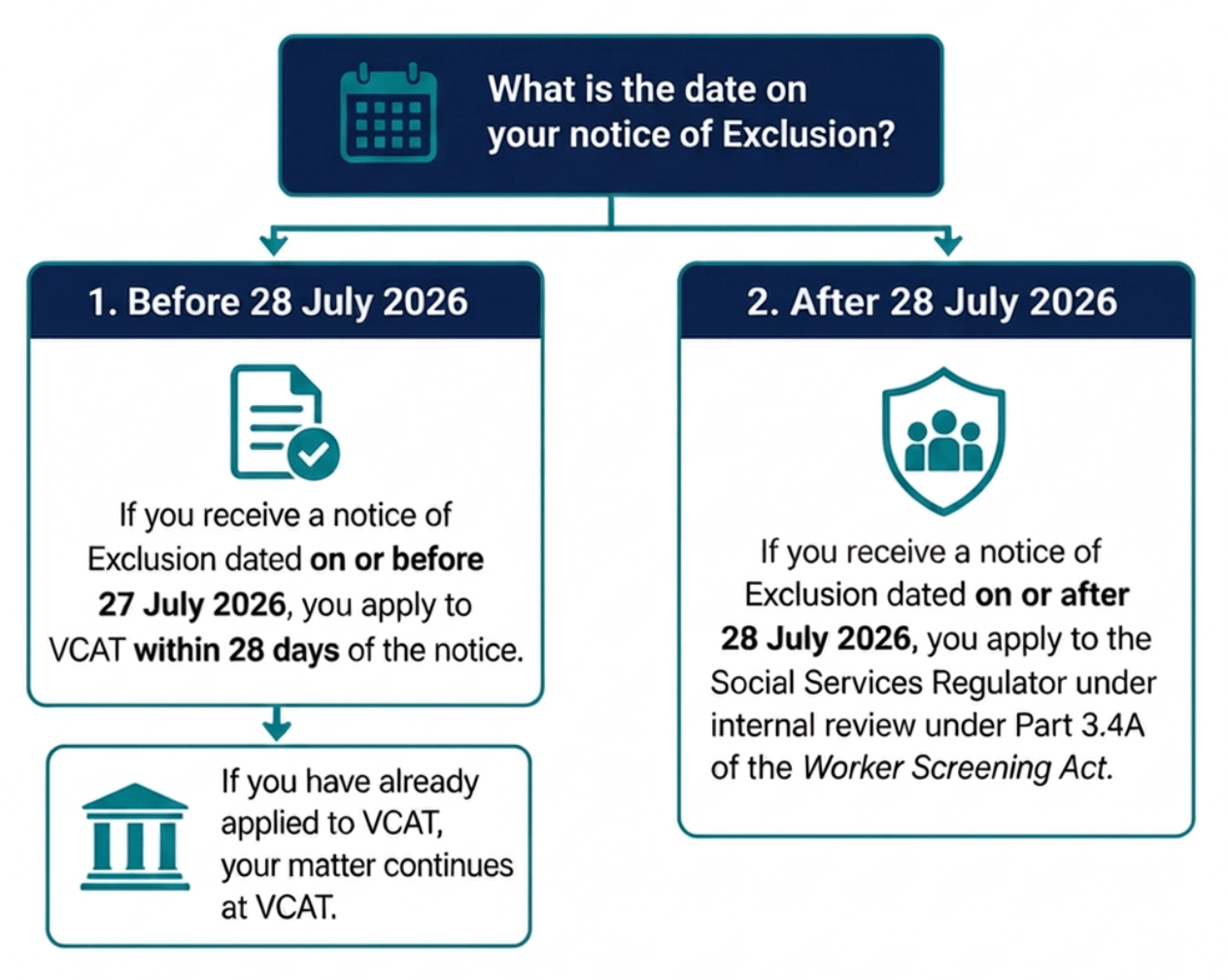
Find an accessible version of this diagram here.
Commencement
From 28 July 2026, a person who receives a decision from the Social Services Regulator (SSR) about their WWC Clearance can no longer apply to the VCAT for a review of that decision. If you wish to make an application for an internal review of a decision made by the SSR about your WWC clearance after 28 July 2026, you must submit an application to the Internal review Branch within the SSR.
WWC Exclusion decisions made by the SSR on or before 27 July 2026 can be reviewed by VCAT
If you receive a WWC Clearance decision on or before 27 July 2026 you will have 28 days to lodge an application for review with VCAT. Late applications must apply for an extension of time to VCAT. It will be up to VCAT to decide if they accept your late application.
How to apply for an internal review
If you apply for an internal review following a WWC Exclusion being issued to you, you have 28 days after the date of the SSR’s decision to make an application.
Applications for internal review must be in writing and must be accompanied by payment of the internal review fee.
In the application form you will be asked to:
- Identify the decision you want reviewed and attach a copy of the decision notice and statement of reasons provided to you.
- State the date you received the decision and the statement of reasons.
- Set out your grounds for review and response to the specific concerns raised by the SSR in the original decision in detail.
- Attach any additional information and evidence to be considered.
Application form for an internal review
To make an application, please complete the form below:
Once you have completed your application form and attached all supporting evidence and information send it by:
Email:
internalreview@ssr.vic.gov.au
Post:
Internal Review Branch
Social Services Regulator
GPO Box 1774
Melbourne VIC 3001
Fees and receipt of application for internal review
Once you have lodged your application for an internal review, the Internal Review Branch will assess your application to determine if it is valid and you are eligible to seek a review.
If you are eligible, you will be sent an invoice with instructions to pay the $345.40 fee. The SSR will not consider your application before the fee is paid. The invoice will explain how long you have to pay the fee. If you fail to pay in time, your application for internal review will be discontinued.
If we need more information or your application is not accepted, we will contact you.
Once the fee has been paid we will tell you when your review has started.
Financial hardship
If you are experiencing financial hardship, you may be eligible for a free internal review (a fee waiver) or for a discount on your fee.
Financial hardship means that paying the fee for an internal review would make you unable to provide for yourself, your family or other dependents, including:
- food
- accommodation
- clothing
- medical treatment
- education
- other basic needs.
Please contact us if you cannot pay the fee on time due to financial hardship. Or provide information in your application form and a SSR staff member will contact you.
Time limit for applying for internal review
You have 28 days from the date of the SSR’s decision to issue a WWC Exclusion to apply for an internal review.
Late applications
If you do not apply within 28 days, you can still ask for an internal review, but you must include a request for an extension of time and explain the reasons for the delay.
The reviewer will consider each request for an extension on a case-by-case basis. When deciding whether to accept a late application, we may consider:
- the length of, and reasons for the delay
- whether there is an acceptable explanation for the delay
- whether it is fair and reasonable in the circumstances to extend time.
Can you apply for an internal review?
If you have a notice of WWC Exclusion issued to you, you will be told about the category your application has been placed in: either Category A, B or C. This will be determined based on your criminal and/or disciplinary history, or whether there are allegations that have been made about you that relate to child safety or relevant criminal charges. Your category matters because it will determine the nature and type of review you can apply for. Not everyone applying for an internal review will fall within one of these categories, particularly if you have no criminal, disciplinary or other child safety information that applies to you. See the Worker Screening Act..
If you can apply for an internal review of a notice of Exclusion, this means the Internal Review Branch (which is separate from the original decision maker) will review your application afresh, including looking at information about you that the SSR has, as well as any new information. The Internal Review Branch and the reviewer will consider the facts and relevant tests that apply to an assessment for a WWC Clearance as if considering them for the first time. This is called a ‘merits review’, where the reviewer decides what the correct or preferable decision is based on all the information they have instead of considering whether the original decision followed the correct process.
Some decisions are not subject to internal review, for example where you receive an Interim Bar, because the SSR has not reached a final decision. And internal review for Category A matters are extremely limited. These circumstances are explained in more detail below.
Which decisions are subject to internal review?
Internal review of applications falling in Category A, B or C
Category A
If your notice of Exclusion falls within Category A, your right to internal review is very limited. You can only apply for an internal review of a Category A Exclusion if you are not the individual referred to in the original application. For example, in a case of mistaken identity where you might share the same name as the actual applicant.
If the SSR does an internal review for your Category A Exclusion, it will only consider whether or not you are the person referred to in the Exclusion.
Category B and C
If the SSR issues you a WWC Exclusion and you fall within Category B or Category C, you can apply for an internal review of that decision. For these decisions, the Internal Review Branch can look at your case afresh.
Category B Exclusions relate to more serious offences. In an internal review on a Category B application, the reviewer must refuse to give a WWC Clearance unless they are satisfied you would not pose an unjustifiable risk to the safety of children. The factors that will be taken into account include, but are not limited to:
- the nature and gravity of the offence (or alleged offence)
- your age and the age of any victim at the time of the offence
- your behaviour since the offence was committed
- whether it is in the public interest to give you a WWC Clearance.
In addition to the above, the reviewer must be satisfied that you are not an unjustifiable risk to the safety of children. They decide this by considering if:
- a reasonable person would be willing to let their own child have direct unsupervised contact with you while you were engaged in child-related work or activity; and
- that your engagement in any type of work with children would not pose an unjustifiable risk to the safety of children.
For Category B WWC Exclusions the reviewer must decide that you pass both of the above tests. And before a reviewer can overturn a Category B WWC Exclusion they must also be satisfied that in all circumstances doing so is in the public interest.
Category C Exclusions relate to matters that are serious, including convictions or charges that are not Category A or B offences. Category C also extends to those circumstances where you have had certain regulatory or disciplinary findings made against you, and where information has been provided to the SSR from third parties that is considered to be child safety risk information even if it is unproven or unsubstantiated.
In an internal review of a Category C matter, the reviewer will need to determine if it is appropriate to refuse to overturn the WWC Exclusion. To overturn a decision relating to a Category C matter the reviewer must be satisfied:
- a reasonable person would allow their own child to have direct unsupervised contact with you while you were doing any kind of child-related work; or
- that your engagement in any type of work with children would not pose an unjustifiable risk to the safety of children.
The reviewer will consider a number of factors, including but not limited to:
- the nature and gravity of the conduct
- the time since the conduct happened
- your age and the age of any victim
- whether it is in the public interest for you to hold a clearance.
Before a reviewer can overturn a Category C WWC Exclusion they must also be satisfied that in all circumstances doing so is in the public interest.
Decisions that can’t be reviewed
Not every decision relating to your WWC Clearance can be internally reviewed. The types of decisions that cannot be reviewed are:
- A decision by the SSR to impose a temporary bar, suspend your Clearance or put a temporary exclusion in place.
- If the SSR sends you a notice saying it intends to issue you with a WWC Exclusion and you do not make a submission or respond in time, the decision that follows to issue a WWC Exclusion is not subject to internal review.
- The decision from an internal review.
- The SSR has decided you are not eligible to lodge a further application for a Category A Exclusion.
- The SSR has refused your new application made under the early re-application pathway for certain Category A WWC Exclusions (see section 77 of the Worker Screening Act).
- A WWC Exclusion based on the SSR forming the view that you have given false or misleading information in your application.
- You have received a decision from VCAT about a WWC Exclusion that you are unhappy with.
A further application of a Category A Exclusion or revocation
If you have been given notice of a WWC Exclusion because your application falls within Category A, or your WWC Clearance was revoked following a reassessment by the SSR, you may in very limited circumstances be able to make a further application to the Internal Review Branch for a WWC Clearance.
You can only do this if your Exclusion was not based on the most serious types of offences in Category A (specified in clause 1 or 2 of Schedule 2 of the Act) and have been under 18 when the offending occurred. If any offence occurred over a period when you were both under and over 18-years-old, this will be treated as having happened when you were an adult.
A further application is not available if you have ever been charged with, convicted of, or found guilty of a Category A offence that you committed as an adult.
If you are eligible for a further application under Category A, you must make your further application within 28 days of the decision to give you the Exclusion. When the Internal Review Branch considers a further application, it must seek advice from the independent expert advisory panel before deciding.
Applying for internal review
Who can apply?
Only the person who was the subject of the WWC Exclusion decision can apply for an internal review.
In limited circumstances, a person acting with the written authority of the person issued with the WWC Exclusion may be able to apply for an internal review on their behalf, such as:
- a guardian
- a family member
- a person with power of attorney
- a legal representative.
A person who is not the subject of the decision, such as an employer or family member, is not able to apply for an internal review.
Who conducts an internal review or further application?
When you apply for an internal review, the application will be allocated to the Internal Review Branch which is a separate, part of the Regulator to the one that made the original WWC exclusion decision.
The Internal Review Branch will decide whether you are eligible for an internal review and the reviewer will consider your application afresh on the facts, evidence, law and any new information identified through the process to decide if you should be issued with a notice of WWC Exclusion.
Evidence and information to support your application
It is important that you provide evidence and information to support your application for your WWC Exclusion to be overturned. You can include any of the information you submitted in your original application or reassessment, keeping in mind that we hold this on file and will consider it as part of your application. You can also give us any new or updated information you think is relevant to why you should be granted a WWC Clearance. The evidence you provide must be current, specific and verifiable.
Evidence that is often given includes:
- proof of engagement with medical and therapeutic professionals, or other relevant services
- evidence of your risk to children, for example expert forensic psychological risk assessment
- evidence of your rehabilitation and post-offence conduct, for example attending and finishing programs
- personal statements that demonstrate insight and remorse
- character and referee evidence including whether they are aware of your history and believe you are a risk to children.
Asking for more information from you and other sources
To make a decision about your application for internal review, the Internal Review Branch and the reviewer have broad powers to ask for more information from a range of sources, or to ask for more information directly from you.
If you need to provide more information to the Internal Review Branch, you will be asked in writing. The request will explain the information or evidence that we need to consider your internal review, and the date by which you need to provide this information. If you do not give the SSR the information it asks for in the timeframe, or you request more time to provide the information, the reviewer may stop considering your application.
After we receive your application for an internal review, the Internal Review Branch will also consider information the SSR has and can ask for information held by a range of third parties, including new information available about you from other law enforcement bodies or other agencies. This can include:
- the information and identity documents you provided with your original application
- your criminal history in Australia and, where relevant, overseas
- information about pending or concluded charges from Victoria Police and interstate police
- professional disciplinary or regulatory findings (for example from the Victorian Institute of Teaching or Australian Health Practitioner Regulation Agency)
- information from equivalent child protection and worker screening regulators in other states and territories
- information from third parties about enforcement, disciplinary action or action taken against you, whether proven or not
- any other relevant submissions, reports, or references you or others provide on your behalf.
When the reviewer reviews a decision about your WWC Clearance, it is not limited to looking only at criminal convictions. Because the question is whether allowing you to work with children would pose an unjustifiable risk to their safety, a much wider scope of your history and conduct can be considered. This can include allegations that were never tested, charges that were later withdrawn, and charges of which you were acquitted. It can also include an allegation that was looked into but not substantiated, because the reviewer forms their own view about what the information means for the safety of children.
The reviewer can take into account information and findings from other bodies as well, such as child safety risk information that includes reportable allegations, criminal intelligence received from law enforcement and child protection information or any other relevant information.
The reviewer can also issue notices to third parties requesting any information the reviewer considers relevant to the internal review.
How will the evidence and information be considered?
The Internal Review Branch and the reviewer will consider all information in its possession, any information provided by you, or information received from other people in relation to each of the criteria in the legislation (where relevant). The WWC Check scheme is designed to protect children, and the reviewer may consider a broad range of material.
If the internal review relates to a decision about a Category B or Category C matter, the law sets out the things the reviewer must consider. They will look at:
- the nature and seriousness of the offence or conduct and how relevant it is to working with children
- how long ago it happened
- whether a court recorded a finding of guilt or a conviction, or whether a charge is still pending
- how old you were, and how old and how vulnerable any victim was, at the time
- whether the behaviour has since stopped being against the law
- how you have behaved since
- how likely it is that you would pose a future threat to a child
- anything you have told us in or about your application
- if it is in the public interest to give you a WWC Clearance
- any other matter we consider relevant.
The reviewer will weigh all the factors above, and your WWC clearance will only be granted if they are satisfied that granting a WWC Clearance would not pose an unjustifiable risk to the safety of children and if it is in the public interest for you to hold a Clearance.
A reviewer will not consider the above list of criteria in a Category A matter. The only question that the reviewer will consider differently to the original decision-making process is if you are the person the Exclusion was intended for (mistaken identity).
How we handle your information?
The SSR handles your information in line with its obligations under Victorian law, including the Social Services Regulation Act 2021, the Privacy and Data Protection Act 2014, the Health Records Act 2001, and the Public Records Act 1973. You can read more about how the SSR collects, uses, stores and shares information on its privacy page.
Giving false or misleading information to the SSR is a serious criminal offence with significant consequences that can carry a fine or even imprisonment in addition to your continued WWC Exclusion.
Sharing your information
Where the law allows, the Regulator may share information about you with other organisations that have a role in keeping children safe. These can include:
- Victoria Police and interstate police
- working with children and worker screening regulators in other states and territories
- the Australian Crime Commission; professional registration bodies such as AHPRA and the Victorian Institute of Teaching
- other regulators of the Child Safe Standards
- the NDIS Quality and Safeguards Commission
- the Department of Families, Fairness and Housing in relation to out-of-home carers
- courts and tribunals where reasonably necessary
- your employer or proposed employer, to the extent the Act permits.
Accessing and correcting your information
You can ask the Regulator for access to documents that contain your personal information, and you can ask for that information to be corrected if wrong. Access requests are usually made under the Freedom of Information Act 1982. Find out more about making a Freedom of information request.
If you have a concern about your privacy
If you believe the Regulator has mishandled your information or disclosed it unreasonably, you can raise it with the Regulator directly. If you are not satisfied with its response, you can complain to the Office of the Victorian Information Commissioner about personal or sensitive information, or to the Health Complaints Commissioner about health information.
What process will the SSR undertake?
Once the SSR receives your application
Once the Internal Review Branch receives your application and you have paid the fee, your internal review will be assigned to a reviewer who:
- will not have made the original decision or been involved with its making
- hold a position equal to, or more senior, than the original decision maker
- be suitably qualified or experience to deal with the issues that are raised within your application.
After being assigned you will receive correspondence acknowledging receipt and setting out the process of the internal review or further application and any additional information that the Internal Review Branch is seeking at that stage.
Time frame for completing an internal review or further application
There is no fixed deadline under the Act for how long your review may take. However, the Internal Review Branch must complete internal reviews or further applications as soon as reasonably practicable.
The time frame of an internal review depends on several factors, including the complexity of the application, whether the reviewer seeks to engage the independent expert advisory panel (or where it may be required), whether further information needs to be sought, and other any other circumstances that need to be satisfied to give the matter full consideration.
What do internal reviewers consider?
In conducting your internal review, the reviewer must consider a range of different factors and tests under the legislation.
The paramount consideration
The paramount consideration in all internal reviews and further applications is the best interests and the safety, welfare and wellbeing of children.
Reasonable person test
When the Internal Review Branch and the reviewer considers your application, the legislation points them to a specific question: ‘would a reasonable person allow their child to have direct unsupervised contact with the applicant while the applicant was engaged in any type of child-related work.’ On a Category B review the SSR must be satisfied of this and that your engagement in child-related work would not pose an unjustifiable risk to the safety of children. On a Category C review, the SSR can decide that your WWC Clearance should be given if it is satisfied with the answer to both of those tests.
This test in the Act contemplates a reasonable person’s own child, which elevates it beyond a general community-standards consideration of children in general. This asks the reviewer to take the more protective perspective a person ordinarily brings to decisions about their own child regarding child safety when considering your internal review application.
Unjustifiable risk
A key question for the SSR is whether your Clearance would pose an unjustifiable risk to the safety of children. The SSR can only decide in your favour if it is satisfied that it would not.
To reach that view, the reviewer weighs the circumstances of any offence or conduct against a number of factors, including the public interest, with the evidence that you have provided and that we have sourced from third parties. Because the starting point is that the Exclusion stands, it is effectively up to you to put forward the information and evidence that satisfies the reviewer the risk is not unjustifiable. The reviewer assesses the degree of risk in a structured way and weighs how reliable the evidence is.
Public interest
When the SSR reviews a decision about your Clearance, it looks at more than your individual circumstances. It also must consider the public interest, which is about the community as a whole. For example, this includes the intention of the legislation to keep children safe generally and maintain public trust in the WWC Check system. It is a wider question than whether you personally are safe to work with children, and the reviewer can accept everything you say about your own situation while still finding that the public interest points the other way.
The public interest works as a final step in your review, and it applies to both categories in the same way. For a Category B review, the reviewer first has to be satisfied of two things (tests): that a reasonable person would allow their child to have direct contact with you while you were doing child-related work, and that you having a Clearance would not pose an unjustifiable risk to the safety of children. For a Category C review, the reviewer must be satisfied of at least one of those two things.
Passing the test for your category is not the end of the review. Even if the reviewer decides your circumstances meet that test, the law says they must still refuse to change the decision unless they are also satisfied that it is in the public interest for you to have a Clearance.
Engaging the independent expert advisory panel
When the Internal Review Branch and a reviewer does an internal review, they may seek advice from an independent expert advisory panel. The panel only provides advice to the Internal Review Branch. Applicants or their representatives cannot engage the independent expert advisory panel, and any decision to engage the panel is at the sole discretion of the Internal Review Branch and a reviewer (other than in limited circumstances mentioned below).
The matters the Internal Review Branch and reviewer may ask the panel for advice on include when the Internal Review Branch has evidence that raises issues outside of the expertise of internal review staff, such a complex psychological or medical evidence or psychosocial evidence.
If you make a further application for a Clearance for Category A, which is a separate pathway available to some people who have been given a category A Exclusion, the Regulator must ask the panel for advice. This is because the panel must decide whether giving you a clearance would be safe for children in a narrower context, and that kind of decision always takes specialist advice into account.
When the Internal Review Branch and the reviewer asks the panel for advice, its advice must be considered before finalising the internal review. If the outcome is not favourable to you, you will still receive written reasons explaining how the advice of the panel was taken into consideration.
Complex questions that are referred to the independent expert advisory panel by the Internal Review Branch may take longer to resolve, which will add time to how long it takes to complete your internal review or further application for Clearance.
After an internal review is finished
Notification of outcome
Once the reviewer has finished reviewing your application, we will write to you with the outcome as soon as possible.
Because the decision impacts whether you can work with children, the SSR must also notify certain other people, including your employer or the organisation engaging you in child-related work, and any agency that lists you for that work. This means your current employer or organisation may be told of the outcome.
Providing reasons
Whenever the SSR excludes you, revokes your Clearance, or decides after a review not to change a decision, you have the right to understand why, and you will be given written reasons explaining how we reached that decision. Those reasons are there to help you understand the outcome and work out what you can do next.
In a small number of circumstances, the law allows the SSR to limit the reasons it provides, for example, if a decision relies on information that, if disclosed, could compromise a police investigation, identify a confidential source, or put someone's safety at risk.
Further review rights
Once your internal review or further application has been completed, if you are dissatisfied with the decision you can seek judicial review in the Supreme Court of Victoria. Judicial review is not a merits review. If this is something you wish to explore, you may wish to seek independent legal advice.
For more information, including how to lodge an application for judicial review please see the Supreme Court of Victoria website.
Updated