
The role of the head of an organisation
The head of the organisation carries all of the legal obligations under the Reportable Conduct Scheme (the scheme) and is ultimately responsible for the organisation’s compliance with the scheme.
The head of organisation will be required to notify the Social Services Regulator (SSR) of reportable allegations and investigate these allegations, among other responsibilities.
Heads of organisations are also required to have systems in place to prevent reportable conduct within their organisation, and systems to enable staff to make reportable allegations.
For further information, see: Information Sheet 3: Responsibilities of the head of an organisation.
Identifying the head of an organisation
The Child Wellbeing and Safety Act 2005 identifies the head of an organisation for the scheme as below:
The Chief Executive Officer (CEO) or Secretary
- The CEO will ordinarily be the highest-ranking executive in an organisation, with power over all major organisational decisions and administration.
- For government departments, the Secretary of the department is the head.
The principal officer
- A principal officer is the most senior officer in an organisation that does not have a CEO.
- The title and responsibilities of principal officer roles vary within different organisations. A principal officer can usually be recognised by their responsibilities and authority.
- In identifying the principal officer, consider whether there is an officer in your organisation who:
- is the most senior or high-ranking officer from the organisation
- has ultimate responsibility for organisation policies relevant to the scheme
- has ultimate responsibility and the powers of an employer in relation to the organisation’s workers or volunteers
- has sufficient authority within the organisation to access and disclose information relevant to a reportable allegation made against one of their workers or volunteers.
If a person or role meets all the above criteria, they are likely to be the principal officer.
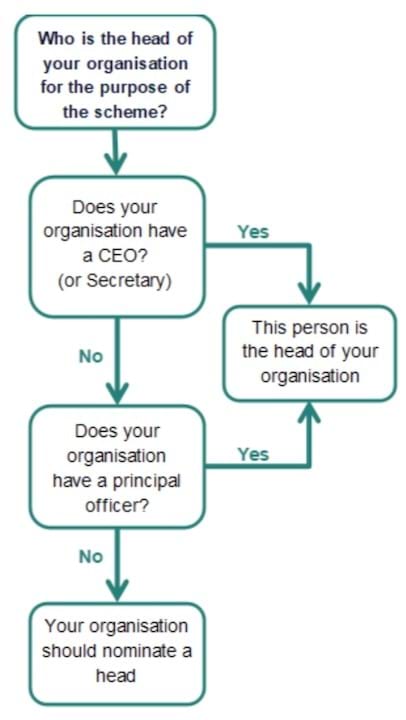
If an organisation does not have a CEO or principal officer, the organisation should nominate a person to be the head of the organisation for the purposes of the Reportable Conduct Scheme.
How to nominate a head of organisation
Step one: before nominating
Consider your organisation’s governance: you must be satisfied that there is no CEO or principal officer.
The SSR cannot approve a nominated head for an organisation with an existing CEO or principal officer.
If the previously nominated head of your organisation has left the organisation or changed roles, you should use the form linked below to nominate a new head.
Step two: decide who to nominate
In deciding who to nominate, organisations should consider whether the nominee:
- is an appropriately senior person in the organisation.
The nominated head of the organisation should be one of the most senior people in the organisation. It is not intended that the role and its legal obligations be delegated to more junior positions - is able to exercise some of the relevant powers for the purposes of the scheme, such as sharing information with the SSR, investigating allegations and embedding reporting and prevention systems within the organisation
- is able to coordinate the other senior people in the organisation who hold other relevant powers for the purposes of the scheme. Sometimes powers can be split between different senior people in an organisation, however a single head needs to be identified
- where possible, is based in Victoria
- consents to the nomination, which confers on them statutory responsibility under the scheme.
Step three: Lodge the nomination
To nominate a head of organisation, complete the nomination webform.
You will require the following information to make a nomination:
Nominee’s details
- Full name, date of birth, position title, contact details (telephone, email, street address, postal address).
Organisation’s details
- Full name of the organisation making the nomination, organisation’s support for the nomination.
Supporting statement
- Why the SSR should approve the nominee.
Declaration
The nominee and a witness will need to sign the declaration form. Download the nomination declaration form for head of an organisation.
Supporting documents
Please provide all supporting documentation to the SSR when you submit your nomination.
The following documents may be relevant to the SSR’s consideration of the nomination:
- the nominee’s position description, statement of duties, or other documents describing their role
- your organisation chart
- documents that show the organisation’s current processes for responding to and reporting suspected child abuse
- documents that show any changes to the organisation’s processes for responding to and reporting suspected child abuse that will be made if the nominee is approved
- certified copies of official government-issued documents that confirm the nominee’s identity (e.g. passport, driver’s licence, working with children check card)
- evidence of the organisation’s endorsement of the nomination (e.g. minutes of a board meeting or Annual General Meeting).
After lodging your nomination
The SSR will provide email confirmation of the application and will consider the nomination.
The SSR will confirm in writing if it:
- approves the nominee, or
- intends to refuse the nominee.
A notice of intention to refuse will outline the SSR’s views on the nomination and give the organisation 10 business days to respond. A notice of intention to refuse may be given either where the SSR needs more information or where it considers that the nominee is not appropriate. The SSR will consider any further information or response to that notice, then proceed to approve or refuse the nomination and confirm its decision in writing.
This process can take up to 30 business days or more.
A person is not a head of organisation until the SSR has approved the nomination.
Please contact the SSR should any concerns arise during this period.
Refused nominations
A decision by the SSR to refuse a nomination is not subject to internal review or review by the Victorian Civil and Administrative Tribunal. If the SSR refuses a nomination, organisations should seek independent legal advice about identifying options for review on a point of law by the Supreme Court of Victoria. The Minister for Children also has some powers to prescribe the head of an organisation.
Integrity of the nomination
It is an offence under section 16ZF of the Child Wellbeing and Safety Act 2005 (Vic) for a person to knowingly give information that is false or misleading to the SSR.
Privacy
The SSR uses the nomination form to collect information, including personal information, before deciding whether to approve a person to be the head for the purposes of the scheme, and to fulfil other functions under the scheme and the Child Safe Standards. If all or part of the information requested in the form is not provided, the SSR may not be able to approve the nomination.
View the SSR’s privacy policy.
Contact us
For further information about the Reportable Conduct Scheme, to talk through issues of concern, or to make a notification, contact SSR by phone on 1300 310 778 or via email at contact@ssr.vic.gov.au.
For all WWC Check queries contact 1300 652 879.
If you need an interpreter, please call the Translating and Interpreting Service on 13 14 50 and ask them to contact the Social Services Regulator on 1300 310 778.
If you are deaf, or have a hearing or speech impairment, contact us through the National Relay Service. For more information, visit: https://www.accesshub.gov.au/about-the-nrs.
Download the information sheet
Updated