
This page includes information about the work land and fire agencies did in 2024-25 to reduce bushfire risk based on Victoria's Bushfire Management Snapshot 2024-25.
To find out more about our capability and capacity for the 2025-26 season, visit 'An overview of bushfire preparedness ahead of 2025-26' or download the Snapshot in full from Victoria's Bushfire Management Snapshot.
Activities delivered by the sector
This section describes a broad range of activities delivered by the sector in 2024-25 to reduce the risk of bushfire.
Prevention and mitigation
Land and fire agencies work year-round to reduce bushfire risk, including delivering activities that help to prevent or mitigate bushfire. This includes:
- FFMVic responding to unattended campfires to help prevent accidental ignitions
- CFA declaring Total Fire Ban Days to help prevent fires from starting by limiting the types of fires that can be lit on high-risk fire days or imposing conditions on some high-risk activities.
Total fire bans are declared by CFA across fire districts.
- 425
- unattended campfires detected by FFMVic
- 14
- Total Fire Ban Days declared
- 1,945
- community events and informal engagements by CFA
- 5,026
- CFA online learning modules completed
Community events held by CFA, including station open days, help build community understanding and awareness of bushfire management. Such activities are critical to keeping communities safe.
Fuel management
Across 2024-25, CFA and FFMVic delivered 114,712 hectares of fuel management, including planned burns and non-burn fuel treatments such as mulching, mowing, slashing and spraying.
FFMVic treated 109,938 hectares:
- 270 planned burns, totalling 92,473ha
- 951 non-burn fuel treatments (mainly slashing and mowing), totalling 17,465ha.
The total investment in the FFMVic fuel management program was $159.8M. The target to maintain bushfire risk at or below 70% was achieved.
More than 300 CFA volunteers participated in the planned burn taskforce. The taskforce supports local crews in delivery of planned burns that reduce fuel loads and the intensity of bushfires.
CFA treated 4,774 hectares:
- 202 planned burns
- 44 non-burn fuel treatments.
Fuel management on roadsides
The Department of Transport and Planning (DTP), councils and FFMVic with the support of CFA manage roadside vegetation on priority routes to reduce the likelihood of fires igniting and spreading, improve the safety of firefighters responding to bushfires and communities leaving the area.
- 2,236
- kilometres of strategic fire access roads improved by FFMVic
- 1,072
- kilometres of fuel breaks maintained
FFMVic maintained more than 1,072 km of existing fuel breaks to ensure they remained fit-for-purpose and constructed an additional 6.9km to the network. Strengthening and expanding the fuel break network is a key strategy to make it easier, faster, and safer for firefighters to suppress bushfires and complements other fuel management works.
FFMVic also replaced or upgraded 10 bridges or crossings to support firefighters to rapidly and safely access and suppress new bushfires.
Fuel-driven bushfire risk
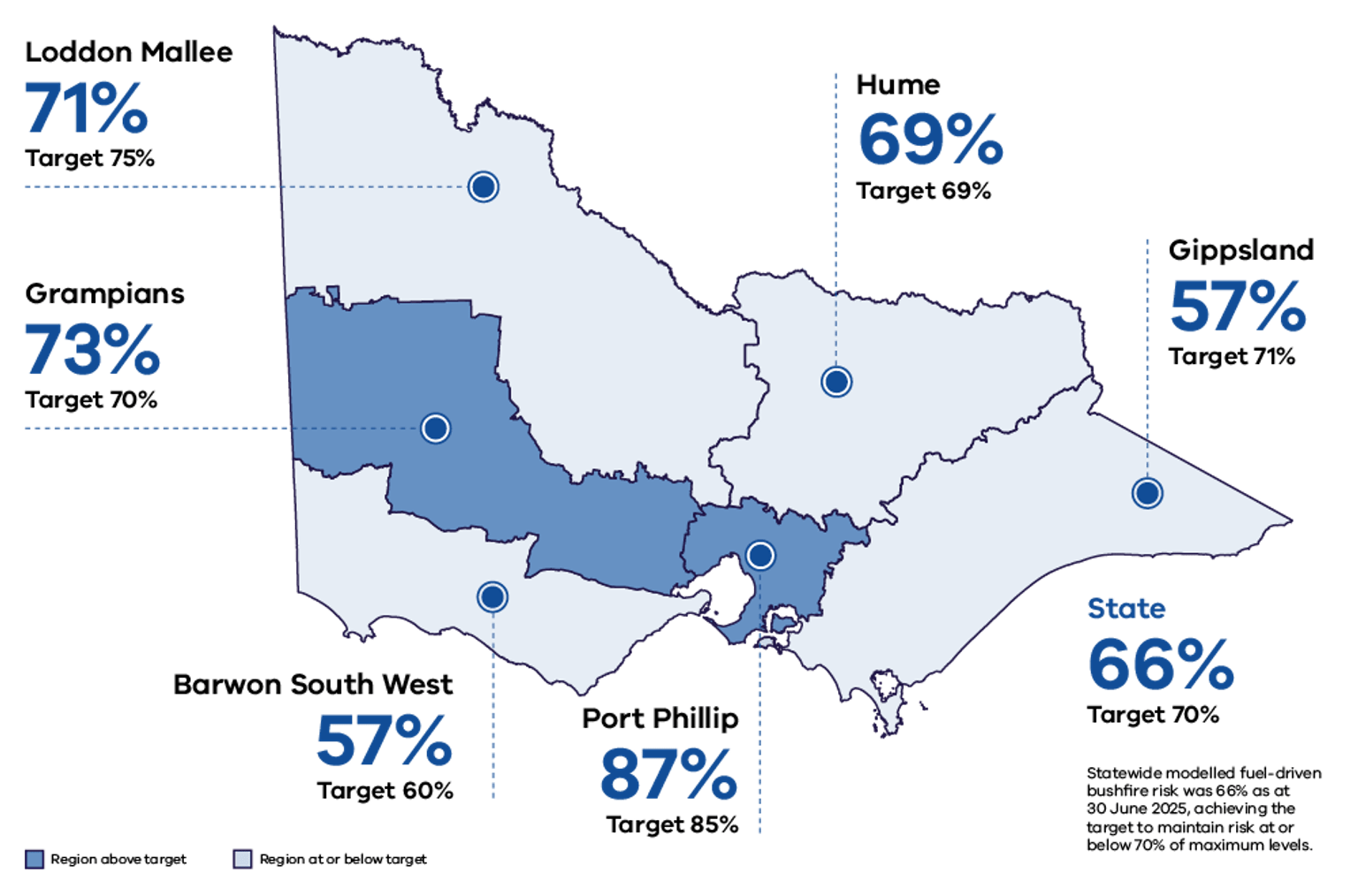
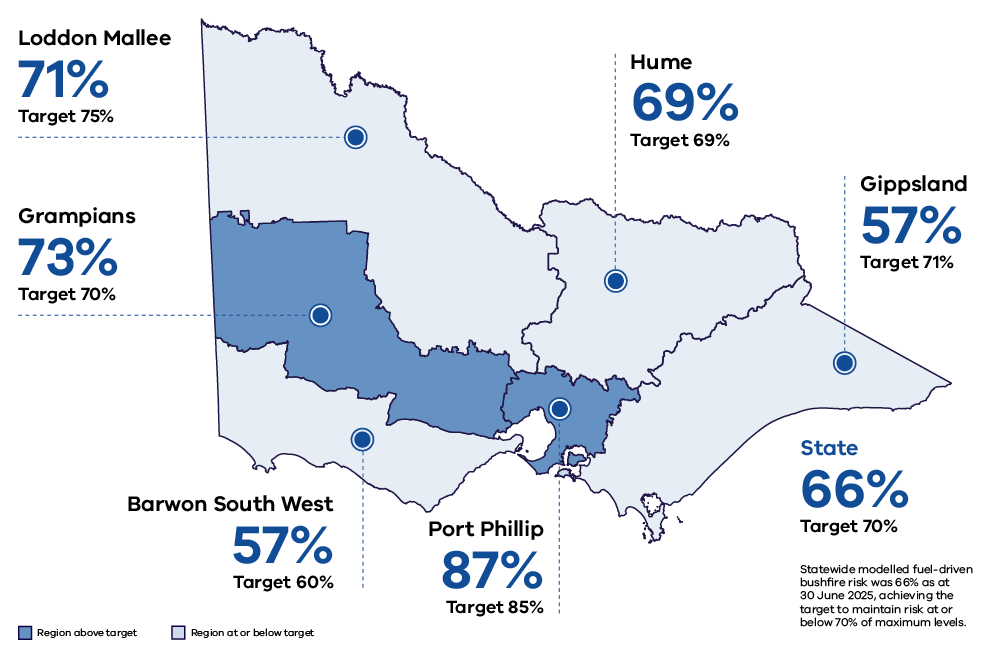
The sector models the impact that planned burning and bushfires have on reducing fuel-driven bushfire risk to human life and property. Victoria has a statewide target to maintain modelled fuel-driven bushfire risk to human life at or below 70% of maximum levels through fuel management.
The level of fuel-driven bushfire risk varies across the landscape due to differences in vegetation, climate, topography and where houses are located. Each FFMVic region and district has a long-term planning target for reducing fuel-driven bushfire risk. These region and district targets contribute to achievement of the statewide target.
Response
FFMVic attended bushfires impacting more than 251,730ha. They contained 92% of bushfires within 5 hectares. This exceeds the target of 80%.
- 1,371
- bushfires attended by FFMVic
- 83%
- bushfires contained on first attack
Information about bushfires attended by CFA and CFA's suppression performance is available in their 2024-25 Annual Report.
Ecosystem resilience
We call the ability of an ecosystem to keep its structure and key characteristics after fire ‘ecosystem resilience’.
Resilient ecosystems are vital for the health and wellbeing of people, plants and animals. The way we manage fire can help ecosystems to be more resilient. Victoria currently monitors ecosystem resilience in relation to fire using two key metrics:
- Tolerable Fire Interval uses reproductive maturity to tell us how well plants are likely to regenerate after fire. Plants that are not mature won't have seeds in the soil to regenerate.
- Growth Stage Structure describes the mix of ages of forests and other vegetation types. Growth stages tell us whether there is habitat available for different species.
In 2024-25, vegetation within tolerable fire interval was maintained at 29% from the previous year. Vegetation in mature and old growth stages decreased slightly from 2023-24 (39%).
- 38%
- vegetation in mature and old growth stages
- 29%
- vegetation within the Tolerable Fire Interval
- 27
- ecological burns delivered by FFMVic
Ecological burns have a primary objective to improve the health of our ecosystems and reduce the intensity and potential destructive impacts of bushfires on our native flora and fauna.
Cultural burns
FFMVic and CFA partner with Victorian Traditional Owners to deliver cultural burns. There are 104 cultural burns nominated to the first year of the the Joint Fuel Management Program (JFMP), bringing the total number of planned cultural burns across the life of the JFMP to 211.
- 31
- cultural burns delivered in partnership with Traditional Owners
- 211
- cultural burns planned
Updated