- Date:
- 28 Nov 2025
Introduction
A resource to assist early childhood education services, local council officers and early childhood support services to talk to parents and carers of children eligible for the additional hours of kindergarten offered through Pre-Prep. This document also provides links to communication materials that can be shared with families.
Communicating with Culturally and Linguistically Diverse Families
To support conversations with families who speak a language other than English or use Auslan, Victorian funded kindergarten services and eligible early childhood support services can access free on-site, telephone and video interpreters – go to the 'Early Childhood Language Services’ webpage for more information. Funded kindergarten services can also access translation services for written information.
Parents and carers can also access free in-bound telephone interpreting to contact a kindergarten service or early childhood support service in their preferred language. For more information including links to translated instructions – go to Guide for parents and carers.
Pre-Prep brochures, in English and other languages, can be ordered on the Victorian Kindergarten Resources Portal to give to families. Orders are paid for by the department and printed and delivered to you. These can be ordered by services, local councils, Maternal and Child Health nurses, and any other organisations or entities that support the early childhood sector. The Portal requires a login which can be created using a work or personal email. Also, see the ‘Communicating about kindergarten to your community’ webpage for Pre-Prep resources.
What is Pre-Prep
Pre-Prep is the new name for increased hours of Four-Year-Old Kindergarten.
Four-Year-Old Kindergarten in Victoria is gradually transitioning to Pre-Prep.
Pre-Prep is an early learning program for four-year-old children that follows Three-Year-Old Kindergarten. It is in the year before school.
Pre-Prep is the new name for increased hours of Four-Year-Old Kindergarten.
The program for children in the year before school is gradually increasing from 15 to 30 hours each week.
Pre-Prep programs will continue to be play-based and led by qualified early childhood teachers.
Pre-Prep will use the same learning framework as Four-Year-Old Kindergarten – the Victorian Early Years Learning and Development Framework (VEYLDF).
When talking to families about Pre-Prep, you may explain your service’s commitment to quality, and what this looks like in your programs. It may be helpful to provide examples, using the 7 quality areas in the National Quality Framework, including how children’s health and safety is supported and children are protected at your service.
Information to give to families
Benefits of more hours
Australian and international evidence shows that quality play-based learning helps set children up for success in education and life.
More hours offered in the year before school gives more time for children of all backgrounds and abilities to deepen their learning and development.
Australian and international evidence shows that 2 years of quality kindergarten can provide life-long benefits and help set children up for success in school and life.
Two years of quality kindergarten can lead to better development in language, pre-reading, early number concepts, independence, concentration, and social skills.
The additional hours provide more opportunities for children to experience the benefits of play-based learning at a time when their brains are rapidly developing.
Children can further develop their identity, sense of belonging, wellbeing, love for learning and communication skills.
Teachers and educators have more time to build relationships with children and understand how they best learn.
Children who need extra support gain the most from more hours of quality early learning programs in the year before school. More hours give more time for relationships to develop between teachers, children and their families. It also provides greater flexibility for learning to meet the needs of each child.
When will Pre-Prep be available
More about the roll-out and when Pre-Prep is available for Victorian children.
Pre-Prep started in 6 regional areas in 2025 and will gradually become available to more children across Victoria each year.
In 2026 and 2028, children who meet the criteria for priority cohorts will become eligible for Pre-Prep, no matter where they live in Victoria.
By 2036, Pre-Prep will be available to all Victorian children in the year before school.
When a child can start Pre-Prep depends on:
- what local government area you live in, or
- if your child is eligible from 2026 or 2028, anywhere in Victoria, based on the criteria for priority cohorts.
Eligibility
Making sure families know their child is eligible
- You can use the below prompts to start a respectful conversation with families who may not be aware they can access Pre-Prep from 2026:
- Our service is making sure families know how the four-year-old kinder year works for their child.
- Your child may be able to get more hours of kinder next year. Is it okay if I give you some information about this?
- We can arrange an interpreter to help tell you more about it, including how to enrol.
If you have families or children from a refugee or asylum seeker background in your community, refer to Foundation House’s ‘Schools in for Refugees’ webpage, which has a range of resources including an information sheet, Identifying children and families of refugee background in the early years. You may also seek support from a CALD Outreach Worker if available in your local government area.
To support conversations with Koorie families in your community, use the information and videos at Koorie Kids Shine. You can also contact a Koorie Education Coordinator for support. If you are a kindergarten service, you may want to let families know how Koorie perspectives are included in the learning curriculum – e.g. through daily Acknowledgement of Country, reading Koorie stories, displaying Aboriginal artwork, and celebrating Aboriginal cultural events such as NAIDOC.
Information to give families:
How services will deliver Pre-Prep
Talking points on the hours, cost and program being delivered by your service.
Hours
Pre-Prep programs are between 16-30 hours each week for children in areas that started Pre-Prep in 2025.
- 2025: Ararat Rural City, Gannawarra Shire, Hindmarsh Shire, Murrindindi Shire, Northern Grampians Shire, Yarriambiack Shire
Pre-Prep programs are between 16-20 hours each week for children in areas that start Pre-Prep in 2026 and 2027:
- 2026: Benalla Rural City, Buloke Shire, Corangamite Shire, East Gippsland Shire, Horsham Rural City, Loddon Shire, Mansfield Shire, Mitchell Shire, Pyrenees Shire, Strathbogie Shire, Wangaratta Rural City, Wodonga Rural City
- 2027: Alpine Shire, Central Goldfields Shire, Colac-Otway Shire, Glenelg Shire, Indigo Shire, Moira Shire, Moorabool Shire, Moyne Shire, South Gippsland Shire, Southern Grampians Shire, Swan Hill Rural City, West Wimmera Shire
Pre-Prep programs are between 16-25 hours each week in 2026 and 2027 for children who meet the Priority Cohort eligibility, wherever they live in Victoria.
Weekly hours will vary from service to service during the roll-out of Pre-Prep. Services should advise families of the number of Pre-Prep hours available to them and any information available about the timetable.
Cost
There is no charge for Pre-Prep at standalone (sessional) kindergartens that have opted into Free Kinder.
If a child is enrolled in Pre-Prep at a long day care service that has opted into Free Kinder, the family will receive an annual fee reduction. The fee reduction increases with the number of hours of Pre-Prep the child is enrolled in.
Families don’t need to be permanent residents or Australian citizens to get these savings.
Families can only receive Free Kinder at one kinder service at a time. If a child attends more than one service with a funded kindergarten program, families need to let each service know at which service they wish to access their one funded kindergarten place and receive Free Kinder.
Program
Pre-Prep programs follow the Victorian Early Years Learning and Development Framework (VEYLDF).
Early childhood teachers design programs for children to reach learning goals in the VEYLDF, which focus on identity, community, wellbeing, learning and communication.
Pre-Prep will be play-based, like all Victorian funded kindergarten programs. Research shows that play is the best way for children to learn and grow in their early years.
More hours of Pre-Prep will also mean more time for teachers and educators to know each child and what they need to feel safe and comfortable to engage in learning. It also provides opportunities to strengthen connections between children and their teachers and educators. There will also be more time to extend children’s learning and provide flexibility around the length of activities and rest times. Rest times will be important in allowing children to relax and engage in quiet play and learning activities like looking at books, puzzles or drawing.
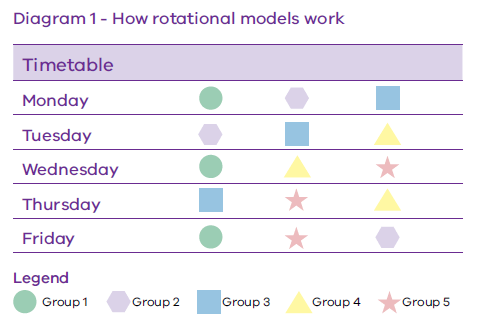
Services may use different approaches so they can deliver additional hours, such as offering longer days and mixed age groups. As services will offer different Pre-Prep hours, there will be different timetables from service to service.
The content of Pre-Prep programs should always be guided by the VEYLDF. It may be helpful for services to talk about what this looks like in practice, and how programs are aligned to children achieving the VEYLDF learning and develoment outcomes at their service. For example, services might discuss how programs support children to learn and develop communication skills. Consider using the Learning Progressions on the VEYLDF webpage to support these conversations.
Services will develop strategies for children who need support to adjust to and feel comfortable in programs. This may include using temporary or permanent support and adjustments.
Families are invited to share information about their child and what they need. This can be related to their learning preferences, wellbeing needs or anything that will support them while they are at kinder.
Families with children with additional needs, medical needs, disability or experience of trauma are encouraged to talk to their kindergarten service about how support can best be provided. See ‘Inclusion in kindergarten programs’ in the ‘Further Resources’ section for more information.
Information about program models
‘Your Guide To’ information sheets on multi-age groups, rotational models, team teaching and teaching longer days.
Support for children with additional needs
Inclusion is an important part of the Best Start, Best Life reforms.
Services work with parents and carers of children with additional needs to develop a program that supports their individual needs and learning goals.
This includes looking at what supports and adjustments are needed for children to feel happy, safe and included to fully participate in the program. In some instances, assistance will be provided through a program called Kindergarten Inclusion Support.
Support may also involve services working around any regular appointments children have, for example, with occupational and speech therapists. At some services this may include facilitating appointments onsite.
A service may set up a group to support a child’s inclusion in kindergarten. This group will bring together key people, such as therapists and other health professionals as well as family members and the child’s kindergarten teacher, to plan for how to best support a child to participate and learn at kinder. This is referred to as a ‘Program Support Group’.
Pre-School Field Officers can work with services to build the capacity of early childhood teachers to make sure children’s needs are met at kinder. They can help services to link families to supports and services.
Registering and enrolling in Pre-Prep
What families may like to know during the registration and enrolment process.
Families can contact their local service or council to ask about their registration and enrolment process.
Registration and enrolment are required for Pre-Prep, even where a child is already attending the service in a Three-Year-Old Kindergarten program.
During this conversation, the service or council should advise the family of the priority of access policy that applies when they enrol their child. This is especially important where there is likely to be significant demand for kindergarten places at a service which may result in some families missing out.
Services and councils have policies and procedures to protect the privacy of families and children when they register or enrol in kindergarten. Services and councils may support families who have questions about why certain information is collected, and how it is used, noting that services should refer to the Education and Care Services National Law Act 2010 and Education and Care Services National Regulations 2011 on what information is required in a child’s enrolment record.
Where a family declines Pre-Prep
Families with children eligible for Pre-Prep from 2026 and 2028 might be unsure about enrolling in Pre-Prep if Pre-Prep isn’t available to all four-year-old children at their service.
Explaining Pre-Prep and the benefit of more hours to families is important for them to make a considered decision.
When talking to families about Pre-Prep and gaining an understanding of their barriers to enrolment, it is important to be sensitive to their needs.
Ultimately, families have choice over the type of program they enrol their child in. Some families will need some time to think about this decision, therefore early conversations around eligibility for Pre-Prep are encouraged.
If a family declines a Pre-Prep place, families can still enrol their child in Four-Year-Old Kindergarten for 15 hours per week. If the family changes their mind on wanting to access Pre-Prep after enrolment has closed, access to a Pre-Prep place will be subject to availability within the service.
Services and local councils should advise their Early Childhood Improvement Branch (ECIB) in the Department of Education of the number of families who decline pre-prep and if applicable, a summary of the reasons that families have declined. This information is to support planning only. No other information is required.
Information to give to families:
Further Resources
More resources to support you and your service.
Best Start, Best Life reforms
- Kindergarten Sector Guide – key information about the reforms, and the support available for children to access and participate in programs.
- Four-Year-Old Kindergarten is becoming Pre-Prep – the roll-out schedule.
- Operational policies supporting the Best Start, Best Life reforms – flexible hours and other policies.
Communicating with families
- Communicating about kindergarten to your community – communication kits, fact sheets, social media tiles and other resources to help services communicate with families and promote their kindergarten programs.
- Benefits of kinder – information about the benefits of kinder programs.
- Pre-Prep roll-out video – shows children who are eligible in 2026.
- Play-based learning and your child – information sheet about how children learn through play.
Inclusion in kindergarten programs
- Children with additional needs in early childhood – supports available for children with additional needs.
- Getting started at childcare and kindergarten – Association for Children with Disability – advice for families and carers of children with additional needs.
- Toolkit: Inclusion is Everyone's Business resource.
Planning for and implementing Pre-Prep
- Change Management Toolkit – information and tools to help services work with their team and families to plan and implement Pre-Prep and continue Three-Year-Old Kindergarten.
Pre-Prep program modelling
- ‘Your Guide To’ information sheets on multi-age groups, rotational models, team teaching and teaching longer days – advice about planning for and the benefits of program models.
- Delivering Pre-Prep to children from priority cohorts – programming considerations for 2026 priority cohort children.
Supporting CALD families and children
- Supporting CALD families to engage in kindergarten – resources for services to communicate with cultural and linguistically diverse (CALD) families about kindergarten and its benefits.
- Supporting families from refugee backgrounds –Foundation House – resources for services to engage with families from refugee backgrounds to support access to early learning.
- Engaging with multilingual families guide – how to create welcoming and inclusive environments, use different ways to communicate, and get the right language supports.
- Early Childhood Language Services – free interpreting and translation services to communicate with parents and carers who speak a language other than English or use Auslan.
- CALD Outreach Initiative – CALD Outreach Workers address barriers to kindergarten access and participation.
Supporting First Nations families and children
- Early childhood education programs supporting Aboriginal children – early childhood programs and services for Aboriginal children and their families.
- Resources to support cultural safety for Koorie children and families – resources to support a welcoming environment for Koorie families at your service.
- Best Start – local partnerships with service providers to support localised and targeted strategies to improve children’s engagement and participation in kindergarten, including 6 Aboriginal Best Start sites around Victoria.
Additional year of funded Three- or Four-Year-Old Kindergarten or Pre-Prep
- Additional year of funded kindergarten or Pre-Prep from 2026 – information about the eligibility criteria and process.
- Does my child need an additional year of kindergarten or Pre-Prep? – information for parents and carers about the guidelines.