Hours
Pre-Prep programs are between 16-30 hours each week for children in areas that started Pre-Prep in 2025.
- 2025: Ararat Rural City, Gannawarra Shire, Hindmarsh Shire, Murrindindi Shire, Northern Grampians Shire, Yarriambiack Shire
Pre-Prep programs are between 16-20 hours each week for children in areas that start Pre-Prep in 2026 and 2027:
- 2026: Benalla Rural City, Buloke Shire, Corangamite Shire, East Gippsland Shire, Horsham Rural City, Loddon Shire, Mansfield Shire, Mitchell Shire, Pyrenees Shire, Strathbogie Shire, Wangaratta Rural City, Wodonga Rural City
- 2027: Alpine Shire, Central Goldfields Shire, Colac-Otway Shire, Glenelg Shire, Indigo Shire, Moira Shire, Moorabool Shire, Moyne Shire, South Gippsland Shire, Southern Grampians Shire, Swan Hill Rural City, West Wimmera Shire
Pre-Prep programs are between 16-25 hours each week in 2026 and 2027 for children who meet the Priority Cohort eligibility, wherever they live in Victoria.
Weekly hours will vary from service to service during the roll-out of Pre-Prep. Services should advise families of the number of Pre-Prep hours available to them and any information available about the timetable.
Cost
There is no charge for Pre-Prep at standalone (sessional) kindergartens that have opted into Free Kinder.
If a child is enrolled in Pre-Prep at a long day care service that has opted into Free Kinder, the family will receive an annual fee reduction. The fee reduction increases with the number of hours of Pre-Prep the child is enrolled in.
Families don’t need to be permanent residents or Australian citizens to get these savings.
Families can only receive Free Kinder at one kinder service at a time. If a child attends more than one service with a funded kindergarten program, families need to let each service know at which service they wish to access their one funded kindergarten place and receive Free Kinder.
Program
Pre-Prep programs follow the Victorian Early Years Learning and Development Framework (VEYLDF).
Early childhood teachers design programs for children to reach learning goals in the VEYLDF, which focus on identity, community, wellbeing, learning and communication.
Pre-Prep will be play-based, like all Victorian funded kindergarten programs. Research shows that play is the best way for children to learn and grow in their early years.
More hours of Pre-Prep will also mean more time for teachers and educators to know each child and what they need to feel safe and comfortable to engage in learning. It also provides opportunities to strengthen connections between children and their teachers and educators. There will also be more time to extend children’s learning and provide flexibility around the length of activities and rest times. Rest times will be important in allowing children to relax and engage in quiet play and learning activities like looking at books, puzzles or drawing.
Services may use different approaches so they can deliver additional hours, such as offering longer days and mixed age groups. As services will offer different Pre-Prep hours, there will be different timetables from service to service.
The content of Pre-Prep programs should always be guided by the VEYLDF. It may be helpful for services to talk about what this looks like in practice, and how programs are aligned to children achieving the VEYLDF learning and develoment outcomes at their service. For example, services might discuss how programs support children to learn and develop communication skills. Consider using the Learning Progressions on the VEYLDF webpage to support these conversations.
Services will develop strategies for children who need support to adjust to and feel comfortable in programs. This may include using temporary or permanent support and adjustments.
Families are invited to share information about their child and what they need. This can be related to their learning preferences, wellbeing needs or anything that will support them while they are at kinder.
Families with children with additional needs, medical needs, disability or experience of trauma are encouraged to talk to their kindergarten service about how support can best be provided. See ‘Inclusion in kindergarten programs’ in the ‘Further Resources’ section for more information.
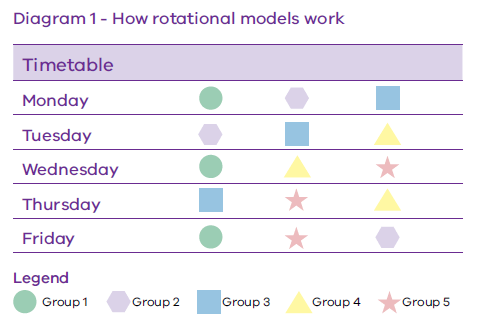
Information about program models
‘Your Guide To’ information sheets on multi-age groups, rotational models, team teaching and teaching longer days.
Updated