On this page
Applications for a General Practice Innovation Grant have now closed.
1. Background
The Victorian Government is supporting general practices to deliver innovative models of care for people at risk of dementia.
The General Practice Innovation Grant Program (the program) is an initiative funded through the 2024-25 Victorian State Budget. It provides grants of $45,000 (excluding GST), over a twelve month period, to general practices to implement an innovative Model of Care that enables the early identification and proactive management of dementia and mild cognitive impairment.
In this context, ‘general practice’ or ‘the practice’, refers to the totality of general practice as an organisation including:
- general practitioners
- practice managers
- practice nurses
- administrative staff and other health professionals who work in a practice.
In 2023, dementia was the leading cause of death in Australia, accounting for almost 17,400 deaths (or 9.5% of all deaths). Dementia was the leading cause of death for women and the second leading cause for men, after coronary heart disease.
In 2025:
- approximately 433,300 Australians live with dementia
- of these, around 110,600 live in Victoria, with all forms of dementia1.
This program aims to:
- demonstrate the valuable role general practices play across the patient care journey
- improve health and wellbeing for target populations
- contribute to reducing avoidable admissions by:
- identifying patients at risk of dementia and mild cognitive impairment
- screening and assessing patients in accordance with established guidelines
- connecting patient, families and carers with support and treatment.
Early intervention improves patient trajectories, connecting patients to treatment, support and information sooner – helping them, their families and carers adjust to the changes impacting their daily life. Improved primary health care can reduce common hospital admissions for people living with dementia.
General practitioners have existing relationships and trust with their patients and will often be the first point of contact for people with dementia or mild cognitive impairment and are best placed for early intervention.
1 Dementia Australia 2023, Dementia Prevalence Data 2024-2054, commissioned research undertaken by the Australian Institute of Health and Welfare, accessed 20 August 2025.
The program guidelines explain how the program works including:
- the grant value
- the eligibility criteria
- how to apply
- how the grants are assessed and awarded
- the contracting and payment process.
These guidelines also include terms and conditions, and a privacy statement. Applicants must read this information in full before applying for this grant.
Appendix 1 includes definitions of key terminology.
2. Program details
Eligible general practices may apply for $45,000 (excluding GST) in grant funding. Funds will be paid in two instalments, subject to the practice demonstrating satisfactory progress and meeting reporting and acquittal requirements:
- first instalment: $22,500 (excluding GST) upon execution of the funding agreement
- second instalment: $22,500 (excluding GST) on submission and approval of the required progress report.
Note: GST will be paid in addition to the grant funds, to organisations registered for GST.
Payments will be made according to an agreed schedule set out in the funding agreement as outlined in Section 3.4.
Please note: Funding is limited, and not all eligible applications will be successful.
Successful general practices are required to implement the following dementia Model of Care which is focused on 4 key areas:
- using patient management software to proactively identify and assess patients at risk of dementia or mild cognitive impairment
- building general practice staff knowledge and confidence through a training and learning network
- improving capability to provide person-centred care in accordance with accepted clinical practice guidelines and principles of care for people with dementia
- improving capacity to provide multidisciplinary care by using a team-based and collaborative approach to care, particularly between general practitioners and practice nurses.
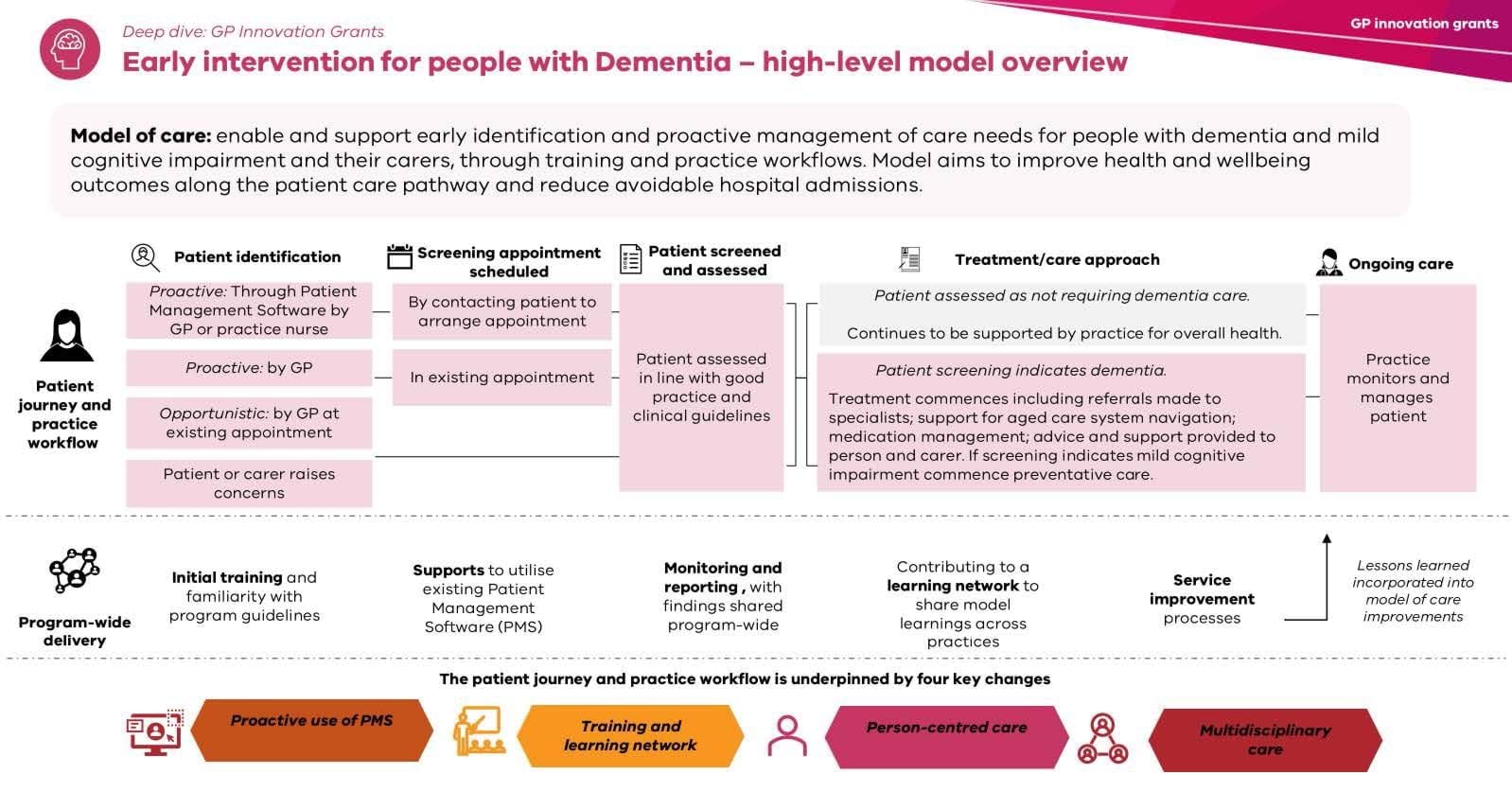
Flowchart of dementia early intervention model showing five care stages from identification to ongoing care in GP practices Note: The Victorian Government is committed to providing a website that is accessible to the widest possible audience, regardless of technology or ability. The graphic above may not meet our minimum WCAG AA accessibility standards. If you are unable to read this content you can contact the content owners for an accessible version.
Further details on the Model of Care.
2.2.1. Target patient cohort
The program enables the early identification and proactive management of dementia and mild cognitive impairment. The target cohort reflects ageing as the most significant non-modifiable risk factor, noting the National Health and Medical Research Council’s Clinical Practice Guidelines and Principles of Care for People with Dementia (2016) recommends against general population screening.
The practice should focus on the following groups:
- people aged 60 years and over with risk factors
- Aboriginal and Torres Strait Islander people aged 50 years and over with risk factors
- patients who have visited the practice three or more times in the past two years (as per the RACGP Standards for General Practices 5th edition definition of an active patient)
- patients where families/carers have expressed concern about possible dementia or mild cognitive impairment.
Risk factors include:
- non-modifiable risk factors including ageing (people 60+), family history of the condition and other genetic mutations or variations.
- modifiable risk factors including tobacco use, excessive alcohol consumption, physical inactivity, obesity, high low-density lipoprotein (LDL) cholesterol, limited education, hypertension, depression, diabetes, traumatic brain injury, low social contact, exposure to air pollution, untreated vision loss, hearing loss.2
- risk factors for Aboriginal and Torres Strait Islander people including renal disease, childhood stress and trauma and low socioeconomic status.3
Exclusion: The program is not intended to cover screening of patients with an existing dementia diagnosis or confirmed mild cognitive impairment or patients currently undertaking assessment.
2 2024 report of the Lancet standing Commission. The Lancet, 404(10452), pp. 572-628
3 Australian Institute of Health and Welfare 2024, Dementia in Australia: Population health impacts of dementia among First Nations people
2.2.2. Proactive use of patient management software
To identify patients at risk of dementia and mild cognitive impairment as outlined in Section 2.2.1, all successful practices must:
- review and ensure their patient management software can identify patients effectively
- extract and analyse patient data to identify target cohorts
- maintain high-quality patient records.
2.2.3. Participation in training and learning network
Successful practices will be required to participate in training on dementia and mild cognitive impairment through the training and learning network being established for grant recipients.
Successful practices must:
- ensure at least one clinical member of staff participates in the training and learning network (information about accessing the training and learning network will be provided)
- share resources and training recommended by the network with relevant staff
- participate in assessments as part of the recommended training.
2.2.4. Person-centred care
General practices are well placed to provide person-centred care. This care respects and responds to the patient’s needs, preferences, values and knowledge about their healthcare needs to deliver individualised, holistic care.
When implementing the Model of Care, successful practices must respond to the needs and preferences of people with dementia, and their families and carers.
2.2.5. Multidisciplinary care
Multidisciplinary care brings together healthcare professionals from different disciplines to provide holistic, comprehensive and coordinated care. This approach helps meet the diverse needs of individuals, especially those with complex or chronic conditions.
The grant supports team-based care, with general practitioners and practice nurses working together to promote good practice dementia primary care.
To be eligible for the program, applicants must meet all the following criteria, which demonstrate they have the organisational structure, clinical capacity and commitment required to deliver the dementia Model of Care as outlined in Section 2.2:
- Your practice must:
- hold an active Australian Business Number (ABN) and if applicable either an Australian Company Number (ACN), or Incorporated Association Number (IAN) and be registered with the Australian Business Register (ABR) under the ANZSIC code of 85110 – General Practice Medical Services
- hold a valid WorkCover Certificate of Currency
- operate from a physical location in Victoria (noted on the ABR)
- be accredited against the Royal Australian College of General Practitioners (RACGP) Standards for General Practice 5th edition
- maintain appropriate public liability and medical indemnity insurance.
- Your practice commits to fully implementing the Model of Care as outlined in Section 2.2
- Your practice has at least one full time equivalent (FTE) AHPRA-registered general practitioner (GP)
Note: You are eligible to apply for multiple practice locations in Victoria, but a separate application will be required for each practice location. Each application and its associated location will be assessed independently of each other.
Note: If your application is successful, your practice must commit to the funding agreement conditions as outlined in Section 3.4.
- Your practice must:
The following are not eligible to apply:
- individuals, who are not registered as a business, applying on their own behalf
- an individual partner without the consent of other partners
- overseas organisations
- practices that have been declared insolvent or have owners/directors that are undischarged bankrupts
- practices not accredited against the Royal Australian College of General Practitioners (RACGP) Standards for General Practice 5th edition
- practices where a member is currently under investigation for medical negligence or malpractice
- practices that do not operate from a physical location in Victoria
- practices that predominantly deliver their services via virtual care, including telehealth
- practices that do not provide the details of two business representatives (unless a sole director company or sole trader) listed as an associate on the Australian Business Register who are authorised to enter into the grant funding agreement.
The grant amount can be allocated towards the following activities:
Activities Eligible activities Identification and management of target patient cohort Additional staff time for:
- contacting patients and booking appointments
- care coordination activities including following up on patient, family and carer queries, referrals in and out, and navigation of services
- secondary consultation time for general practitioners and practice nurses
Participation in training and learning network - time and expenses spent participating in the training and learning network to build capability and expertise in relation to this program
Proactive use of patient management software - additional time and resources to proactively identify patients using patient management software
- program-related administrative tasks including updating patient management software and identifying opportunities for improvement in patient records
- purchase of software, add-ons and updates to patient management software
Purchase of tools and resources - purchase of dementia or cognitive impairment assessment tools and resources to enhance service delivery
The grant amount cannot be allocated towards the following:
- items covered by the Medical Benefits Schedule (such as nurse and GP consultations with patients) or gap fees
- screening or care provided to patients with an existing dementia or mild cognitive impairment diagnosis or patients currently under assessment
- retrospective funding for activities that have already commenced, or resources already purchased.
Applications open 11am, Tuesday 18 November 2025 Applications close 4pm, Tuesday 16 December 2025 Assessment period January - February 2026 Notification of application outcome Estimated February 2026 Contract execution and first instalment payment Estimated February 2026 - March 2026 Progress report due Estimated September 2026 Second instalment payment (subject to meeting conditions and approval of progress report) Estimated October 2026 Final report due March 2027 Program ends March 2027
3. Overview of application and assessment process
3.1.1. Before applying
Before applying, applicants must:
- read these program guidelines and the frequently asked questions
- consider your practice’s ability and capacity to meet all program requirements and provide the required information as outlined in these guidelines
- consider the practice’s patient management software and whether it can support identification of the size and composition of the target cohort as outlined in Section 2.2.1 and costs associated with any upgrades
- consider seeking advice from a legal, business or financial adviser to confirm eligibility and ability to meet the funding conditions and understand any impact on the business.
- consider whether the organisation and practice members are willing to undertake the activities required under the Grant Agreement as outlined in Section 3.4.1
Note, applicants are:
- responsible for any costs or risks related to preparing and applying for this grant
- where available, use an email address associated with the general practice, not a personal email address, when submitting the application.
3.1.2. Required information
Applicants must provide the following information and documentation in their application:
- ABN and if applicable either ACN or IAN of the employing legal entity
- practice name and address
- name, position and contact details of business representatives, as listed on the Australian Business Register (ABR), authorised to sign a grant funding agreement:
- Two Directors (or One for a Sole Director Company), or
- Sole Trader, or
- Two Board Members for an Incorporated Association
These details must match the associate details listed on the ABR to be eligible and to enable contracting.
- a valid WorkCover Certificate of Currency issued by WorkSafe Victoria
- FTE of AHPRA-registered general practitioners and nursing staff working at the general practice
- estimated number of patients in the target cohort
- estimated number of patients currently screened per month for dementia
- how your Practice Management Software is currently used to extract and analyse patient data for the purpose of patient care
- how you intend to use the funding to improve health, wellbeing, or care outcomes for people living with dementia.
The person applying on behalf of the practice and with permission, must provide details from one of the following current documents for verification of their identity through the Australian Government’s Document Verification Service:
- Australian passport or New Zealand passport
- Medicare card
- Australian driver licence or learner permit
- Australian visa (international passport).
Verification occurs after submission. If proof of identity cannot be verified, the applicant will receive a follow up email with instructions on how to provide their supporting documents.
3.1.3. How to apply
To apply:
- gather all required supporting documents as outlined in Section 3.1.2
- submit the application on the program website by 4pm on 16 December 2025.
- Monitor emails and ensure you promptly respond to further requests we may have in relation to your application (also check spam/junk mail).
Applicants must confirm they meet the eligibility criteria at the time of application. Draft applications not submitted by the closing date will not be assessed.
Late applications will not be accepted. Only one application is permitted per general practice location.
Applications will go through the following process:
- assessment against eligibility criteria as outlined in Section 2.3
- assessment against the assessment criteria as outlined below and due diligence checks
- requests for further information (where required)
- review of assessment recommendations and final funding decisions by the Department of Health
Please note: Funding is limited, and not all eligible applications may be successful.
The Department of Health has the absolute discretion over final grant funding decisions and will consider the equitable distribution of funds based on overall state need.
Assessment criteria Demand for dementia care:
- practices located within areas with a high prevalence of dementia
- practices from areas with high socio-economic disadvantage as measured by the Index of Relative Socio-economic Disadvantage (IRSD)
Organisational capacity and capability to meet program requirements:
- practice size (FTE of GPs and practice nurses)
- number of active practice patients over 50 years of age
- current number of dementia and mild cognitive impairment screenings undertaken by the practice
- proposed use of funding to improve care outcomes for patients with or at risk of dementia and mild cognitive impairment
- commitment to engage in the training and learning network
Proactive use of the patient management software:
- ability to extract and analyse patient data to use for proactive identification and screening
Applicants will receive notification of their grant application outcome via email within 3 months of the application closing date.
3.4.1. Grant requirements
If your application is successful in order to receive the grant, your practice must agree to:
- develop or maintain the capacity and staffing required to deliver the dementia Model of Care over the 12-month grant period including at least:
- one full-time AHPRA-registered GP
- one AHPRA-registered practice nurse with at least 0.3 FTE (approximately 11 hours per week) allocated to the program
- conduct at least 8 in-person screenings per month over the 12-month grant period to assess newly identified patients for possible dementia or mild cognitive impairment (excluding patients with an existing diagnosis)
- engage in the training and learning network specific to this program and ensure relevant clinical staff members attend training as outlined in Section 2.2.3
- use or plan to upgrade the practice patient management software, as outlined in Section 2.2.2, to proactively identify and screen the target patient cohort as outlined in Section 2.2.1
- undertake required reporting as outlined in Section 4.1
- a Recipient Created Tax Invoice (RCTI) arrangement as a condition for payments under this agreement, as authorised under section 29-70(3) of the GST Act.
3.4.2. Funding agreement process
If your application is successful, we will:
- notify your nominated funding agreement signatories
- issue your nominated signatories a funding agreement for signature
- require your nominated signatories to return the signed funding agreement within 10 business days.
The Victorian Government reserves the right to withdraw the offer if the contract is not signed and returned within this timeframe.
The funding agreement becomes binding only after both you and the Department representative have executed (signed) it. The agreement specifies all funding obligations and conditions including payments, funding use, deliverables, payment instalments, reporting, acquittal, audit and termination conditions.
3.4.3. Project commencement
You must not commence the project or expend any grant funds until both parties have executed the funding agreement. Once the funding agreement has been executed, you will receive your first payment instalment and must commence implementing the Model of Care within the agreed timeframe. We may terminate the contract at our absolute discretion if you fail to commence the project by the specified commencement date.
3.4.4. Second instalment payment
To be eligible for the second instalment payment, you must submit a progress report. We will assess your compliance against the program requirements, including a demonstrated increase in dementia screenings, attendance at training and learning network events, and provision of information regarding activities undertaken to implement the Model of Care.
- develop or maintain the capacity and staffing required to deliver the dementia Model of Care over the 12-month grant period including at least:
4. Terms and conditions
1. The Department of Health reserves the right to:
- amend these guidelines and application terms at any time as it deems appropriate
- request additional information from applicants to support application assessment
- at any time, remove an applicant from the application assessment process or terminate a contract if, in the department’s opinion, association with the applicant may bring the department, a minister or the Victorian Government into disrepute
- take further action, including referring applicants to law enforcement or regulatory bodies if inaccurate, misleading or fraudulent conduct (as determined by the department in its discretion) is suspected. Providing inaccurate, untrue or misleading information may be an offence.
2. Decisions on all matters regarding the recommendation and awarding of grant funding is at the absolute discretion of the relevant minister and department.
3. Applications and claims may be subject to audit by the Victorian Government or its representatives for a period of up to 3 years following completion of the General Practice Innovation Grant Program. An audit may review whether the application and information provided during the term of the contract was compliant with the terms and conditions as stated in the application form, claim form and these guidelines.
4. If an applicant enters into the funding agreement and does not comply with its terms and conditions, including but not limited to not expending the grant funds, the applicant may be required to pay back any amounts already paid to them, in addition to any other remedies available to the Victorian Government as stated in the contract.
As a condition of funding, grant recipients will be required to participate in any program monitoring and evaluation activities initiated by the department. This includes submitting progress and grant acquittal reports and may include providing additional information about the program for up to one year after program completion to measure progress to achieving outcomes.
5. Privacy statement
1. To apply for the program, applicants are required to provide personal information. As the program administrator, the Department of Government Services (DGS) will collect and use this information to:
- assess applications
- administer claims or payments information
- conduct other activities such as program monitoring and evaluation
- make referrals to law enforcement where fraud or other illegal activity is suspected
- support Victorian Government evaluation and reporting (where collected demographic data will be de-identified)
- seek repayment of any funds that are paid under this program if the application is found to be false, misleading or fraudulent.
2. DGS will share relevant data with Victorian Government departments and third parties for identification and application verification, and payment processing including:
- Victorian Government Department of Health
- Victorian Government Department of Jobs, Skills, Industry and Regions
- Victorian Government VicRoads
- Australian Government Services Australia
- Australian Government Department of Foreign Affairs and Trade
- Australian Government Department of Home Affairs
- Australian Government Attorney-General’s Department
3. DGS will share relevant data with Victorian Government departments and third parties to administer the program and the training and learning network, including:
- Victorian Government Department of Health
- the training and learning network provider
4. You have the right to request access to your personal, sensitive or health information that is collected at any time. If you identify information that is incorrect, you may request its correction.
5. A copy of our privacy statement is located on our website. If you have concerns about your privacy and/or how your personal, sensitive or health information has been used, please email DGS.
6. Additional information
If you believe that your application or claim has been incorrectly assessed or paid, you can lodge a complaint. Complaints will be assessed on their merits against the eligibility criteria, as described in these guidelines. However, funding is limited and not all eligible applications may be successful, even following a complaint review. The complaint must be received within 60 days from the date the department notifies you of the outcome of your application or claim. If a complaint is not received within 60 days, the decision will be final.
Please contact us at gp.innovation@grants.vic.gov.au.
Any discussions you may have with the program’s representatives are for information only, and do not constitute advice.
Applicants should seek independent advice before making an application or entering into a funding agreement.
For more information and support regarding the General Practice Innovation Grant Program, please contact us at gp.innovation@grants.vic.gov.au.
7. Appendix
ABN Australian Business Number ABR Australian Business Register ANZSIC Australian and New Zealand Standard Industrial Classification DGS Department of Government Services DH Department of Health FTE Full-Time Equivalent GP General Practitioner GST Goods and Services Tax RACGP Royal Australian College of General Practitioners General practice/practice General practice or practice refers to the totality of general practice as an organisation including:
- general practitioners
- practice managers
- practice nurses
- administrative staff and other health professionals who work in a practice.
General practitioner General practitioners or GPs are registered medical practitioners that are qualified and competent to provide general practice. Practice nurse Practice nurses are nurses that work within a general practice or community setting. General Practice Innovation Grant Program General Practice Innovation Grant Program is an initiative funded through the 2024-25 Victorian State Budget. It provides funding to general practices to implement an innovative Model of Care that enables the early identification and proactive management of dementia and mild cognitive impairment. Model of Care The Model of Care is the approach successful recipients will be required to implement as part of this program and is comprised of 4 parts:
- improving capability to provide person-centred care; in accordance with accepted clinical practice guidelines and principles of care for people with dementia
- improving capacity to provide multidisciplinary care by utilising a team-based and collaborative approach to care, particularly between general practitioners and practice nurses
- proactively using patient management software
- building general practice staff knowledge and confidence through a training and learning network.
Updated