

Victorian Government Statement
Victoria is home to over 273,000 Muslims1, who come from a range of diverse backgrounds, countries and branches of Islam.
Despite Victoria’s rich diversity, Muslim Victorians continue to experience incidents of Islamophobia that impact every part of life including sense of belonging, safety and access to opportunity and services.
In developing this resource, we heard from Muslim communities that experiences of Islamophobia have been normalised and are considered part of being Muslim in Victoria.
This is unacceptable. There is no place for Islamophobia in Victoria. Our Muslim communities have the right to live, work and pray without fear of intimidation, exclusion, harassment and violence.
Challenging Islamophobia requires not only naming its harm but also understanding its roots and how it is shaped by fear, history, and narratives that falsely link Muslim identity with threat.
This document provides an overview of the impact that Islamophobia has on our Muslim communities. There are two other supporting documents:
- Active bystander toolkit detailing how Victorians can stand up to Islamophobia and support people who have experienced it
- Accessing support and reporting Islamophobiapractical guide on reporting Islamophobia and support services available for people who have experienced it.
This work forms part of a suite of actions the Victorian Government is taking to combat racism and discrimination of all kinds.
This work is underpinned by the Anti-Racism Strategy 2024-2029, which outlines the roadmap for a Victoria free from racism and discrimination, where all Victorians enjoy equal rights, freedoms and protections, and thrive in safe, healthy and supportive communities.
On 15 March 2025 the Victorian Government recognised the International Day to Combat Islamophobia and reaffirmed our commitment to standing up to hate and racism in all forms.
Every Victorian has a role to play in combatting Islamophobia, hate and racism.
References
1Australian Bureau of Statistics, Cultural Diversity: Census, 2021.
What is Islamophobia?
Islamophobia is a form of racism and can be understood in different ways. In this guide, it means prejudice, fear or hatred of Muslim people (or those thought to be Muslim) and the religion of Islam. Islamophobic acts can include hostility, violence, threats, harassment or abuse.
Even though Islam is not a race, Islamophobia is understood and experienced as a form of racism. This is because Muslim people often face unfair treatment, hate and discrimination because of who they are or the faith they follow.
Some people use the term ‘anti-Muslim hate’ to show that it is based on hatred, not fear. This can help describe certain experiences, but it may not fully capture the wider, systemic discrimination and prejudice that Muslim people can face.
Islamophobia at a personal level
Islamophobia can occur at a personal level, between individuals. It can be direct or indirect and includes:
- verbal abuse and harassment such as insults, yelling, intimidation, threats or swearing
- non-verbal intimidation and harassment such as offensive hand gestures
- physical assault and violence, including spitting or pulling off a hijab (head covering)
- targeting and bullying of young people in school settings
- graffiti
- hate mail
- online abuse, typically on social media and can include misinformation, hate speech, calls to violence or bullying.
Islamophobia at structural levels
Structural Islamophobia or systemic Islamophobia is racism and discrimination that has become part of daily life. It is deeply embedded and considered the ‘way things are’. It worsens social, emotional and economic outcomes and entrenches disadvantage. Structural Islamophobia can include:
- under-representation of Muslims in the media and in positions of leadership
- profiling by security and authorities based on how a person dresses or looks
- misrepresentation and negative stereotypes of Muslims by the media and public figures.
Experiences of Islamophobia can overlap with other forms of racism and discrimination.
For instance, people can experience Islamophobia because they are Muslim as well as other forms of racism because of their race or ethnic background or discrimination because of their gender, age or ability. This can make racism, discrimination or exclusion even worse for Muslim people.
Islamophobia is often targeted at women and girls who choose to wear a hijab, niqab, burqa or other head covering. It is also experienced by men who wear religious attire and individuals who are not identifiable as Muslim and choose not to wear religious attire.
Islamophobia in Australia Report
Islamophobia in 2023-24
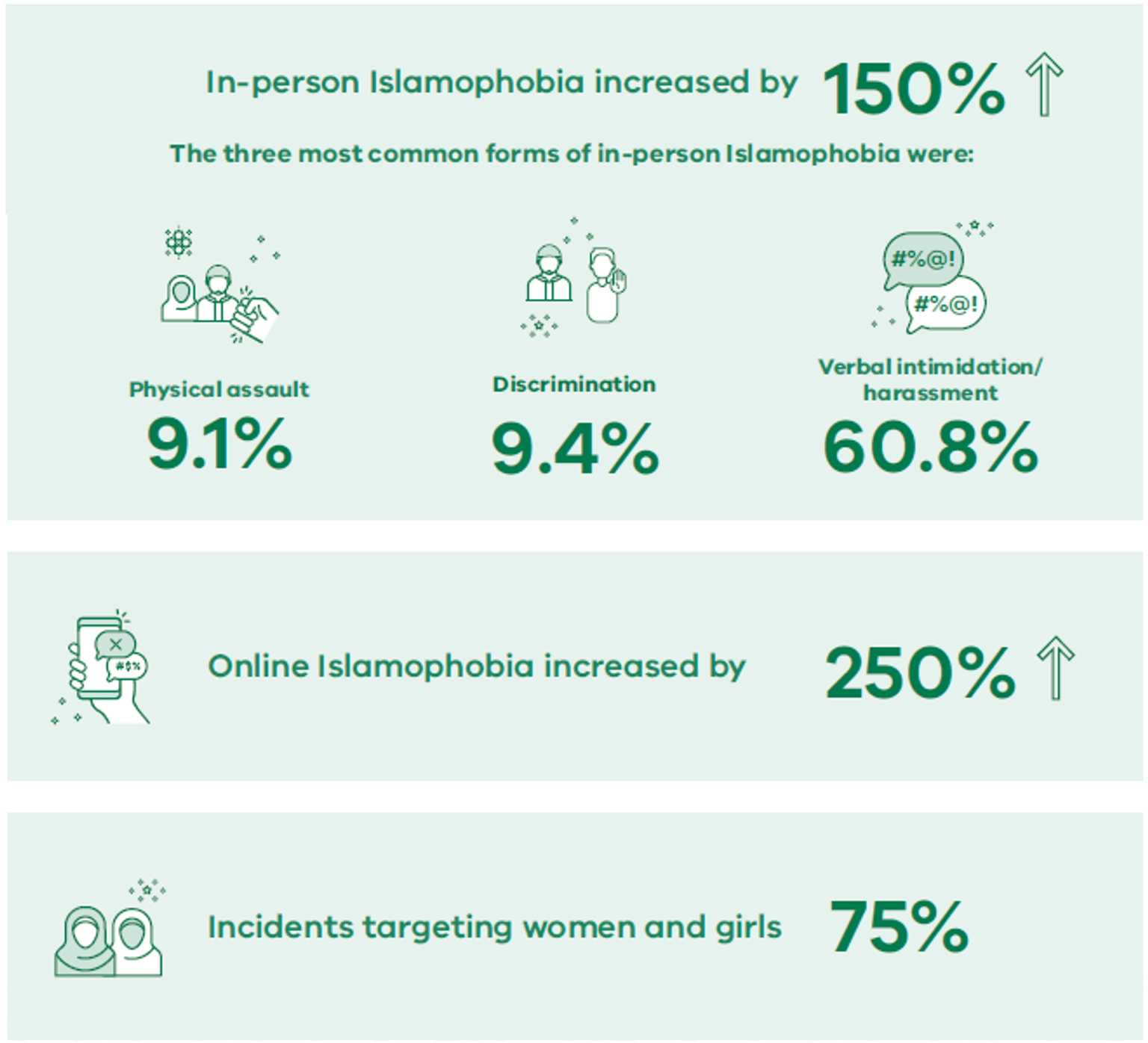
People who experience Islamophobia do not always report it. This means that actual rates of Islamophobia are likely higher than what is reported. There are many reasons for this. These include:
- feeling hopeless and that reporting won’t help
- trauma associated with recounting experience of Islamophobia
- language barriers
- not knowing where or how to report an incident
- feeling unsure of what can be reported
- not trusting authorities.
In 2024, most reports of Islamophobia were in public spaces such as on the street, driving or parking, shopping centres, on public transport, at workplaces and online3.
All forms of Islamophobia are deeply harmful to Muslim people and communities and contribute to a decline in wellbeing.
References
2S Carland, N Alziyadat., M Vergani and & K O’Brien, Islamophobia in Australia Report V, Islamophobia Register Australia, 2025.
3Carland et al, Islamophobia in Australia Report V
Drivers of Islamophobia
The drivers of Islamophobia are complex. Despite the Muslim community making significant cultural, social and economic contributions, one third of Australians reportedly had a negative attitude towards Muslims in 2024.
Trigger events
Trigger events are incidents that cause a broad social, political or economic reaction. They may not directly involve Muslims but often bring attention to Muslim communities. Triggers can include:
- misinformation or disinformation
- global and local events
- political narrative, commentary and debate
- negative media coverage
- comments from public figures or leaders.
Misinformation and disinformation
Misinformation and disinformation, including incorrect, misleading or malicious representations of Muslim communities and people, their views and their values, can drive Islamophobia.
Misinformation is incorrect or misleading information.
Disinformation is deliberately misleading content, spread to deceive people.
Misinformation and disinformation can stem from intolerance and hate, including far-right ideology. This can be shared via social media, in-person or news media.
Media coverage
Media coverage and influential figures in the media can drive harmful stereotypes of Muslims, as the media strongly influences public opinion.
Inconsistent reporting also reinforces bias. For example an Australian Human Rights Commission project noted inconsistencies in media reporting on crime:
- crimes involving Muslim Australians often highlight their religion and label them as "terrorists".
- crimes involving non-Muslims tend to focus on mental health, with little or no mention of religion.
This unequal treatment in the media contributes to negative public attitudes toward Muslims.
Impacts of Islamophobia
The impact of Islamophobia can be severe and long-lasting. Islamophobia impacts all aspects of someone’s life.
Experiences of Islamophobia impacts a person’s ability to do day-to-day activities like a trip to the shops, taking public transport or attending work or school. It has significant implications to accessing education, healthcare and work.
Health
Islamophobia has serious impacts on health.
People who have experienced Islamophobia report ongoing mental health and psychological impacts including anxiety, fear, anger, humiliation, despair or sadness4.
This can lead to intergenerational trauma, where the harmful and insidious impact of Islamophobia is felt through multiple generations.
Witnessing or experiencing Islamophobia can also prevent some people from accessing healthcare services because they don’t feel safe accessing essential services. Participants in an Australian Human Rights Commission project that explored the experiences of Muslim Australians, reported unfavourable and discriminatory treatment when accessing healthcare5.
Education
Educational settings are a particular site of concern for Islamophobia.
Muslim students can face bullying, physical assaults, and discrimination6. These experiences negatively impact young people’s view of themselves and their sense of belonging and can lead to low self-esteem and mental health issues7.
Participants in an Australian Human Rights Commission project reported experiences of discrimination and vilification at university. These reports are supported by data from the 2023-24 Islamophobia in Australia report which included reports of verbal abuse, hate speech and physical assault at universities8.
Employment
Participants in an Australian Human Rights Commission project identified structural (systemic) Islamophobia as a key barrier to seeking employment and noted that the workplace was a key site of Islamophobic treatment9.
Research found that people with Middle Eastern names seeking employment in Australia had to submit 64 per cent more applications to receive the same opportunities as a person with an Anglo-sounding name10. While not all Muslims have a Middle Eastern name, this study is an example of structural Islamophobia.
Children and young people
Islamophobia impacts children and young people, with research noting that exposure to Islamophobia can lead to internalising negative stereotypes about their own community, along with feelings of hopelessness and being disempowered. Young people surveyed as part of a research paper noted the prevalence and normalisation of Islamophobia in Australia11. Exposure to Islamophobia as a child or young person can have long term impacts on mental health and self-esteem.
Suppression of culture
Seeing or experiencing Islamophobia can cause people to hide their culture or religion.
Some may stop wearing the hijab in public or avoid going to mosques or community events out of fear. This makes it difficult to freely express who they are, celebrate their culture, and practice their religion without fear of being harassed or discriminated against.
Disengagement from the community
Experiencing Islamophobia can make people feel like they don’t belong in Victoria or Australia. It can lead to feeling left out and like they are not accepted for who they are. As a result, people may feel less connected to their community and less interested in getting involved in political or community activities. Over time, these feelings can grow, leading to a sense of exclusion, feeling isolated and declining mental health.
Responding to Islamophobia
Everyone has a role to play in creating a safer, more inclusive Victoria. An important part of this is being able to identify and stand up to Islamophobia when you see it. One way to help is to be an active bystander. This can include offering support to someone who has experienced Islamophobia, calmly calling Islamophobic behaviour out (if it is safe to do so), or reporting what you witnessed. See the Active bystander toolkit for practical steps on how you can stand up to Islamophobia.
If you have experienced or witnessed Islamophobia, there are services that can provide you with advice on what to do, options for reporting your experience and how to access support. See the Guide to accessing support and reporting Islamophobia for more information.
In Victoria, there are laws to protect people from discrimination and vilification (hate speech).
Under the Victorian Equal Opportunity Act 2010 it is against the law to discriminate against someone based on their race, skin colour, ancestry, nationality, ethnic background or religion in areas of public life such as:
- at work
- at school
- when using services
- when renting or buying property
- when taking part in sport
- when accessing public places.
Under the Crimes Act 1958, it is a criminal offence to incite hatred or threaten physical harm against someone because of who they are or what faith they follow.
Combatting Islamophobia is not just the responsibility of individuals.
Decision makers and people in positions of power also have an important role to play in combatting Islamophobia.
Schools, workplaces, universities, and governments have a responsibility to prevent and address Islamophobia, hate and racism.
Under the Victorian Equal Opportunity Act 2010, some organisations such as education institutions, workplaces and goods and services providers, have a legal duty to eliminate discrimination and victimisation as far as possible12.
This means that these organisations must take positive and proactive action, regardless of whether a complaint has been made.
References
4Carland et al, Islamophobia in Australia Report V.
5Australian Human Rights Commission, Sharing the Stories of Australian Muslims.
6Carland et al, Islamophobia in Australia Report V.
7Hammond, K and Bottriell, N, Stand Out, Speak Up: Racism and Islamophobia in Victorian schools, Australian Muslim Women’s Centre for Human Rights, 2023.
8Carland et al, Islamophobia in Australia Report V.
9Australian Human Rights Commission, Sharing the Stories of Australian Muslims.
10A L Booth, L Andrew and E Varganova, ‘Does Ethnic Discrimination Vary Across Minority Groups? Evidence from a Field Experiment’, Oxford bulletin of economics and statistics, 2011, 74(4), doi: 10.1111/j.1468-0084.2011.00664.x.
11A Bedar, N Bottriell, S Akbarzadeh, Supporting Muslim Families and Children in dealing with Islamophobia, Australian Muslim Women’s Centre for Human Rights, 2020.
12Victorian Equal Opportunity and Human Rights Commission, Positive Duty
Further Resources
If you wish to learn more about Islamophobia, its impacts and how to be an active bystander see the below resources.
Support and resources for Muslim communities
Active bystander guidance
Racial discrimination in the workplace
The Victorian Equal Opportunity and Human Rights Commission have developed a guide on being a bystander in the workplace.