

- Date:
- 9 Dec 2025
Introduction
The Industry Engagement Framework sets out the Victorian Skills Authority’s (VSA) approach to working with industry to find solutions for skill needs that are innovative, responsive and world-leading. A skills system that is informed by employers and employees - underpinned by high-quality data and evidence - helps Victorian learners, workforces and businesses thrive, grow and prosper.
While we consider the needs, perspectives and priorities of multiple stakeholders across the education, government and community sector, including learners, this framework focuses specifically on our engagement with industry stakeholders.
Industry has direct knowledge of the skills needs across sectors and regions, offering rich insights on challenges and potential solutions. The aim is to ensure businesses, unions, employer peak bodies and associations, operating across Melbourne and Victoria’s regions, can contribute their expertise and work in collaboration to get the best skilling outcomes for all Victorians.
The importance of engagement in building the skills of the future
Victoria’s prosperity is based on creating jobs and growing the state’s economy while making sure no one is left behind. Jobs are created and businesses grow when Victorians learn new skills and apply these skills in the workplace.
The Productivity Commission estimates that around 20% of labour productivity growth in Australia over recent decades is due to rising skill levels*. Post secondary education and training, including pre-accredited adult, community and further education (ACFE), vocational education and training (VET) and universities collectively have a role in building productivity and providing the skills that help deliver Victoria’s growth.
Of the approximate 392,00 new workers expected to enter the workforce in Victoria by 2027, 85% are expected to gain employment in occupations usually requiring post-secondary qualifications. Around 180,000 of these workers are expected in occupations usually requiring a VET qualification, followed by 163,000 new workers in occupations generally requiring a higher education qualification.
*5-year Productivity Inquiry: From learning to growth Inquiry report - Volume 8 February 2023.
Our role
The Victorian Skills Authority (VSA) is the key liaison point between industry, unions, employers, government and the skilling system in Victoria.
We provide evidence-based planning and advice, including the annual Victorian Skills Plan, that helps Victorians access skills, employment and career pathways, while supporting industry with workforces that meet current and future skills needs.
We use the industry and regional insights we gather to ensure Victoria’s skills and training system is collaborative, innovative and delivers the best outcomes for learners, workers and business, whilst working cohesively across the education and training sectors.
We work with others across the Victorian Government to advocate for the state’s needs within a national training framework, and provide advice and insights on Victoria’s delivery of important Commonwealth Government-led initiatives, including the National Skills Agreement and the Australian Universities Accord.
Our engagement approach
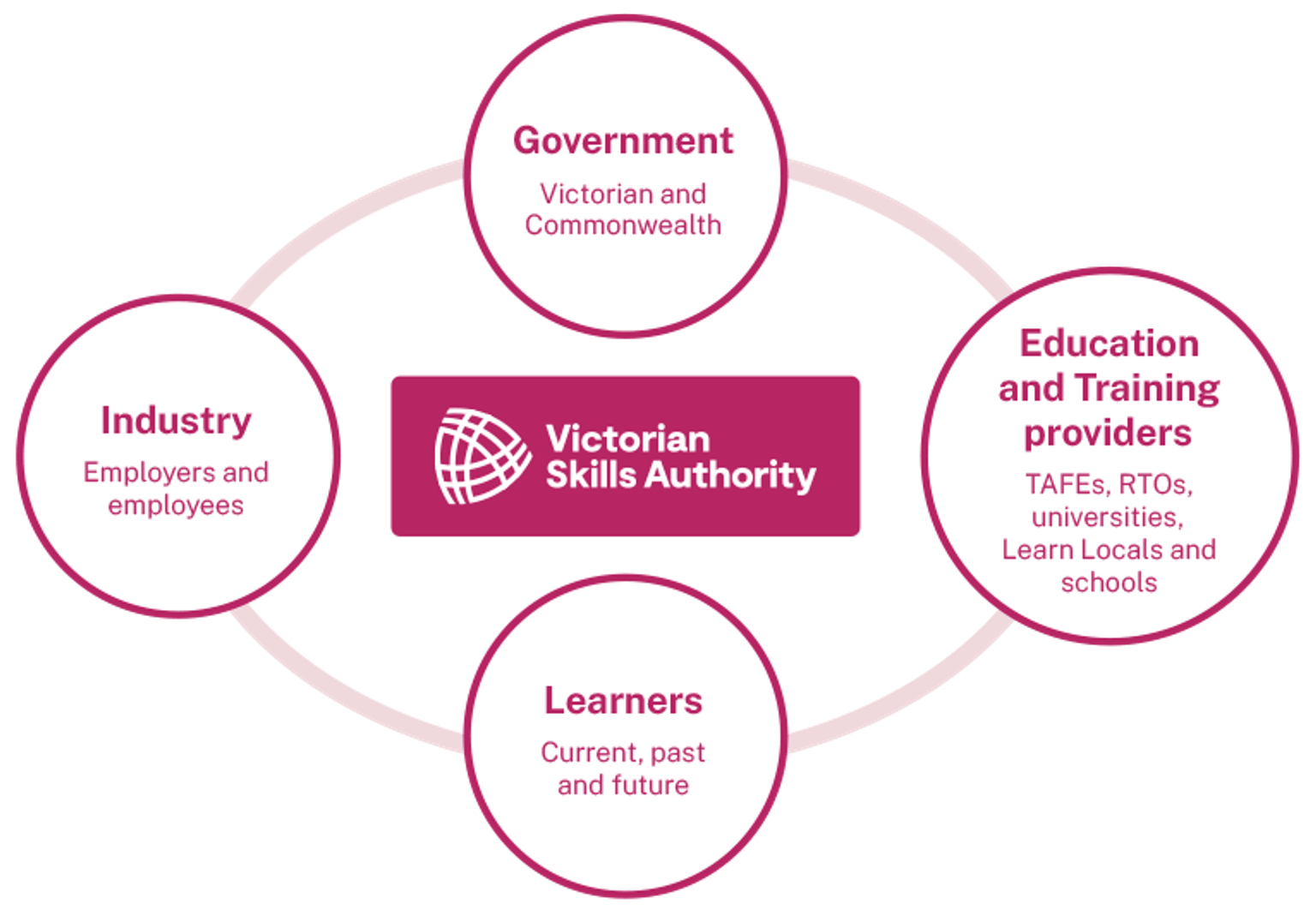
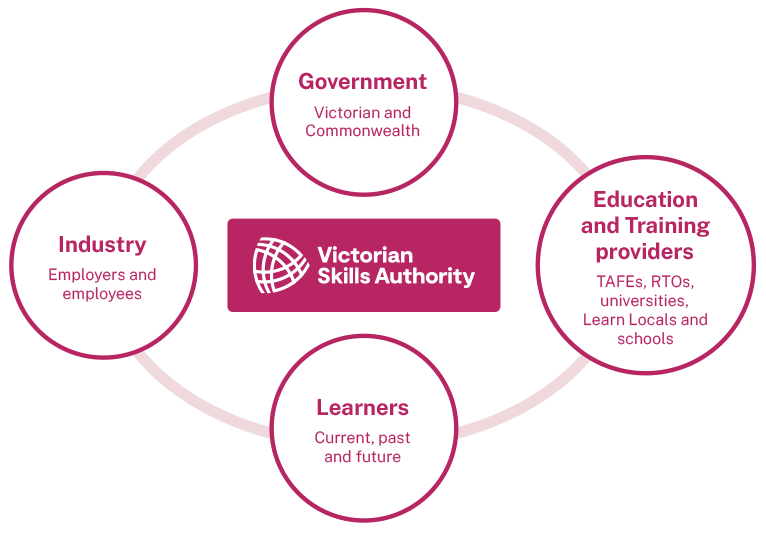
Victoria’s skills system has many stakeholders whose perspectives and priorities must all be considered in the planning and delivery of high-quality, accessible skills and training.
Successful and sustainable skills solutions rest on shared aspirations. Deep engagement with industry, educators, learners and government helps ensure cross-sector understanding of key challenges, as well as opportunities for collaborative solutions.
By bringing the perspectives of all stakeholders together, engagement defines responses that support Victorians with their journeys into work and through their careers, and better enables government to deliver on its priorities by addressing future skills needs.
Our engagement is led by the 5 key objectives outlined in our Strategic Plan:
- provide a forward view on skill requirements
- enable increased participation in vocational education that leads to good jobs and career pathways
- lift quality and performance
- develop innovative solutions to skills design and delivery
- create connections and impact.
Our approach to engagement
We consider the needs, perspectives and priorities of multiple stakeholders who can inform and support future planning and the delivery of high-quality, accessible skills initiatives.
Our approach to engagement
Our 6 engagement principles
We apply the following principles when planning and delivering our engagement actions and activities.
- Collaborative: recognising that the best strategic and sustainable solutions are found by working together
- Transparent: being honest and open about the purpose and parameters of the engagement, and clear on what the outputs and outcomes will be
- Mutually valuable: providing meaningful engagement that is seen as valuable by all parties
- Inclusive: ensuring engagement provides opportunities for multiple voices and perspectives, and caters for the different engagement needs
- Respectful: valuing and acknowledging expertise, experience, support, input and time, and respecting diverse views
- Integrity: approaching all engagement with a commitment to being honest, ethical, trustworthy, and avoiding any conflicts of interest.
Engagement with industry
Victoria’s skills system is complex, with multiple local, regional, statewide and national influences shaping it.
Engagement with industry covers a vast range of sectors that play an important role in Victoria’s economy and community including:
- Arts, personal services, retail, tourism and hospitality
- Building, construction, mining and property
- Early educators, health and human services, sport and recreation
- Electrotechnology, energy, gas and renewables
- Finance, technology and business
- Furniture, textiles, timber, forestry and forest products
- Manufacturing
- Primary production, horticulture and racing
- Public safety and government
- Transport and logistics.
We facilitate robust discussion with both employer and employee representatives from these industry sectors on multiple initiatives, issues and opportunities. This supports high-quality skills and workforce analysis and policy development, as well as program delivery by the Victorian Department of Jobs, Skills, Industry and Regions (DJSIR), other Victorian Government bodies, the Commonwealth Government and other national skills bodies.
This supports high-quality skills and workforce analysis, policy development and program delivery across the Victorian Government, the Commonwealth Government and national skills bodies.
Key industry engagement themes and topics
- VET quality and qualification reforms
- Growing VET uptake
- Training packages, courses and skill sets
- Gender and diversity
- The National Skills Agreement and Australian Universities Accord
- Victorian Skills Plan
- Jobs and Skills Councils strategies and workplans
- Employment forecasts and workforce challenges
- Victorian Training Needs List
- Localised skills solutions
- Apprenticeships and traineeships
- Victorian Government priorities (for example, Housing Statement, Big Build, clean economy, care economy and digital skills)
- Self-determination and Treaty
How we engage
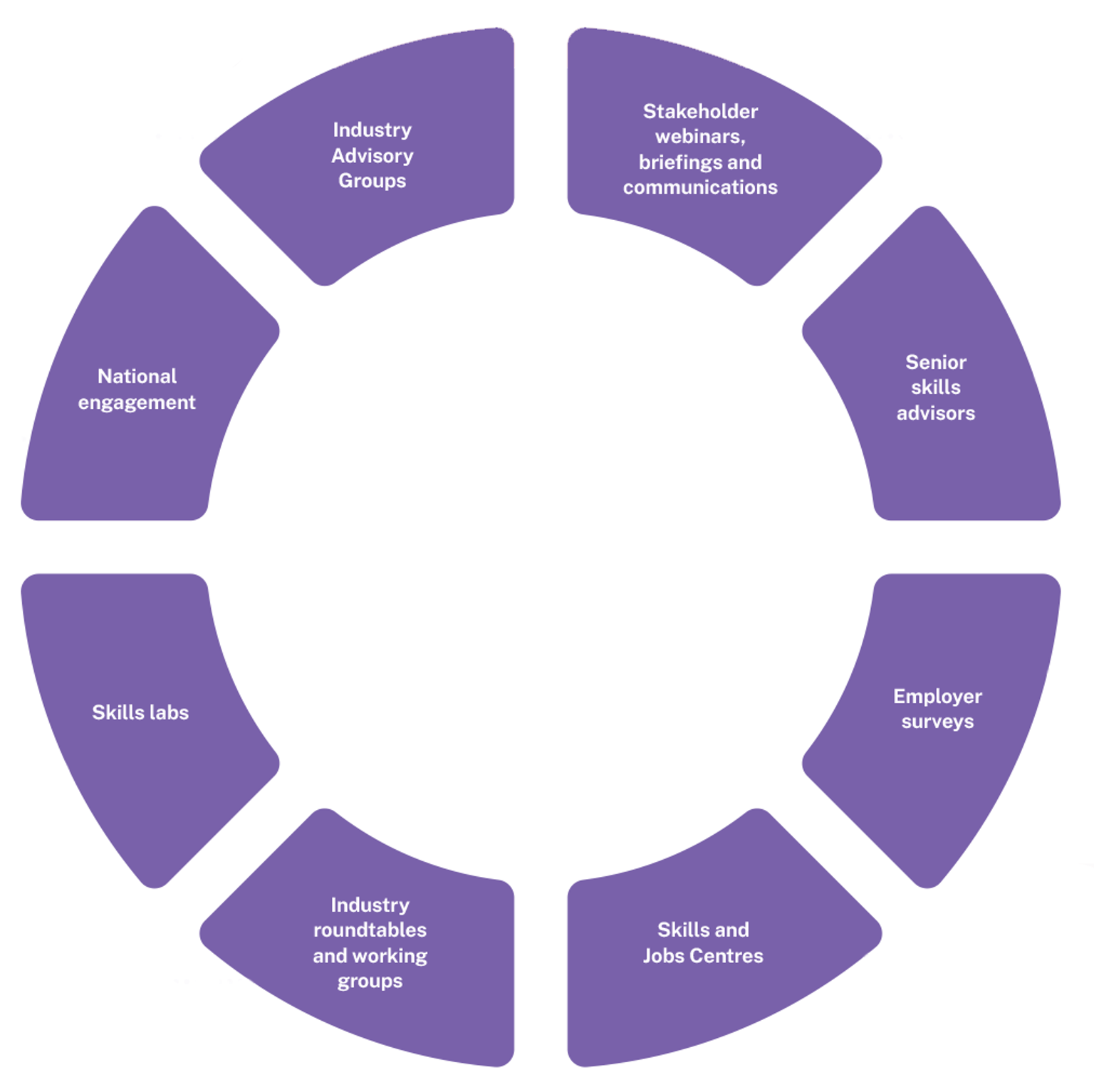
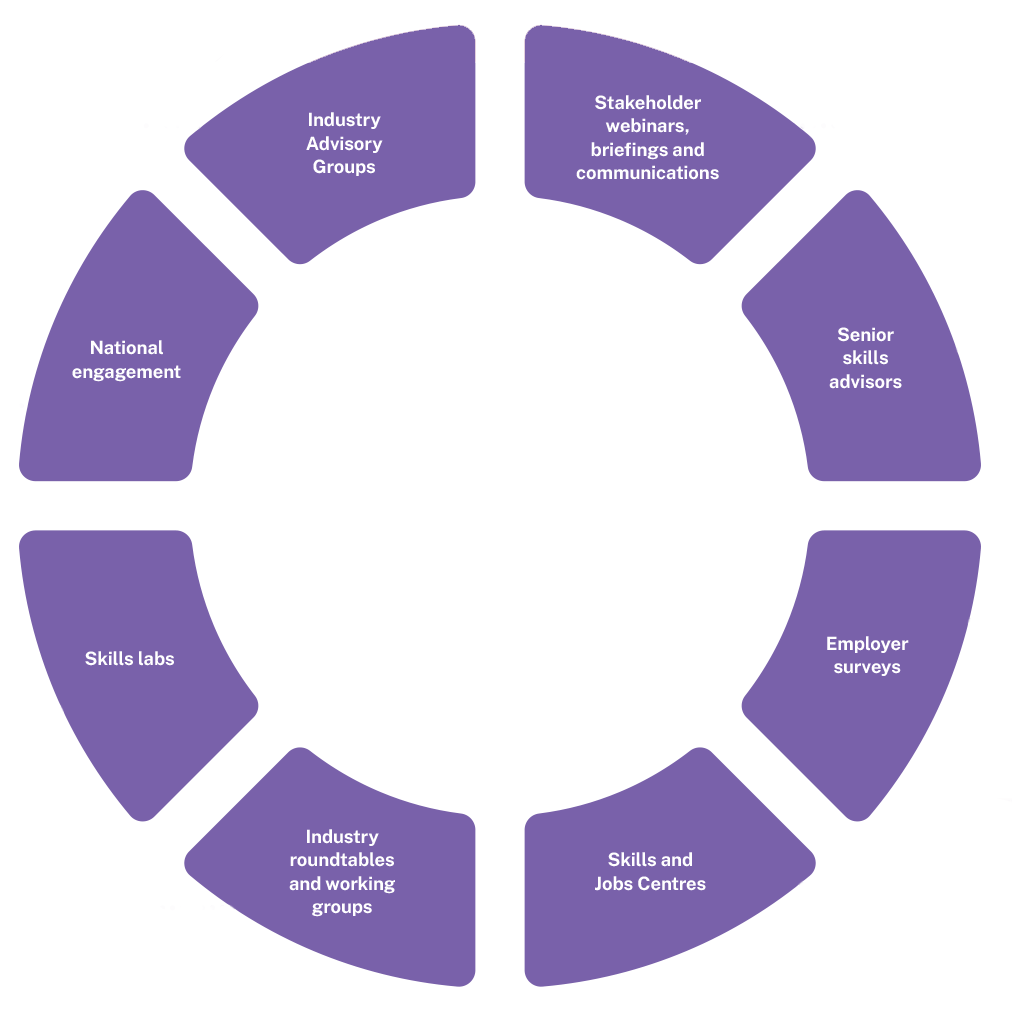
We test and validate data and gather industry insights through multiple engagement mechanisms - including Industry Advisory Groups, employer forums and roundtables, and through outreach and engagement by VSA staff based in metropolitan Melbourne and regional Victoria.
This provides industry with opportunities to raise the skills and workforce opportunities and challenges important to them, test and interrogate available data and evidence, and provide us with advice to help inform Victorian Government priorities. Combined, all of these activities provide opportunity for discussion, robust debate and solution finding, where we collectively lead innovation and responses to current and future skills needs.
How we engage
Industry Advisory Groups (IAGs)
Covering Victoria’s key employing industries, the IAGs are tripartite and include representatives from unions and employer peak bodies. IAGs provide us with specialised knowledge and insights into skills and workforce challenges, current and future skills needs and potential solutions. In addition to industry focused IAGs, cross-industry IAGs tackle economy-wide skills challenges in areas like the clean economy, clean economy, digital transformation, self-determination and gender representation.
National engagement
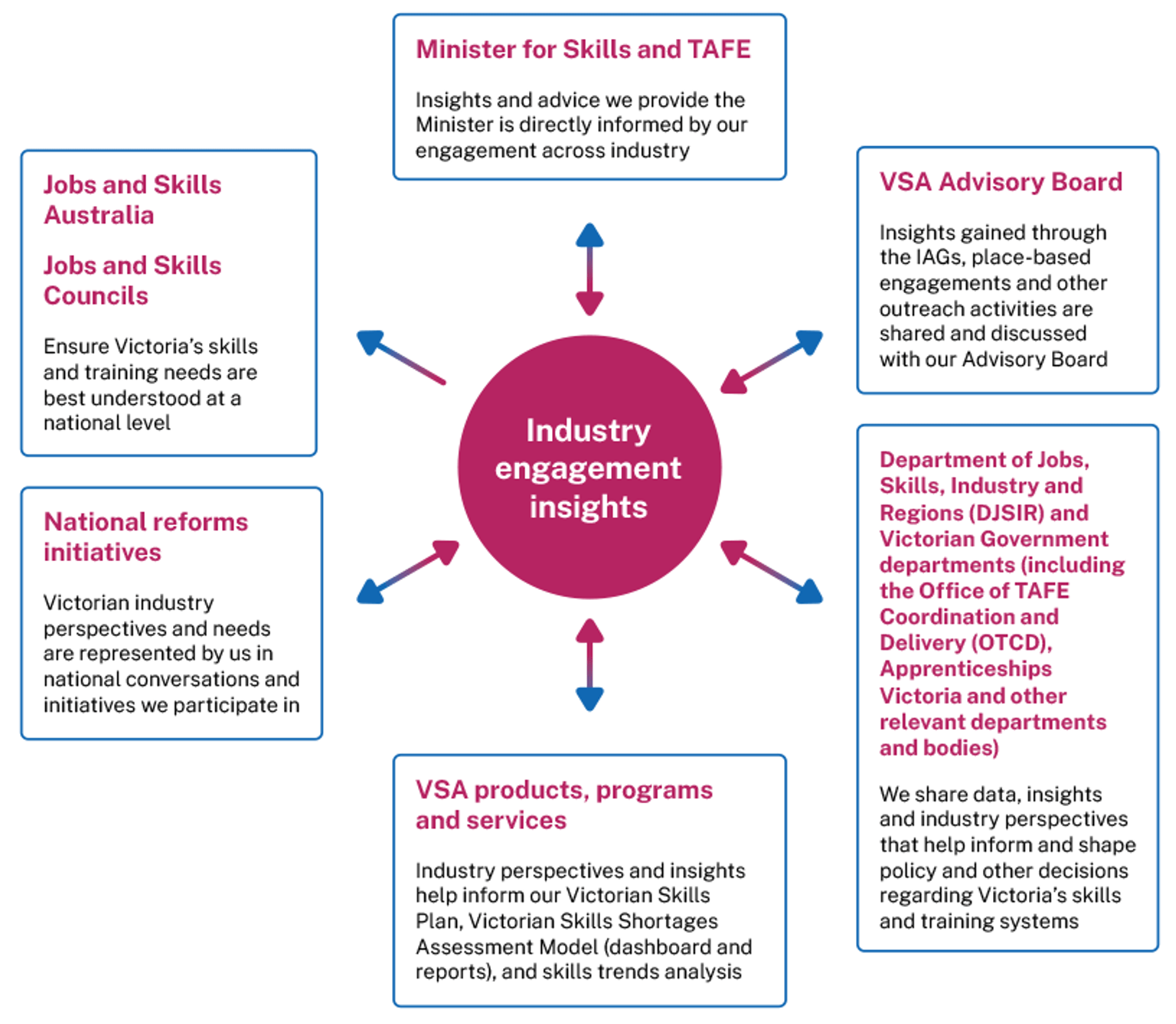
Engagement with national bodies such as industry-based Jobs and Skills Councils, Jobs and Skills Australia and Commonwealth Government departments with responsibilities for skills ensures Victorian perspectives are represented in national skills reform dialogues. Drawing on our IAGs and the technical expertise in the curriculum maintenance manager program, we aim to ensure national training packages, accredited courses and workforce planning reflects the needs of Victoria’s economy.
Skills labs
Future Skills Labs bring diverse stakeholders together to drive solutions and improvements across the skills sector. Hosted by TAFEs, the labs cover areas such as housing and construction in a clean economy, advanced manufacturing and offshore wind.
Industry roundtables and working groups
Time bound activities and groups that bring together industry and technical leaders to focus on specific sector or economy challenges, cross-sector themes, priorities or particular government initiatives.
Stakeholder webinars, briefings and communications
Industry and other stakeholders are kept informed of developments across the Victorian VET sector, and significant developments at a national level, through a series of online and in-person briefings, as well as regular bulletins. These channels also invite feedback and responses.
Senior skills advisors
Our senior skills advisors are based across metropolitan Melbourne and regional Victoria, and work with local businesses, TAFEs, RTOs, learn locals and other communities to identify skills trends, challenges and opportunities. They work collaboratively in-place to co-design responses and facilitate local partnerships that inform statewide skills policy and program improvement, and drive innovation and systemic change in Victoria’s skills system.
Employer surveys
The VSA undertakes surveys with employers to gain insights into a number of areas. For example, previous Employer Satisfaction Surveys have provided feedback from Victorian employers of apprentices and trainees about staff who either completed or were completing vocational education.
Skills and Jobs Centres
Located in TAFEs and dual sector universities, Skills and Jobs Centres offer free, independent, professional careers advice to Victorians. They also provide advice on TAFE and post-secondary skills pathways, as well as advice and referral for employment and other supports. Further, the centres provide support to local employers to help them meet their workforce skilling needs. Their local interactions provide feedback to us on skilling issues and trends from the perspective of employers, those enquiring about their skilling options and learners.
Taking a holistic approach
Our advisory and engagement approaches and activities support multiple purposes, collectively informing our understanding of current and future skills needs and how we can work together to address them.
Exchanging intelligence, research and insights on challenges and opportunities:
- Industry Advisory Group
- Senior skills advisor
- Roundtables and working groups
- Skills and Jobs Centres
- Webinars, briefings and communications
Identification of current and future skills needs:
- Industry Advisory Group
- Roundtables and working groups
- Employer surveys
- National engagement
- Webinars, briefings and communications
Identification of place based and local skills challenges:
- Senior Skills Advisor
- Roundtables and working groups
- Skills and Jobs Centres
Finding skills solutions that government, industry and educators can lead:
- Industry Advisory Group
- Roundtables and working groups
- Employer surveys
- Skills and Jobs Centres
Finding place-based solutions:
- Senior skills advisor
- Roundtables and working groups
- Skills and Jobs Centres
Testing and validating data and analysis:
- Industry Advisory Group
- Senior skills advisor
- Roundtables and working groups
- National Engagement
Advice/input to government policies, initiatives and decisions:
- Industry Advisory Group
- Senior skills advisor
- Roundtables and working groups
- Employer surveys
- National Engagement
Sharing information and outcomes
Insights and feedback gathered through our engagement informs advice we provide to stakeholders, as well as our work in local communities and with learners through Skills and Jobs Centres.
Industry engagement insights
Our Industry Advisory Groups
Our 10 IAGs are central to our industry engagement approach.
IAGs are generally aligned with the Commonwealth Government’s Jobs and Skills Councils, while also reflecting the economic and social development priorities of the Victorian Government.
IAGs meet at least 3 times per year to provide strategic advice to us on industry’s current and future needs.
The 10 IAGs and their industry and sector coverage are as follows:
Arts, personal services, retail, tourism and hospitality
- Accommodation
- Creative services across art, music, dance and theatre
- Floristry
- Funeral services
- Hair and beauty services
- Hospitality and food services
- Retail
- Tourism
- Travel
Building, construction, mining and property
- Architectural and design services
- Building and construction
- Building cleaning and pest control
- Building installation services
- Engineering design and consulting services
- Exploration and mining
- Fire safety installation and services
- Heavy and civil engineering construction
- Investigation and security services
- Land development, site preparation and landscaping services
- Plumbing services
- Property operators and real estate services
- Surveying and mapping services
Early educators, health and human services, sport and recreation
- Allied health services
- Health and mental health services
- Human services (including social services, aged care and disability services)
- Outside school hours care (OSHC) and long day care
- Preschool and early childhood education and care
- School education
- Sports and recreation services
Electrotechnology, energy, gas and renewables
- Air conditioning
- Electricity distribution
- Electricity generation and supply
- Electrotechnology
- Gas supply
- New energy technology including renewables and clean energy
Finance, technology and business
- Business services
- Financial services
- Human resources services
- Legal and accounting services
- Marketing and communications services
- Professional, scientific and technical services
- Information and communications technology including cyber security and digital technology such as artificial intelligence
Furniture, textiles, timber, forestry and forest products
- Forestry and logging
- Furniture manufacturing
- Other wood product manufacturing
- Pulp, paper and paperboard manufacturing
- Textile, leather, clothing and footwear manufacturing
Manufacturing
- Caravan and automotive manufacturing
- Circular economy and waste manufacturing processes
- Engineering
- Food and beverage product manufacturing
- Manufacturing
- Medical technology and pharmaceuticals manufacturing
- Metal
- Printing and graphic arts
Primary production, horticulture and racing
- Agriculture and rural production
- Animal care and management
- Conservation and land management
- Food, beverage and pharmaceutical production
- Horticulture and nursery
- Landscaping
- Meat processing
- Racing
- Seafood and aquaculture
- Viticulture
Public safety and government
- Ambulance services
- Correctional services
- Defence services
- Fire services
- Local government
- Other emergency services
- Police services
- Public administration
- Public safety
- State government
- Water supply, sewerage and drainage services
Transport and logistics
- Automotive vehicle repair
- Aviation
- Maritime
- Ports and warehousing
- Rail
- Road transport
- Transport and logistics
- Warehouse distribution and supply chain
About the VSA
We are an independent administrative office of the Victorian Government, led by a Chief Executive Officer (CEO). An Advisory Board - appointed by the Minister for Skills and TAFE, and comprising representatives with industry, community and skills expertise - provides independent advice to both the Minister and CEO on skilling priorities.
Our role is to gather and analyse industry data, identify where there are current and future skills issues or opportunities for Victoria’s workforce, and work collaboratively with stakeholders to develop strategies to fill these gaps. We are responsible for delivering a range of products, programs and services:
- Victorian Skills Plan: annual publication that provides a skills roadmap to meet our workforce needs over the next few years
- Employment Projections Dashboard: provides up-to-date information on in-demand jobs to assist government and industry with forward planning
- State of the Victorian Labour Market Report: provides detailed, in-depth analysis of labour market trends and challenges in Victoria
- VSA website: provides key information and valuable resources for stakeholders, learners, industry, training providers, employers and the general public
- Victorian Skills Gateway website and coursefinder: offers information on more than 400 VET courses, apprenticeships and traineeships - and more than 300 related occupations - to help current and prospective students
- TAFE and Training Line: provides free phone and email advice about TAFE and training courses, qualifications, eligibility and training providers
- Skills and Jobs Centres: provide free career, employment and training support services to help Victorians make informed decisions about skills, training and career opportunities
- Student and Employer Satisfaction Surveys: delivered annually and track the performance and outcomes of government-funded VET in Victoria, to help raise the quality of VET
- Victorian Training Awards and Learn Local Awards: annual awards programs that recognise and reward excellence in vocational and community education and training.