
- Date:
- 12 Jan 2026
Current labour market conditions
Key points
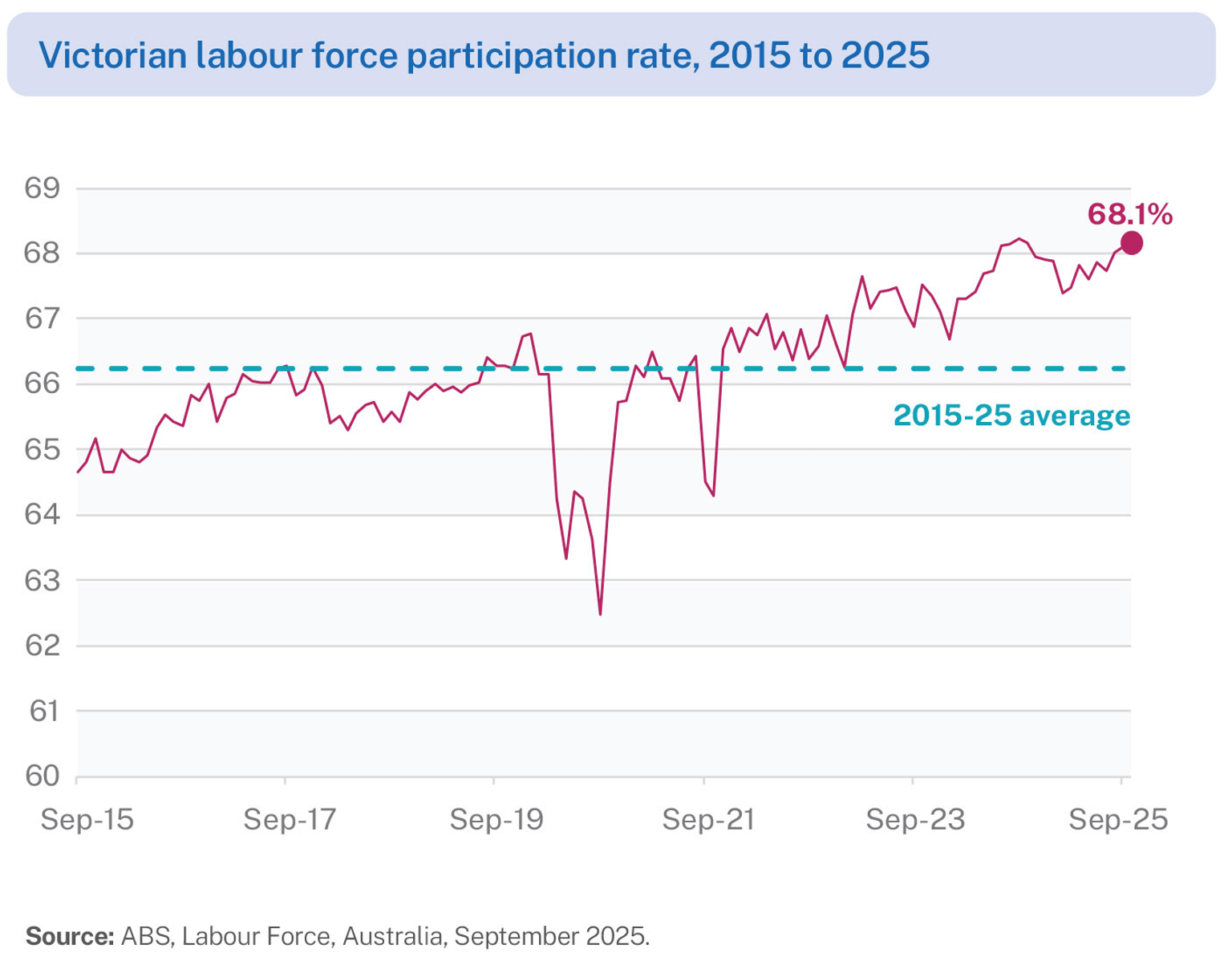
Victoria’s labour market remains strong, with 3.8 million people employed, a high participation rate of 68.1% and a low unemployment rate of 4.7% (as at September 2025).
Job vacancies
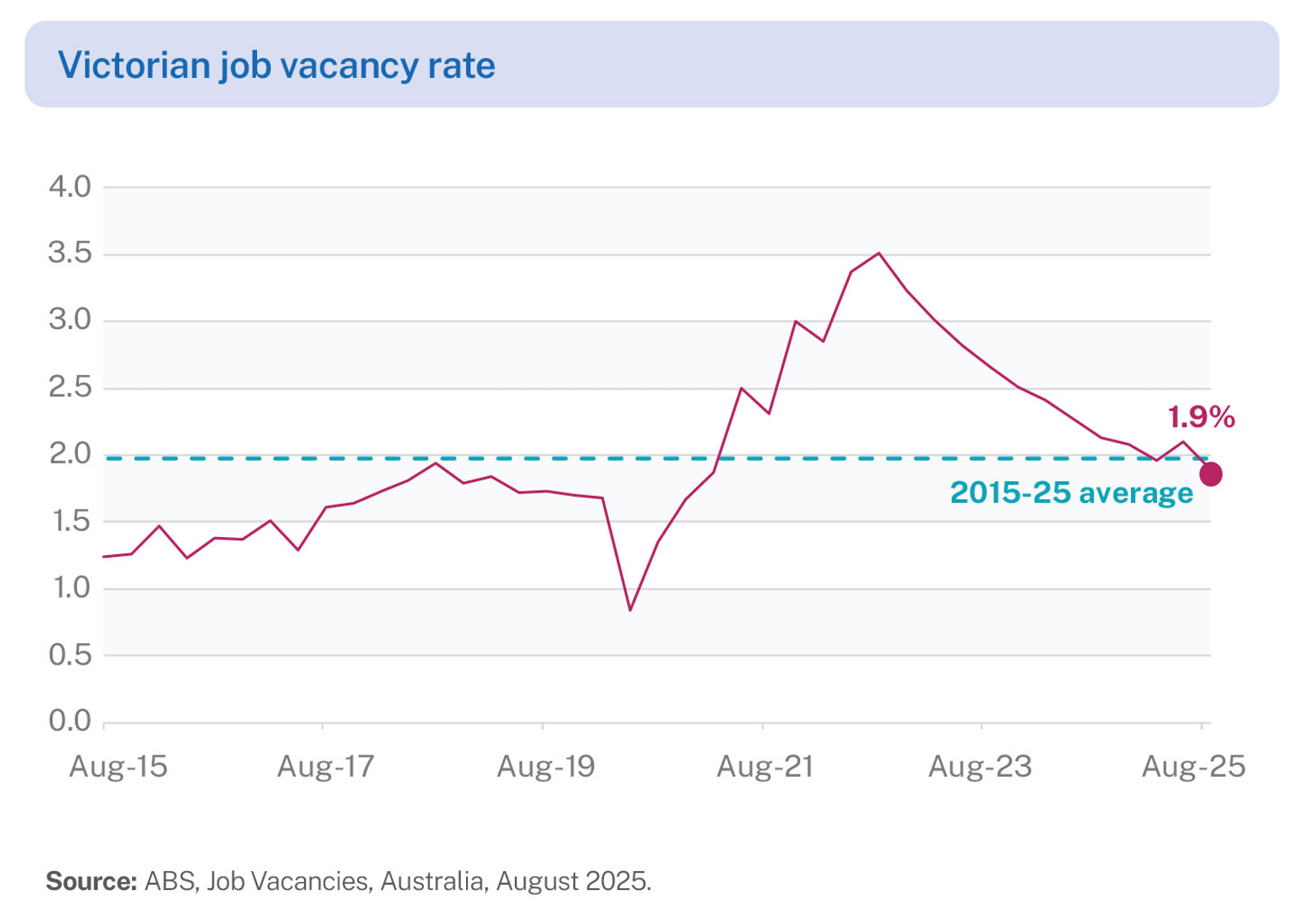
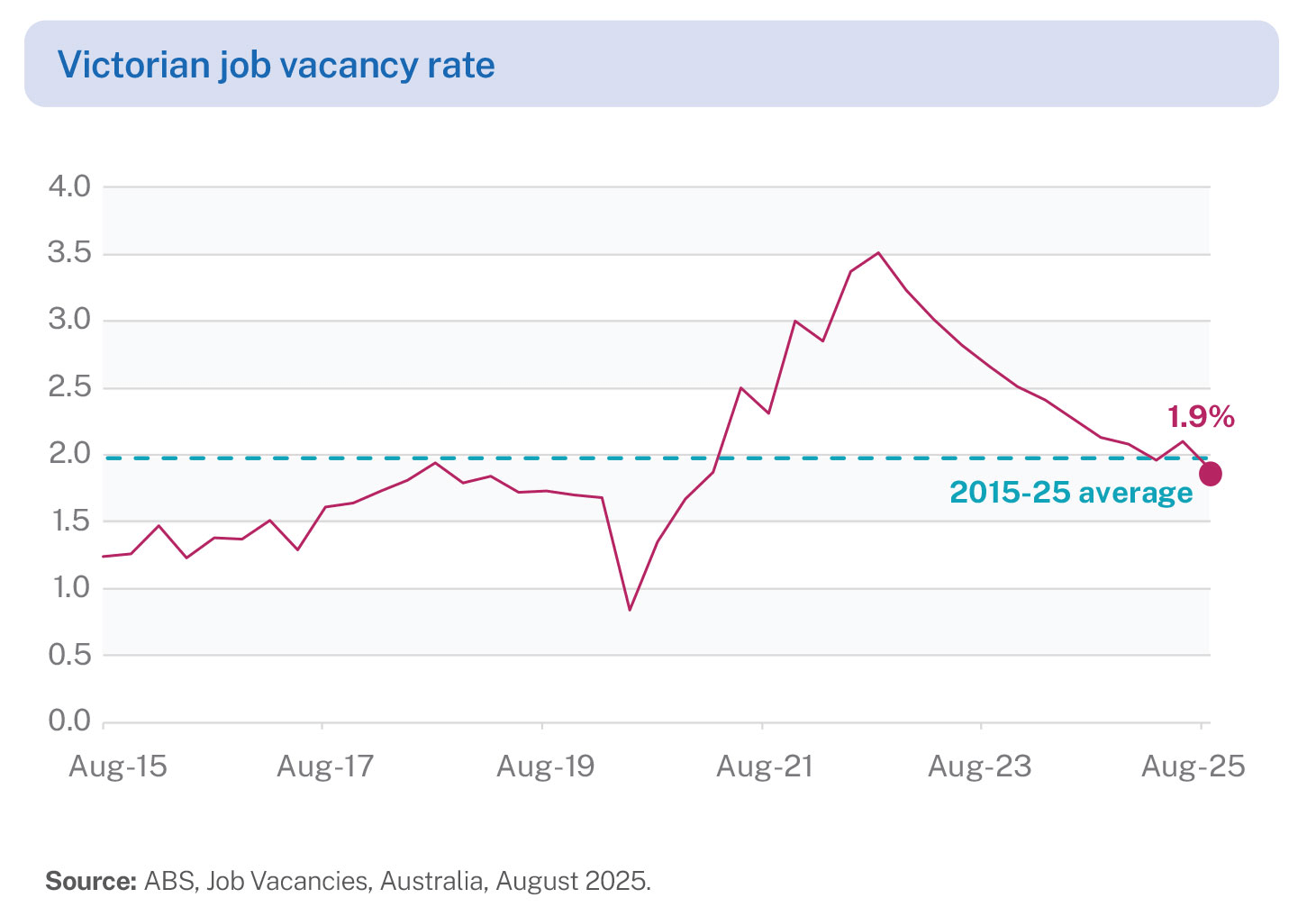
- The job vacancy rate, which is the share of job vacancies to the labour force, has declined to be slightly below its 10-year average.
- The number of applicants per job vacancy has increased substantially, making it easier for employers to fill vacant positions.
Skills in demand
- An increasing share of job advertisements requires non-technical skills like communication, problem solving, initiative and leadership.
- Demand for advanced digital skills has been growing, particularly for artificial intelligence (AI) skills, data analysis, computer science and cybersecurity.
- Vocational Education and Training (VET) is important for re-skilling and up-skilling, with many Victorians undertaking VET to change jobs or get more skills for their current job.
The share of Victorians in employment is high and unemployment remains low
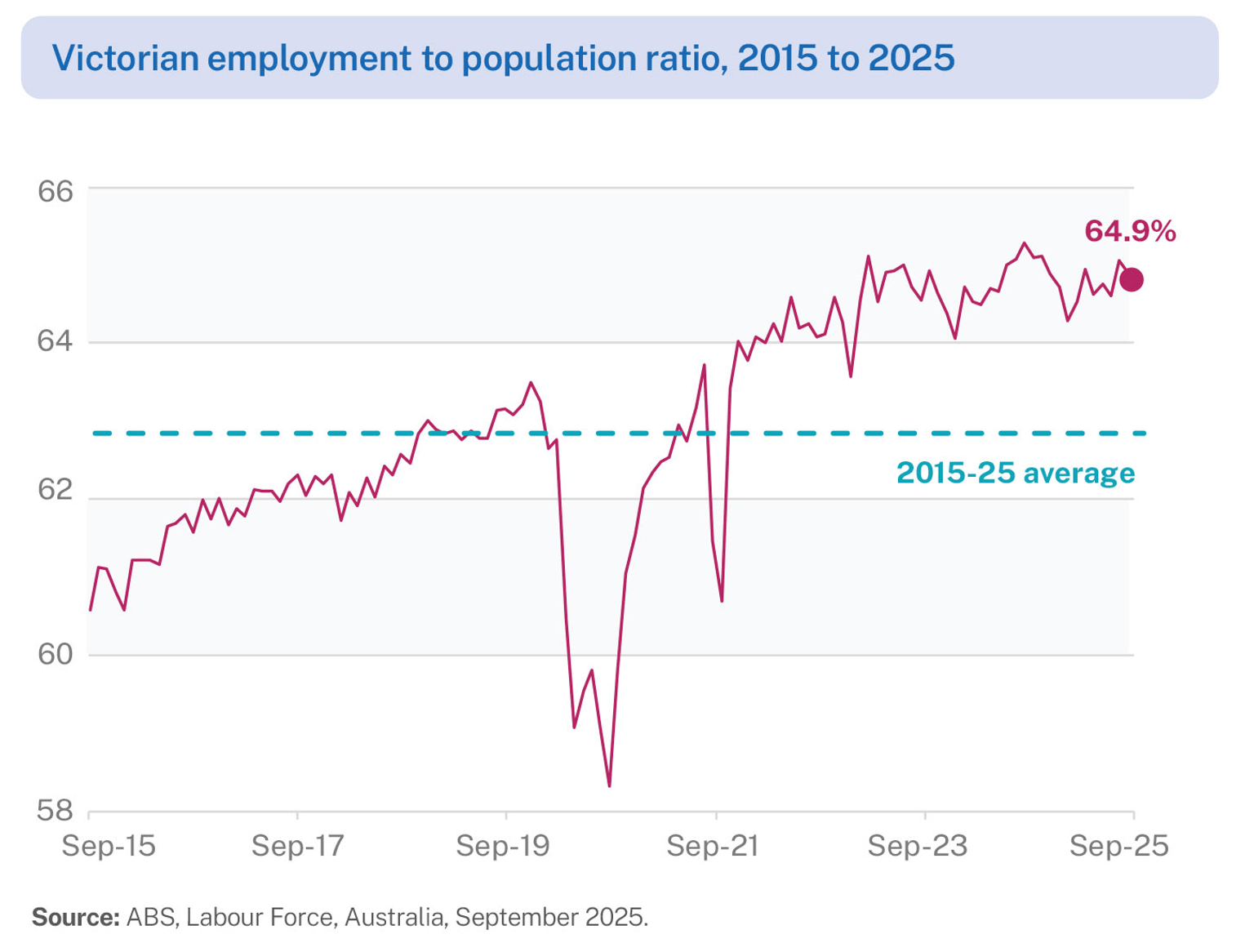
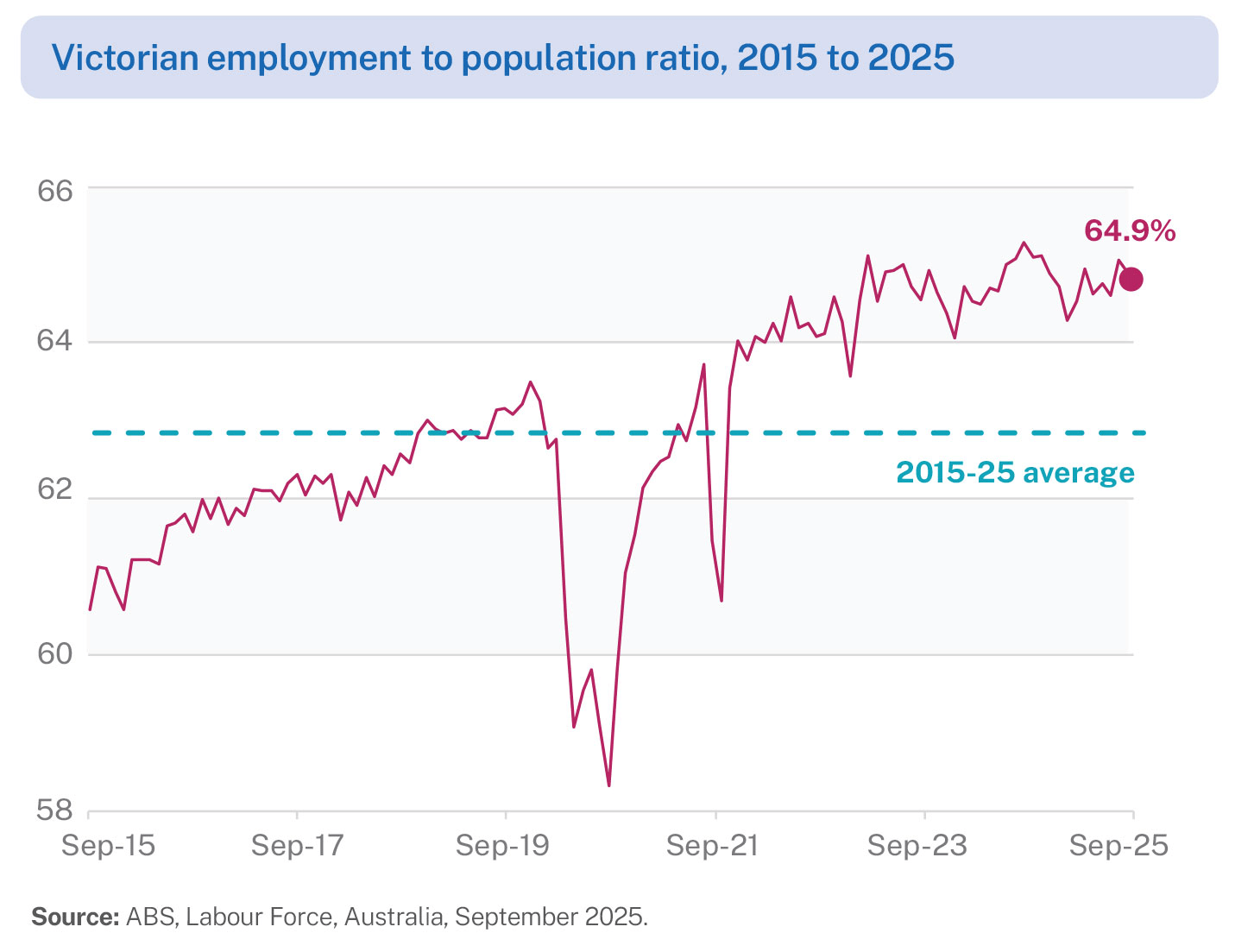
The number of Victorians in employment as a share of the population remains high at 64.9% in September 2025 – a key strength of Victoria’s labour market. More than 3.8 million Victorians are employed throughout the state.
Victorian employment to population ratio, 2015 to 2025
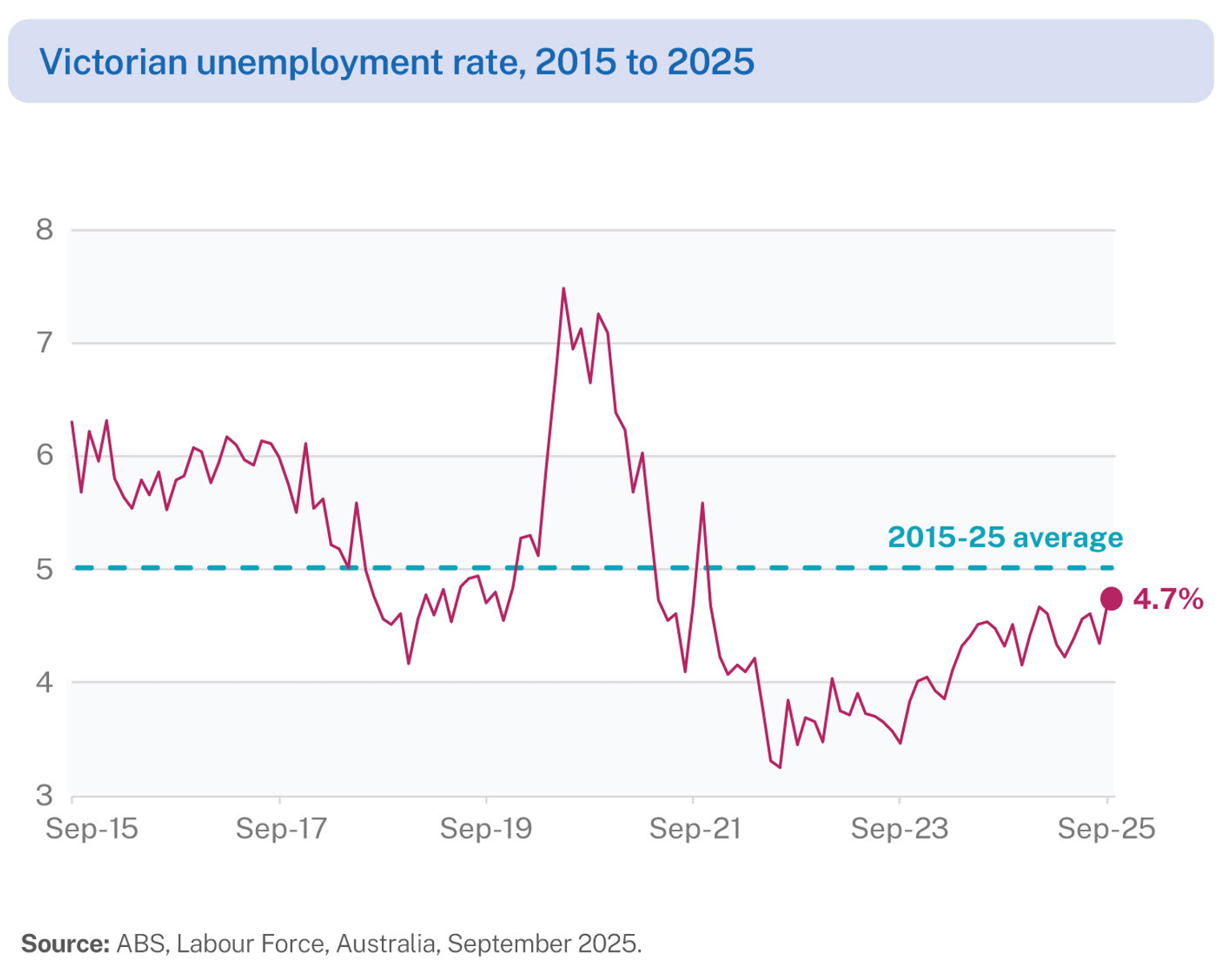
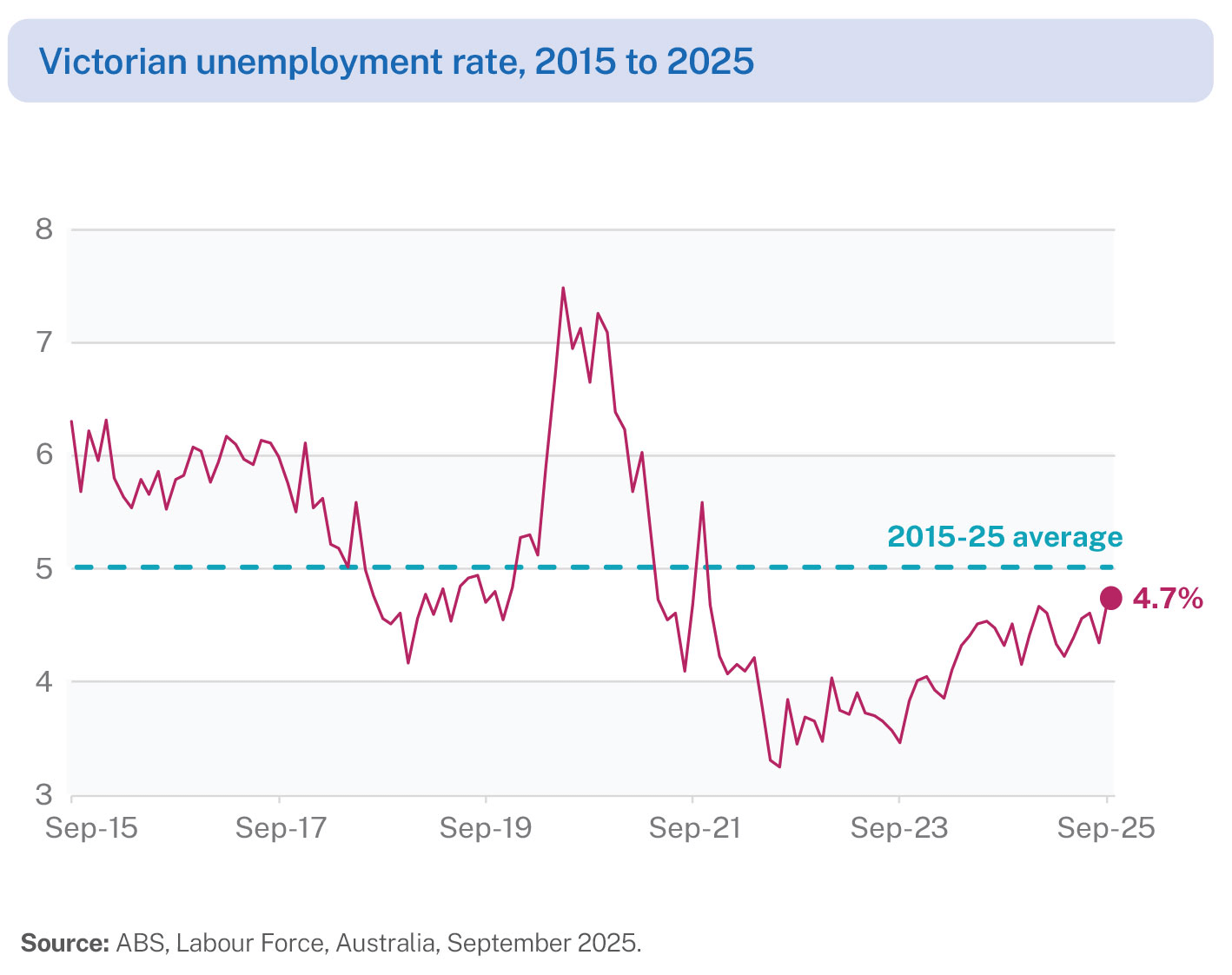
- Victoria’s unemployment rate was 4.7% in September 2025.
- The unemployment rate remains below its average of 5% over the past 10 years.
Victorian unemployment rate, 2015 to 2025
Underemployment has declined and participation in the labour force remains high
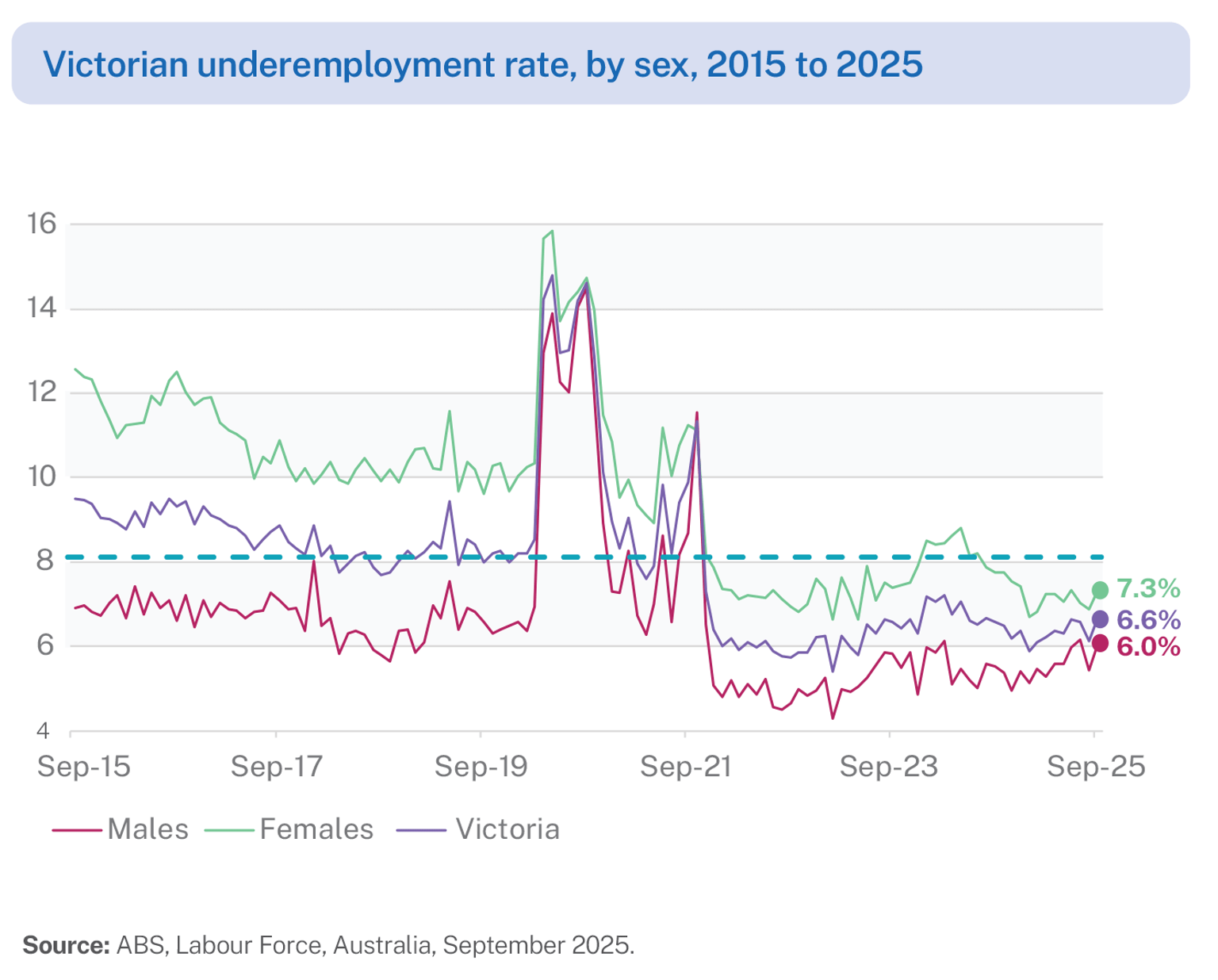
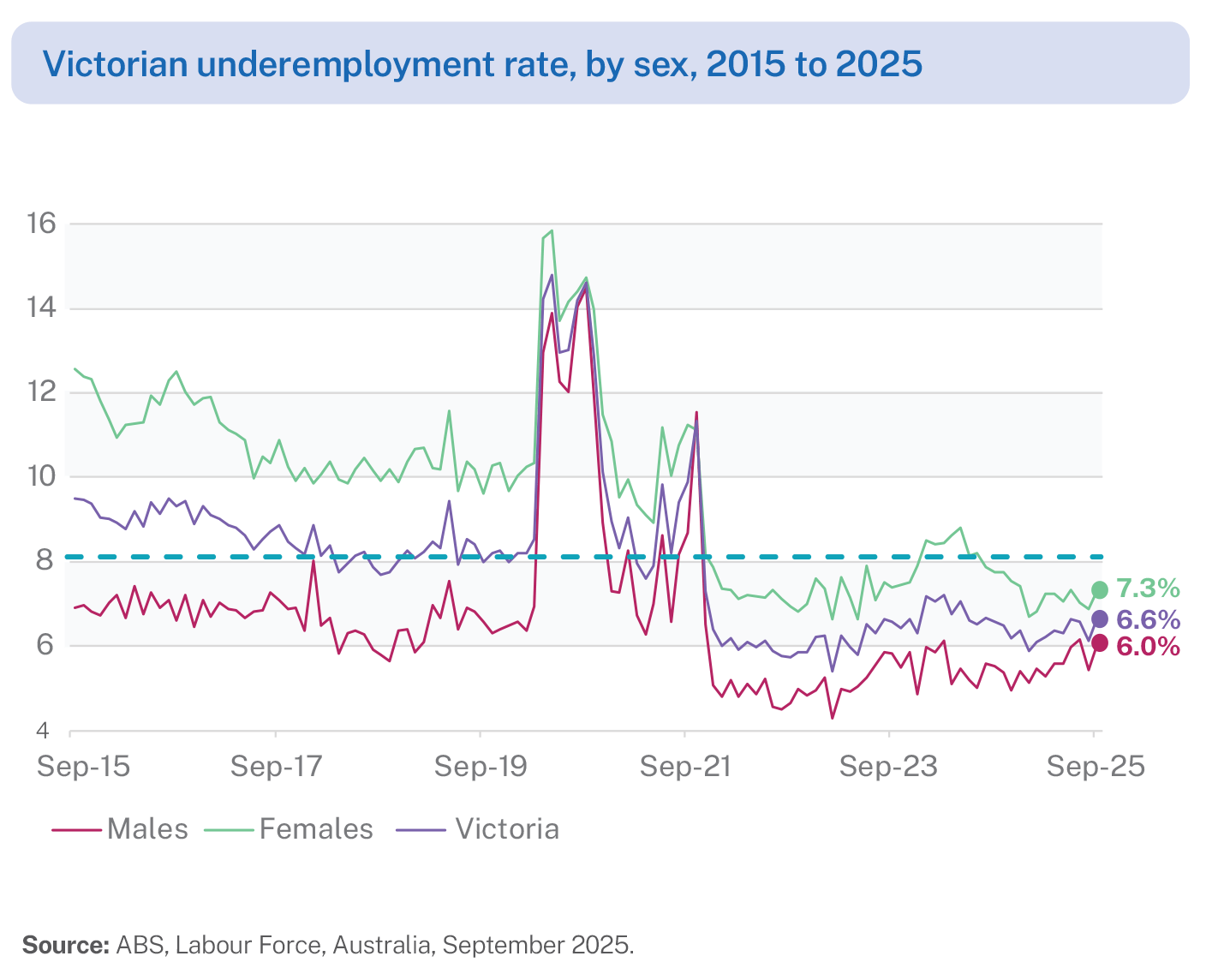
- The share of workers in the labour force who want to work more hours has declined, as reflected in the underemployment rate which fell from 7.2% in March 2024 to 6.6% in September 2025.
- This decline is primarily attributable to the drop in the female underemployment rate from 8.4% in March 2024 to 7.3% in September 2025. In comparison, the male underemployment rate fell marginally from 6.1% to 6% over the same period.
Victorian underemployment rate, by sex, 2015 to 2025
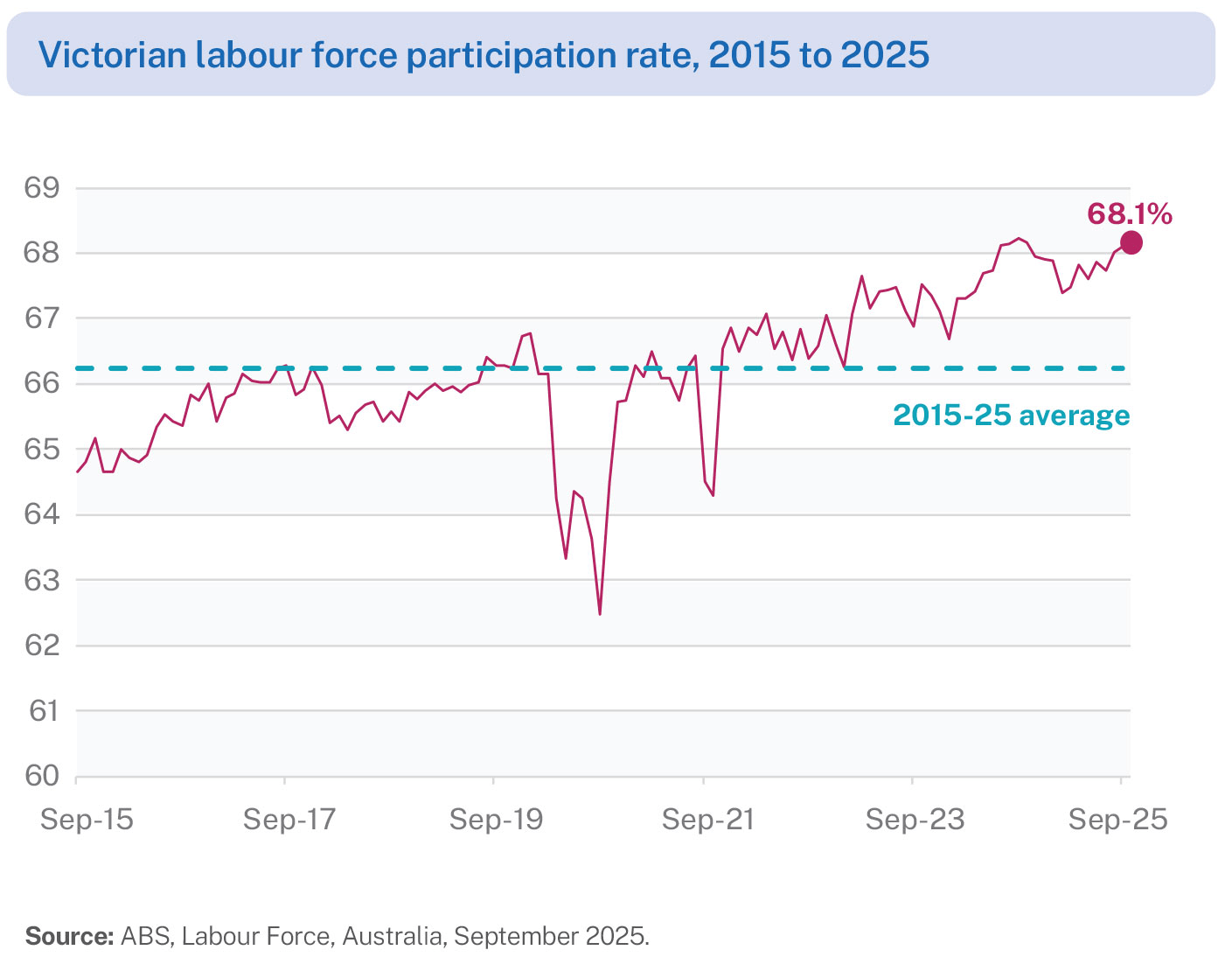
- The Victorian labour force participation rate rose to 68.1% in September 2025, almost equal to the all-time high of 68.2% in September 2024.
Victorian labour force participation rate, 2015 to 2025
Job vacancies have eased over 2025
- Job vacancies as a share of the Victorian labour force (as measured by the job vacancy rate) declined from its peak
of 3.5% in August 2022 to 1.9% in August 2025. - There were around 74,800 job vacancies in Victoria in August 2025, compared to 126,600 job vacancies in August 2022.
- Around 265,000 Victorians changed jobs over the year to February 2025, representing 7.1% of all employed people. Of people who changed jobs, 47.9% changed industry and 36.9% changed occupation.1
Victorian job vacancy rate
1 ABS, Job Mobility, February 2025.
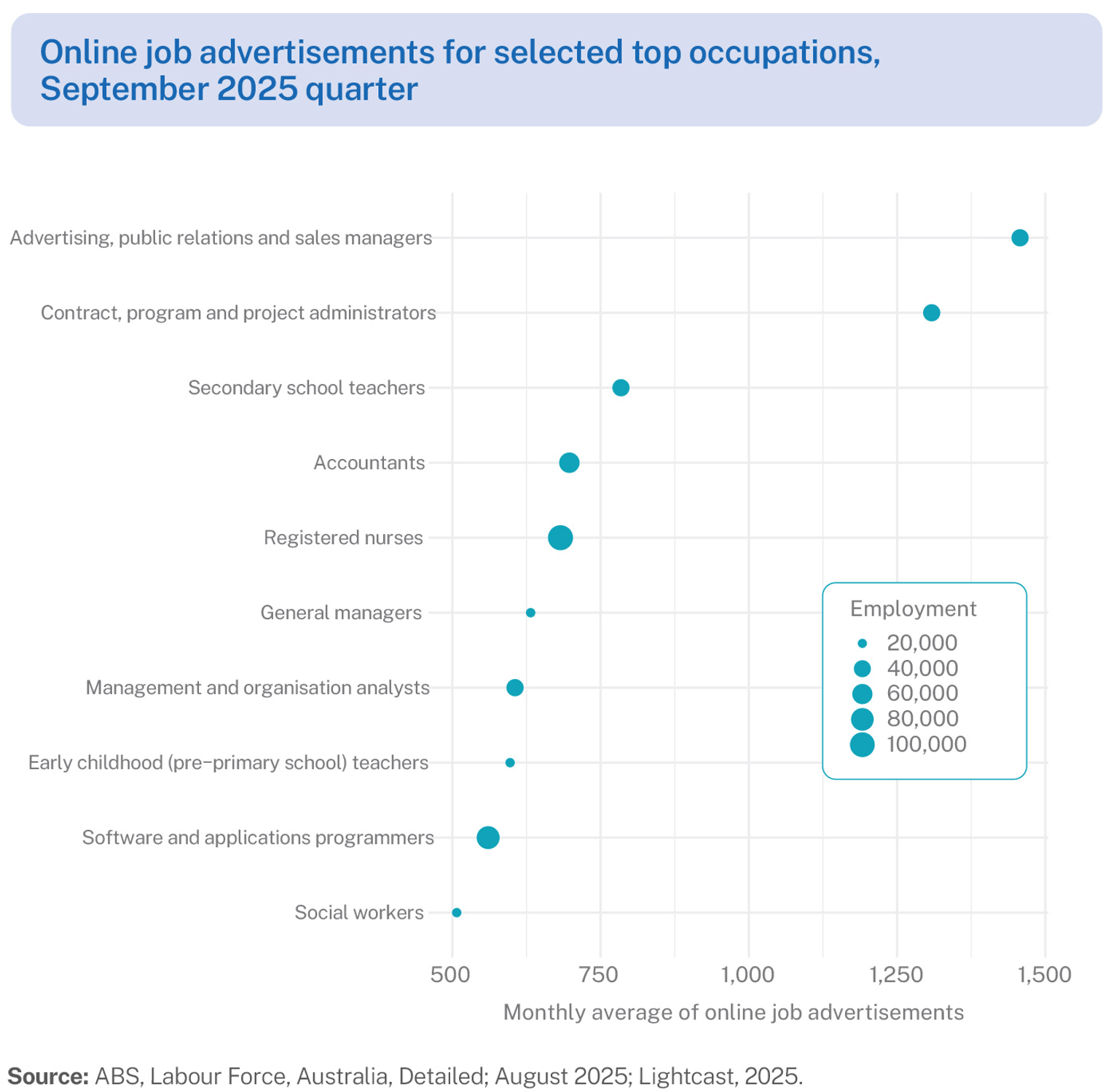
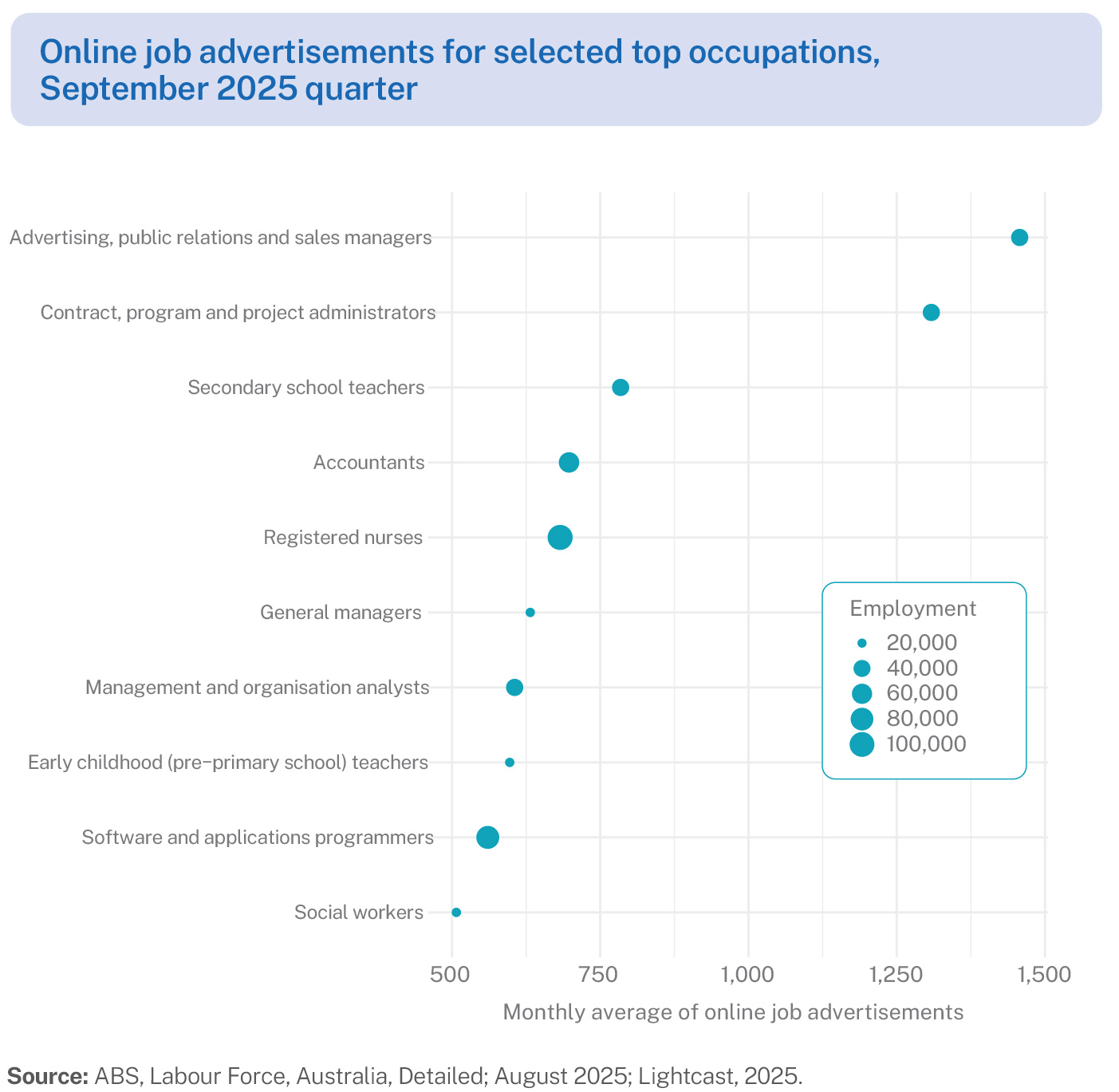
- Over the September 2025 quarter, advertising, public relations and sales managers (1,500 online job advertisements per month) and contract, program and project administrators (1,300 advertisements) were the most advertised occupations.
- In general, online job advertisements for professional occupations and occupations in the health and education sectors featured prominently among the top occupations advertised.
Online job advertisements for selected top occupations, September 2025 quarter
The number of applicants per job vacancy is increasing and employers are filling vacancies at a higher rate
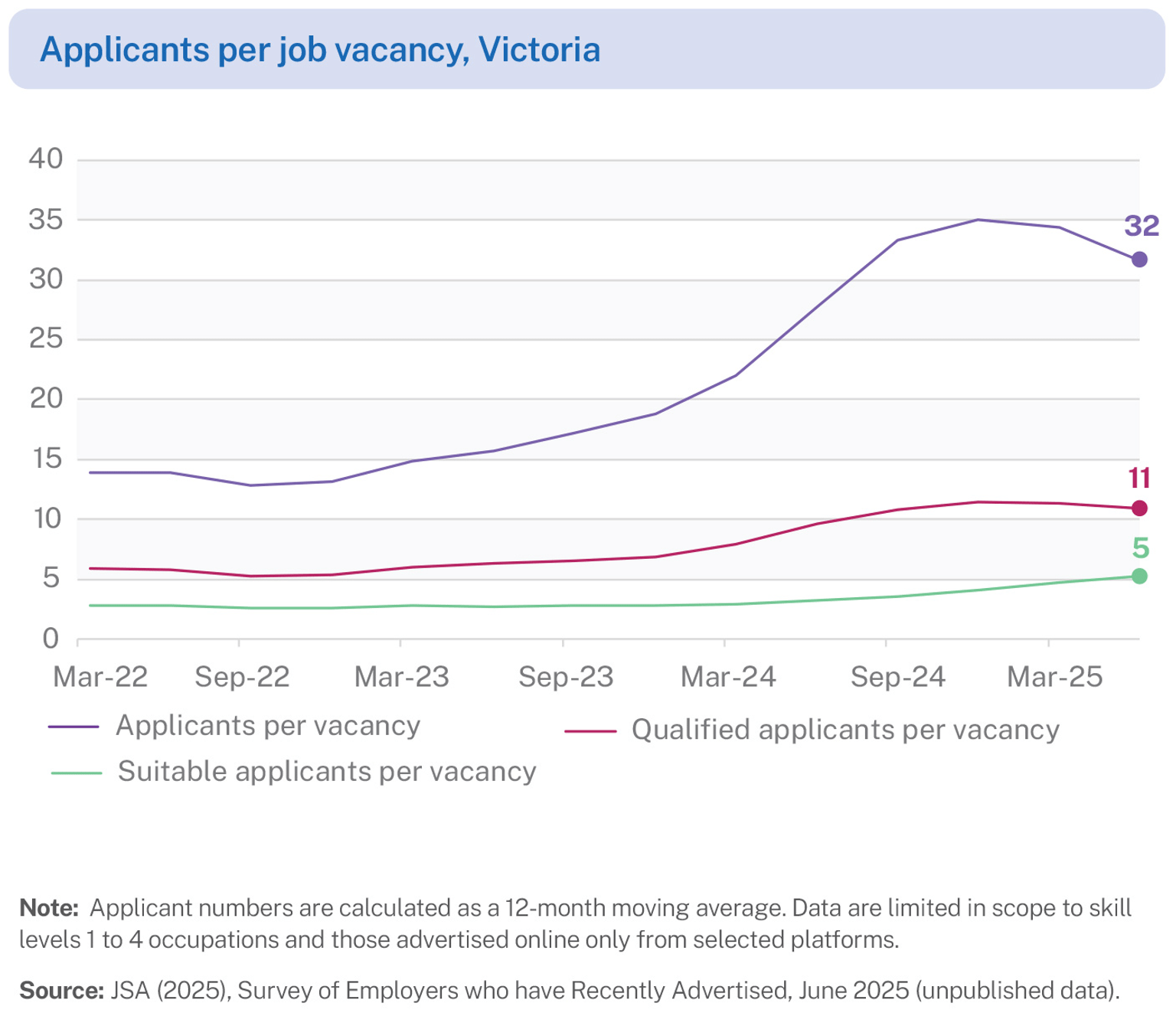
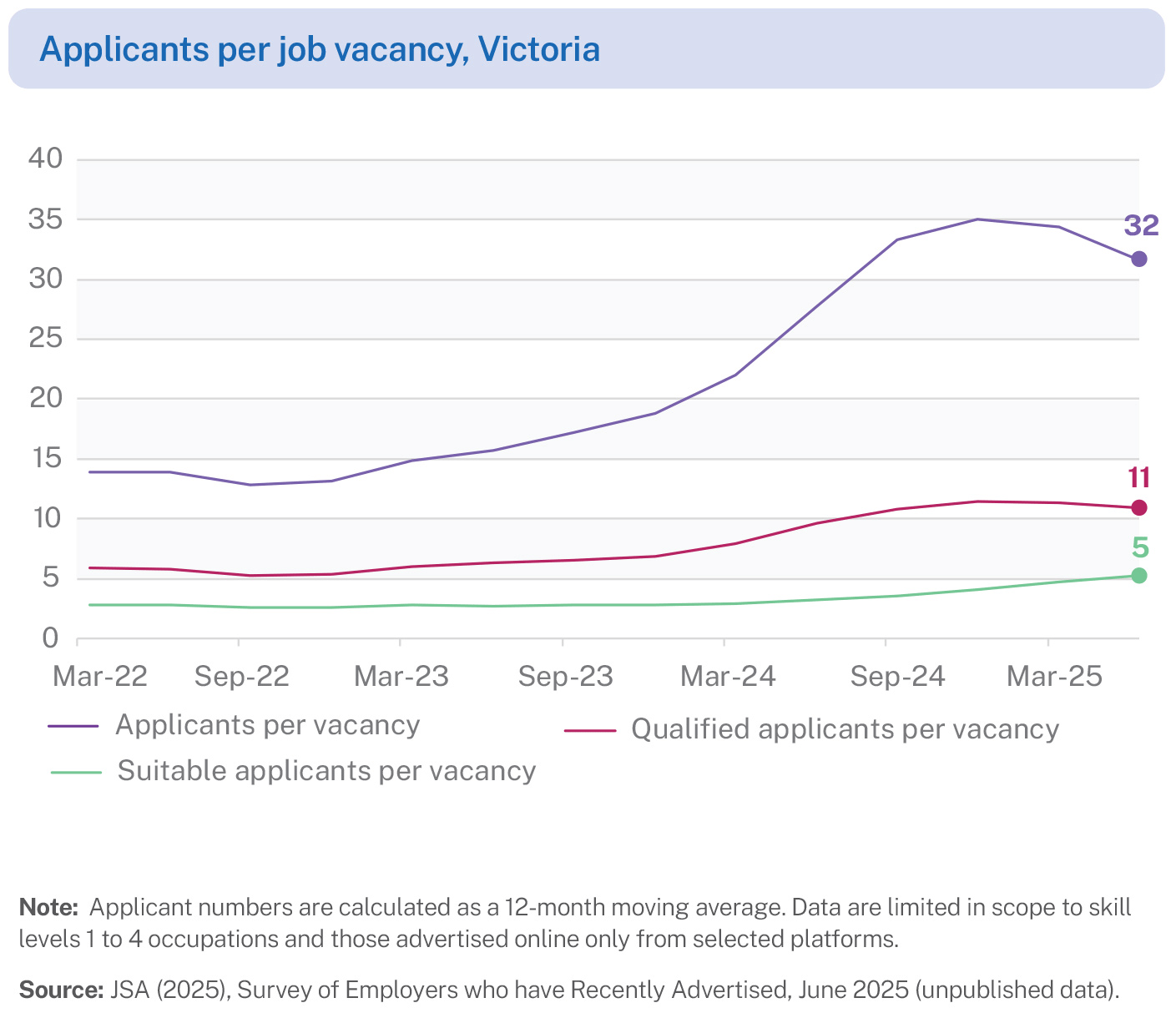
- While the number of applicants per vacancy in Victoria has fallen in recent quarters, it remains higher than in 2022, with 32 applicants per vacancy in June 2025 compared to 14 per vacancy in the first half of 2022.
- The number of qualified applicants (deemed by employers as having the right qualification for the job) per vacancy has increased over the same period. The number of suitable applicants (deemed by employers as suitable for the job) has also increased though not as quickly as the number of applicants per vacancy or qualified applicants per vacancy. This can indicate a skills mismatch, or that employers are being more selective during recruitment as they have a larger pool of applicants to choose from.
Applicants per job vacancy, Victoria
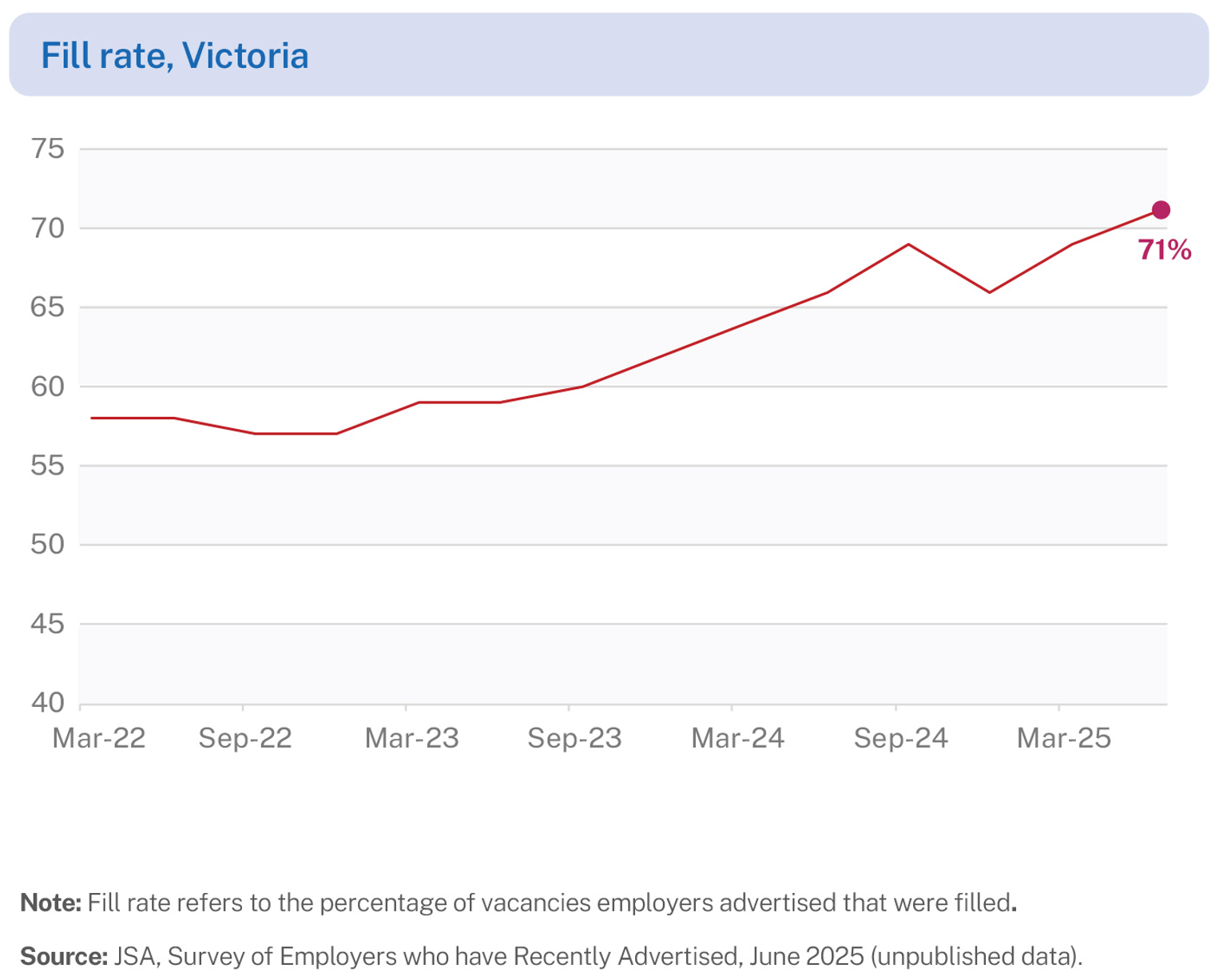
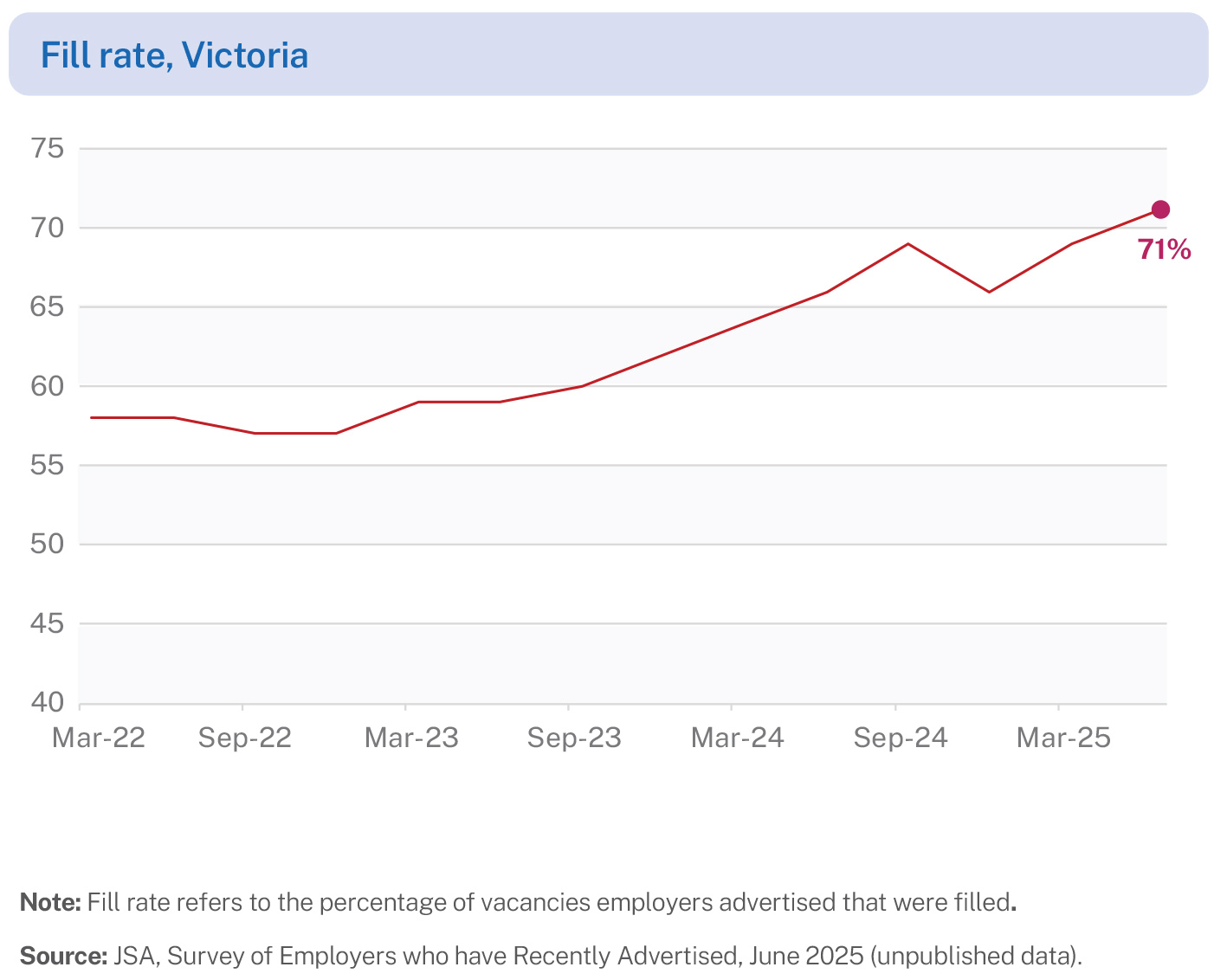
- The share of vacancies filled by Victorian employers has steadily increased over the past 3 years, with around 7 in 10 vacancies now filled.
Fill rate, Victoria
Employer demand for non-technical skills and specific digital skills is growing
- Non-technical skills include communication, problem solving and innovative thinking.
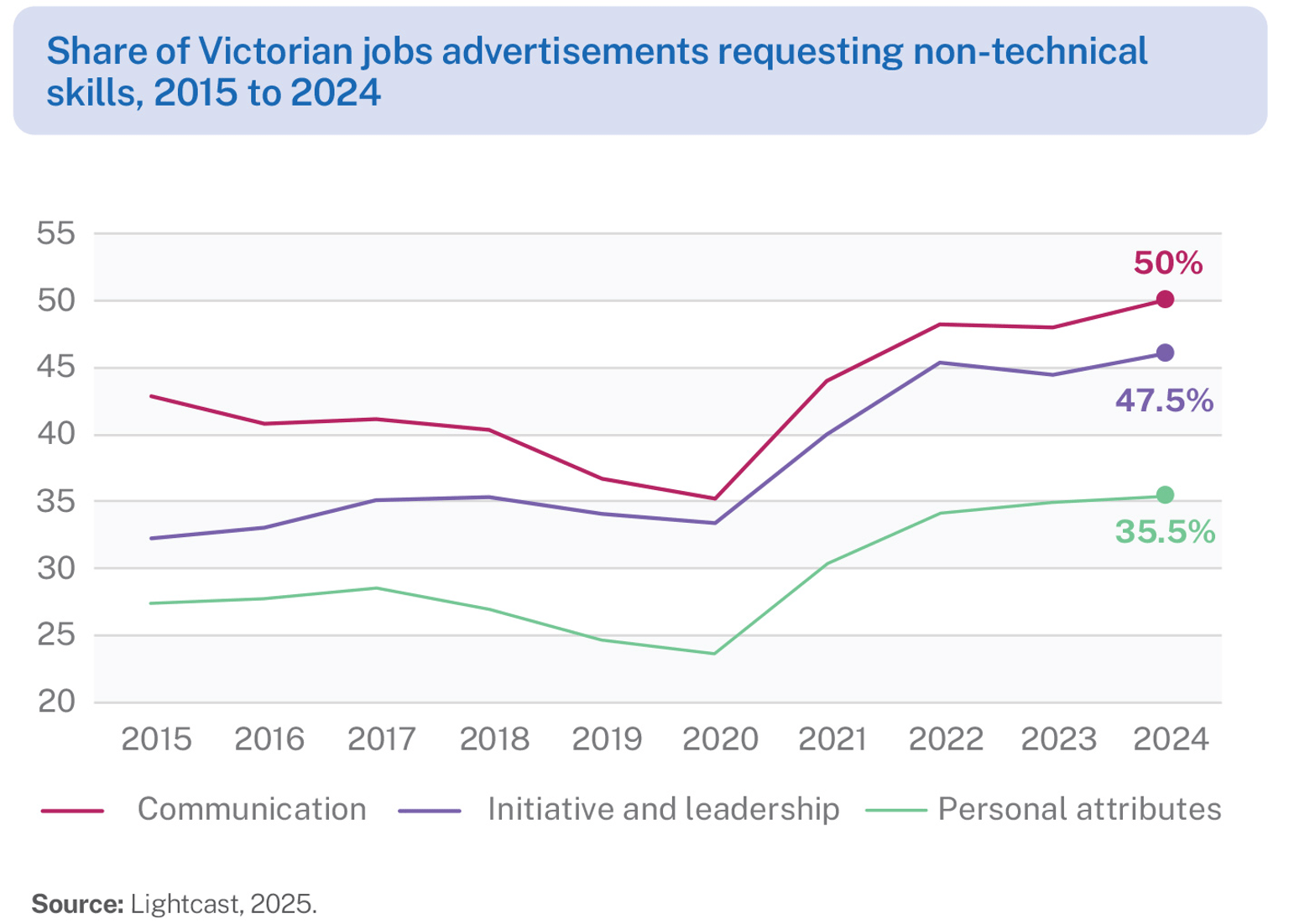
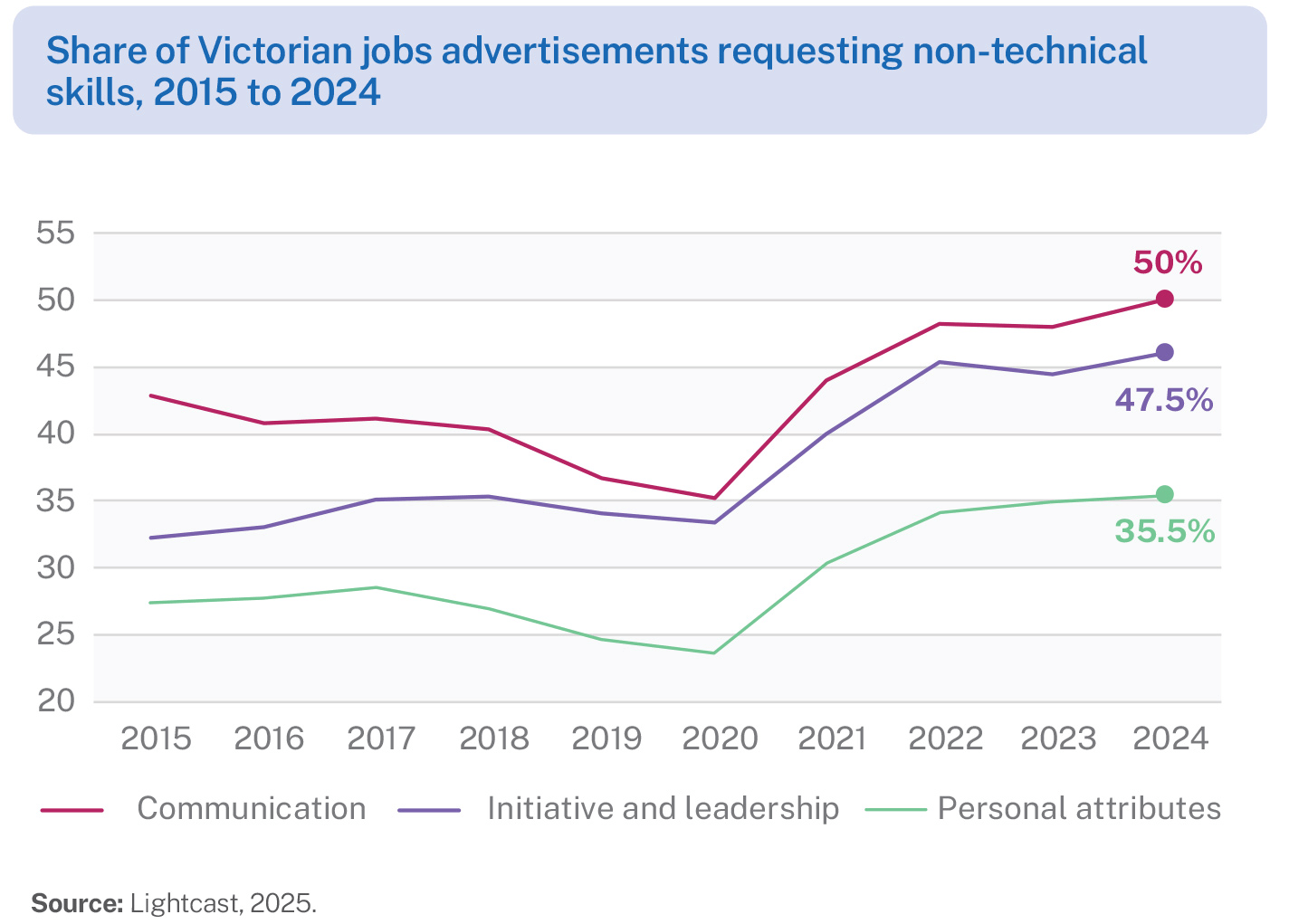
- The share of job advertisements requiring non-technical skills has been trending up since 2020. Around 73% of job advertisements require applicants to have at least one of the 3 non-technical skills shown on the right, with communication, and initiative and leadership skills most in demand.
Share of Victorian jobs advertisements requesting non-technical skills, 2015 to 2024
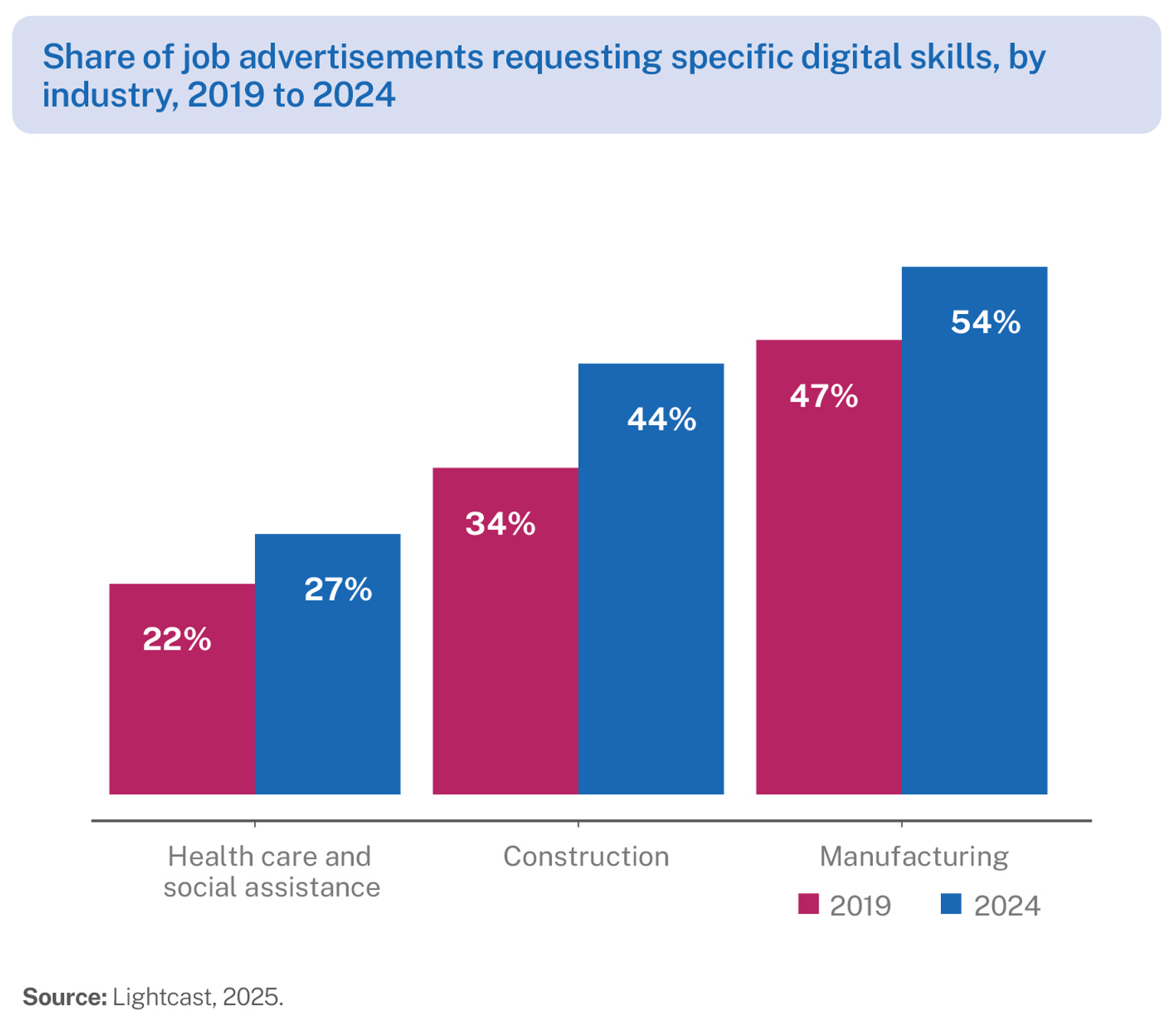
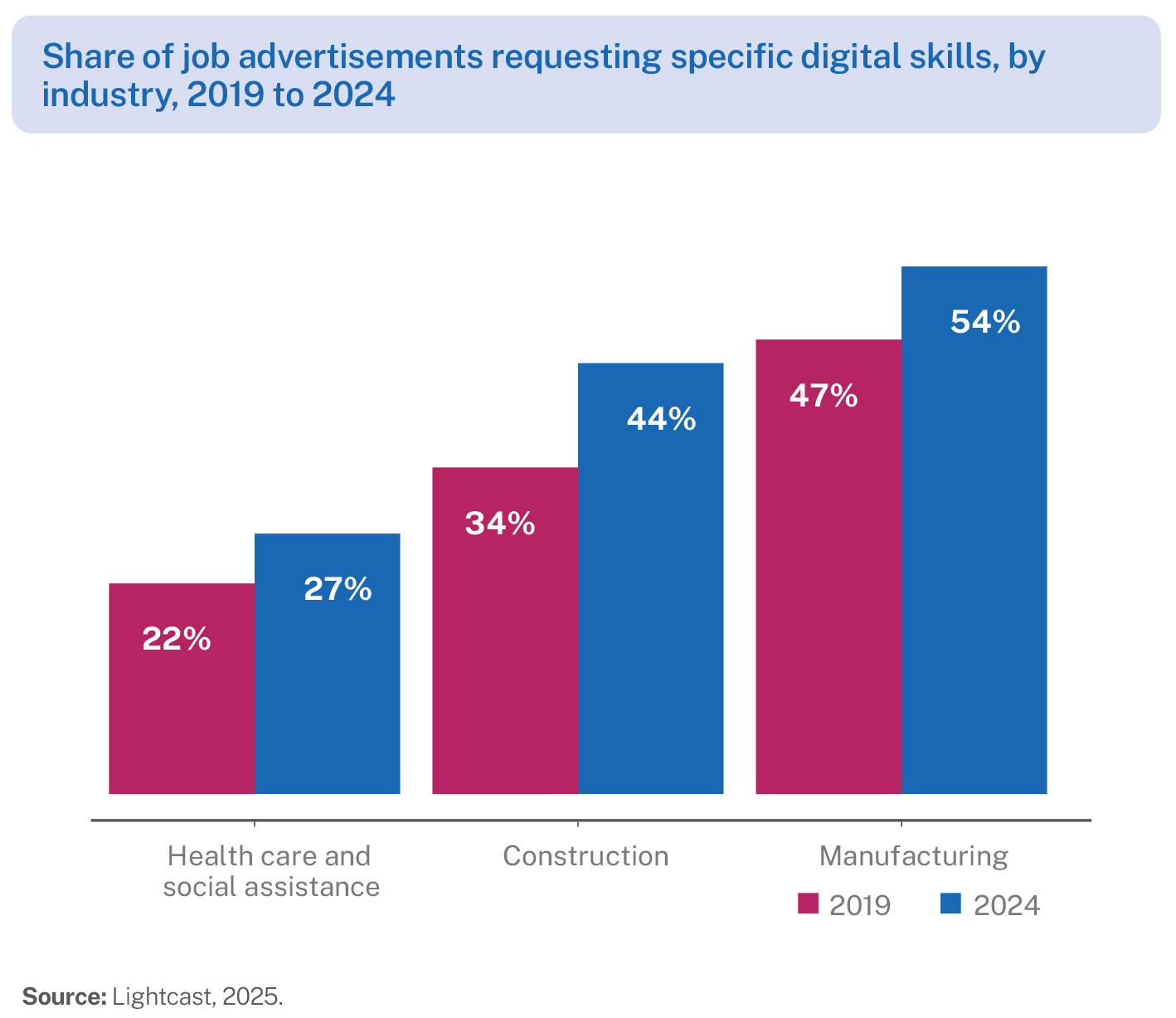
- Demand for specific digital skills, such as AI skills, data analysis, computer science and cybersecurity, has grown strongly across many industries. For example, the share of job advertisements requiring specific digital skills between 2019 and 2024 in:
- health care and social assistance has grown from 22% to 27% due to increased use of patient management systems
- construction increased from 34% to 44% as the use of project management and technical design software continues to grow
- manufacturing increased from 47% to 54% driven by strong demand for skills related to advanced manufacturing, such as data analysis, automation and systems engineering.
Share of job advertisements requesting specific digital skills, by industry, 2019 to 2024
New occupations are appearing in health care and across emerging sectors
- The Victorian Economic Growth Statement and Victorian Industry Policy identify growing sectors of the economy including digital technologies, circular economy, and health technologies and medical research. New types of jobs are emerging in these sectors.
- Jobs and Skills Australia’s 2024 Emerging Roles report identified a number of new and trending occupations appearing in the Australian job market. These occupations were sorted into sectors which broadly align with some of the priority sectors in the Victorian Economic Growth Statement and Victorian Industry Policy.
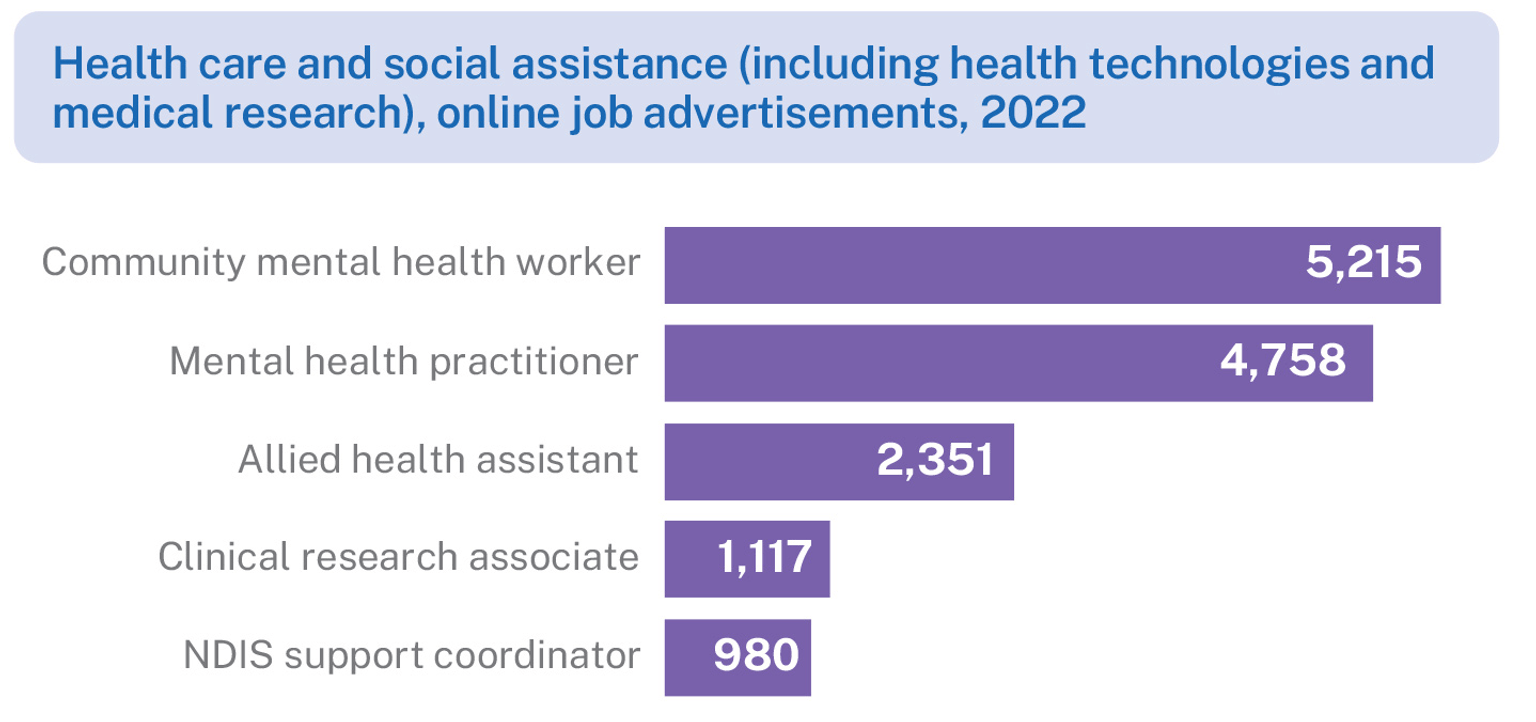
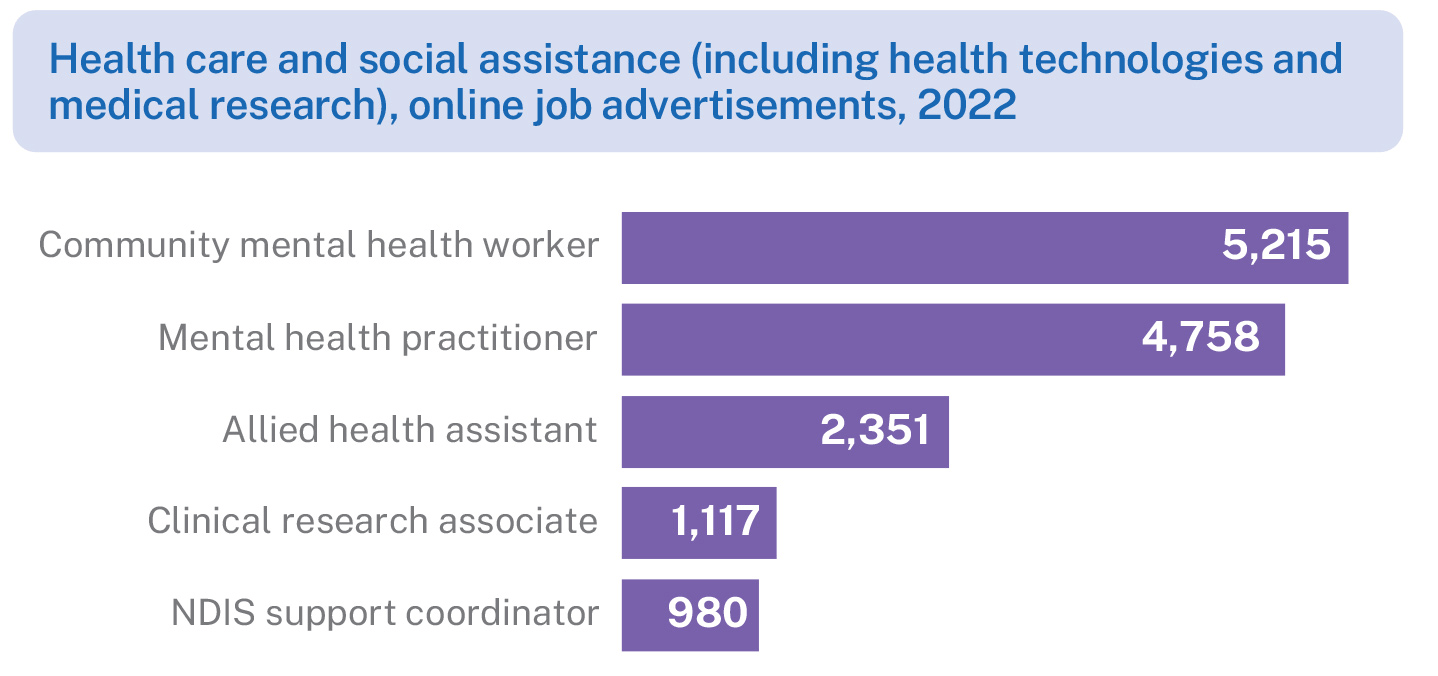
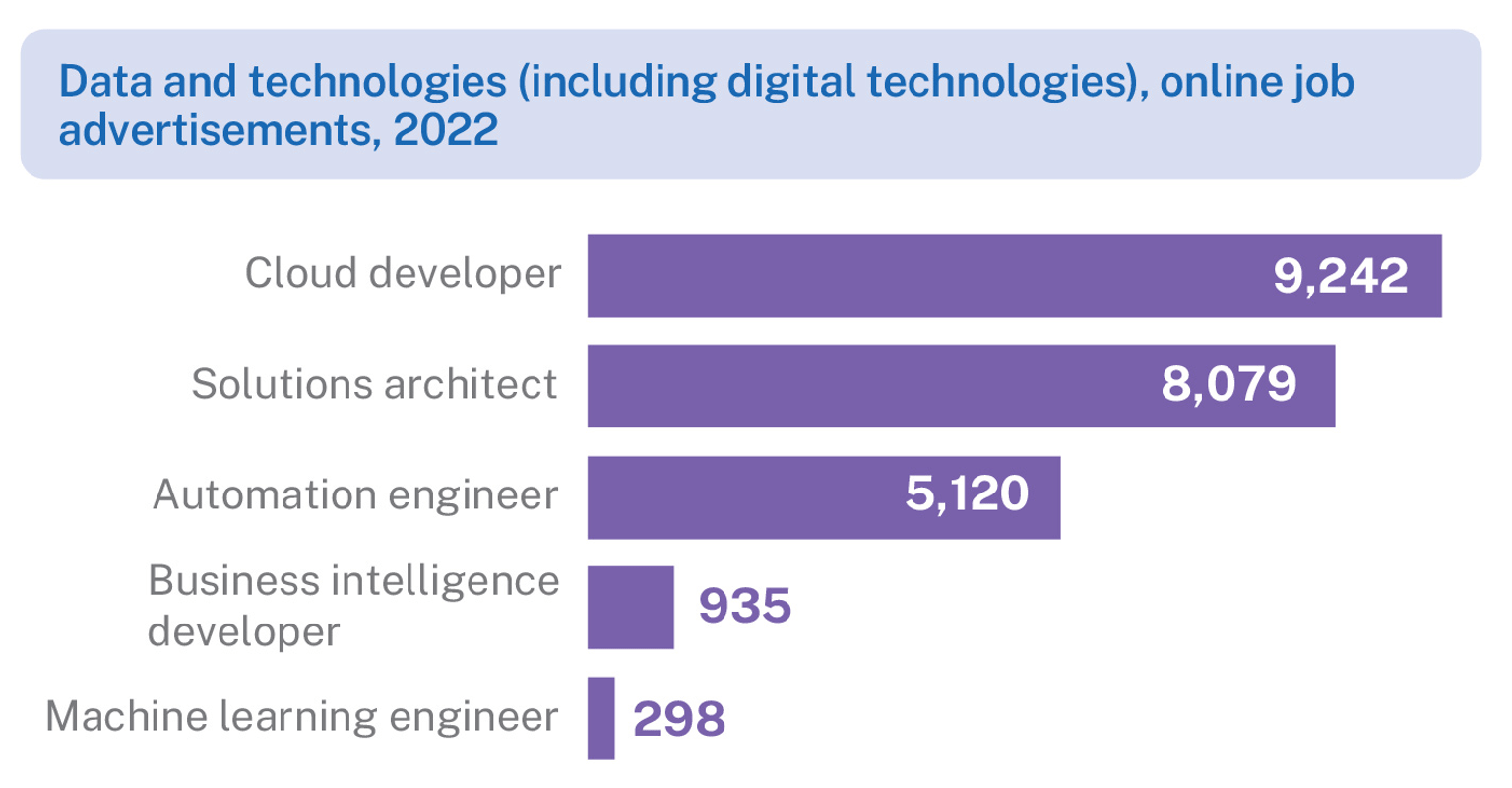
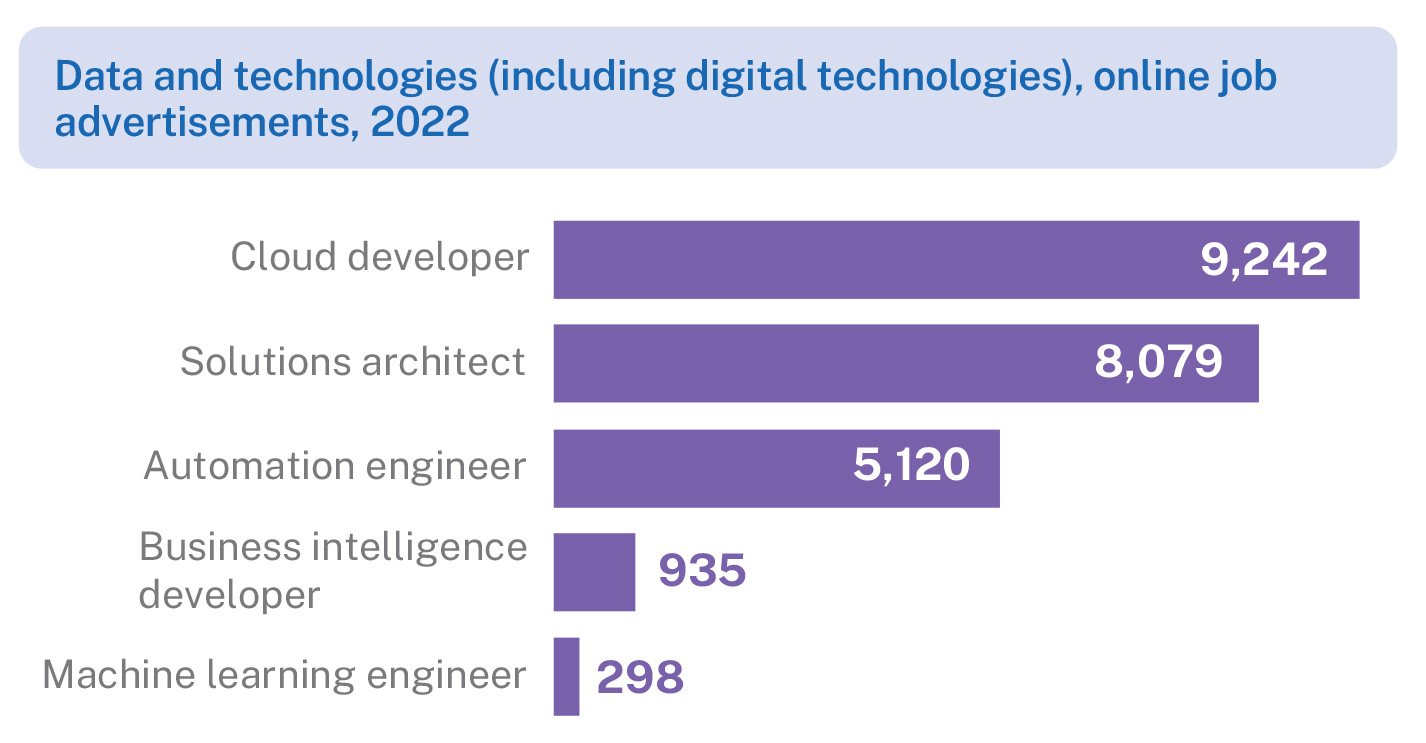
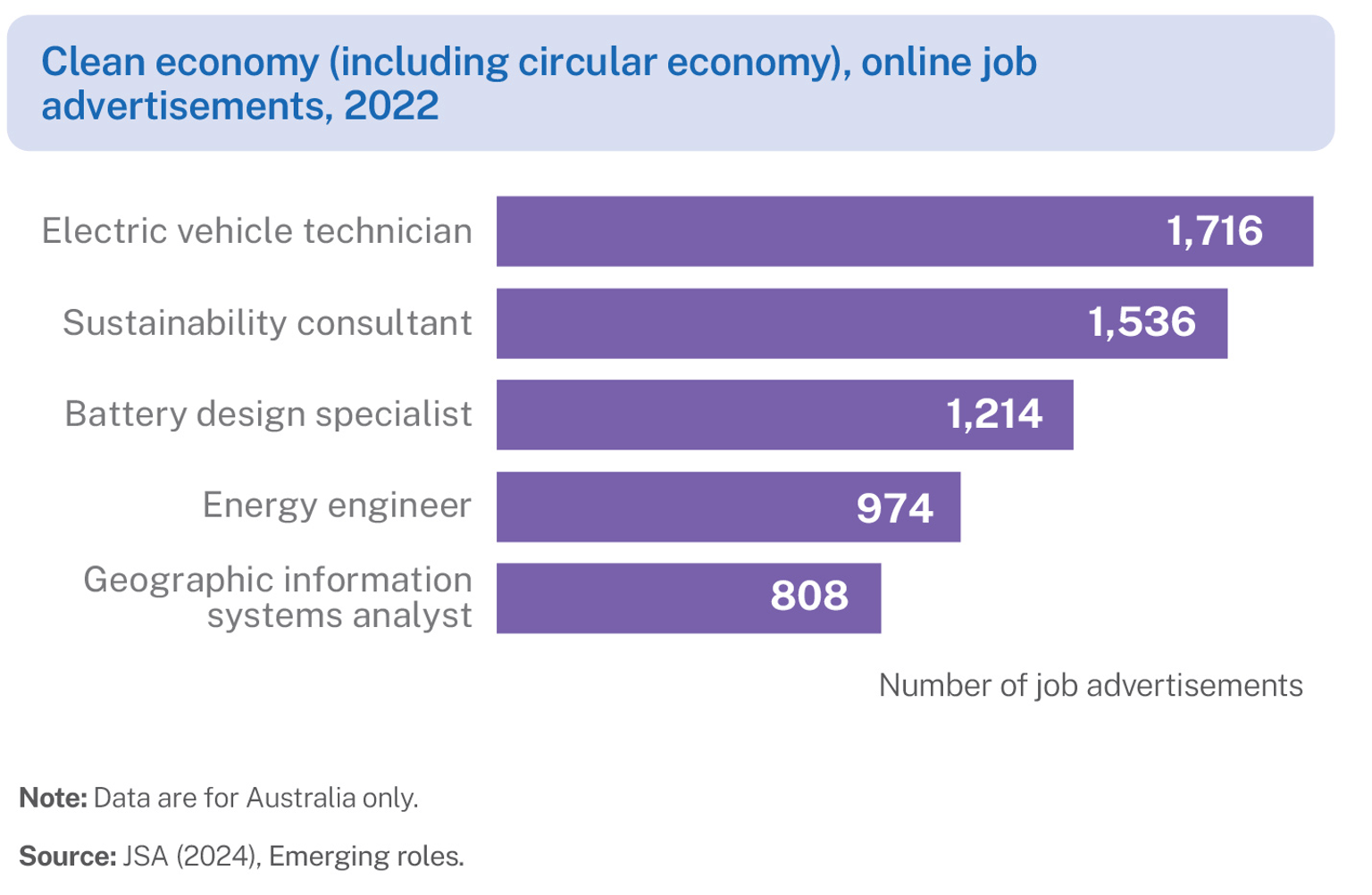
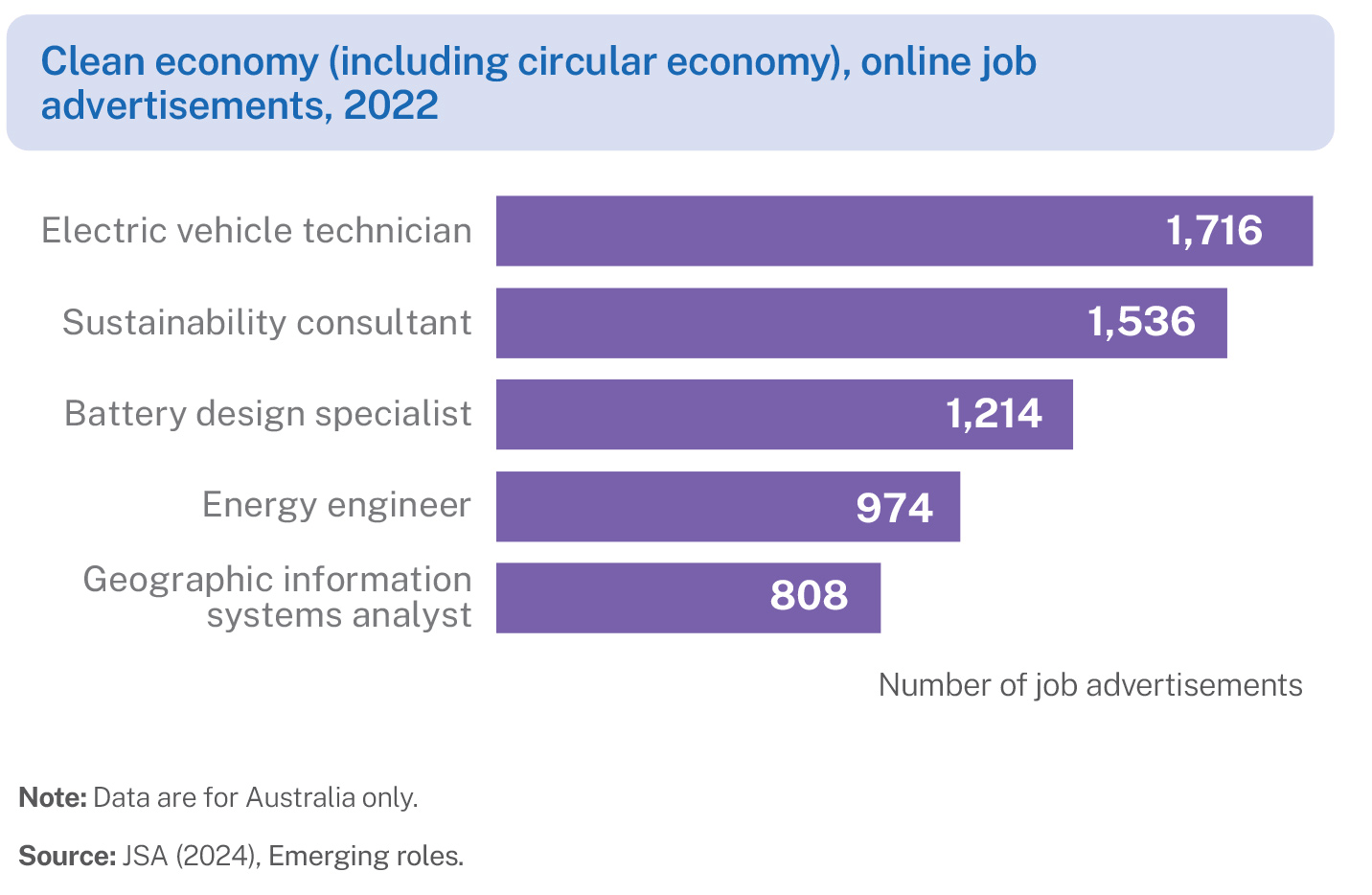
- Based on online job advertisements for 2022, the top 5 growing and emerging occupations in Victoria’s key sectors of health care, digital technologies and the clean economy are provided on this page.
Health care and social assistance (including health technologies and medical research), online job advertisements, 2022
Data and technologies (including digital technologies), online job advertisements, 2022
Clean economy (including circular economy), online job advertisements, 2022
Employment projections
Key points
- Around 373,000 new workers are expected to enter the Victorian workforce by 2028 and 1.5 million new workers by 2035.
- Approximately 87% of new workers in the coming decade will need a post-secondary school qualification, including 49% expected in occupations aligned with a VET qualification and 38% in occupations aligned with higher education.
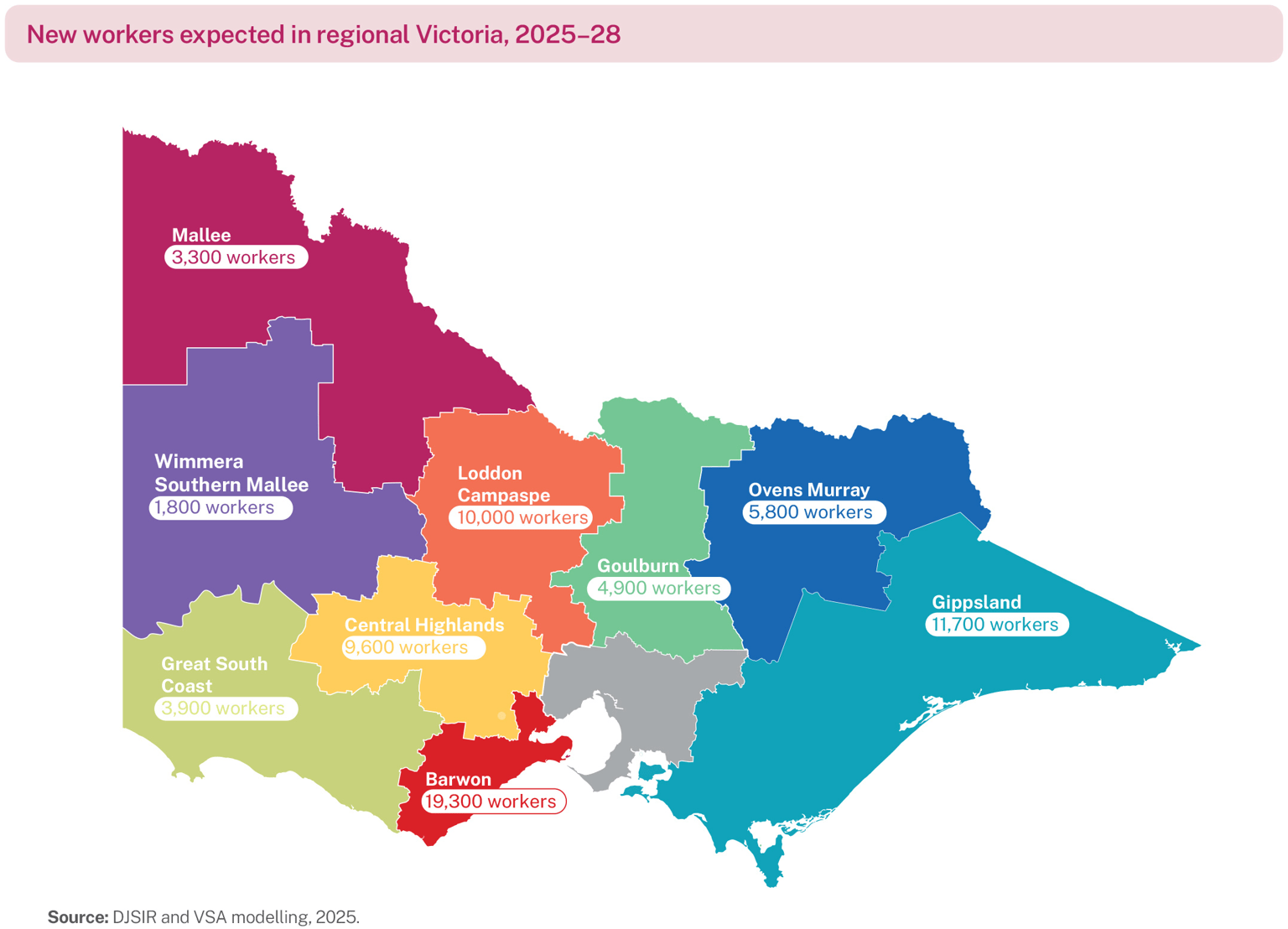
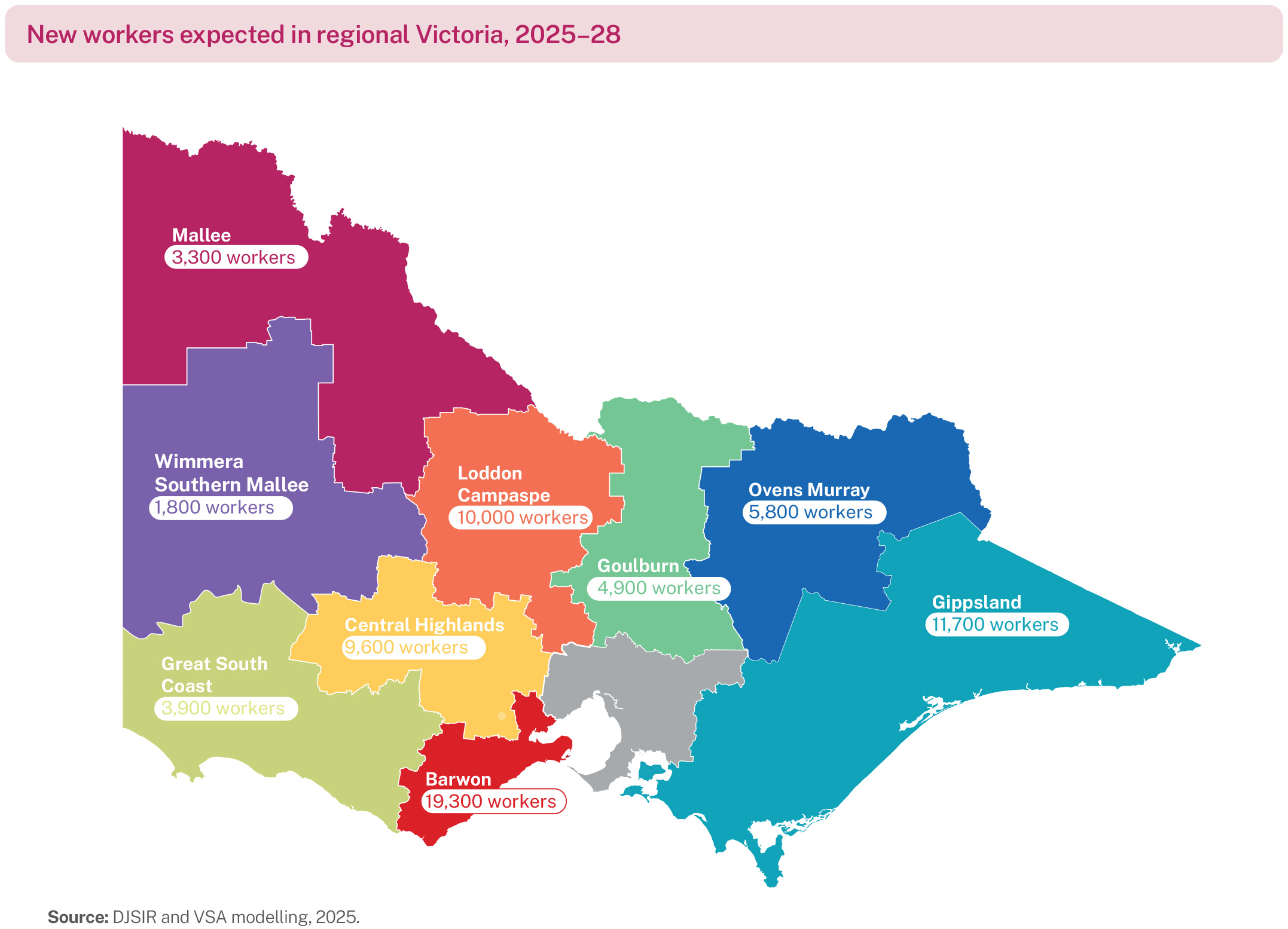
- Regional Victoria is expected to account for 70,000 (or 19%) of new workers over 2025–28, with Barwon and Gippsland leading the growth.
Industries and occupations
- Health care and social assistance and construction are expected to lead workforce growth. Over 40% of new workers are expected in jobs within these industries over 2025–28.
- Occupations in demand include ageing and disability carers; registered nurses; carpenters and joiners; construction managers; and plumbers.
- The Victorian Economic Growth Statement identifies sectors of the economy where workforce needs are changing and new occupations are emerging. For example, over 2025–28:
- 19,300 new workers are expected in the digital technologies sector. Software and applications programmers are in high demand and occupations such as cloud developers and solutions architects are emerging.
- 5,400 new workers are expected in agriculture, forestry and fishing, with agribusiness earmarked as a growing sector. Agriculture and agritech technicians and agricultural consultants are emerging occupations.
- 2,200 new workers are expected in advanced manufacturing. In-demand occupations include production managers and emerging occupations include robotics engineers.
Around 373,000 new workers are expected to enter the Victorian workforce over the next 3 years
Projections of employment growth and retirements provide an estimate of how many workers will enter the labour market and fill jobs.
Employment growth + Retirements = New workers expected
Employment growth
- The projected change in employment between years in an industry, occupation or region.
- Benchmarked to the Victorian Department of Treasury and Finance's budget forecasts of total employment and the Victoria in Future population projections.
Retirements
- Refers to the number of workers over 50 years of age projected to leave the workforce based on estimates of retirement rates using linked ATO income tax data and longitudinal census data from the ABS Person Level Integrated Data Asset (PLIDA).
- Retirements are included on the basis that they leave positions which will need to be filled.
New workers expected
- New workers expected is an estimate of how many workers will enter the workforce across industries, occupations and regions.
- New workers fill new jobs being created (employment growth) and replace those who leave the workforce (retirements).
The Victorian workforce is expected to add:
- 373,000 new workers over the next 3 years to 2028
- 1,454,000 new workers over the next 10 years to 2035.
Source: Victorian Department of Jobs, Skills, Industry and Regions (DJSIR) and VSA modelling, 2025.
Most new workers will need to have a VET or higher education qualification
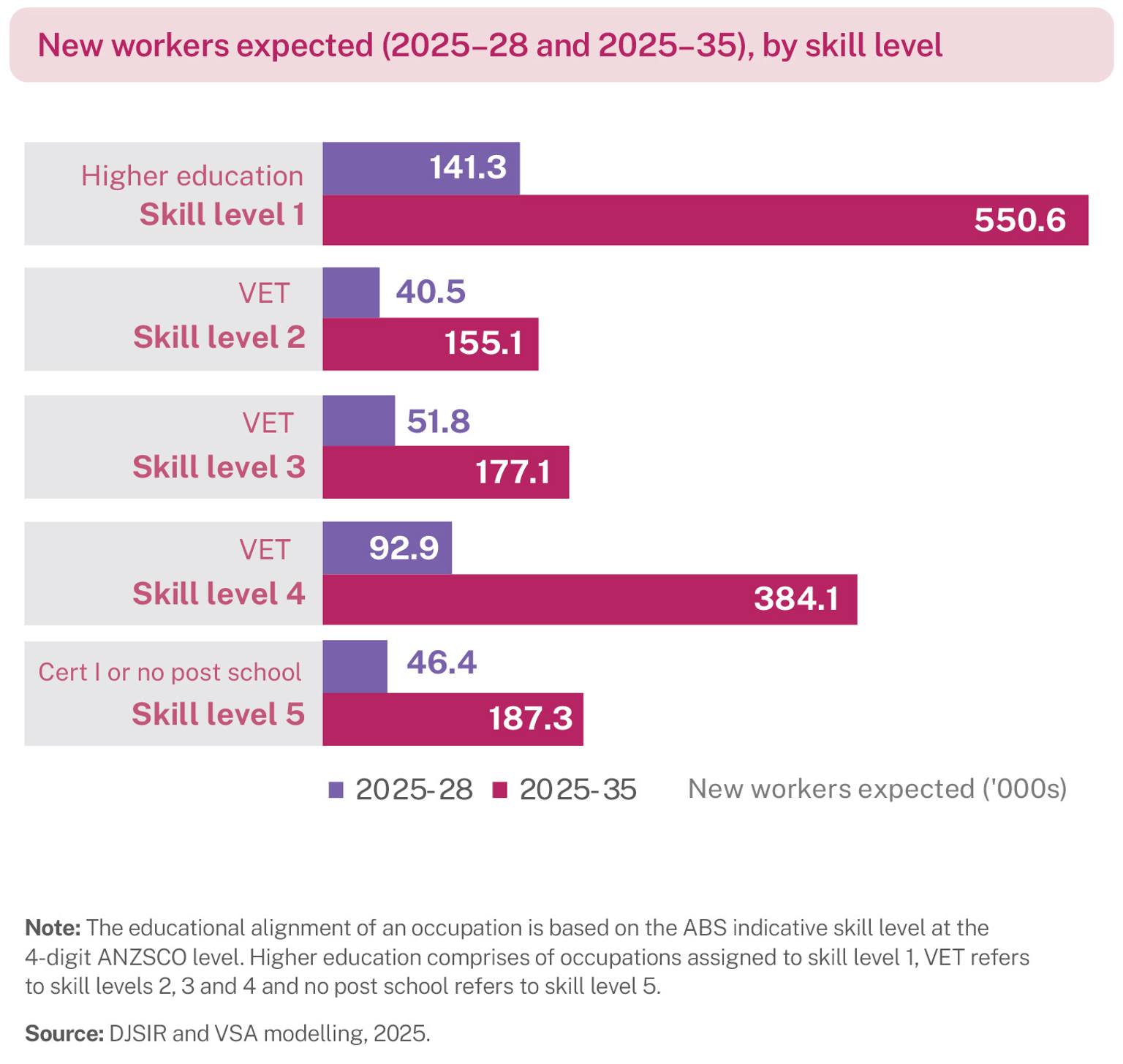
- Over the next 3 years (2025–28), around 50% of all new workers (or 185,700 new workers) are expected in occupations aligned with a VET qualification.
- Around 38% of new workers (or 141,300 new workers) are expected in occupations that are aligned with a higher education qualification.
- Over the longer-term, approximately 87% of new workers in the next decade are expected to enter occupations which require a post-secondary school qualification (VET or higher education). This includes 49% expected in occupations aligned with a VET qualification and 38% in occupations aligned with higher education.
New workers expected (2025–28 and 2025–35), by skill level
Health care and social assistance, and construction, are expected to have the highest workforce growth over the next 3 years
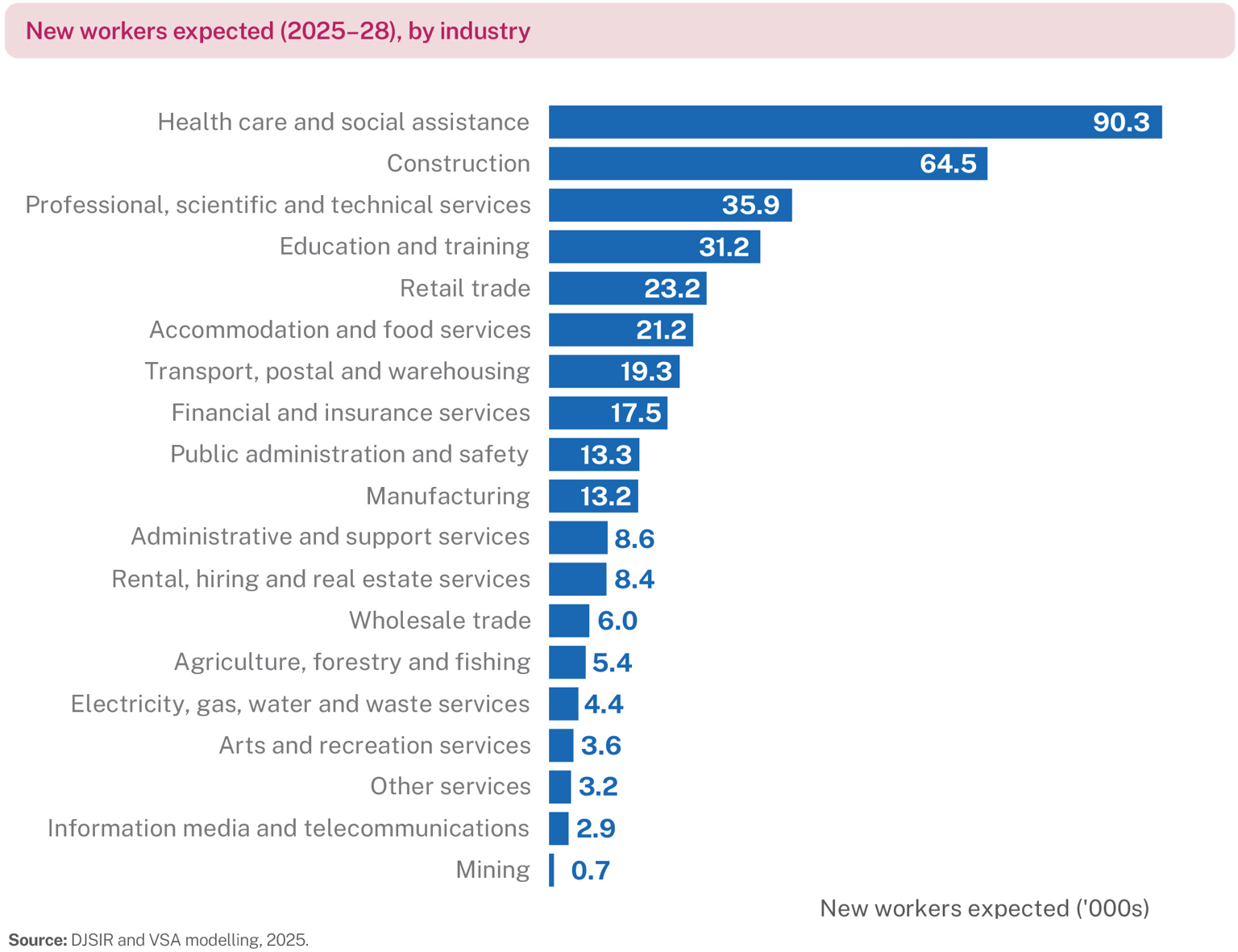
- In terms of new workers expected, health care and social assistance and construction are Victoria’s highest growth industries.
- Together, both industries account for around 42% of new workers expected over 2025-28.
New workers expected (2025–28), by industry
- Priority sectors identified in the Victorian Economic Growth Statement and Victorian Industry Policy will also see workforce growth over 2025-28. For example:
- 19,300 new workers are expected to work in the digital technologies sector, with in-demand occupations including software and applications programmers and ICT managers. Technological advances are also driving growth in emerging occupations such as cloud developers, solutions architects (who help businesses adapt to new technologies, methodologies and best practices) and automation engineers.
- 5,400 new workers are expected in agriculture, forestry and fishing, including in agribusiness. Agriculture and agritech technicians and agriculture consultants are emerging as important occupations in this sector.
- 2,200 new workers are expected in advanced manufacturing, including in occupations such as industrial, mechanical and production engineers and emerging occupations such as robotics engineers.
Occupations in highest demand are mostly in the care economy and construction
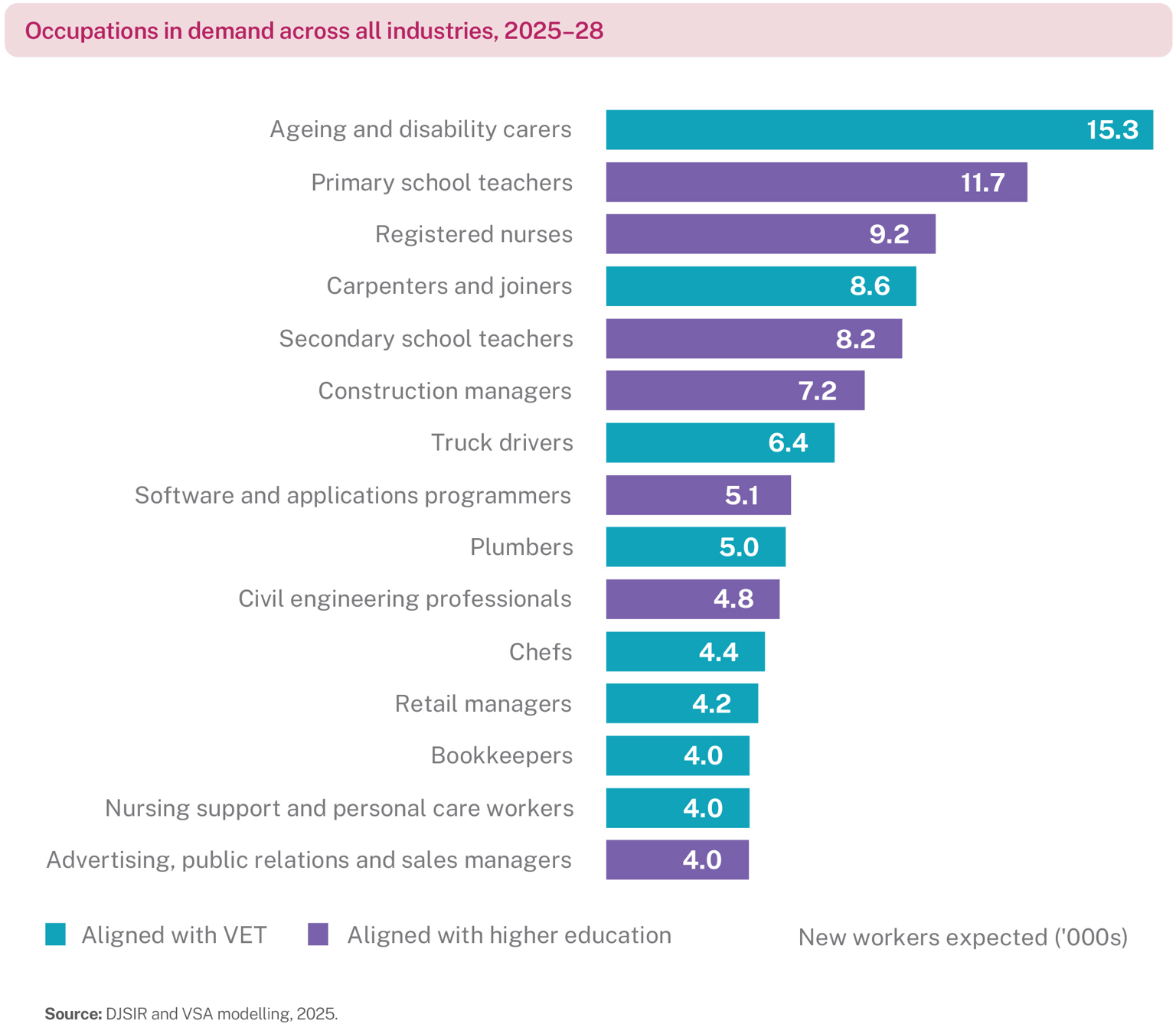
- Across all industries, ageing and disability carers (15,300 new workers expected), registered nurses (9,200), carpenters and joiners (8,600), and construction managers (7,200) are among the occupations most in demand.
- Many occupations in demand generally require a VET qualification.
Occupations in demand across all industries, 2025–28
Around 303,000 new workers are expected across metropolitan Melbourne
- Metropolitan Melbourne accounts for around 80% of all new workers expected to enter the Victorian labour market over the next 3 years.
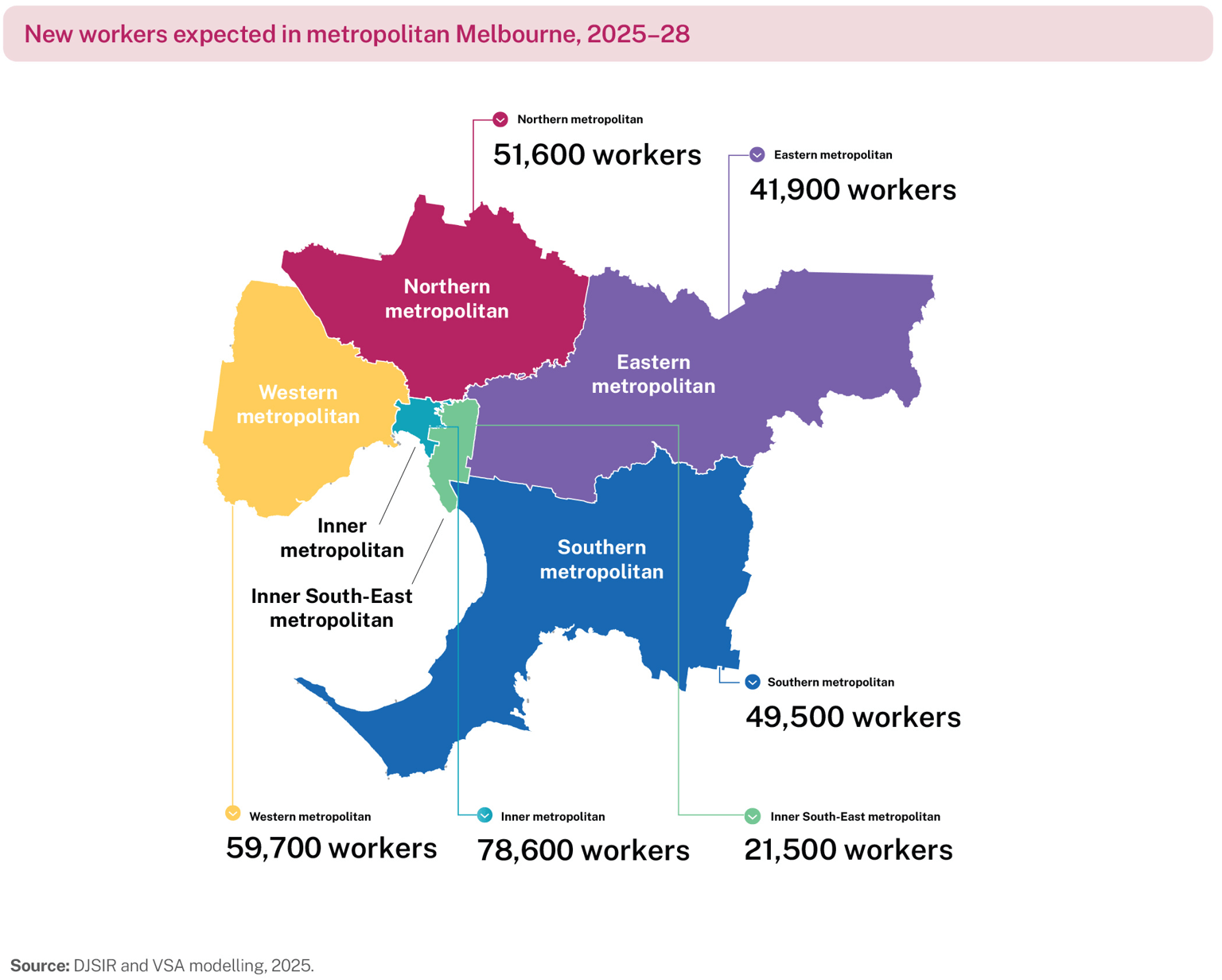
- The inner and western metropolitan areas are expected to account for the highest proportion of new workers.
- Health care and social assistance, construction and professional service industries are the highest growth industries in metropolitan Melbourne.
Top occupations in demand
| Occupation | New workers expected |
|---|---|
| Ageing and disability carers | 10,900 |
| Primary school teachers | 9,000 |
| Registered nurses | 7,100 |
| Carpenters and joiners | 6,700 |
| Secondary school teachers | 6,300 |
New workers expected in metropolitan Melbourne, 2025–28
Around 70,000 new workers are expected across regional Victoria
- Geelong in Barwon is a centre for advanced MedTech manufacturing and research and Gippsland is a clean energy and agribusiness hub. These two regions are expected to lead regional workforce growth, representing almost 45% of new workers expected across regional Victoria.
- Similar to metropolitan Melbourne, occupations related to health care and social assistance, and education and training are also in high demand across regional Victoria.
- In regional Victoria, occupations in demand also include those relating to the agriculture, forestry and fishing industry, such as livestock farmers and mixed crop and livestock farmers.
Top occupations in demand
| Occupation | New workers expected |
|---|---|
| Ageing and disability carers | 4,300 |
| Livestock farmers | 2,900 |
| Primary school teachers | 2,700 |
| Mixed crop and livestock farmers | 2,400 |
| Registered nurses | 2,100 |
New workers expected in regional Victoria, 2025–28