What was a rural school
You might think a rural school is simply a school in the country. That is true, but between 1869 and 1873 the term 'rural school' meant something specific. It referred to a type of country school that had its own funding rules and its own numbering system.
The challenge of small communities
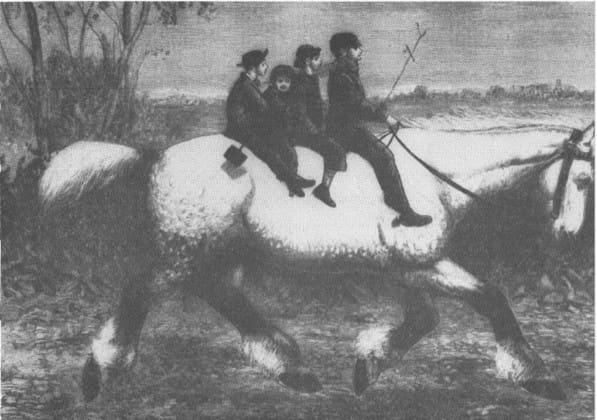
During the 1860s, schools could only receive funding if they guaranteed at least 20 students in regular attendance. This was difficult for remote areas with fewer children.
Debates about how to educate small, rural populations reflected wider arguments about public education at the time. Some people believed that wealthy landowners (squatters) should provide education for their staff's children.
Others suggested different solutions, including:
- 'dame' schools (see the history of school types)
- itinerant teachers who travelled between properties; teaching for a day before moving on
- boarding schools, where children lived and studied away from home.
Funding and rules
In 1868 the Board of Education proposed to fund teacher salaries at rural schools. Communities, however, had to provide the buildings and the furniture themselves.
- Full-time schools needed an average attendance of 15 students.
- Half-time schools needed 10 students at each school.
Because these schools were not part of the common school system in place at the time, they were given their own numbering sequence. See the rural schools list.
Tied to land settlement
Inspector John Elkington observed that rural schools often followed new settlements created by the Land Selection Acts, which allowed small farmers to take up land. He noted that many rural schools lasted only about 18 months before either closing, or becoming common schools.
He praised them as “the advance guard of education, pioneering the way through a very jungle of ignorance …”1
This type of rural school ended in 1873, when the new Education Act made education compulsory for all children regardless of financial means or location.
Identifying rural schools
If you are researching a school, check the rural schools list.
The book Vision and Realisation often records if a school began as a rural school, sometimes giving its original rural number.
Many rural schools later became common schools and then state schools.
Rural education after the 1872 Education Act
After the Education Act of 1872, education became compulsory for all children under 16 years. Education in rural areas was provided by state schools. But these schools continued to face challenges of distance, small enrolments, and poor facilities.
Historian Sarah Mirams shows this in her description of Mallacoota State School No. 3515 in the early 1900s. The children studied in a shed with broken, rotting floorboards. Their teacher was in charge of 3 schools and rowed 24 kilometres between Mallacoota and Genoa every few days.2
By the 1920s, 83% of Victorian schools were one-teacher schools. Discussions about merging small schools began as early as 1902. But it was not until the mid century that the first consolidated schools and group schools appeared.
- Consolidated schools operated between 1944 and 1958. They required at least 200 students, with buses transporting children from surrounding areas.
- Group schools were similar but had fewer than 200 students and only taught children up to the age of 14.
Both types of schools had disappeared by the late 1960s.
Rationalisation and closures
Improvements in roads, transport, and car ownership made it easier to consolidate schools. Large numbers of schools closed or merged in the early 1990s.
Footnotes
- Vision and Realisation, Volume 1, page 135.
- Tired Little Australian Children Are Still Plodding Unnecessary Miles in Wet and Shine in the Public Record Office Victoria publication Provenance
Updated