This article draws on information contained in ACECQA’s information sheets on Quality Area 5.
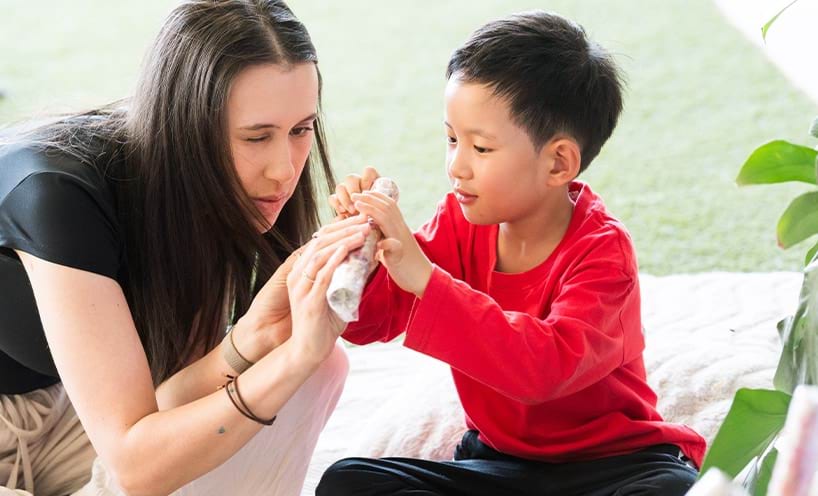
The relationships between educators and children are crucial for children’s social and emotional development. Warm, respectful, emotionally available educators set the foundations for secure relationships to grow between children and educators. Children who experience secure relationships with their educators demonstrate increased empathy, greater self-esteem and better relationships with peers and teachers. Learn more about supporting children to regulate their own behaviour.
Educators can be important role models for children at all ages, supporting them to learn about their emotions and how to regulate their own behaviours. In this way children can learn to understand others’ feelings, be respectful and considerate.
The National Quality Standard (NQS) underlines the importance of this role in Quality area 5:
- 5.1 – Respectful and equitable relationships are maintained with each child
- 5.1.1 – Responsive and meaningful interactions build trusting relationships which engage and support each child to feel secure, confident and included
- 5.2 – Each child is supported to build and maintain sensitive and responsive relationships
- 5.2.2 – Each child is supported to regulate their own behaviour, respond appropriately to the behaviour of others and communicate effectively to resolve conflicts.
Importantly, poor interactions between educators and children can have the opposite effect, impacting children’s ability to learn and grow emotionally in a healthy way. Children’s behaviours can become more challenging, leading to other problems. Positive guidance for children to move them towards acceptable behaviours, rather than harsh or inappropriate discipline is needed.
Read more about the regulatory requirements and responsibilities for approved providers under the National Law and National Regulations. This includes the offence of inappropriate discipline, as well as a reminder to follow the Early Childhood Australia Code of Ethics.
How can you support children?
The Circle of Security classroom model creates a helpful visual map to guide how educators can respond to children’s needs, and to be both:
- recognising that behaviour represents a child’s underlying emotional state and relationship needs.
- separating the child’s identity from their behaviour to hold a positive view of the child even when behaviours may be challenging to respond to.
- offering more closeness, support and help when children are expressing strong emotions or engaging in challenging behaviours.
- prioritising safety and connection over learning in stressful or emotionally charged moments.
- understanding the possible impact of trauma, and implementing strategies to support children who may be exhibiting fight, flight or fear responses or behaviours.
- supporting the development of new skills when a child is calm and engaged.
- being aware of your own needs for regulation and support. Notice if need to take a break to calm down, before you can go back to the floor.
Learn about other ways to support children to regulate their own behaviour including information about:
- involving families
- links to access additional support
- critical reflections about professional practice and the service environment
- using intentional strategies to guide educator interactions
- empowering children.
Case studies to prompt reflection and discussion
Read about how other services have approached improving their interactions between educators and children.
These case studies include long day care, family day care and outside school hours care: Case studies supporting Quality Standard 5.1 and 5.2.
How can services support staff to support children?
To succeed in this important role, educators need the support of providers and service management.
Working through times of great change can create additional stress for educators and teams, so improving educator child interactions has two parts:
- supporting educator and team wellbeing so they can be present for children, and
- additional professional development or mentoring for staff to uplift their skills.
Resources
Read more and find links to additional support:
- Guide to the National Quality Standard – Quality Area 5
- Relationships with children – Quality Area 5 information sheet
- Supporting children to regulate their own behaviour – Quality Area 5 information sheet
- Supporting educator wellbeing through these challenging times - Quality Area 5 information sheet
- Planning and strategies to promote positive behaviour (5-12 years)
- Resources relating to Quality Area 5 – links to additional reading
- Circle of Security classroom approach
Updated