The MARAM Framework is Victoria’s legislated policy for best practice of family violence risk assessment and management.
It ensures consistent, collaborative and evidence-based responses across service sectors.
It supports professionals and organisations to identify, assess and manage family violence risk.
This improves safety and wellbeing for victim survivors, including children and young people. It also promotes accountability for perpetrators.
Figure 4: MARAM Framework on a page
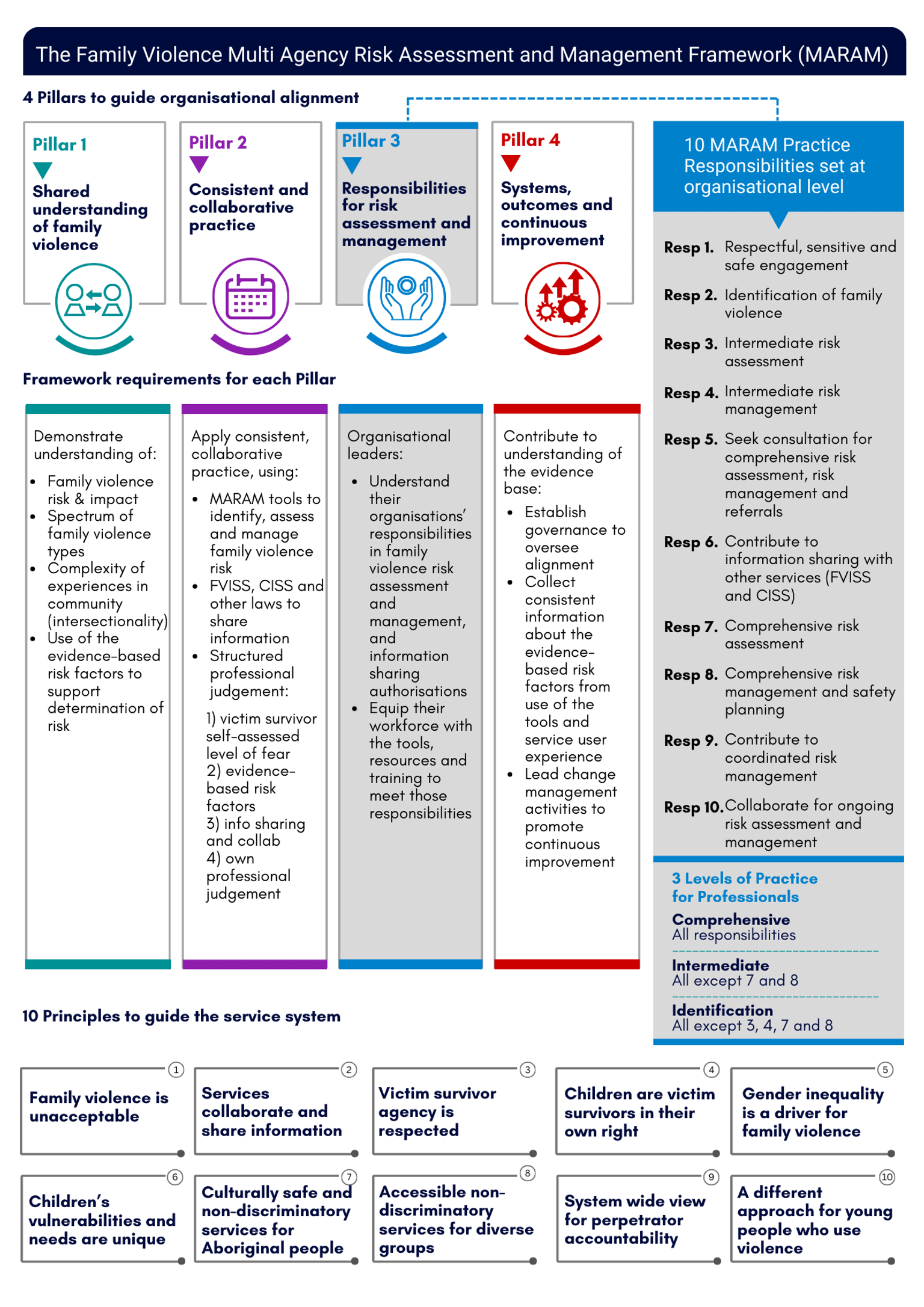
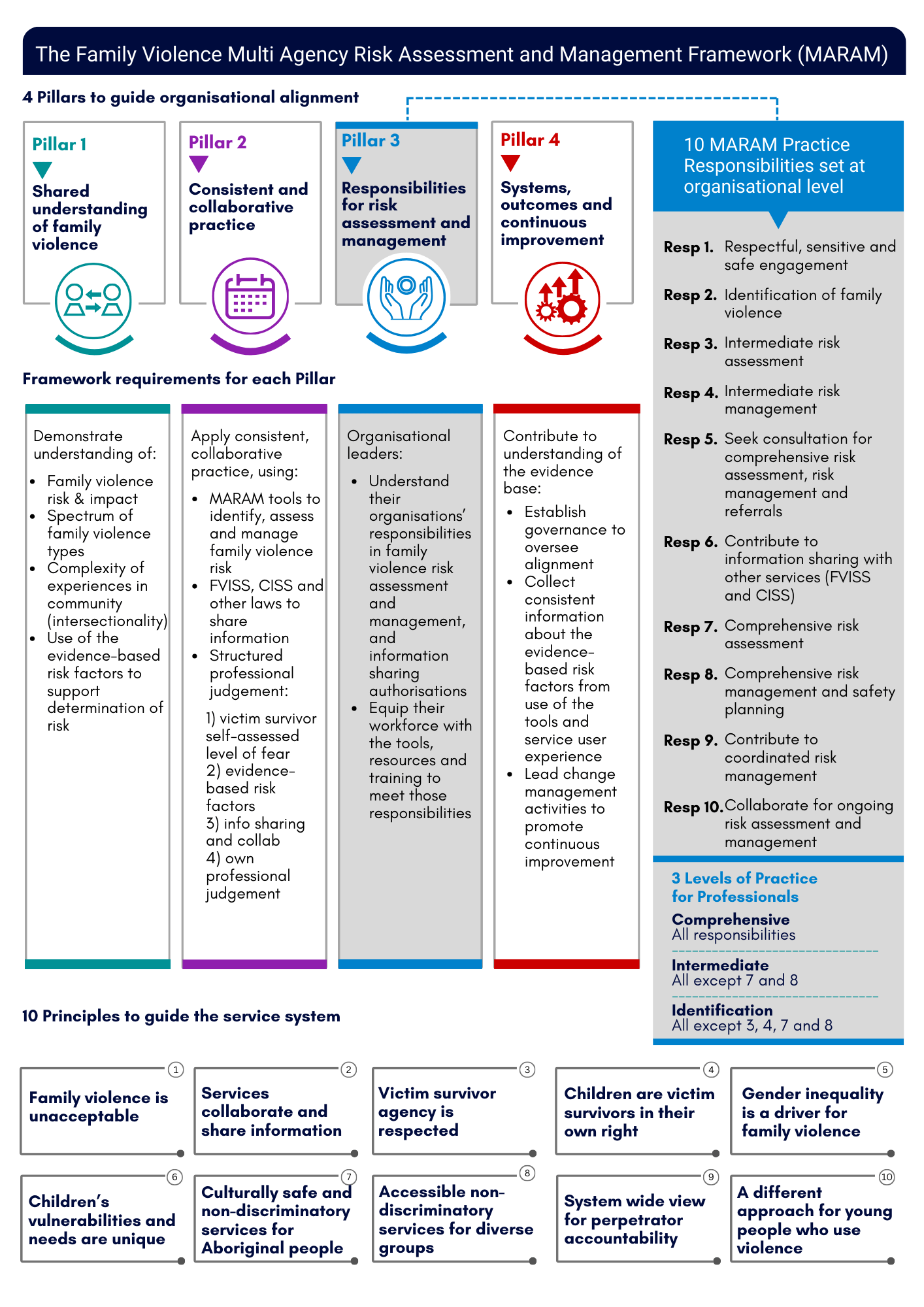
The Multi-Agency Risk Assessment and Management Framework (MARAM)
4 pillars to guide organisational alignment
- Pillar 1 – Shared understanding of family violence
- Pillar 2 – Consistent and collaborative practice
- Pillar 3 – Responsibilities for risk assessment and management
- Pillar 4 – Systems, outcomes and continuous improvement
10 MARAM practice responsibilities set at organisational level
- Respectful, sensitive and safe engagements
- Identification of family violence
- Intermediate risk assessment
- Intermediate risk management
- Seek consultation for comprehensive risk assessment, risk management and referrals
- Contribute to information sharing and other services (FVISS and CISS)
- Comprehensive assessment
- Comprehensive risk management and safety planning
- Contribute to coordinated risk management
- Collaborate for ongoing risk assessment and management
3 levels of practice for professionals:
Comprehensive
- All responsibilities
Intermediate
- All except 7 and 8
Identification
- All except 3, 4, 7 and 8
Framework requirements for each pillar
Pillar 1
Demonstrate understanding of:
- Family violence risk and impact
- Spectrum of family violence types
- Complexity of experiences in community (intersectionality)
- Use of the evidence-based risk factors to support determination of risk
Pillar 2
Apply consistent collaborative practice through use of:
- MARAM tools to screen, identify, assess, manage family violence risk
- FVISS/other laws to share information
- Structured professional judgement –
- Victim survivor self-assessed level of fear
- Evidence-based risk factors
- Info sharing and collab
- Own professional judgement
Pillar 3
Organisational leaders:
- Understand their organisation’s responsibilities in family violence risk assessment and management, and those that relate to the operation of the information sharing scheme
- Equip their workforce with the tools, resources and training to meet those responsibilities
Pillar 4
Contribute to understanding of the evidence base:
- Establish governance to oversee alignment
- Collect consistent information about the evidence-based risk factors from use of the tools and client feedback
- Lead change management activities to promote continuous improvement
10 principles to guide the service system
To help achieve a shared understanding, the Framework principles support each pillar and help guide Victoria’s family violence system-wide response.
- Family violence is unacceptable
- Services collaborate and share information
- Victim survivor agency is respected
- Children are victim survivors in their own right
- Gender inequality is a driver for family violence
- Children’s vulnerabilities and needs are unique
- Culturally safe and non-discriminatory services for Aboriginal people
- Accessible non-discriminatory services for diverse groups
- System-wide view for perpetrator accountability
- A different approach for young people who use violence
- Download 'Figure 4: MARAM Framework on a page'
Updated