- Published by:
- Department of Education
- Date:
- 3 Dec 2025
The new kindergarten year marks an exciting time for children and the early childhood education sector. Thousands of children will be starting Three- and Four-Year-Old Kindergarten, and a further 12 local government areas (LGAs) will start to deliver Pre-Prep, following a successful launch in 6 LGAs in 2025.
The Best Start, Best Life reforms are the most significant change to Victoria's early childhood sector in a generation. There will be many exciting milestones over the life of the reforms, including a growing workforce and record infrastructure investment.
With all that is happening, the Department of Education has developed this resource with key information about early childhood education in Victoria. This guide will be updated for the start of each year so you can stay up to date on the reforms.
How to use this guide
The guide is for service directors and managers, teachers and educators. It includes key information about the Best Start, Best Life reforms, and the support available for children to access and participate in kindergarten programs.
The content in this guide can be used on websites, social media and newsletters and to help respond to questions from staff and families.
For up-to-date information about the range of funding that is available, eligibility criteria and the obligations and accountability in receiving funding, refer to the Kindergarten Funding Guide(opens in a new window).
Where we are now – 2026
- Free Kinder continues to be available
- Three-Year-Old Kindergarten continues to be delivered, with services offering programs between 5 and 15 hours
- Four-Year-Old Kindergarten is becoming Pre-Prep, with hours gradually increasing from 15 to 30 hours a week
- A further 12 local government areas (LGAs) will start to deliver Pre-Prep, following a successful launch in 6 LGAs in 2025
- Aboriginal and Torres Strait Islander children, children from a refugee or asylum seeker background, and children who have had contact with Child Protection services have statewide access to 16 to 25 hours per week of Pre-Prep
- This includes children who were supported by Early Start Kindergarten or Access to Early Learning in their Three-Year-Old Kindergarten Year
- 18 Victorian Government-owned early learning and childcare centres will provide over 1,800 licensed places for local children and families
- Service providers that receive kindergarten funding will use Arrival for mandatory kindergarten data reporting. All sessional services will report attendance data to the Department of Education via the Arrival digital sign in and out functionality or through a third-party provider where the data will flow automatically into Arrival.
Resources
- Communicating about kindergarten to your community:(opens in a new window) for resources about kindergarten, including Free Kinder, that can be shared with families
- Information about kindergarten in your language:(opens in a new window) for information in 30 languages about kindergarten in Victoria
- Arrival: shares information and resources related to Arrival and the collection of attendance data from sessional services.
The Best Start, Best Life reforms
Victoria is building on its nation-leading early childhood system.
Victoria is building on its nation-leading early childhood system by delivering:
- Free Kinder: Free Kinder is available for all 3- and 4-year-old children at participating Victorian services in standalone (sessional) kindergartens and long day care centres.
- Three-Year-Old Kindergarten: Three-Year-Old Kindergarten continues, with programs increasing to 15 hours a week across the state by 2029, providing Victorian children with 2 years of quality early learning before school.
- Pre-Prep: By 2036, 4-year-old children in all locations across Victoria will have access to between 16 and 30 hours of Pre-Prep.
- Early learning and childcare centres: 50 Victorian government-owned and operated early learning and childcare centres are being established. These centres will be built in areas with the greatest need and make it easier for families to access early childhood education and childcare.
Victoria’s expansion of Four-Year-Old Kindergarten gives children more time with qualified early childhood teachers and educators, during a period of rapid brain development.
This increase in hours in the year before school gives children even greater access to the many benefits of early childhood education.
Teachers and educators can also provide deeper and more deliberate play experiences, which will give children opportunities to embed their learning.
Resources
- Early Learning Victoria:(opens in a new window) for information about the government owned and operated early learning and childcare centres, including the 14 new centres for 2026
- The Best Start, Best Life reforms:(opens in a new window) for information about the Best Start, Best Life initiatives and the roll-out schedule
Free Kinder
Free Kinder is available for funded Three-Year-Old Kindergarten, Four-Year-Old Kindergarten and Pre-Prep at participating services in standalone (sessional) services and long day care centres.
A critical part of the Best Start, Best Life reforms is Free Kinder, which supports access to 2 years of quality kindergarten programs for Victorian children.
Free Kinder is available for funded Three-Year-Old Kindergarten, Four-Year-Old Kindergarten and Pre-Prep at participating services in standalone (sessional) services and long day care centres. In 2024, 97% of services offered Free Kinder.
Free Kinder is for everyone. Families don’t need to be permanent residents or Australian citizens to access a free kindergarten program.
Let families know that participating services receive funding directly from the Victorian Government, so they won't have to claim the savings back.
Free Kinder at standalone (sessional) kindergartens
- Families with children enrolled in participating standalone (sessional) kindergarten services in 2026 receive a free program.
- For Three-Year-Old Kindergarten, this means a free program of between 5 and 15 hours per week.
- For Four-Year-Old Kindergarten, this means a free program of 15 hours per week.
- For Pre-Prep, this means a free program of between 16 and 30 hours per week.
- Where additional hours are offered over and above the free program, these hours are optional and will incur a fee.
Free Kinder at long day care centres
- Families with children enrolled in participating long day care centres in 2026 will receive a fee offset.
- The funding rates for Three- and Four-Year-Old Kindergarten and Pre-Prep can be found on the department website (see second listed webpage in the ‘Resources’ section).
- Most families will still pay some fees for their child’s attendance across the week, depending on the number of days attended and their Commonwealth Child Care Subsidy entitlement.
Children who are eligible for Early Start Kindergarten (ESK) should still be enrolled in ESK, even where Free Kinder or 15 hours per week of funded Three-Year-Old Kindergarten is offered. Enrolling children through ESK ensures they have priority of access to kindergarten and also means services can receive additional funding and support.
It is important that families understand they can only access a funded kindergarten program and Free Kinder at one service at a time. Services are required to have a completed ‘one funded place’ form for all families. This form can be included with any enrolment materials provided to families.
Resources
- Free Kinder: for more information about Free Kinder
- Kindergarten funding rates: for information about Free Kinder funding rates
- Kindergarten funding guide: for information about kindergarten funding and policies
- Communicating about kindergarten to your community: for information about Free Kinder that can be shared with families
- Free Kinder funding requirements: for sessional services
- Free Kinder funding requirements: for long day care services
- Resources for funded kindergartens: for the ‘one funded place’ form.
Three-Year-Old Kindergarten
Tens of thousands of children are benefiting from the statewide implementation of Three-Year-Old Kindergarten, which is now available in more than 3,000 services across Victoria.
Services determine how many hours of funded Three-Year-Old Kindergarten are delivered per week, with a minimum of 5 hours and a maximum of 15 hours, within set parameters. In 2024, more than 80% of services offered 15 hours per week.
The priority is to give as many Victorian children access to a funded Three-Year-Old Kindergarten place as possible. Where places are limited, the participation of children is prioritised over the number of weekly program hours delivered
Services will be funded pro-rata for the program hours delivered.
Services should not increase their Three-Year-Old Kindergarten program hours in 2026 if this lowers the number of 3- or 4-year-old places that were offered in 2025. The department’s priority of access criteria will continue to apply to the allocation of funded kindergarten places to 3- and 4-year-old children. Where places are limited, access to a funded kindergarten program should be prioritised over the number of weekly program hours delivered.
Key milestones for Three-Year-Old Kindergarten:
- 2020: introduced in 6 regional local government areas (LGAs)
- 2021: launched in a further 15 LGAs
- 2022: available across Victoria
- 2023-2026: services across Victoria are providing between 5 and 15 hours of Three-Year-Old Kindergarten each week.
From 2026, across Victoria, children who meet the eligibility requirements due to their learning or developmental needs can access an additional year of either Three-Year-Old Kindergarten or Four-Year-Old Kindergarten (or Pre-Prep for eligible children), but not both.
Kinder Kits
As part of Three-Year-Old Kindergarten, all eligible children receive a Kinder Kit. Everything inside a Kinder Kit has been recommended by education experts to help families make learning through play part of everyday life.
The specially designed Kinder Kits are filled with books by Australian authors and educational toys and activities, made especially for three-year-olds to enjoy at home.
Resources
- Operational policies supporting the Best Start, Best Life reforms:(opens in a new window) for more information on flexible hours and other policies for funded kindergarten service providers
- Additional year of funded kindergarten or Pre-Prep from 2026: for more information about an additional year of kindergarten
- Kinder Kits: for videos and resources about Kinder Kits. There is information about the authors and makers, and readings of Kinder Kit books with Auslan translations.
- Information in your language: each Kinder Kit includes a printed Guide for Families(opens in a new window), with tips and ideas to help parents and carers guide their child’s early learning and development at home. The Guide for Families is also available online in 31 languages.
What you need to know about Pre-Prep
From 2025, Four-Year-Old Kindergarten in Victoria began gradually transitioning to Pre-Prep.
From 2025, Four-Year-Old Kindergarten in Victoria began gradually transitioning to Pre-Prep. This means that hours will steadily increase from 15 hours to 30 hours per week. By 2036, all services will offer between 16 and 30 hours each week of kindergarten for 4-year-olds.
Led by qualified teachers, the increase in hours through Pre-Prep will give 4-year-old children more opportunities to socialise and learn through play.
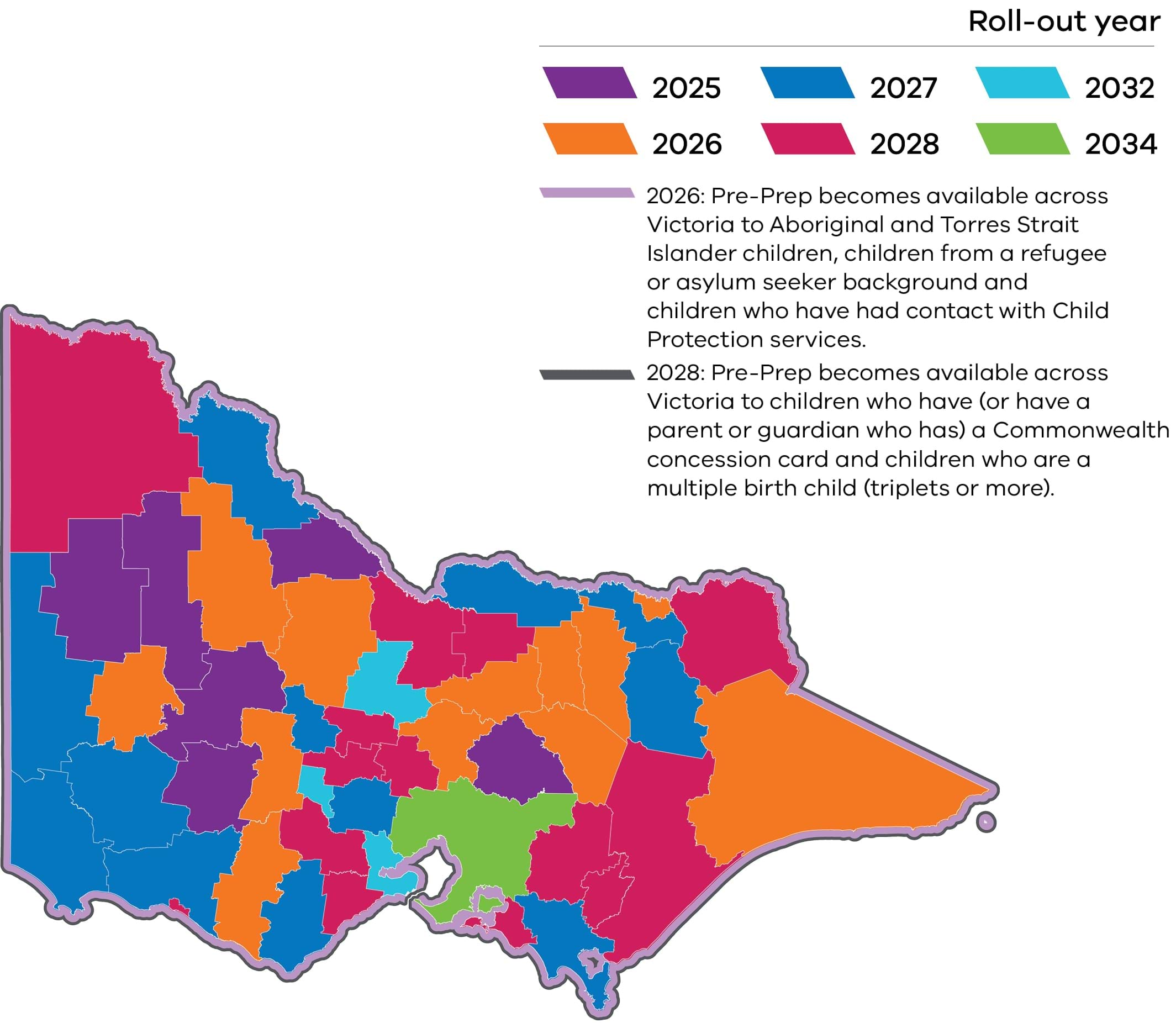
A further 12 local government areas (LGAs) will deliver Pre-Prep in 2026, following a successful launch in 6 LGAs in 2025.
The staged schedule allows time to grow the necessary workforce and build the infrastructure required, and for services to prepare for expanded programs.
New LGAs will start to deliver Pre-Prep each year:
- From 2025 through to 2028, Pre-Prep will roll out in all Victorian regional LGAs (except Ballarat, Bendigo and Geelong).
- From 2032, Pre-Prep will begin rolling out in Ballarat, Bendigo and Geelong.
- From 2034, Pre-Prep will begin rolling out in Metropolitan Melbourne.
Pre-Prep will also be rolled out to the below priority groups across Victoria:
- From 2026, Aboriginal and Torres Strait Islander children, children from a refugee or asylum seeker background, and children who have had contact with Child Protection will have access to Pre-Prep. In addition, if a child is eligible for Early Start Kindergarten or enrolled in Access to Early Learning in 2025, they can start Pre-Prep in 2026.
- From 2028, children who have (or have a parent or guardian who has) a Commonwealth concession card, and children from a multiple birth (triplets or more) will have access to Pre-Prep.
See the roll-out map and link to full roll-out schedule below, which also outlines how many hours are available and when.
Resources
- Four-Year-Old Kindergarten is becoming Pre-Prep(opens in a new window): for information about Pre-Prep, as well as a calculator you can share with families which will allow them to check their child’s eligibility for Pre-Prep.
- Pre-Prep roll-out schedule: for information about the roll-out schedule.
Expanding your early childhood education programs
The way your service approaches making changes to deliver more hours of kindergarten will depend on what is right for your service and community.
The scale of the Best Start, Best Life reforms means some degree of change at every service, whether your service is a large provider with multiple programs, or a small kindergarten with a parent-run committee of management.
The way your service approaches making changes to deliver more hours of kindergarten will depend on what is right for your service and community.
When you are considering how to increase your program hours, your local Early Childhood Improvement Branch(opens in a new window) can help you to explore:
- changes to your program modelling, such as through multi-age or rotational groups
- grants, supports and initiatives available for new and expanded facilities, and to improve existing facilities.
This advice will be tailored to the characteristics of your service, and your unique circumstances.
Your local Early Childhood Improvement Branch can also talk to you about the initiatives in place to support services to attract and retain workforce, including:
- Best Start, Best Life communications collateral to encourage people from all backgrounds to choose careers in early childhood education
- scholarships, Free TAFE and flexible and supported study pathways (including traineeships and other employment based options) for new students wanting to become teachers or educators as well as for existing educators looking to upskill
- financial incentives available for early childhood teachers and educators to join or re-join the Victorian kindergarten sector. Relocation support may also be available, including for those moving with families
- recruitment supports to help services and providers find early childhood professionals seeking a new role or a move to Victoria
- induction, coaching and mentoring supports for early career teachers and educators, to enhance the transition from study to practice
- professional development and career supports, including coaching, Early Years Learning Networks, and programs to enhance leadership and career development
- guides to careers in early childhood education are also available to support secondary school students to explore the range of study and career pathways available, and services may find them helpful to support discussions with other interested members of the community.
Resources
- Delivering Pre-Prep to children from priority cohorts: for information about what to consider with program models at your service to maximise outcomes for children
- Shaping the Best Start, Best Life reforms(opens in a new window): to see the infrastructure and workforce strategies
- Early childhood grants(opens in a new window): for information about Building Blocks and other early childhood infrastructure grants
- Career opportunities and support: for information about job opportunities and support available for anyone interested in a career in early childhood education
- Guide to careers in early childhood education: for more information on study and career pathways in early childhood education
The benefits of 2 years of quality early childhood education
Australian and international evidence shows that quality play-based learning helps set children up for success in education and life.
By 2036, all children across Victoria will be able to access up to 1,800 hours of funded kindergarten before school, including 600 hours of Three-Year-Old Kindergarten and up to 1,200 hours of Pre-Prep.
Two years of quality early childhood education has more impact than one year and can lift children’s outcomes across all learning domains.
Studies show children who attend kindergarten for 2 years have better development in language, pre-reading, early number concepts, independence, concentration, and social skills when starting school.
The first 5 years of life are a period of rapid brain development — by the time a child turns 5, around 90% of their brain development has occurred.
Two years of quality early learning programs have a particularly strong impact on children who need extra support.
Resources
- The evidence behind 2 years and more time in kindergarten:(opens in a new window) for information about the evidence behind the reforms.
Why play-based learning?
As an early childhood professional, you see how powerful play-based learning can be for young children as they explore, experiment, question and discover new concepts.
Play-based learning is now widely understood to be one of the most important ways to support children to develop the skills they need to live well now and into the future.
You may want to explain to families what play-based learning is, and that through purposeful play, children can engage with the people, places and objects around them to build an understanding of themselves and their world. Let parents and carers know that positive attitudes towards learning, such as persistence, curiosity, and imagination, are all developed during play, and it can set children up for a life-long love of learning.
As Victorian kindergarten programs will continue to be play-based when Pre-Prep is introduced, the increase in hours will provide opportunities to create deeper and more deliberate play experiences. It may be helpful to let families know this will often include a combination of physical play, dramatic play, sensory play, nature/outdoor play and creative play.
Resources
- Why play-based learning:(opens in a new window) for information about what play-based learning is and its benefits
- Communicating about kindergarten to your community:(opens in a new window) contains the ‘Play-based learning and your child’ factsheet with families listed under ‘Infographics and fact sheets’.
Child safety
All children have the right to learn and play in nurturing, secure and safe environments. Supporting this right is a fundamental obligation of all Victorian early childhood education and care services.
The following information may help you to have conversations with families about your service’s commitment to child safety and safety measures in place at your service.
Child safety reforms
In 2025, the Victorian Government introduced child safety measures in early childhood education and care settings, including creating a register of early childhood workers and restricting the use of personal electronic devices.
The government also commissioned the Rapid Child Safety Review to identify actions to further strengthen the safety of children in Victorian early childhood education and care settings.
The government has accepted and is implementing all proposed reforms. This includes:
- establishing an independent and strengthened Early Childhood Education and Care Regulator to ensure that early childhood services provide high quality and safe early childhood education and care to Victorian children
- bringing the Working with Children Check (WWCC), Reportable Conduct Scheme and Child Safe Standards into the Social Services Regulator (SSR) so individual workers can be detected more quickly and prevented from working with children again
- working with experts to provide parents and carers with evidence-based advice and resources on prevention awareness, signs of grooming and how to raise concerns.
The Child safety in early childhood education and care webpage includes information for parents and carers to help them understand:
- what to look for when choosing a service
- how to talk to their service about child safety
- what to do if they have concerns
- the actions services take to keep children safe
- what Victoria is doing to improve child safety.
Resources
Child Safe Standards
All services are required to comply with the Child Safe Standards. To create and maintain a child safe organisation, services need to consider how they promote and model child safety and put in place systems and processes to keep children safe.
The standards include clear, practical guidance to services on how to create organisational cultures and use practices that are in the best interests of children and protect them from harm.
The standards also outline how you can demonstrate to families and the community that your service prioritises children’s safety, including by:
- consulting with families on your child safety policies, and regularly seeking formal and informal feedback on how these are working
- making sure policies are written in clear, easy-to-follow language, and translated where appropriate
- displaying your child safety policies in a prominent area, as well as publishing them on your website
- making it clear how parents/carers can raise concerns, including nominating a dedicated person or child safety officer
- include regular updates on child safety issues in parent communications
- schedule child safety briefings as part of information sessions
- include a child safety agenda item at all parent/carer meetings
- proactively share information about staff qualifications and ratios.
Resources
- Early childhood services - guidance: best practice advice for implementing the Child Safe Standards in early childhood services.
Child Information Sharing Scheme
The Child Information Sharing Scheme (CISS) enables services to appropriately share information to support child wellbeing or safety. Authorised organisations and professionals can either request information or decide to share it with other authorised professionals. This includes education professionals, such as teachers, day care and kindergarten workers. Information can only be shared when it will assist in providing services, making plans, or investigating or managing risks to children.
Resources
The Teaching Excellence Approach
Supporting high-quality teaching is a key aspect of the Best Start, Best Life reforms and is the focus of the department’s new Teaching Excellence Approach.
Teaching Excellence is a comprehensive approach to supporting teaching quality in Kindergarten and Pre-Prep through the development of skills and knowledge in sector staff from Victorian funded Kindergartens.
Teaching Excellence is supported by a new Early Childhood Hub (the Hub), a highly interactive professional learning platform that allows early childhood teachers, educators and educational and service leaders to access high-quality, on-demand and tailored supports to meet their specific learning needs. The Hub has a range of on-demand self-paced eLearning opportunities and will also deliver coaching and mentoring programs. The Hub was launched in August 2025 and will continue to expand over the coming years.
The Victorian Early Years Learning and Development Framework (VEYLDF)
The Victorian Early Years Learning and Development Framework (VEYLDF) includes a range of discipline-specific guidelines and practice resources. It supports all professionals who work with children aged 0 to 8.
Victorian Kindergarten Learning Progressions
The Learning Progressions describe how children typically develop over time across eight key learning domains. They’re not checklists or tick-box assessments. Instead, they:
- reflect a developmental continuum, showing a range of capabilities from emerging to more advanced
- align closely with the VEYLDF Outcomes
- help educators notice and describe learning with shared, profession-informed language
- support intentional teaching, formative assessment, and transitions.
Importantly, the progressions were designed to be used in everyday practice: to guide your thinking, shape planning conversations, and deepen your documentation.
To help educators connect the learning progressions to the VEYLDF, clear mapping has been established across each of the eight learning domains. These show how the progressions enhance and extend the VEYLDF Outcomes by offering more granular, observable indicators of development.
A professional learning module on the learning progressions has been made available on the Early Childhood Hub.
Resources
- Victorian Kindergarten Learning Progressions (PDF, 1.3KB): for information on the Learning Progressions. Refer to page 8 for alignment with the VEYLDF Learning and Development Outcomes.
Supporting families with enrolment and attendance
Supporting Victorian 3- and 4-year-old children to enrol in and experience the benefits of a quality, play-based kindergarten program continues to be a priority.
The following information may be helpful when talking to families about when and how to enrol in kindergarten programs. The enrolment may be directly through the service or the Central Registration and Enrolment Scheme (CRES) provider. It may also be helpful to support families’ engagement and attendance at kindergarten.
Supporting all Victorian children to participate in kindergarten programs
Quality early childhood education is an opportunity to help children develop the skills they need to thrive at school and throughout their life.
There are a range of supports for funded kindergartens to enable Victorian children from all backgrounds to access and participate in kindergarten programs. These supports may be particularly useful when engaging with Aboriginal and Torres Strait Islander children, children from a refugee or asylum seeker background, and children who have had contact with Child Protection, who will have statewide access to Pre-Prep from 2026.
Supporting children with additional needs
Inclusion is an important part of the Best Start, Best Life reforms. Use the resources below to support the inclusion of all children at your service.
Kindergarten Inclusion Support Program
The Kindergarten Inclusion Support Program (KIS) enhances a kindergarten’s capacity to respond to the individual abilities, interests and needs of children with a disability, developmental delay, high support needs or complex medical needs.
Support can include:
- specialist consultancy
- specialist training for staff
- minor building modifications
- additional staffing support.
Resources
- Kindergarten Inclusion Support (KIS): for information about the types of KIS supports and who to contact.
Kindergarten Inclusion Support - Specialised Equipment Program
Specialised equipment is available through Kindergarten Inclusion Support (KIS) Specialised Equipment Program (SEP) for loan, and at no cost, to Victorian Government funded kindergarten programs to support children with significant disabilities to participate in kindergarten.
Resources
- Kindergarten Inclusion Support (KIS) Specialised Equipment Program (SEP): for more information on the program, including eligibility, and how to apply.
Preschool Field Officer program
The Preschool Field Officer program is designed to provide practical advice and support to early childhood teachers in funded kindergarten services for children with additional needs.
Support can include:
- providing information, resources and program strategies
- coaching for teachers, including modelling specific strategies
- identification of referral pathways.
Preschool Field Officers do not deliver direct interventions with children, but rather support, guide and coach early childhood teachers to provide high-quality programs that support the inclusion of children with additional needs.
Resources
- Preschool Field Officer program: for more information about the work Preschool Field Officers do (including guidelines and a factsheet) and a list of regional contacts.
Kindergarten Sector Guide - Video Resources
Videos about Free Kinder that can be shared with families.
Watch the videos below to help you answer questions your families may ask.
BSBL
Video – Kindergarten programs in Victoria
Make everyday a new adventure
Experience a day in kinder, where learning through play makes every day a new adventure.
Free Kinder
Free Kinder is available to refugee and asylum seeker families. Hear from three families as they share their experiences with kindergarten.
Bachar Houli recognises the opportunity Free Kinder gives Victorian families.
Three-Year-Old Kindergarten
3YOK – Celebration Video
Four-Year-Old Kindergarten
Pre-Prep is available in 2026
Enrolments
2025 kindergarten enrolments
Supports
Supporting CALD families to engage in kindergarten shares resources for services and providers to communicate with cultural and linguistically diverse (CALD) families about kindergarten and its benefits.
In-language videos help families learn more about the benefits of kinder and help them enrol. Further information can be found on the Use an interpreter in early childhood education services webpage.
Other
The importance of VEYA 2024
Beach kinder
Where to get more help
The department holds meetings and events that can help you and your team.
For more information, contact your local Department of Education Early Childhood Improvement Branch (ECIB), which can provide tailored support. Their specialist staff work with early childhood staff, services and providers. They offer advice and resources to help services with the implementation of the Best Start, Best Life reforms.
The department also holds meetings and events that can help you and your team:
- Early Learning Leadership Forums – held in each of the 17 department areas twice a year, these forums provide a valuable opportunity for service and organisational leaders to connect locally
- Best Start, Best Life Evening Leadership Series – statewide hybrid events held twice each year to keep the sector informed on the reforms
- Early Years Learning Networks – over 60 local networks meet once each term, where teachers share learning, build collaborative connections, drive continuous quality improvement and embed the reforms in their practice.
You may also consider contacting the following early childhood education peak body that best represents you and your service for additional assistance. These peak bodies are funded by the Department of Education to provide support to both members and non-members to implement the Best Start, Best Life (BSBL) reforms.
Resources
- Events for service and organisational leaders(opens in a new window): for upcoming dates of Early Learning Leadership Forums and the Best Start, Best Life Evening Leadership Series.
- Early Years Learning Networks for early childhood teachers(opens in a new window): for more information around the Early Years Learning Networks and how to get involved.
Your feedback is important
This guide will be regularly updated as the Best Start, Best Life reforms progress. The department welcomes your feedback on this resource.
Email: bsbl.change.management@education.vic.gov.au(opens in a new window).