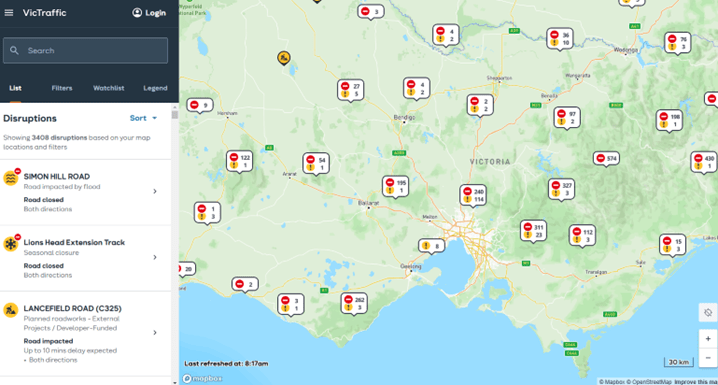
VicTraffic has been an essential tool in supporting transport users, emergency response units, and the public, ensuring safe and informed movement across Victoria's road network, particularly during emergencies.
However, the platform lacked key accessibility features in line with standards in the World Wide Web Consortium’s latest Web Content Accessibility Guidelines (WCAG 2.1).
This significantly limited its usability for people with disability, users who relied on assistive technologies or had difficulty navigating the website, especially during high-stress situations such as bushfires and floods.
Accessibility improvements and fixes
Recognising these shortcomings, we undertook a comprehensive programme of accessibility improvements as part of the VicTraffic re-platform project.
We ensured a more user-centred approach was adopted, ensuring accessibility considerations were embedded from the outset.
Maps have always posed unique difficulties for users with visual impairments or colour deficiencies. To make them more accessible and ensure that all users, regardless of visual ability can engage effectively with the map content, we:
- Ensured that all information displayed on the map is also available in a text-based format, enabling screen readers to interpret the data easily.
- Introduced a toggle feature that allows users with colour vision deficiencies to distinguish between lines, routes, and disruptions using glyphs and patterns, rather than relying solely on colour.
- Enhanced the contrast of colours for better readability.
- Ensured all interactive elements were navigable via keyboard.
- Implemented clear, concise alt text for all images and buttons.
- Followed best practices for form labels, error handling, and dynamic content updates to ensure the site was fully compatible with screen readers.
Challenges faced
Accessibility criteria had not been well-defined in past projects and basic principles of accessibility were not well understood by internal teams.
As a result, we undertook an activity to deliver education resources on accessibility best practices, which helped uplift the overall skillset and improved our ability to deliver accessible solutions.
Another challenge encountered was the understanding that there is no single, uniform response from accessibility criteria. For example, when selecting a button, one screen reader might announce, "Button Name - Selected," while another might say, "Name - Button Selected."
These discrepancies can cause issues during testing if the criteria are too prescriptive and testers do not receive the expected output, leading them to incorrectly mark the feature as a fail.
This issue was also addressed through further education, helping teams understand that while the actual output may differ between screen readers, if accessibility best practices and patterns are followed, the variance in output does not constitute a failure.
Outcomes of testing and fixes
As a result of these efforts, VicTraffic’s accessibility has significantly improved. Key accessibility metrics, including tab indexing, colour contrast ratios, and screen reader compatibility, all saw substantial enhancements.
We reduced the number of blockers from four to zero, inhibitors from eight to zero, and WCAG 2.1 essential issues from 20 to just a few minor issues.
This means that the platform is now accessible to a much wider audience, including those with visual, auditory, and cognitive impairments, ensuring that everyone can access real-time road information, particularly in emergencies.
Supporting the community
These changes had a positive impact on the Victorian community, especially during emergencies when timely and accurate road disruption information is vital.
By ensuring that VicTraffic is accessible, we are supporting vulnerable groups such as the elderly, people with disabilities, and those in remote or regional areas who may face additional challenges during emergencies like bushfires and floods.
The accessibility improvements ensure that all users can confidently navigate road closures, incidents, and disruptions, thus improving safety and inclusivity across the entire community.
Updated