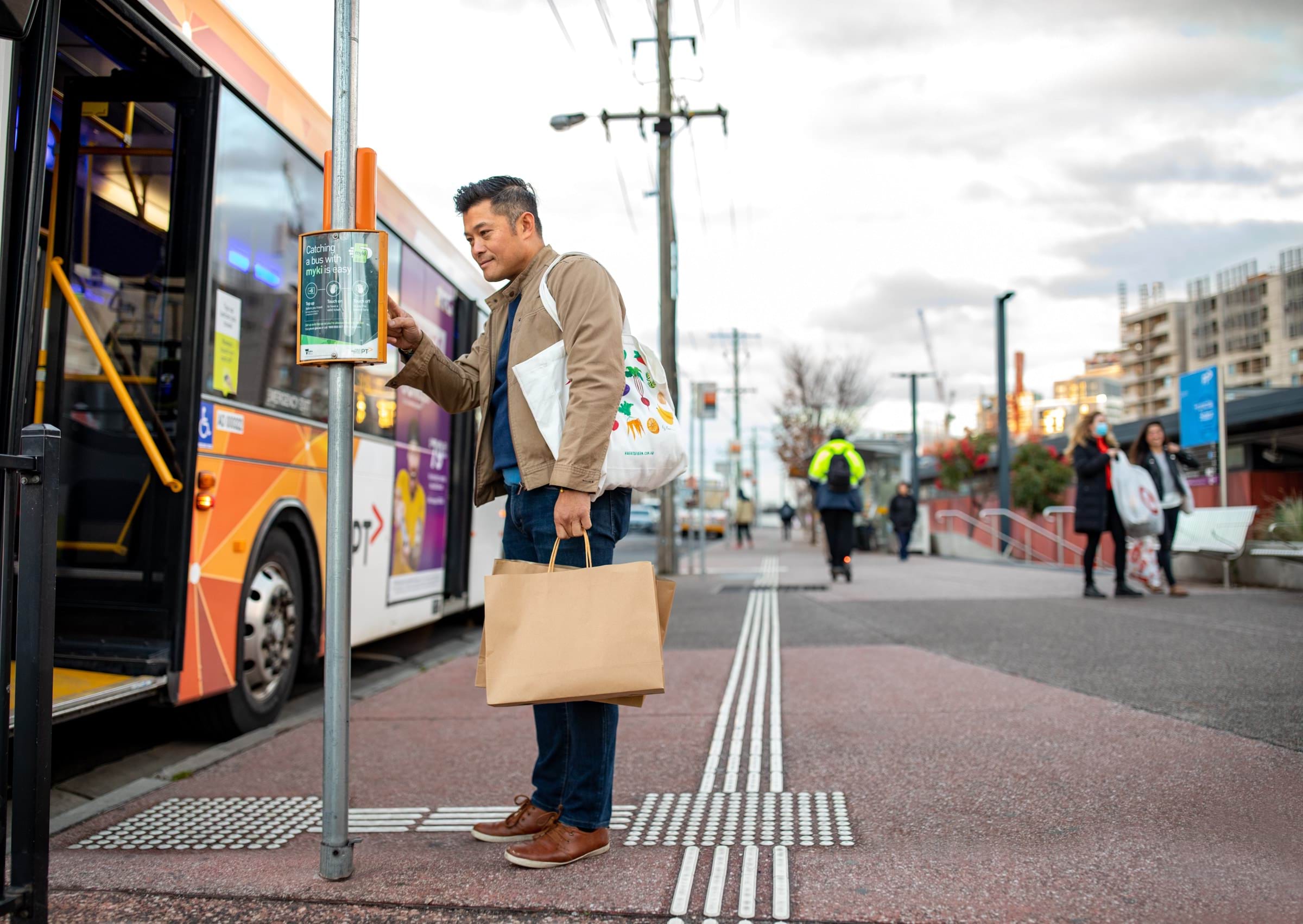
Having accessible and reliable information is one of the most important requirements for inclusive transport and planning. We aim to:
- Fill data gaps
- Make information available so that people with disability can plan their journeys more easily, and use our planning, housing, building and land delivery systems and services both when the system is operating normally and when it is disrupted.
- Ensure information is accessible.
Wayfinding and signage
Action: Deliver on trams:
- Simplified signage across all new and existing rolling stock, and
- Improved digital wayfinding information on all new rolling stock.
Outcome: Increased user confidence when travelling on trams. Support people with disability to understand route accessibility and progress arrival at key interchanges.
Measure: Positive feedback on signage and digital wayfinding information.
Timeframe: Year 1.
Action: Review wayfinding and directional signage at new and existing train stations, and nearby transport interchanges.
Outcome: Improved wayfinding, including for accessible pathways at train station precincts and nearby transport interchanges.
Measure: Wayfinding signage updated at fifteen train stations, informed by the departmental style guide that has, in part, been developed with users with accessibility requirements.
Timeframe: Year 4.
Action: Review wayfinding at existing bus interchanges.
Outcome: Improved wayfinding at existing bus interchanges to make finding the right bus easier.
Measure: Wayfinding signage updated at eight bus interchanges, informed by user testing, including users with accessibility requirements.
Timeframe: Year 4.
Action: Develop a new suite of wayfinding standards and guidelines.
Outcome: Stronger alignment of signage and information with the broader wayfinding strategy. More consistent customer wayfinding experience. Embedded user testing processes, including with people with disability.
Measure: Deliver a new suite of wayfinding standards and guidance for planning and delivering signage and information at stops, stations and precincts.
Timeframe: Year 2.
Action: Develop a strategy to ensure consistency for accessible boarding points at shared regional and suburban train stations.
Outcome: Users with accessibility requirements can self-serve with clearly marked boarding points steering them to accessible carriages on their service of choice.
Measure: Accessible boarding points for V/Line services identified at twelve Metro train stations. Development of strategy to differentiate boarding points between modes including any relevant artwork updates to allow for delivery at stations when feasible.
Timeframe: Year 2.
Action: Review passenger public address announcements for the public transport network.
Outcome: An understanding of how to achieve consistent messaging delivered in a consistent tone across the entire metropolitan train network at stops, stations, and onboard vehicles for both live and automated announcements.
Measure: Review of passenger public address announcements for the public transport network is completed.
Timeframe: Year 2.
Action: Develop a strategy and requirements for train service naming conventions for the next metropolitan train contract (MR5), informed by user testing.
Outcome: Consistent information to identify metropolitan train services and improved user understanding.
Measure: User testing completed with different cohorts, including people with disability. Requirements developed and adopted for the next metropolitan train contract (MR5).
Timeframe: Year 2.
Action: Review signage for accessible evacuation refuge points at Metropolitan Underground Rail Loop (MURL) stations.
Note: MURL stations refer to Flagstaff, Melbourne Central and Parliament stations.
Outcome: An understanding of how MURL stations can provide a visible and consistent experience, including identifying opportunities for updated communications that is informed by users with accessibility requirements.
Measure: Recommendations for improved consistency, visibility and communication to assist users with accessibility requirements during travel training and in the unlikely event of an evacuation at MURL stations.
Timeframe: Year 2.
Advice, guidance and engagement
Action: Increase departmental use of the prioritisation tool to inform advice to Government on accessibility priorities.
Outcome: Consistent and aligned approach to advising Government on accessibility that removes the most significant barriers first.
Measure: Completed staff engagement sessions. Prioritisation tool made available to all staff.
Timeframe: Year 1, Ongoing.
Action: Explore engagement opportunities between departmental accessibility subject matter experts and leads of infrastructure funding proposals.
Outcome: Accessibility is built into the start of infrastructure projects.
Measure: Infrastructure planning considers accessibility impacts as part of developing funding proposals.
Timeframe: Ongoing.
Action: Develop policy and guidance to improve understanding and drive more consistent interpretation of specific elements within the transport disability standards, with consideration of universal design.
Outcome: Improved understanding and more consistent interpretation of the transport disability standards.
Measure: Publish policy and/or guidance materials. Feedback on implementing materials demonstrates improved and more consistent application of the transport disability standards.
Timeframe: Ongoing.
Action: Deliver public transport information to users in regional Victoria.
Outcome: Information about public transport is provided flexibly and responds to the changing needs of users.
Measure: Increase to the number of people accessing public transport information in regional Victoria.
Timeframe: Year 1, Ongoing.
Action: Deliver communications and engagement activities to support users with accessibility requirements in the lead up to and after the opening of the five Metro Tunnel stations to ensure:
- Station familiarisation and understanding of accessibility features, and
- Effective wayfinding and connections to other transport modes.
Outcome: Improved user experience when transiting to and around Metro Tunnel stations.
Measure: Delivery of tailored activities and communications materials in partnership with accessibility stakeholders to support station familiarisation.
Timeframe: Year 1.
Action: Review network technical standards and guidelines to align with project requirements for consistent interpretation of disability standards.
Outcome: Improvements in the delivered accessibility outcomes across the network.
Measure: Delivery of endorsed changes to accessibility requirements in the Network Technical Standard (NTS002) for Public Transport Precincts.
Timeframe: Year 2, Ongoing.
Public transport ticketing
Action: Ensure digital platforms enabling Public Transport Ticketing to be compliant with web content accessibility guidelines (WCAG) 2.1AA and identify opportunities for continuous improvement.
Outcome: Ensure all users, including people with disability, can navigate and use public transport ticketing digital platforms independently and effectively.
Measure: Project work includes user acceptance testing with people with a range of accessibility requirements to validate the project.
Timeframe: Ongoing.
Action: Reduce barriers to accessing public transport ticketing services by ensuring corresponding digital products are available in multiple languages.
Outcome: Ensure all users, including people with disability, can navigate and corresponding digital platforms independently and effectively.
Measure: Public transport ticketing digital platforms are available in multiple languages.
Timeframe: Ongoing.
Action: Reduce barriers to understanding and using public transport ticketing services by developing information materials for corresponding digital products in multiple languages.
Outcome: Ticketing system information is accessible to a greater range of users.
Measure: User information and marketing materials to support behaviour change when transitioning to the new ticketing system is produced in multiple languages.
Timeframe: Ongoing.
Digital
Action: Add accessibility compliance to decision-making processes for technology project requirements and design.
Outcome: Project teams plan for and implement accessibility requirements.
Measure: Accessibility compliance checklist included and completed to demonstrate consideration. Guidance provided to DTP and relevant initiatives.
Timeframe: Year 1.
Action: Departmental digital content meets the web content accessibility guidelines level 2.0 AA.
Outcome: All users can access departmental digital content.
Measure: The vic.gov.au content management system includes templates to ensure compliance with accessibility standards.
Timeframe: Ongoing.
Updated